
Temple of Hephaestus (Athens): opening hours, last entry and the gate that is open
Free audio guide in English · no app, no sign-up
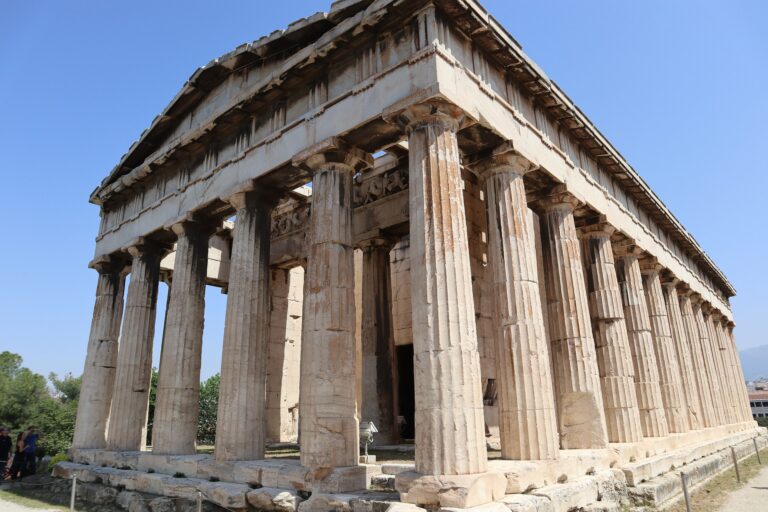
This free audio guide to the Temple of Hephaestus plays straight from your phone — no app, no sign-up — as you walk up the hill of Kolonos Agoraios and round the columns. It tells you why this building still has a roof when everything below it is at ankle height, what the 10 metopes facing the square show and why they count 9 labours, when the stone vault over the cella really went up, who is buried under the floor, and what caught the eye of Pausanias here in the 2nd century AD. Press play at the foot of the hill.
 Audio guide
Before you go in
The few things that change your visit.
- Everyone enters and leaves by the Thiseio Square gate, at the foot of the temple's hill
- Today it closes at 18:30 and the last entry is at 18:00; the hours change on 1 October
- Free entry for everyone on Saturday 26 and Sunday 27 September 2026, tickets at the counters only
- It has no ticket of its own: you pay the Ancient Agora ticket, €20.00
- The over-65 reduction for Greece and the EU applies only from 1 October to 31 May
- You walk around it: there is no visit to the interior
- Wheelchair access to the temple exists, after telephoning +30 210 3214824
- The stone roof over the cella is medieval, and there are 53 graves under the building
On this page
- What the audio guide tells you
- The gate that is open, and how to get there
- Opening hours and last entry
- Free entry on 26 and 27 September 2026
- Tickets: €20.00, and who pays less
- You walk around it: there is no visit to the interior
- Accessibility, and the call you make first
- Why this temple is still standing
- When it was built, and for whom
- The metopes and the frieze: Herakles, Theseus and the centaurs
- The roof is medieval, and there are graves underneath
- The English graves, and the epitaph attributed to Byron
- The church, the museum and the name
- The garden that was dug up and replanted
- What Pausanias saw, and the name that was never right
- Nearby, with their own free audio guides
- Tickets and prices
- Where to find it
- FAQs
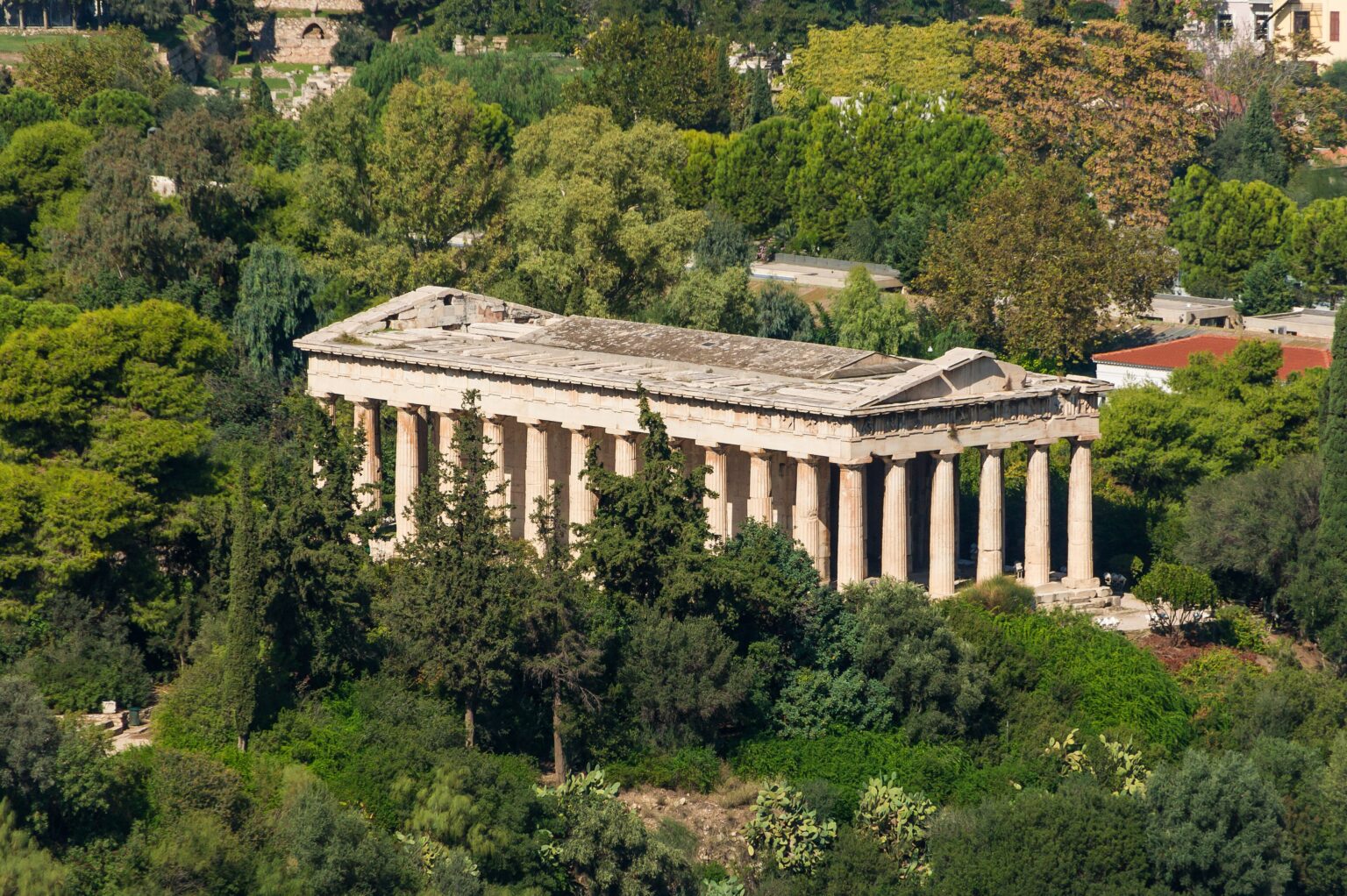
The Temple of Hephaestus stands on the hill at the western edge of the Ancient Agora of Athens, and it is the best preserved Doric temple in mainland Greece. It has no ticket of its own: you go in on the €20.00 Ancient Agora ticket. Today, 23 September 2026, the site closes at 18:30, last entry 18:00, and everyone enters by the Thiseio Square gate.
This page is the free audio guide, plus the practical detail read on 23 September 2026 from the Greek Ministry of Culture, the state ticket office and the Ephorate of Antiquities of the City of Athens: which gate is open, what the ticket costs and who pays less, what time the gate shuts tonight and how that changes 3 times before November, how the temple is actually visited, and what you are looking at once you are up there.
What the audio guide tells you
It is free, it plays in your phone’s browser, and there is no app to install and no sign-up. Press play at the foot of the hill, as you start up towards the columns, and walk the circuit with it. These are the stops:
| The one building still roofed | What you are looking at from below, and why this hill kept its temple when the plain below kept nothing. |
| Two reasons it is still here | Athens sits outside the major earthquake belt, and the building was given a use that made it worth keeping. |
| The roof is not Greek | The stone vault over the cella went up in the medieval centuries, and the lower courses inside still carry the church plaster. |
| 53 graves under the floor | 26 in the peristyle, 5 in the opisthodomos, 22 in the cella, and the jewellery that says whose they were. |
| The man who dug for Theseus | A grave opened in the exact centre of the temple in 1799, and what came up instead. |
| The epitaph attributed to Byron | George Watson, the slab of reused Hymettos marble, and the bones put back in 1939. |
| 10 metopes, 9 labours | Why the arithmetic does not add up, and why the Minotaur still has a head when almost nothing else does. |
| The garden is a reconstruction | Flowerpots of the 3rd century BC, dug up in the 1930s and replanted in the 1950s, pomegranate and myrtle. |
| What Pausanias noticed | The eyes of the statue, a Libyan story about Athena, and a sanctuary of Theseus that has never been found. |
The gate that is open, and how to get there
The official address of the enclosure is Adrianou 24, in Monastiraki. The gate the Ministry of Culture currently marks as the way in and the way out for visitors is a different one: the Thiseio Square gate, on Jacqueline de Romilly Square, off Apostolou Pavlou street. For this particular visit that is good news, because Thiseio Square is the gate at the foot of the temple’s own hill. Come in there and the Hephaisteion is the first thing you reach.
The main Adrianou 24 entrance was handed back on 29 July 2026 after being redesigned, with a new reception area, a new ticket office, canopies, seating and LED lighting; the south entrance was refurbished at the same time. It may well be working again, so the practical thing is to confirm at the gate on the day. If you do come in from Adrianou, you cross the flat of the Agora from east to west and climb to the temple at the end.
The metro is the easy way. The right station is Thiseio on line 1, which sits beside that gate: from the station exit to the temple is about 600 metres, under 10 minutes including the climb. From Monastiraki, where lines 1 and 3 meet, it is roughly 8 minutes of street to the Thiseio Square gate and then the slope. Bus lines 025 and 026 stop at Monastiraki as well. Those distances are our own measurement on the map; no official source publishes a walking time.
Coming from the sacred rock, allow more. From the Acropolis and from the Odeon of Herodes Atticus it is about 25 minutes on foot, because you have to walk right around the rock on the pedestrian street. The coordinates of the temple are 37.975604 N and 23.721412 E.
Opening hours and last entry
The enclosure always opens at 08:00. What moves is the closing time, and it moves in short steps: today, 23 September 2026, the Ancient Agora closes at 18:30 and the last entry is at 18:00. Admission stops half an hour before the gates do, so the time to put in your diary is the last entry, not the closing.
| Dates | Open | Close | Last entry |
| 1 April – 31 August | 08:00 | 19:30 | 19:00 |
| 1 – 15 September | 08:00 | 19:00 | 18:30 |
| 16 – 30 September | 08:00 | 18:30 | 18:00 |
| 1 – 15 October | 08:00 | 18:00 | 17:30 |
| 16 – 31 October | 08:00 | 17:30 | 17:00 |
| 1 November – 31 March | 08:00 | 17:00 | 16:30 |
Look at what happens over the next 6 weeks. The timetable steps back on 1 October, again on 16 October, and again on 1 November, when it settles at 08:00 to 17:00 for the winter. Between today and November the site loses 1 hour and 30 minutes of afternoon. And because the temple sits on top of the hill and you walk up to it, the winter last entry of 16:30 leaves very little margin for getting up there in daylight.
The site is shut altogether on 1 January, 25 March, 1 May, Easter Sunday, and 25 and 26 December. It keeps special hours on Good Friday, 12:00 to 17:00, and on Holy Saturday, 08:30 to 15:30. All of it checked on 23 September 2026.
Two closures inside the enclosure have been running since 1 November 2025 and are worth knowing before you plan the full visit: the upper floor display of the Stoa of Attalos, and the church of the Holy Apostles. Neither of the 2 affects the Temple of Hephaestus, which is visited as normal.
Free entry on 26 and 27 September 2026
There is a date in this week worth moving a plan for. Entry to the Ancient Agora, and therefore to the Temple of Hephaestus, is free for everyone on Saturday 26 and Sunday 27 September 2026. That is the last weekend of September, which the Ministry of Culture lists among its free admission days for the European Heritage Days.
One practical condition goes with it, and it is the part that catches people out: on free admission days tickets are issued only at the counters, not online. So you turn up at the Thiseio Square gate, collect the free ticket there, and walk in. If you are in Athens on those 2 days, the €20.00 becomes €0.00.
The other free days across the year are 6 March, 18 April, 18 May and 28 October, plus the first and third Sunday of each month between 1 November and 31 March. Checked on 23 September 2026.
Tickets: €20.00, and who pays less
The Temple of Hephaestus is filed by the Ministry of Culture as a monument, not as a site, and that has a consequence at the till: it has no price, no timetable and no ticket office of its own. What you buy is the ticket for the Ancient Agora of Athens, the enclosure it stands in: €20.00 full and €10.00 reduced, and that one ticket covers the archaeological site, the museum in the Stoa of Attalos and the temple itself. Nothing on the hill is charged separately.
The ticket carries a compulsory time slot. It can be changed up to 2 hours before the visit and up to 2 times per ticket, and the money is not refundable. It is valid for 1 entry only, so plan the Agora as a single continuous visit. Large bags, suitcases, food and professional camera equipment are not allowed in, and the ticket includes access to the Ministry’s official digital audio guide app.
Now the reduction that catches out a great many visitors, because it is the one that depends on the calendar. Over-65s from Greece or another European Union country pay €10.00 — but only between 1 October and 31 May. Today, 23 September, they pay the full €20.00. On 1 October, in 8 days, the same person pays half.
| Ticket | Price | What it covers |
| Ancient Agora, full | €20.00 | The site, the museum in the Stoa of Attalos and the Temple of Hephaestus. Checked 23-09-2026 |
| Reduced | €10.00 | The same. Checked 23-09-2026 |
| Over-65s from Greece or the EU | €10.00 | Only between 1 October and 31 May, on an ID card or passport |
| Under-25s from the EU | Free | On an ID card or passport |
| Under-18s from outside the EU | Free | On a passport |
| Visitors with a disability, and 1 companion from 67% | Free | On ID or passport and a disability certificate |
| Saturday 26 and Sunday 27 September 2026 | Free | Last weekend of September. Tickets issued at the counters only |
| A ticket for the Temple of Hephaestus alone | Not sold | It is a monument inside the enclosure: you enter on the Ancient Agora ticket |
Students over 25 in secondary or vocational education in the EU or the EEA go free on a certificate of enrolment, as do teachers accompanying school visits from the EU and the EEA. The same €20.00 buys the whole enclosure, which is the point of pairing this page with the Ancient Agora of Athens: 1 ticket, 2 guides.
You walk around it: there is no visit to the interior
This is the question everybody asks at the top of the hill, so here is the answer before you climb. You walk around the Hephaisteion from the outside. The official route comes up from the Thiseio Square gate, goes the whole way round the building outside the ring of columns, and carries on to the south-east. There is no visit to the interior. What you see of the inside is what you can see between the columns, which is a great deal more than it sounds.
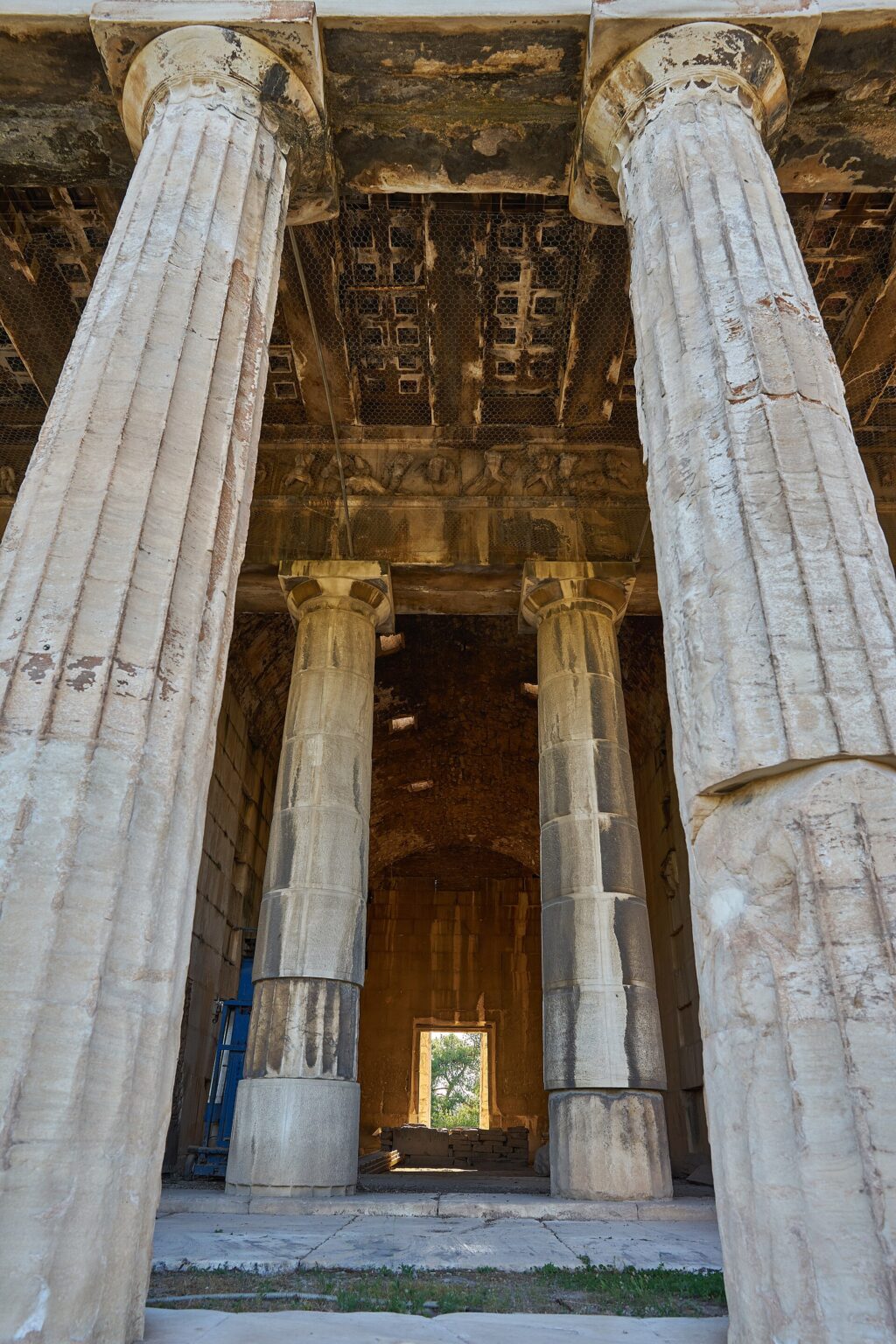
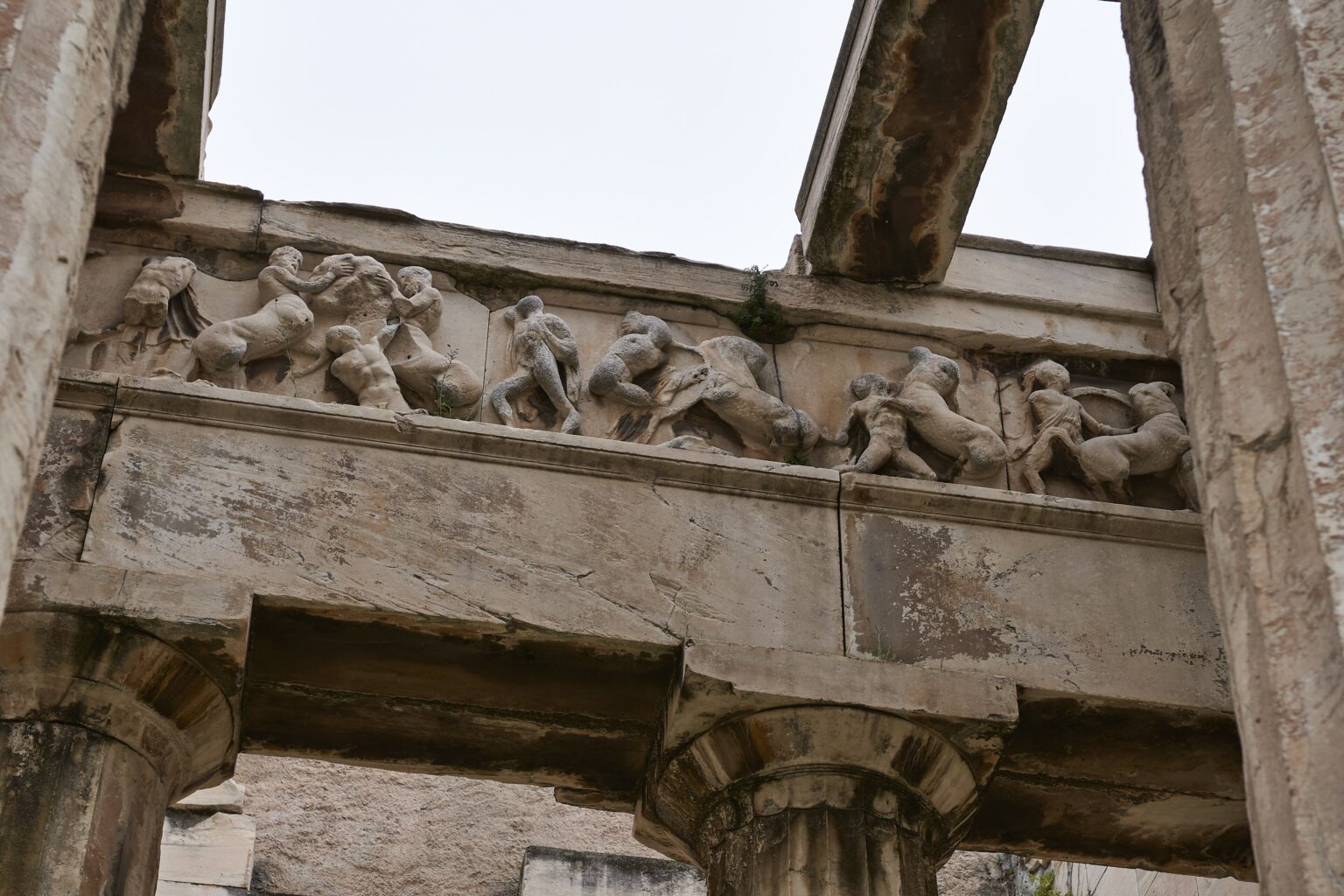
It is worth knowing in advance, because it changes how you look. From the step of the porch, with your neck craned, you take in the coffered marble ceiling of the peristyle, the carved band of the frieze above the porch columns, and the cella running away from you to the doorway at the far end. The best sculpture on this temple is in there, inside the porch, and not on the façade. Anyone who photographs the front and walks on misses it.
The rules of the enclosure ask visitors to follow the signs, keep to the marked routes and stay out of restricted areas. And since the Agora is an open site with very little cover, the one place on the circuit with reliable shade is the temple itself, under its own colonnade.
Accessibility, and the call you make first
The temple can be reached in a wheelchair, and the route to it is published. It starts at the dedicated accessible entrance on Thiseio Square, off Apostolou Pavlou street, climbs the hill and goes around the temple outside the colonnade. There is 1 condition attached, and it is in the Ministry’s own wording: access there is possible upon communication, that is, after you telephone ahead. The numbers are +30 210 3214824 and +30 210 3210180. Making that call before you set out is the single most useful thing on this page for a visitor with reduced mobility.
The second thing to know is that the accessible route to the temple and the accessible route to the museum are 2 separate routes and they do not join up. The museum route starts at the central Adrianou 24 entrance and goes down to the Stoa of Attalos, where there is a ramp and a lift. So a wheelchair user who goes up to the temple does not reach the museum from inside the site, and the other way round.
About the surface itself, 2 dated facts rather than a guess. In 2021 the path up to the temple was described by the city’s own visitor information as earthy, with gravel. In 2026 the Ministry handed over new visitor routes through the Agora with suitable gradients and a stable surface, together with ramps and a wheelchair lifting platform, as part of the works completed on 29 July 2026. What it is like on the day you go is worth asking on that same phone call.
Inside the museum in the Stoa of Attalos, both floors are accessible and there is a lift, which the attendants operate on request; there is an adapted toilet in the museum building, and the information desk holds tactile plans and braille leaflets in Greek and English. The 2026 works added a tactile model of the plan of the monuments, special display tables and audio guides for visitors with impaired sight, and rebuilt the Stoa toilets completely.
Why this temple is still standing
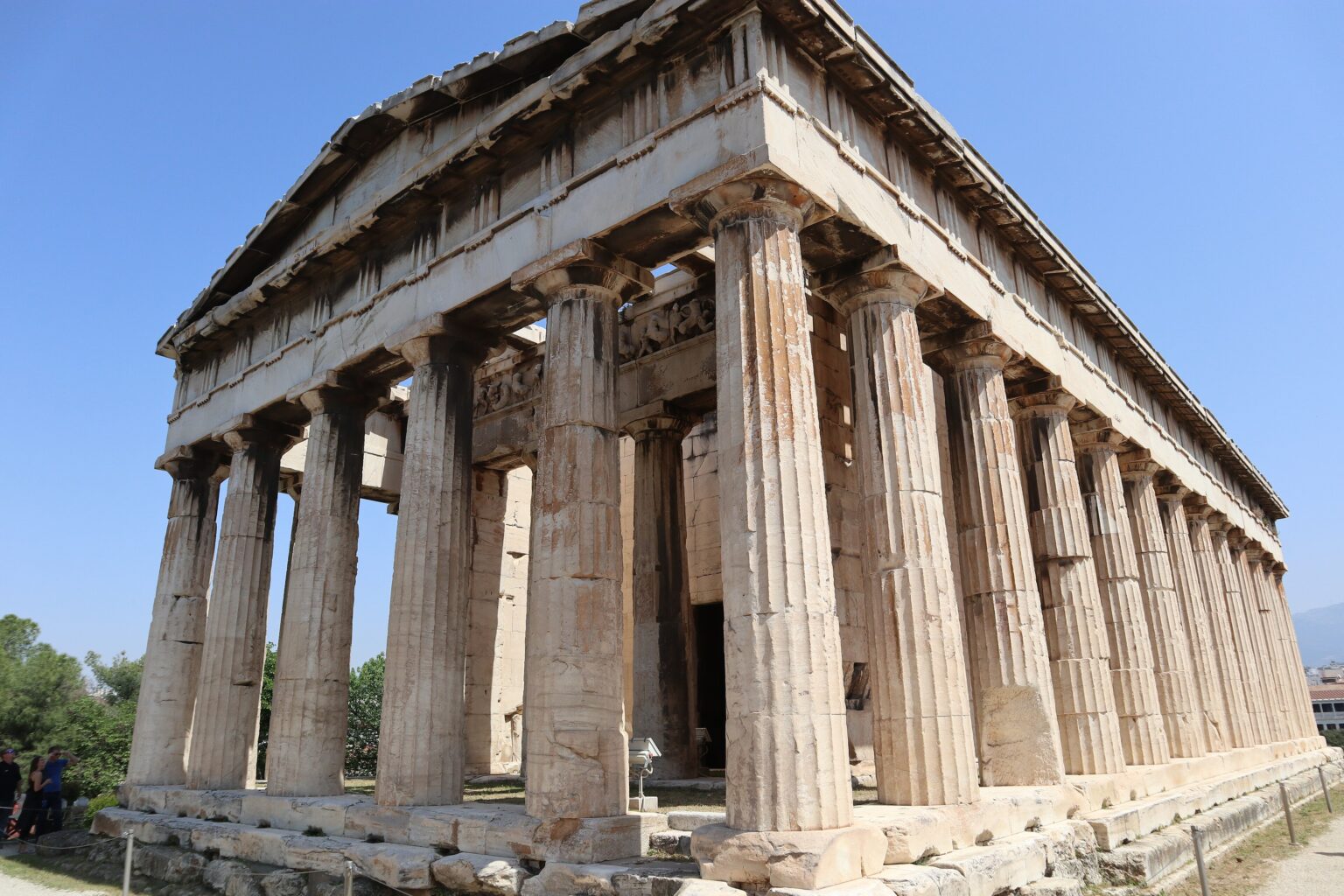
Everything else on this hillside is at ankle height, and this building has its columns, its entablature, both pediments and a roof. The American School of Classical Studies, which has excavated the Agora since 1931, puts it down to 2 things rather than 1: Athens does not lie in a major earthquake zone, and the temple was turned into a Christian church in the 7th century, according to the Ministry of Culture’s record.
The Region of Attica adds the third leg, and it is the one that explains the most. The temple survived earthquakes and the destruction of this side of the Agora, and it also survived a far more serious threat: being quarried for its own stone. Marble that nobody is using is marble that ends up in somebody’s wall or in a lime kiln. A building with a use is a building nobody takes apart. The church saved it, in the most literal sense available.
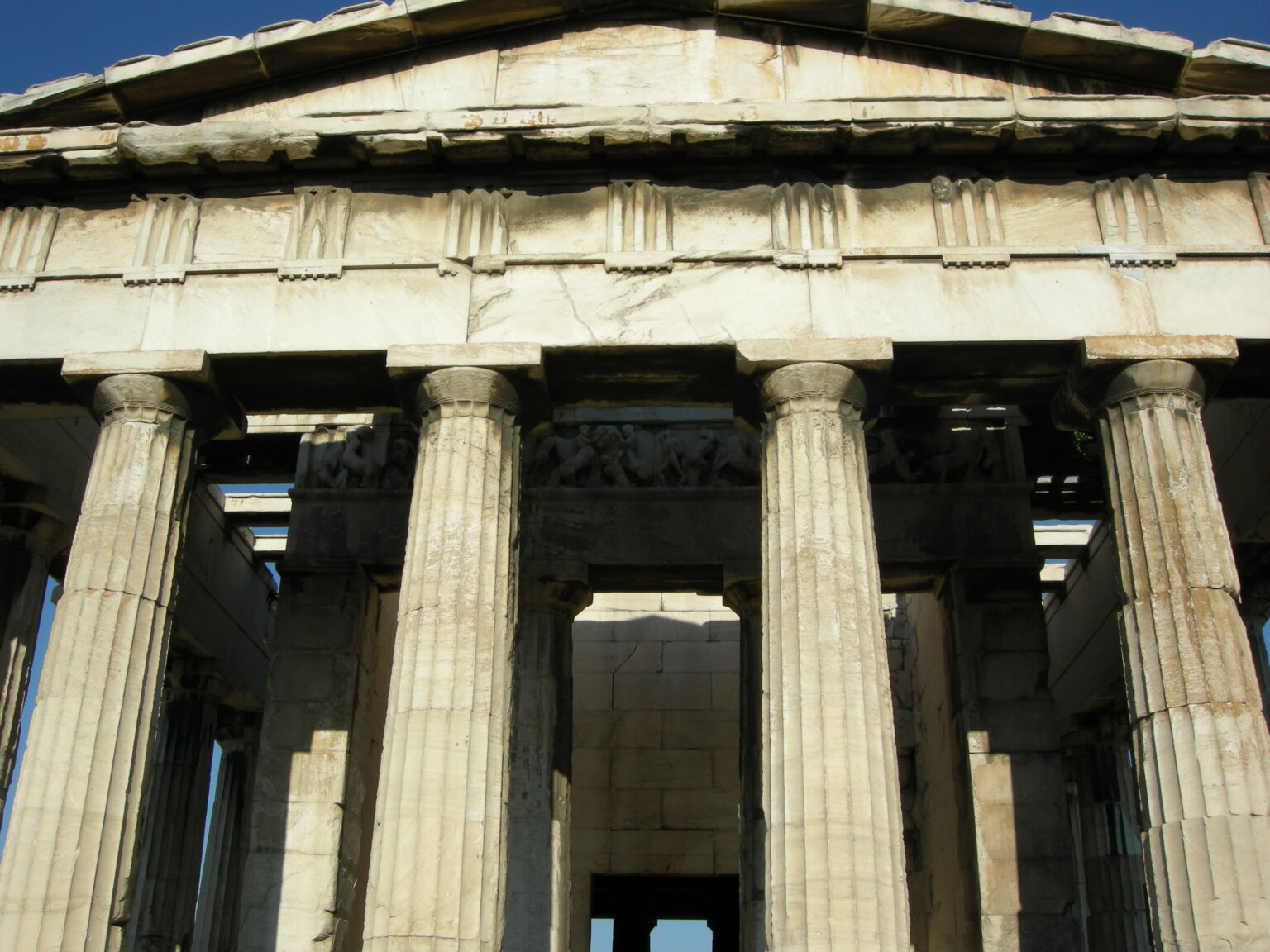
It is all Pentelic marble, from the steps to the roof, with the architectural sculpture cut in Parian. There are 6 columns on each short side and 13 down each long one, which makes 34 counting each corner once, and the porch at each end has 2 columns between the wall ends.
When it was built, and for whom
The Ministry of Culture dates the temple to between 460 and 420 BC and states plainly that the architect is not known. The Ephorate of Antiquities of the City of Athens calls it the best preserved temple of the 5th century BC; the Region of Attica goes further and says that in the richness and quality of its sculptural decoration only the Parthenon surpasses it, and suggests the architect kept adjusting his details against the Parthenon as that building went up, which would explain how slowly this one advanced.
That dating is under discussion right now, and it is worth having both versions. In 2024 the American School published a new study of the building which proposes 2 stages instead: foundations laid about 480 BC, then a pause, with the superstructure finished about 465 to 460 BC and repairs after the earthquake of 426 BC. That is some 40 years earlier than the official bracket. The same study proposes that the cella was finished without an inner colonnade and with painted walls instead, so the safest thing to look for inside is the pedestal at the far end, which nobody disputes.
The temple was shared by 2 deities: Hephaistos, patron of metalworkers, and Athena, worshipped here alongside him. The epithet Ergane, the Worker, is the archaeologists’ addition rather than an ancient label attached to this building, and it comes from what the excavation found: metalworking shops all around the hill. That is what settled the identification, and it ruled out the earlier candidates, Theseus, Herakles and Ares. The bronze cult statues of Hephaistos and Athena were the work of Alkamenes, made between 421 and 415 BC — during the Peace of Nikias, when Athens had money again and building could carry on. Nothing of them survives.
One more thing from the stones themselves, measured block by block in 1941. The stylobate was designed in round Doric feet, 42 by 97 and a third, and it was built at 13.708 by 31.776 metres: 8 millimetres out over nearly 14 metres. The south flank and the north flank are not the same length either, 31.776 against 31.762. And the foundations show the order of work: the ring of columns went up first, and the building inside it came afterwards.
The metopes and the frieze: Herakles, Theseus and the centaurs
Look up at the east end, the side that faces the Agora. There are 10 metopes up there and they carry 9 labours of Herakles, and the reason the arithmetic does not work is that the death of Geryon and the theft of his cattle take 2 metopes. The rest, in order: the Nemean lion, the Hydra of Lerna, the Cerynean hind, the Erymanthian boar, the mares of Diomedes, Cerberus brought up out of Hades, the fight with the queen of the Amazons, and the apples of the Hesperides.
The flanks carry Theseus, 4 and 4, and only as far as the third column, so the sculpture wraps around the east front rather than running the length of the building. North: the Crommyonian sow, Sciron, Cercyon and Procrustes. South: Periphetes, Sinis the pine-bender, the bull of Marathon and the Minotaur, which is the hero’s most brilliant and most recognisable deed.
Most of the metopes are in poor condition today, and there is a reason for it that you can still read on the stone. When the temple became a church, the heads of almost all the figures were systematically cut away. The figures that survived are the ones that stood for the powers of evil being crushed — the Minotaur above all — because they were identified with Satan and his punishment. So the monster kept its face and the heroes lost theirs.
The frieze does not run around all 4 sides of the cella; there are 2 bands only, one over the east porch and one over the west. Over the east porch, Theseus fights the 50 sons of Pallas, the rivals for the throne, with 6 Olympian gods watching. Over the west porch, a centauromachy. In the pediments, a centauromachy again at the west end, while the Ministry offers 2 readings of the east pediment and does not choose between them: the reception of Herakles on Olympus, or the birth of Athena. Almost nothing of the pediments survives, and the proof that the figures existed at all is indirect, in the cuttings in the floor of the pediments where they were fixed.
The surviving fragments are in the museum in the Stoa of Attalos, in Parian marble. The best preserved is a group of 2 women, one carried on the shoulders of the other, in the position the Greeks called ephedrismos, find number S 429. There is also the torso of a draped female figure in a very transparent chiton with strongly marked movement, find number S 182, which may have been one of the temple’s acroteria.
The roof is medieval, and there are graves underneath
Here is the detail that changes the photograph you are about to take. The stone roof over the cella is not ancient. The barrel vault you can see was put there in the medieval centuries, replacing the wooden roof of the original design, and it belongs to the middle Byzantine phase of the building. The original timber roof has not existed for roughly a thousand years. While it was a church the building was turned round: the main door moved to the west porch, the east porch became the apse, 2 doors were opened in the ends of the long sides, and the 6 lowest courses of the cella walls were plastered — the plaster is still on them.
And then the floor. The temple was a cemetery as well as a church, and the graves were counted and numbered one by one on a plan: 66 in all, of which 53 lie under the building. 26 inside the ring of columns, 5 in the opisthodomos, 22 in the cella, plus 12 outside to the north and south and 1 cistern reused as a tomb on the south side.
The coins in them date the busy period to the 13th and 14th centuries. The 9 graves in the western peristyle line up exactly with the 9 slabs in each row of the ancient pavement: they were dug by lifting alternate slabs and leaving the ones between, and the other 6 went in later. And these were not monks’ graves: the finds are dominated by women’s ornaments, and at least 4 women have their epitaphs cut into the columns, among them a nun called Eudokia who died in 1040.
The English graves, and the epitaph attributed to Byron
In 1799 an Englishman named John Tweddell died in Athens, on 25 July. There was no Protestant burial ground in the city, and the Orthodox clergy of Athens gave over the church of Saint George for the funeral. The French consul Fauvel saw an opportunity in it. He held the view that this building really was the Theseion and really did contain the bones of Theseus, and he had the grave dug in the exact centre of the temple to find out. Theseus did not appear. What the digging found was the medieval graves.
That accident started a Protestant cemetery inside a Greek temple. The one that left a mark you can still look for belongs to George Watson, who died in August 1810. Byron wrote to Hobhouse from Athens on 23 August 1810 that “here hath been an Englishman ycleped Watson, who died and is buried in the Tempio of Theseus”. The slab went down on 25 February 1811, and it was not cut for him: it is a reused Hymettos marble table, 0.956 by 1.613 metres, hollowed out on the back in antiquity to lighten it, found after a fortnight’s search and needing no trimming at all.
The Latin epitaph on it is attributed to Byron, on the evidence of a letter from Athens saying the inscription to be engraved was written by him. It ends “si miserandus in morte, saltem in sepulchro felix”: if pitiable in death, at least fortunate in his grave. The stone is still inside the temple, worn so smooth by feet that some lines have gone completely, and had to be restored from a copy made in 1814. The bones found beneath it in 1939, probably Watson’s, were put back where they were.
Others followed him. Benjamin Gott died at Piraeus on 30 June 1817 at 24; the architect and archaeologist Carl Haller von Hallerstein died on 5 November 1817 and was buried beside Tweddell, without any inscription at all; and Marius Wohlgemuth, buried in 1822 with crossed cannon, a pile of shot and 2 laurel branches cut on his stone, was most likely one of the philhellenes who fell at the start of the siege of the Acropolis that April. There are earlier names on the walls too, scratched by travellers: the Fourmonts in 1729, Choiseul-Gouffier in 1776 and 1785, Lady Craven in 1786, the prince of Rohan in 1788.
The church, the museum and the name
The Ministry of Culture dates the conversion into the church of Saint George to the 7th century, and that is the dating generally followed today, although an earlier date in the 4th or 5th century has also been argued from the pilaster capitals. The Greek sources and the academic literature write the dedication as Saint George Akamates. Akamates means something like “the idle one”, and the story told in Athenian local history is that the nickname came from the church being allowed to celebrate only once a year, on the saint’s day. It is a tradition rather than a documented fact, and worth telling as one.
The building’s life as a church ended in the 1830s. The last great service in it was the doxology, the thanksgiving for the arrival of King Otto in Athens, which the Greek sources date to 1 December 1834 — the day the capital moved here. What formally ended the religious use was a decision of the Holy Synod in 1835, which ordered the altar removed from it, and with it every other object that marked it as a church.
And then it changed job again. In 1835, after repairs and remodelling by the Ephor of Antiquities Ludwig Ross and Eduard Schaubert, the building became the Public Central Museum of the new Greek state. Inscriptions that later went to the Epigraphic Museum were displayed in here. In the 1930s it was emptied and excavated: the straight east wall built in 1835 was taken out in 1936 and 1937 by A. K. Orlandos, who also consolidated the porch and re-erected the 2 inner Doric columns, and the interior was dug in February, March and April of 1939.
The garden that was dug up and replanted
The trees and shrubs around the temple are not landscaping. They are a reconstruction, and the evidence for them came out of the ground.
In the 3rd century BC a garden was planted around the building in large terracotta flowerpots, set at regular intervals: 2 rows along the south and north sides and 3 rows along the west side. Nothing on the east — that is the side the temple was meant to be seen from, down in the square. The pots came to light in the excavation of 1936 and 1937, and were published by Dorothy Burr Thompson in 1937. The originals are in the museum in the Stoa of Attalos, about 200 metres away.
Then, in the mid 1950s, the archaeologists planted the garden again in exactly the places the pots had marked: pomegranates close to the temple and myrtles further out. The landscape plan for the Agora is dated May 1954 and is the work of the landscape architect Ralph E. Griswold; the garden is photographed and growing by 1956, and the kerb around it went in by 1958. There is one photograph from 11 February 1955 that says the whole thing in one frame: the director of the excavation, Homer A. Thompson, holding a flowerpot used in antiquity to transplant shrubs in this garden, standing next to Griswold, who is holding a balled myrtle bush.
What Pausanias saw, and the name that was never right
The ancient description of this temple is 1 short passage: Pausanias, Description of Greece, book 1, chapter 14, passage 6, written in the 2nd century AD. He says that above the Kerameikos and the portico called the King’s Portico there is a temple of Hephaistos, and that he was not surprised to find a statue of Athena standing beside him, because he knew the story of Erichthonios.
What did surprise him were the eyes. The statue of Athena had glaukos eyes, grey-blue, the Homeric colour of the goddess — the English translation renders it as blue. And that, he says, sent him looking for the reason, which turned out to be Libyan: the Libyans say the goddess is the daughter of Poseidon and Lake Tritonis, and that this is why her eyes are like her father’s. It is 1 sentence of a travel writer noticing the colour of a statue’s eyes, nearly 1,900 years ago, in a building you are standing in.
The name is the other good story. The temple was called the Theseion for centuries because of the metopes with the deeds of Theseus on its flanks, and that name stuck to the whole neighbourhood and to the metro station below the hill. But the real Theseion was a different building somewhere else. Pausanias describes it at book 1, chapter 17, passage 2, near the gymnasium of Ptolemy, and explains at passage 6 that it was built to house the bones that Cimon brought back from Skyros. It has never been found. So the district and the station are named after a sanctuary nobody has located, by way of a temple that was never it.
Nearby, with their own free audio guides
The obvious pairing is the enclosure itself: the Ancient Agora of Athens is the same €20.00 ticket and the same gate, and the Stoa of Attalos at the far side holds the flowerpots from the garden, the pediment fragments and the temple’s own finds. Up on the rock, the Acropolis is a separate €30.00 ticket and about 25 minutes’ walk around the pedestrian street, and it is the one place from which you see this temple whole, side on, on its hill. On the way there you pass the Odeon of Herodes Atticus, which has been closed for restoration since 1 July 2026 but is in full view from the street.
For a second temple on the same kind of ticket, the Temple of Olympian Zeus is €20.00 as well and about 25 minutes east; and for an evening with nothing to pay at all, Lycabettus Hill is free to walk up and has no closing time. All of them, and the rest of the city, are on the free audio guides of Athens page.
Reading this in Spanish? The same guide, written for a Spanish-speaking visitor and narrated in Spanish, is at Templo de Hefesto en vozviajera.com.
Tickets for the Ancient Agora and the Temple of Hephaestus
| Ticket | Price | What it covers |
|---|---|---|
| Ancient Agora, full | €20.00 | The site, the museum in the Stoa of Attalos and the Temple of Hephaestus. Checked 23-09-2026 |
| Reduced | €10.00 | The same. Checked 23-09-2026 |
| Over-65s from Greece or the EU | €10.00 | Only between 1 October and 31 May, on an ID card or passport |
| Under-25s from the EU | Free | On an ID card or passport |
| Under-18s from outside the EU | Free | On a passport |
| Visitors with a disability, and 1 companion from 67% | Free | On ID or passport and a disability certificate |
| Saturday 26 and Sunday 27 September 2026 | Free | Last weekend of September. Tickets issued at the counters only |
| A ticket for the Temple of Hephaestus alone | Not sold | It is a monument inside the enclosure: you enter on the Ancient Agora ticket |
Swipe to see the other columns
Where to find it
FAQs · Temple of Hephaestus (Athens): opening hours, last entry and the gate that is open
Can you walk inside the Temple of Hephaestus?
No — you walk around it. The official route climbs from the Thiseio Square gate, goes the whole way round the building outside the ring of columns and carries on to the south-east. There is no visit to the interior.
What you see of the inside is what you can see between the columns, and it is more than it sounds: from the step of the porch you take in the coffered marble ceiling, the carved frieze over the porch columns and the whole cella as far as the doorway at the far end. The rules of the enclosure ask visitors to keep to the marked routes.
Do you have to pay to see the Temple of Hephaestus?
Yes, but not for the temple itself. It is a monument inside the Ancient Agora of Athens and has no ticket of its own: what you buy is the Ancient Agora ticket, €20.00 full and €10.00 reduced.
That single ticket covers the archaeological site, the museum in the Stoa of Attalos and the temple, and nothing up on the hill is charged separately. Price checked on 23 September 2026 at the Greek state ticket office.
Is the Temple of Hephaestus ever free?
Yes, on set days, and the next ones are this week: Saturday 26 and Sunday 27 September 2026, the last weekend of September, when entry to the Ancient Agora is free for everyone.
The other free days are 6 March, 18 April, 18 May and 28 October, plus the first and third Sunday of each month between 1 November and 31 March. One condition applies on all of them: tickets are issued only at the counters, not online.
What are the opening hours of the Temple of Hephaestus?
Today, 23 September 2026, 08:00 to 18:30, with last entry at 18:00. The temple keeps the hours of the Ancient Agora, the enclosure it stands in.
There are 6 bands across the year: 1 April to 31 August, 08:00-19:30; 1 to 15 September, 08:00-19:00; 16 to 30 September, 08:00-18:30; 1 to 15 October, 08:00-18:00; 16 to 31 October, 08:00-17:30; and 1 November to 31 March, 08:00-17:00. Last entry is 30 minutes before closing. The site shuts on 1 January, 25 March, 1 May, Easter Sunday, 25 and 26 December.
Which entrance do you use for the Temple of Hephaestus?
The Thiseio Square gate, on Jacqueline de Romilly Square, off Apostolou Pavlou street. That is the gate the Ministry of Culture marks as the way in and out for visitors, and it is also the one at the foot of the temple's hill, so the Hephaisteion is the first thing you reach.
The official address of the enclosure is Adrianou 24, in Monastiraki. That main entrance was handed back on 29 July 2026, redesigned and with a new ticket office, so it may be open again; worth confirming at the gate on the day. The nearest metro to the Thiseio Square gate is Thiseio, on line 1.
Is the Temple of Hephaestus in the Acropolis?
No. It stands in the Ancient Agora of Athens, a separate archaeological site on the other side of the pedestrian street, on top of the low hill of Kolonos Agoraios that closes the Agora on its western side.
They are 2 different tickets: €20.00 for the Ancient Agora and €30.00 for the Acropolis and its Slopes. On foot it is about 25 minutes between the two, around the rock. From the top of the Acropolis you can see the temple whole, side on, on its hill.
Why is the Temple of Hephaestus so well preserved?
For 2 reasons rather than 1, according to the American School of Classical Studies, which has excavated the Agora since 1931: Athens does not lie in a major earthquake zone, and the temple was turned into a Christian church in the 7th century, according to the Ministry of Culture's record.
The Region of Attica adds the third: as a church it escaped the far more serious threat of being quarried for its own stone. A building in use is a building nobody takes apart. It still has its 34 Doric columns, its entablature, both pediments and a roof — though that stone vault over the cella is medieval, not ancient.
Can you get to the Temple of Hephaestus in a wheelchair?
Yes, and there is a published route, but you have to telephone first. Access is through the dedicated accessible entrance on Thiseio Square, off Apostolou Pavlou street, and the Ministry states it is possible upon communication: the numbers are +30 210 3214824 and +30 210 3210180.
The route climbs the hill and goes around the temple outside the colonnade. Note that the accessible route to the museum is a different one, from the Adrianou 24 entrance down to the Stoa of Attalos, where there is a ramp and a lift, and the 2 routes do not join up. In 2021 the path up to the temple was described as earthy with gravel; in 2026 the Ministry handed over new routes with suitable gradients and a stable surface, on 29 July 2026. Worth asking on that same call.
FAQs
How do the free audio guides work?
Our audio guides work through the website audioguidetravel.com; you don’t need to download any app. Just follow the instructions on the website to guide you through Temple of Hephaestus (Athens): opening hours, last entry and the gate that is open while listening to our experts’ explanations.
Can I take the tour at my own pace?
Of course! Our free audio guides are designed so that you set the pace. You can pause, rewind, or listen as many times as you want without missing a detail. By visiting Temple of Hephaestus (Athens): opening hours, last entry and the gate that is open your way, you’ll enjoy it even more.
If I'm in a group, can we use the same audio guide?
Yes, our website allows sharing the same free audio guide among multiple devices. This way, you can visit Temple of Hephaestus (Athens): opening hours, last entry and the gate that is open as a group or family, listening to the explanations simultaneously. The quickest way to do this is to share the link via WhatsApp, email, or any method you like. I’ve included some buttons below for you to do that now.
Visitor information
As of 23 Sep 2026- Opening hours
- 16 to 30 September: 08:00 to 18:30, last entry 18:00. From 1 October: 08:00 to 18:00, last entry 17:30. The temple keeps the hours of the Ancient Agora, the site it stands in.The Temple of Hephaestus publishes no timetable of its own: it is a monument inside the enclosure of the Ancient Agora of Athens and it opens and closes with it. The enclosure always opens at 08:00, and the closing time steps back through the autumn in 6 bands: 1 April to 31 August, 08:00-19:30; 1 to 15 September, 08:00-19:00; 16 to 30 September, 08:00-18:30; 1 to 15 October, 08:00-18:00; 16 to 31 October, 08:00-17:30; 1 November to 31 March, 08:00-17:00. Last entry is 30 minutes before closing, so today that is 18:00 and from 1 November it is 16:30. The site shuts on 1 January, 25 March, 1 May, Easter Sunday, and 25 and 26 December, and keeps special hours on Good Friday, 12:00 to 17:00, and Holy Saturday, 08:30 to 15:30. Since 1 November 2025 the upper floor display of the Stoa of Attalos and the church of the Holy Apostles have been closed; neither affects the temple. Checked on 23 September 2026.
- Tickets
- €20.00 full · €10.00 reduced (Ancient Agora ticket)The temple has no ticket of its own. What you buy is the Ancient Agora of Athens ticket, €20.00 full and €10.00 reduced, and it covers the archaeological site, the museum in the Stoa of Attalos and the Temple of Hephaestus, with nothing on the hill charged separately. Price checked on 23 September 2026 at the Greek state ticket office. The ticket carries a compulsory time slot, changeable up to 2 hours before the visit and up to 2 times per ticket, is not refundable and is valid for 1 entry only; it includes access to the Ministry's official digital audio guide app. Free entry: under-25s from the EU and under-18s from anywhere, on an ID card or passport; visitors with a disability, plus 1 companion from 67%, on a disability certificate; students over 25 in EU or EEA secondary and vocational education, on a certificate of enrolment. Over-65s from Greece or the EU pay €10.00, but only between 1 October and 31 May, so on 23 September 2026 they still pay the full €20.00. Entry is free for everyone on 6 March, 18 April, 18 May, the last weekend of September and 28 October, and on the first and third Sunday of each month between 1 November and 31 March; in 2026 that September weekend is Saturday 26 and Sunday 27, and on free days tickets are issued only at the counters.
- Best time to go
- The first hour after 08:00, before the hill heats up. The Agora is an open site and the one reliable patch of shade on the route is the temple's own colonnade. In autumn the closing time steps back 3 times — on 1 October, 16 October and 1 November — so from November the last entry is 16:30 and there is little margin for getting up the hill in daylight.
- Getting there
- The metro is Thiseio (line 1), right beside the Thiseio Square gate that visitors use today: from the station exit to the temple is about 600 metres, under 10 minutes including the climb up the hill.The official address is Adrianou 24, in Monastiraki, but the gate the Ministry of Culture currently marks as the way in and out is the one on Thiseio Square (Jacqueline de Romilly Square), off Apostolou Pavlou street — which for this visit is the convenient one, because it sits at the foot of the temple's hill. The main Adrianou 24 entrance was handed back on 29 July 2026, redesigned and with a new ticket office, so it may be working again: worth confirming at the gate. Metro Thiseio, line 1, is beside the Thiseio Square gate; from Monastiraki, lines 1 and 3, it is about 8 minutes of street to that gate. Bus lines 025 and 026 stop at Monastiraki. From the Acropolis and the Odeon of Herodes Atticus it is about 25 minutes on foot, around the pedestrian street. The distances are our own measurement on the map; no official source publishes a walking time. Wheelchair access to the temple is through the accessible entrance on Thiseio Square, and the Ministry states it is possible upon communication, that is, after telephoning +30 210 3214824 or +30 210 3210180. The accessible route to the museum is a separate one, from Adrianou 24 down to the Stoa of Attalos, where there is a ramp and a lift; the 2 routes do not join up.
- Address
- Temple of Hephaestus (Naos Ifestou), Kolonos Agoraios hill, Ancient Agora of Athens · official address of the enclosure: Adrianou 24, 10555 Athens, Greece · entry and exit through the Thiseio Square gate (Jacqueline de Romilly Square), Apostolou Pavlou street
- Official website
- odysseus.culture.gr
Nearby
More free audio guides in Athens
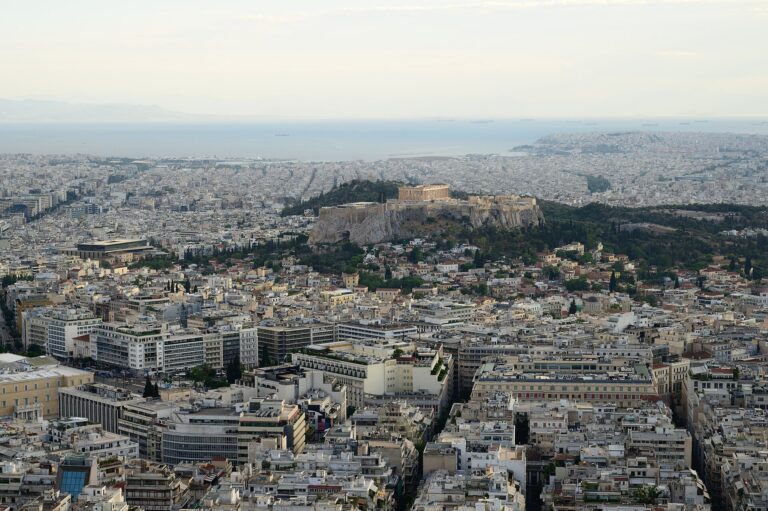 7:00AthensLycabettus HillThis free audio guide to Lycabettus Hill plays straight from your phone — no app, no sign-up —…
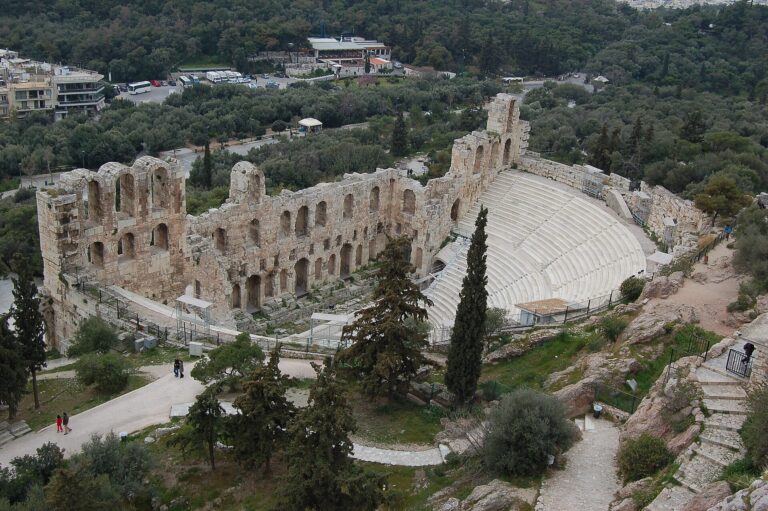 5:59AthensOdeon of Herodes AtticusThis free audio guide to the Odeon of Herodes Atticus plays straight from your phone — no app,…
 5:26AthensTemple of Olympian ZeusThis free audio guide to the Temple of Olympian Zeus plays straight from your phone — no app,…