
The Alcazaba of Málaga: free audio guide, hours and tickets
Free audio guide in English · no app, no sign-up
Free audio guide to the Alcazaba of Málaga, in English: just under 5 minutes of audio up the hill, from the entrance gates and the Coracha to the 11th-century and Nasrid palaces, playing on this page.
 Audio guide
The Alcazaba of Málaga is the walled Moorish palace-fortress on the lower slope of Mount Gibralfaro, right above the city centre: 2 rings of walls, a run of defensive gates and, at the top, the courtyards of 2 palaces, one from the 11th century and one Nasrid. A ticket costs €7, or €10 with Gibralfaro Castle, and entry is free on Sundays from 14:00. This is its free audio guide, in English.
What the audio guide tells you
It is free, it plays on this page in your phone’s browser, with no app and no sign-up, and it lasts 4 min 53 s. It walks you up the hill in the order you visit it: the entrance gates built to slow attackers down, the lower enclosure, with its view of the Coracha climbing to Gibralfaro Castle and the story of the 30-metre well that gave the fortress its water, the Plaza de Armas garden, the double gate into the upper enclosure, and the 11th-century and Nasrid palaces at the top.
Some points of interest described in the Alcazaba of Málaga Audio Guide, with the minute where each one starts:
| Minute · point of interest | Brief Description |
|---|---|
| 0:24 · Torre Albarrana | The tower that juts out into the Plaza de la Aduana, its corners built with stone blocks from the Roman Theatre. |
| 0:56 · Puerta de la Bóveda and Puerta de las Columnas | An 11th-century bent gate under a brick vault, and a gate built with reused Roman marble columns. |
| 1:19 · Puerta del Cristo | The bent gate with a key carved on its keystone, named after an altarpiece with a figure of Christ. |
| 1:40 · La Coracha | 2 parallel walls climbing to Gibralfaro Castle, begun by Yusuf I around 1340; only 1 other survives in Spain. |
| 2:20 · Pozo Airón | A well 30 metres deep, cut into the rock down to a natural spring: this is where the fortress got its water. |
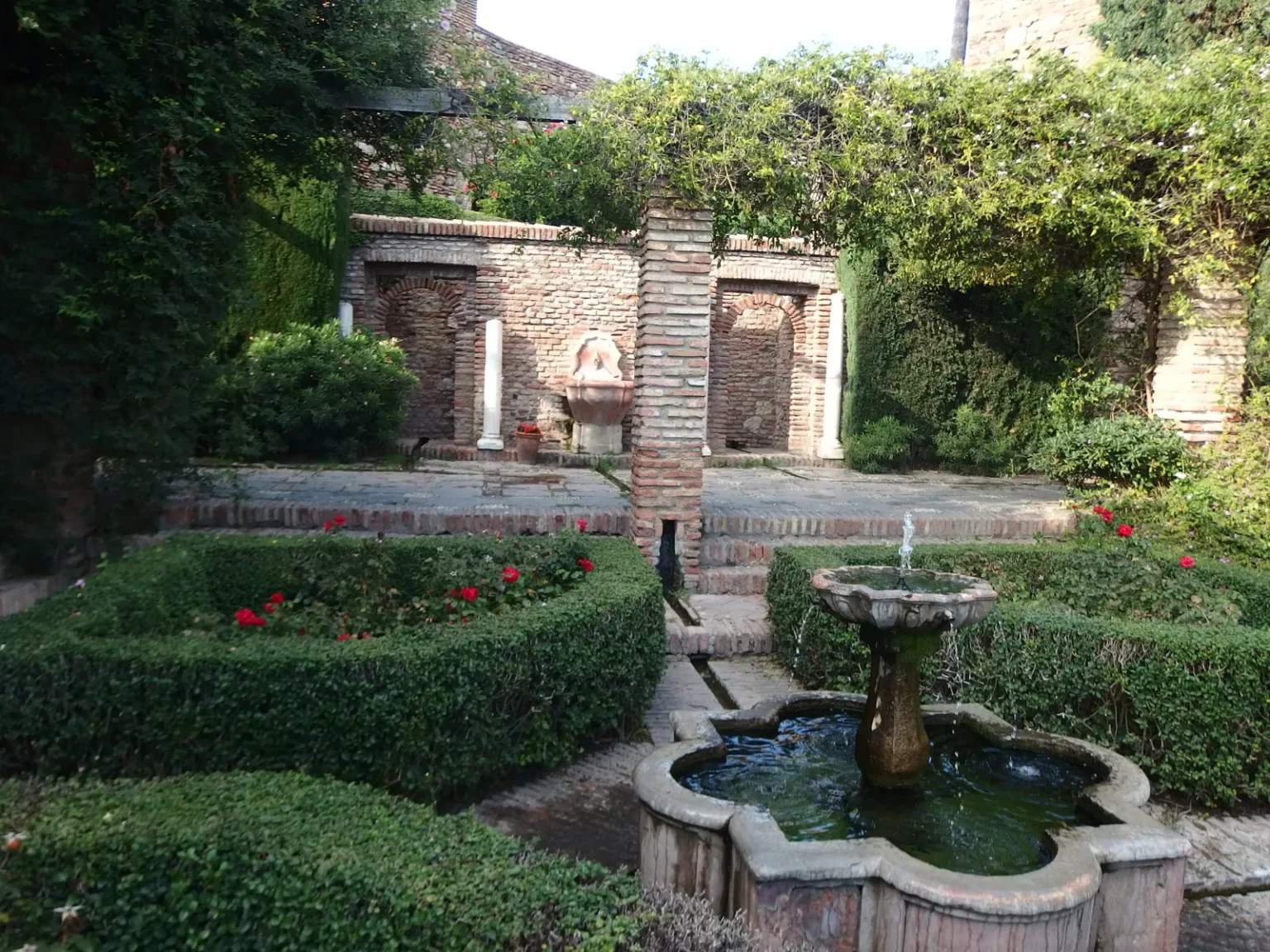
| 2:50 · Plaza de Armas | The garden whose small channels carry water from the palace down to the central fountain. |
| 3:05 · Puerta de los Cuartos de Granada | The double gate into the upper enclosure, a trap for attackers, rebuilt from an engraving of 1839. |
| 3:29 · Patio de los Surtidores | The courtyard of the 11th-century Taifa palace, with the Pavilion of the Lobed Arches. |
| 3:59 · Nasrid palace | The Patio de los Naranjos and the Patio de la Alberca, whose long pool reflects the tower at its north end. |
Drag the player’s bar to the minute of the point you have reached. To listen without mobile data, download the MP3 (4.7 MB) to your phone before you go: it is the same audio as the player, and once saved, it plays offline. The order is the one you walk uphill from the main entrance on Calle Alcazabilla; if you come in by the lift from Calle Guillén Sotelo, which arrives at the top of the fortress, start at minute 3:29 with the palaces, and if you then walk down to Calle Alcazabilla, use the minutes in the table in reverse order.
Hours, tickets and the free Sunday afternoon
From 1 November to 31 March the Alcazaba opens from 09:00 to 18:00, with the last entry at 17:00. From 1 April to 31 October it opens from 09:00 to 20:00, with the last entry at 19:00. A general ticket costs €7, and the combined ticket with Gibralfaro Castle, €10. Reduced tickets cost €3, or €5 combined, for European Youth Card holders, EU citizens over 65, retired or unemployed, EU students, people with a disability of 33% or more and large-family card holders. Groups of 10 or more pay €5, or €8 combined, and under-6s go in free. Tickets for the Alcazaba, alone or combined with Gibralfaro Castle, are also sold online, on the official ticket site.
The main entrance is at Calle Alcazabilla 2, next to the Roman Theatre, and the nearest Metro stop is Atarazanas, on Line 1. A lift from Calle Guillén Sotelo goes up to the upper part of the fortress and is also used as a visitor entrance and exit. Gibralfaro Castle, at the top of the same hill, is a separate visit: about 20 minutes on foot up the Paseo de Don Juan Temboury, or EMT bus 35, which runs about every 30 minutes from the historic centre.
The way in: gates built to slow you down
Before you reach the first ring of walls you walk through what the restoration architect Leopoldo Torres Balbás called the “entrance fortifications”: a narrow path that climbs between walls with small solid towers and one gate after another. Most of it comes from the great rebuilding by Badis, the Zirid king of Granada, after he added Málaga to his kingdom in the 11th century.
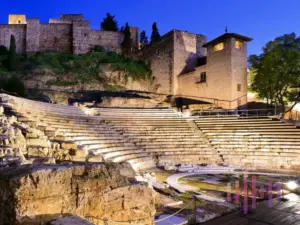
The first thing you see from the street is the Torre Albarrana, a tower that stands out from the walls into the Plaza de la Aduana and once reached the edge of the sea. Its corners are built with large stone blocks taken from the Roman Theatre at the foot of the hill.
 Free audio guideRoman Theatre of Málaga
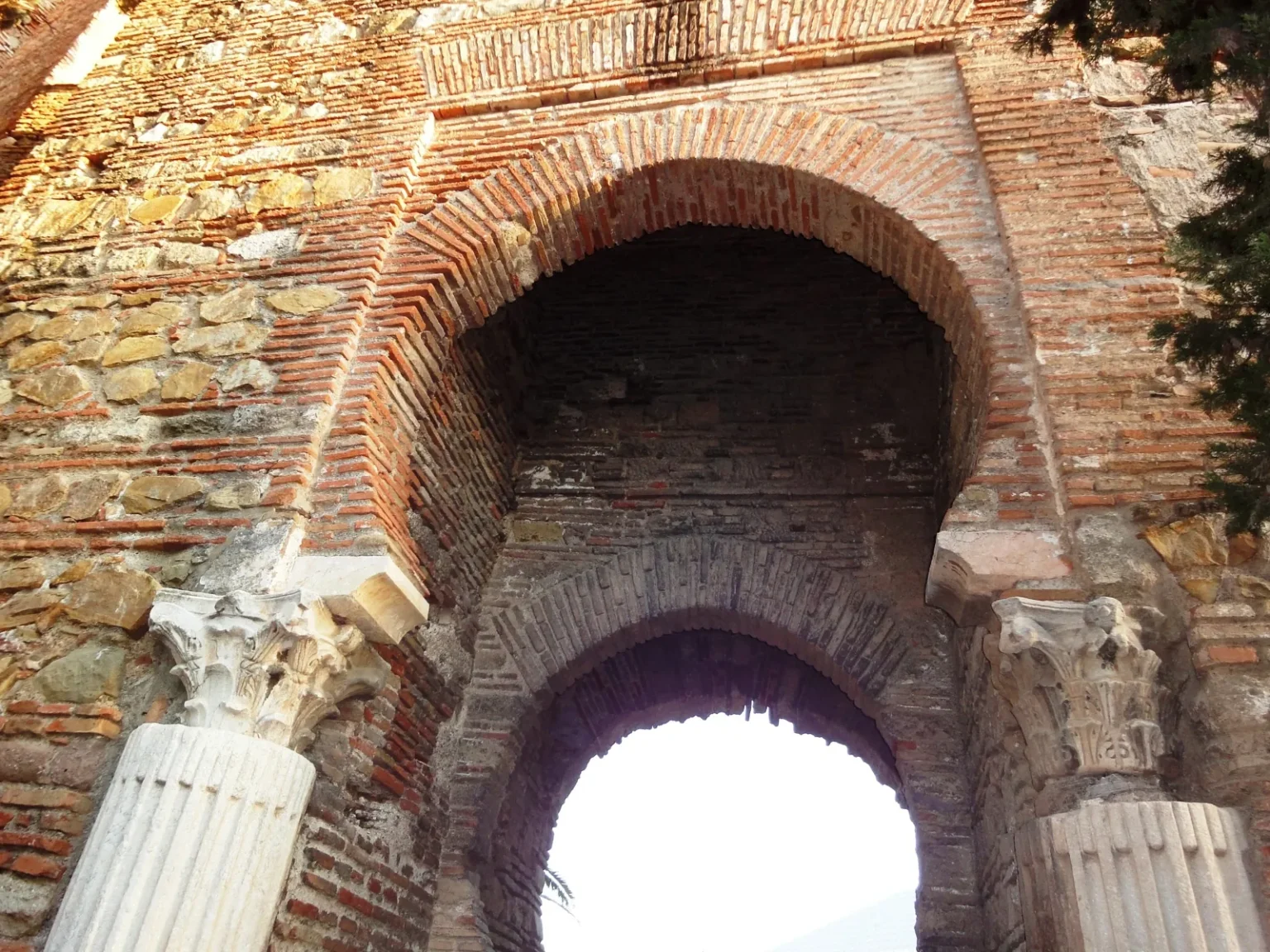
Inside, the path turns through the Puerta de la Bóveda, an 11th-century gate with a bend under a brick vault, and then the Puerta de las Columnas, where the builders reused white marble Roman column shafts and Corinthian capitals. The way then climbs the Cuesta del Cristo to the Puerta del Cristo, another bent gate: the keystone of its entrance arch has a key carved on it, as on the Gate of Justice of the Alhambra, and its name comes from an altarpiece with a figure of Christ that turned it into a small street chapel from the 17th century.
Plaza de Armas, the lower enclosure and the Coracha
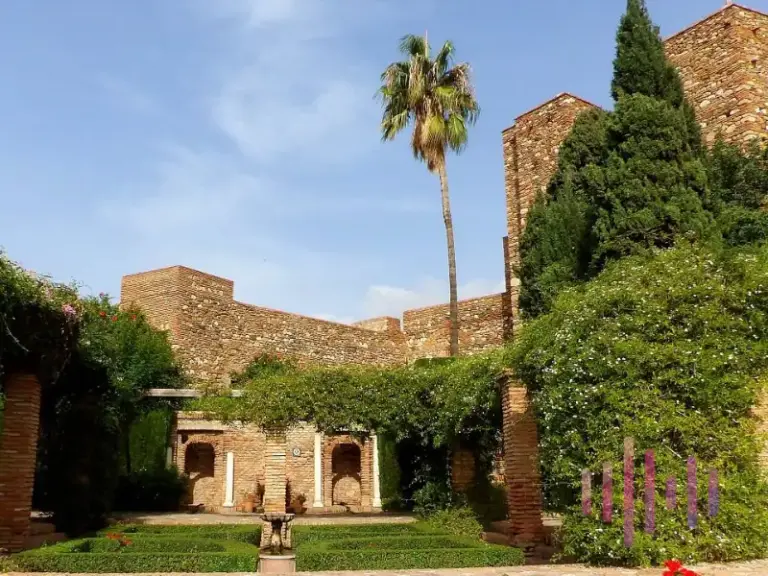
The Puerta del Cristo leads into the lower enclosure, which wraps right round the upper one. Just past the gate, through an arch, is the Plaza de Armas, today a Hispano-Muslim garden designed by the architect Fernando Guerrero-Strachan Rosado: low hedges, a sunken centre and small channels that carry water down from the palace to the fountain in the middle.
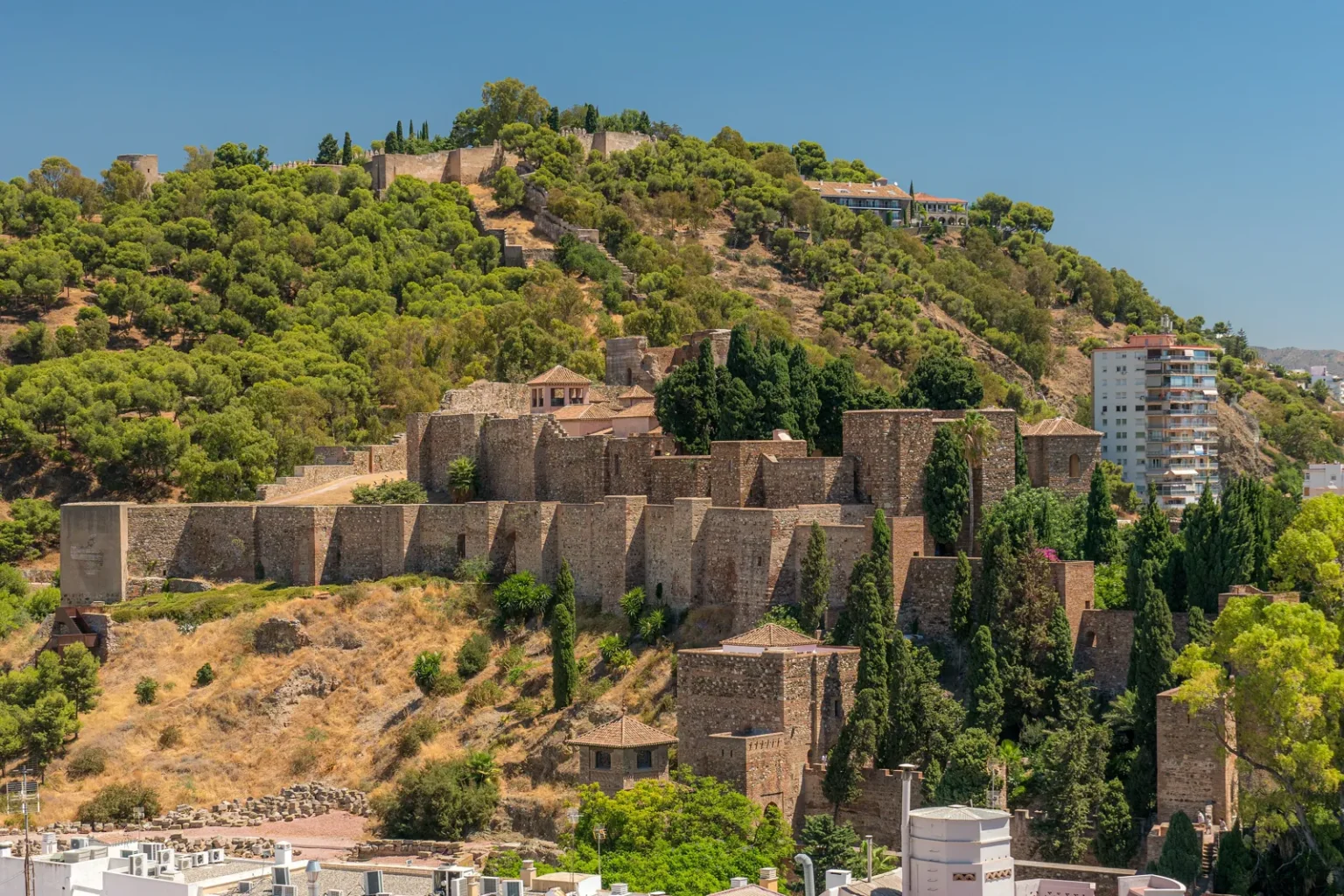
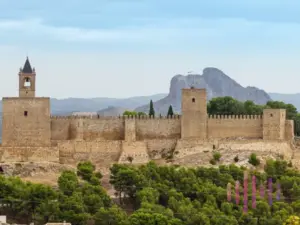
From the highest viewpoint on the south side you see the Coracha climbing the hill to Gibralfaro Castle: 2 parallel walls with a walkway on top, laid out in a zig-zag so that no projecting towers were needed. It was the only protected way between the palace-fortress and the castle. You see it from this viewpoint; the walk up to the castle today is the separate climb described above.
 Free audio guideGibralfaro Castle
From the same viewpoint you look at the ruin of the Torre del Homenaje, the keep at the east end of the upper enclosure, which the restorers chose to consolidate rather than rebuild. On the north side of the lower enclosure, beyond a gate, are the Pozo Airón, a well 30 metres deep cut into the rock down to a natural spring, which gave the fortress its water, and the 2 narrow mouths of the dungeons, shaped like upside-down funnels so that nobody could climb out.
The palaces at the top
The main gate of the upper enclosure is the Puerta de los Cuartos de Granada, a double gate with a small open courtyard between its 2 passages: a trap for anyone who got through the first one. The tower was almost completely demolished in 1854 and rebuilt from an engraving of 1839, and Guerrero-Strachan finished its restoration in 1938.
Inside are the remains of 2 palaces. The Patio de los Surtidores was the central courtyard of the 11th-century Taifa palace. In the room on its south side, a triple horseshoe arcade framed by an alfiz follows the arches of the Salón Rico of Madinat al-Zahra, near Córdoba, and to the right stands the Pavilion of the Lobed Arches, dated to the mid-11th century (between 1026 and 1057), in what may have been the area of government, echoing the splendour of the Caliphate. Beside them, the Torre de Maldonado has 2 marble columns with a text from the Koran from the Almohad period, and a 16th-century room keeps its Mudéjar wooden ceiling in the place it was made for.
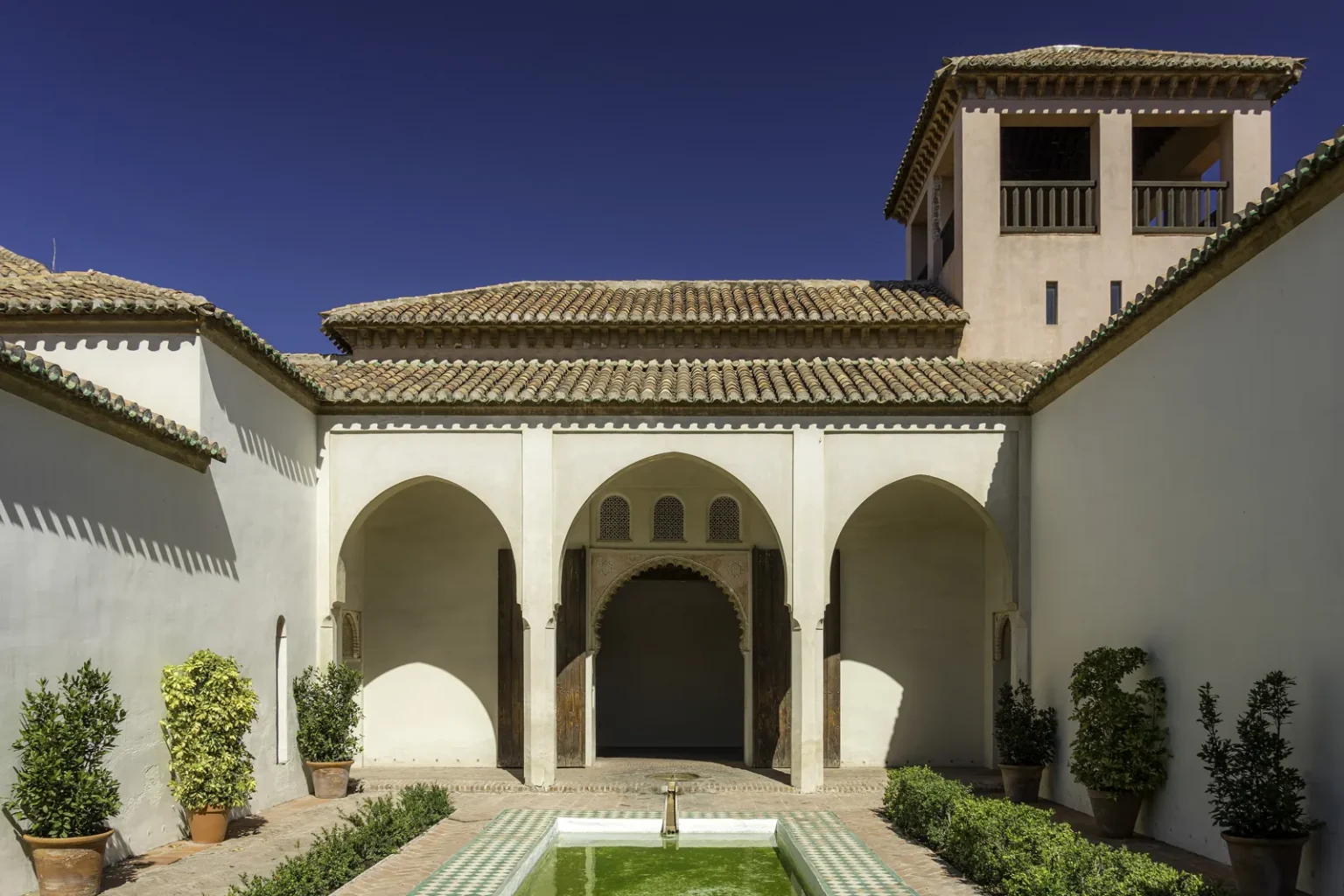
The Nasrid palace beyond is laid out around 2 courtyards: the Patio de los Naranjos and the Patio de la Alberca, with its long pool between myrtle hedges. Little of the original building survived, so the restorers recreated it on the model of the palaces of Granada, and its rooms now hold a permanent exhibition that opened in 2003. Next to the palaces is the 11th-century housing quarter, with its own bath and cistern, built for courtiers or palace servants: about 50 people could live there.
A short history in 7 dates
- Around 600 BC — the Phoenicians settle on the hill.
- 755 — the Alcazaba is first recorded as a fortress, in the time of Abd al-Rahman I; in the same century a Friday mosque is ordered inside it.
- 11th century — the Hammudids begin the palace, and Badis gives the fortress its double wall and most of the entrance fortifications.
- Around 1340 — Yusuf I starts Gibralfaro Castle and the Coracha; both may have been finished by his successor, Muhammad V.
- 1487 — the Catholic Monarchs take the city after besieging Gibralfaro Castle in the summer. On 30 August 1494 they grant Málaga its coat of arms, with the Alcazaba, the Coracha and the castle on it.
- 18th century — the military leave, and the upper part of the fortress fills with houses and becomes a poor quarter of the city.
- 3 June 1931 — it is declared a Historic-Artistic Monument; the restoration works begin in 1933, with Juan Temboury (1899-1965), whose bust greets you at the entrance, behind them until his death.
The whole complex covers 14,200 m², of which 7,000 m² are built. (Hours and prices from the council’s own page, checked on 1 November 2026.)
Nearby, with their own free audio guides
- Gibralfaro Castle — at the top of the hill, on the €10 combined ticket.
- Roman Theatre — right at the foot of the Alcazaba, on Calle Alcazabilla.
- Cathedral of the Incarnation — a few minutes’ walk away, in the old town.
- Central Market of Atarazanas — the city’s central food market, in the old town.
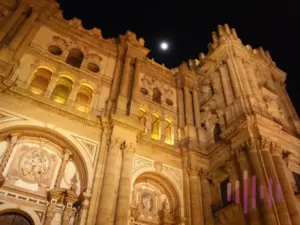 Free audio guideCathedral of the Incarnation
All of them are on the free audio guides of Málaga page. The same guide in Spanish is at La Alcazaba en vozviajera.com.
Where to find it
FAQs
How do the free audio guides work?
They play right here on audioguidetravel.com, with no app to download and no sign-up. Press play and listen as you walk round: a phone and a pair of headphones are all you need. The audio streams from this page, so you’ll need mobile data or Wi-Fi.
Can I take the tour at my own pace?
Of course! You set the pace: pause whenever you like, jump back or forward 15 seconds, or tap the bar to jump to any point, and listen as many times as you want so you don’t miss a thing.
If I'm in a group, can we use the same audio guide?
Yes. The same free audio guide opens on as many phones as you like, so you can go round together as a group or with your family, each person at their own pace and with their own headphones. The quickest way is to send the link via WhatsApp, Telegram or however you like: the buttons just below let you share it right now.
Visitor information
As of 1 Nov 2026- Opening hours
- 09:00–20:00 from 1 April to 31 October · 09:00–18:00 from 1 November to 31 March.
- Tickets
- €7 · €10 with Gibralfaro Castle
- Getting there
- Main entrance on Calle Alcazabilla. Metro Line 1: Atarazanas.
- Accessibility
- A lift from Calle Guillén Sotelo reaches the upper part; the rest of the route has slopes and steps
- Tip
- Go on a Sunday from 14:00, when entry is free; on other days the €10 ticket adds Gibralfaro Castle
- Official website
- alcazabaygibralfaro.malaga.eu
Nearby
More free audio guides in Malaga
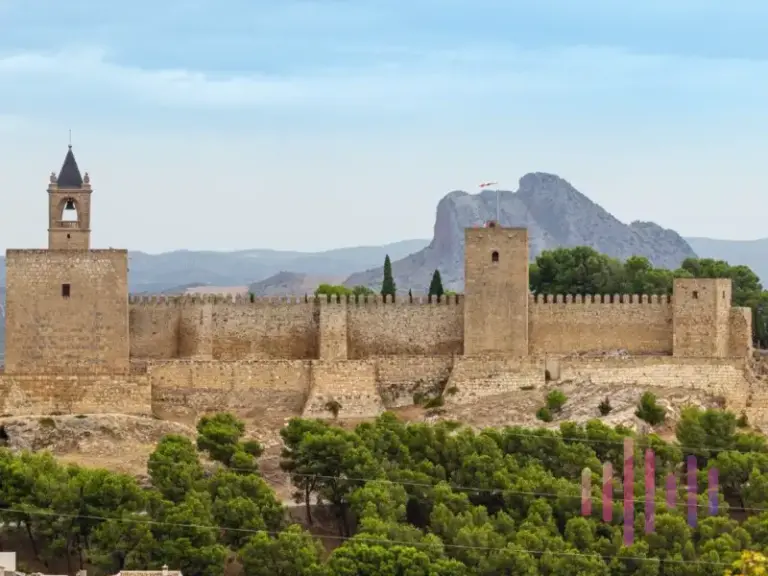 6:44MalagaGibralfaro Castle: free audio guide, hours and ticketsFree audio guide to Gibralfaro Castle in Málaga, in English: just under 7 minutes on the hill of…
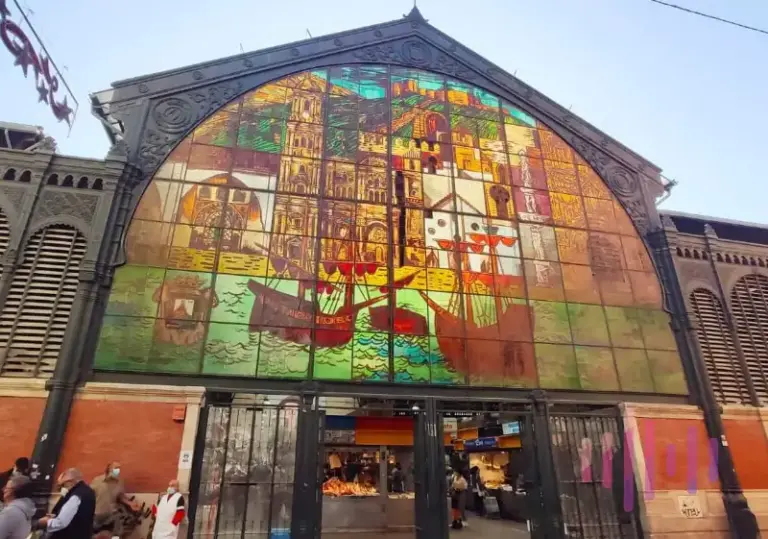 4:17MalagaCentral Market of AtarazanasIn the heart of Málaga stands the Atarazanas Market, an emblematic meeting point where history intertwines with the…
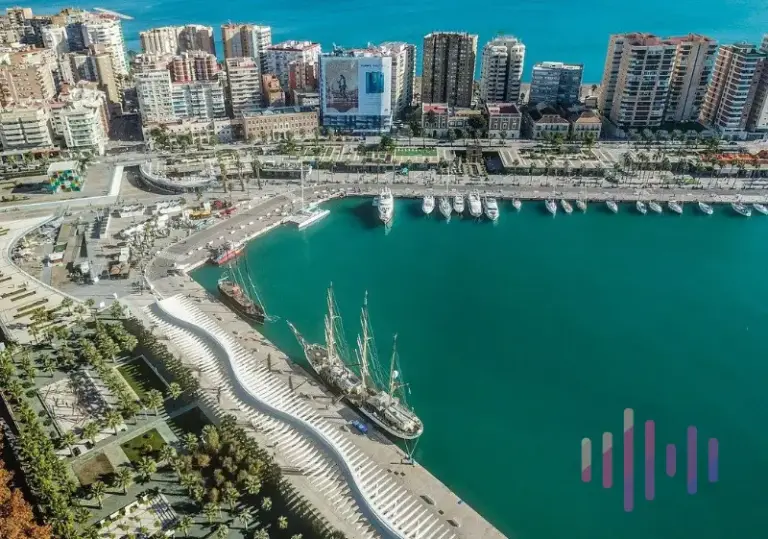 6:25MalagaPort of MálagaThe Port of Málaga, a jewel embedded in the sunny Costa del Sol, invites you to discover its…