
This free audio guide to Lycabettus Hill plays straight from your phone — no app, no sign-up — while you climb. It tells you why there is a loose mountain in the middle of Athens and what the bird that broke the news lost for it, who started planting this wood in 1865 on a hill that had no trees on it, and what stood on the summit before the white chapel of the 18th century. Press play at the station on Aristippou.
 Audio guide
Before you go in
The few things that change your visit.
- Walking up is free: the hill is public, with no ticket and no ticket office
- The funicular costs €10.00 one way and €13.00 return, checked 18 September 2026
- It runs every day from 09:00 to 02:30, from Aristippou 1 in Kolonaki
- On days of very high fire risk the City of Athens can close the whole hill
- The theatre reopened on 15 September 2023, with 3,000 seats; the 2026 season ends 5 October
On this page
- What the audio guide tells you
- It is free: there is no ticket and no ticket office
- The funicular: €10.00 one way, €13.00 return
- Walking up: where the path starts and how long it takes
- Is it worth it if you have already seen the Acropolis?
- The chapel of Agios Georgios on the summit
- The theatre is open again, and the season has an end date
- Athena, the crow and the rock that landed here
- A 277-metre hill that was once bare
- Before you go: the day the hill can be shut
- Nearby, with their own free audio guides
- Tickets and prices
- Where to find it
- FAQs
Lycabettus Hill is the 277 m cone that rises out of the middle of Athens, above the Kolonaki district. It belongs to the City of Athens and it is a public open space: no ticket, no ticket office, nothing to pay to walk up. A funicular runs to the top through a tunnel bored inside the rock. On the summit stand a whitewashed chapel, a restaurant, and the view people climb for.
This page is the free audio guide, plus the practical detail read on 18 September 2026 from the City of Athens, the Region of Attica and the company that runs the funicular: what the ride costs, how late it runs, where the lower station is, and the one thing that can shut the hill for a day.

What the audio guide tells you
It is free, it plays in your phone’s browser, and there is no app to install and no sign-up. Press play at the funicular station on Aristippou, or at the foot of the path if you are walking: the route climbs with you and comes back down through the pines.
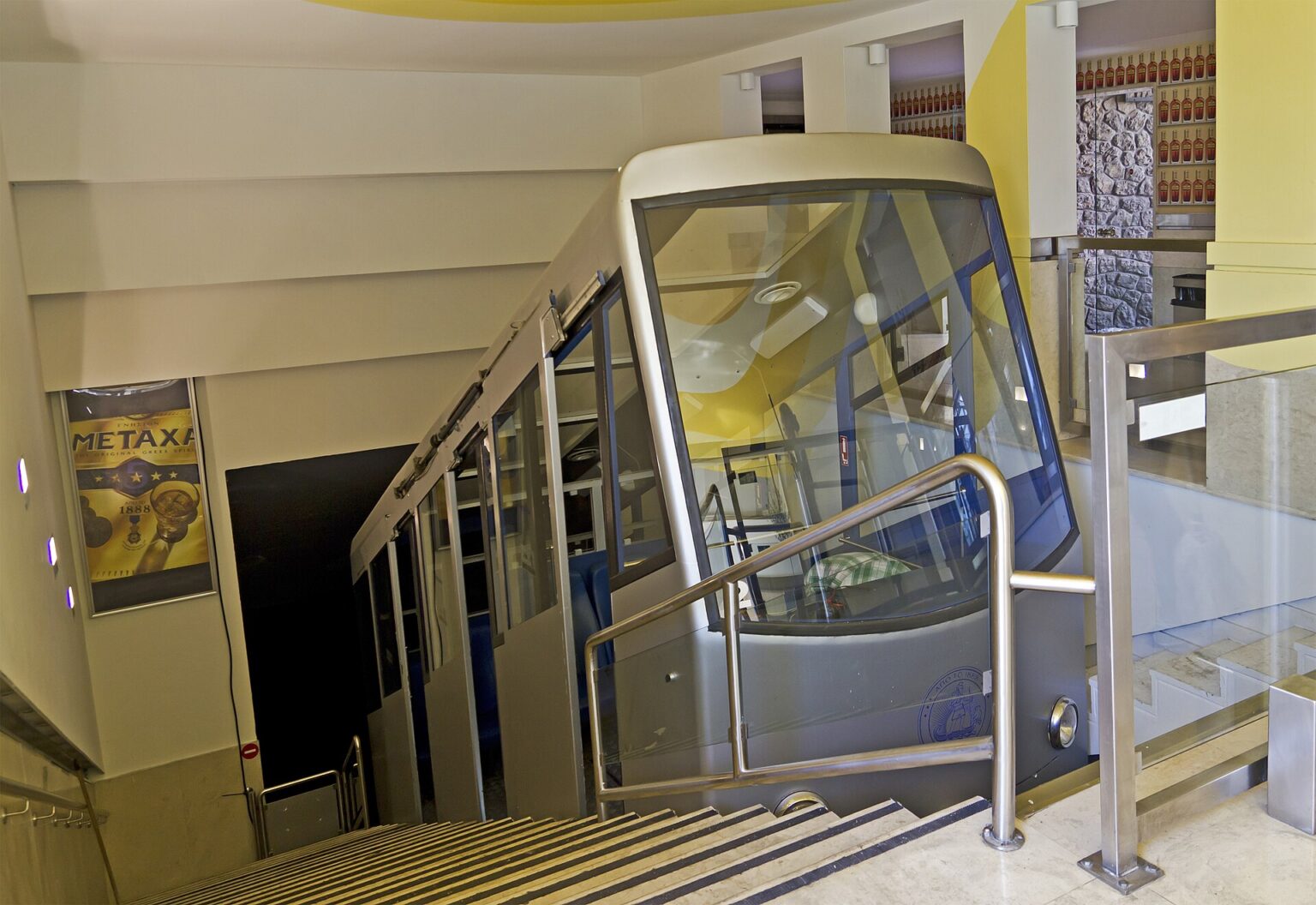
| The lower station on Aristippou | Where the funicular starts, what a ticket costs, and why the 210 m ride shows you nothing at all through the window. |
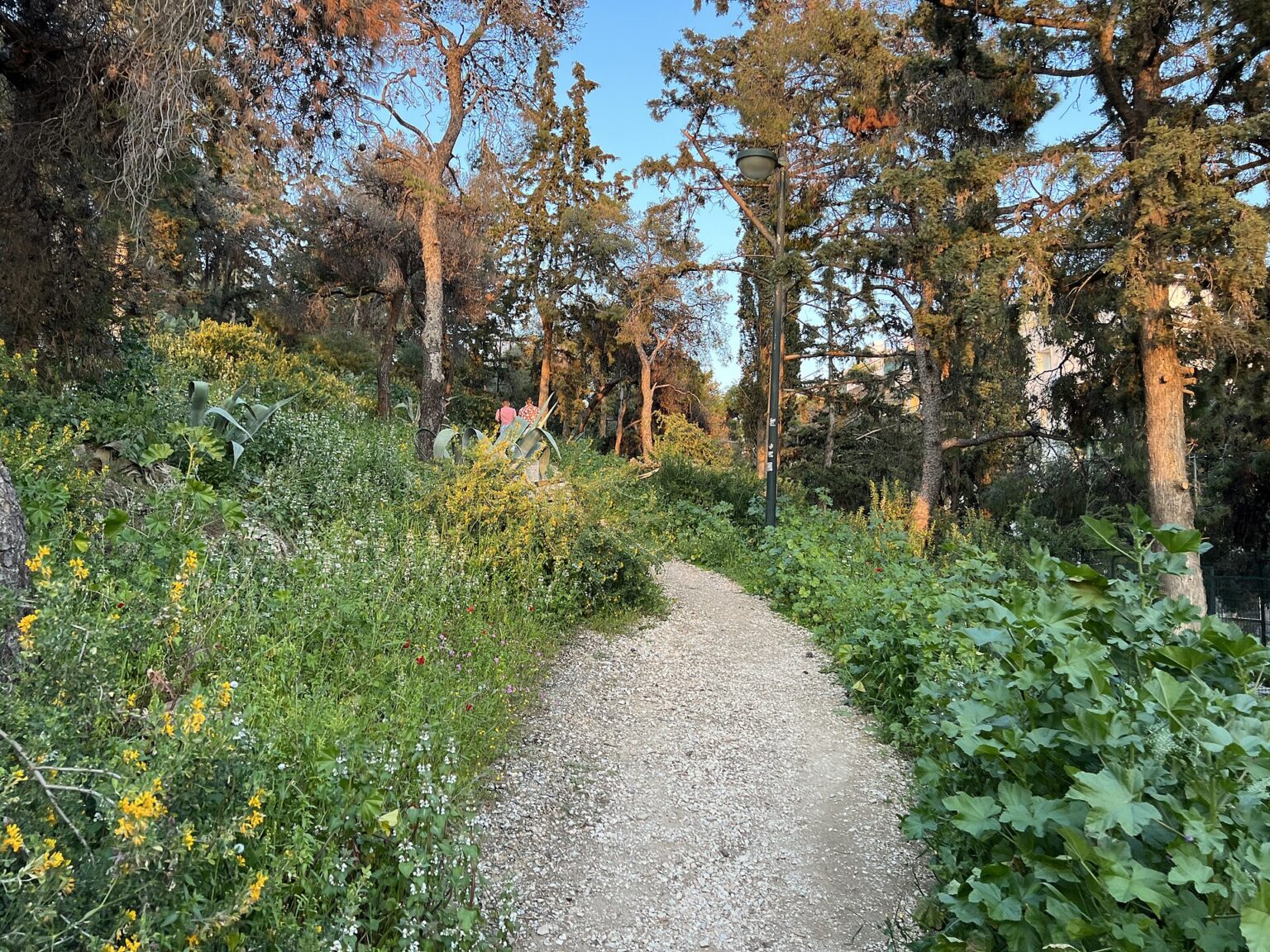
| The gravel path under the pines | The zigzag up the flank, who planted this wood on a hill that had no trees on it, and which side they started from. |
| The chapel of Agios Georgios | The whitewashed 18th-century church on the summit, and what stood on that exact spot before it. |
| The bell tower and the hermit’s cell | Who paid for the tower in 1902, where its bell was cast, and the Cretan monk who spent the rest of his life beside the church. |
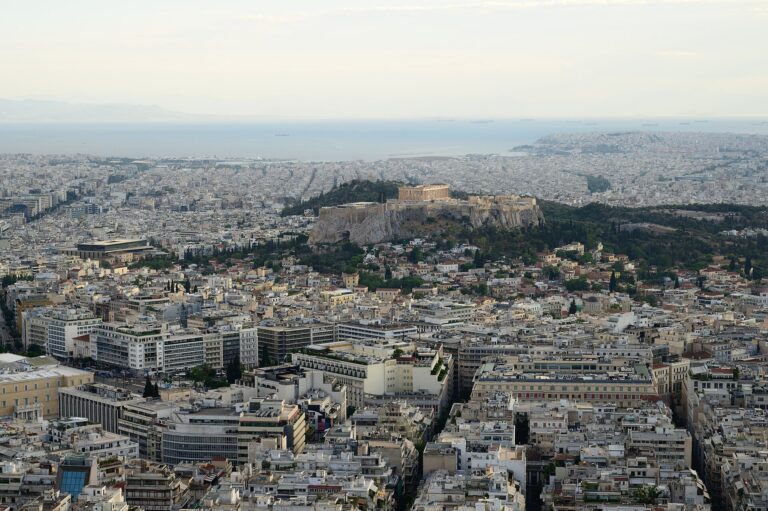
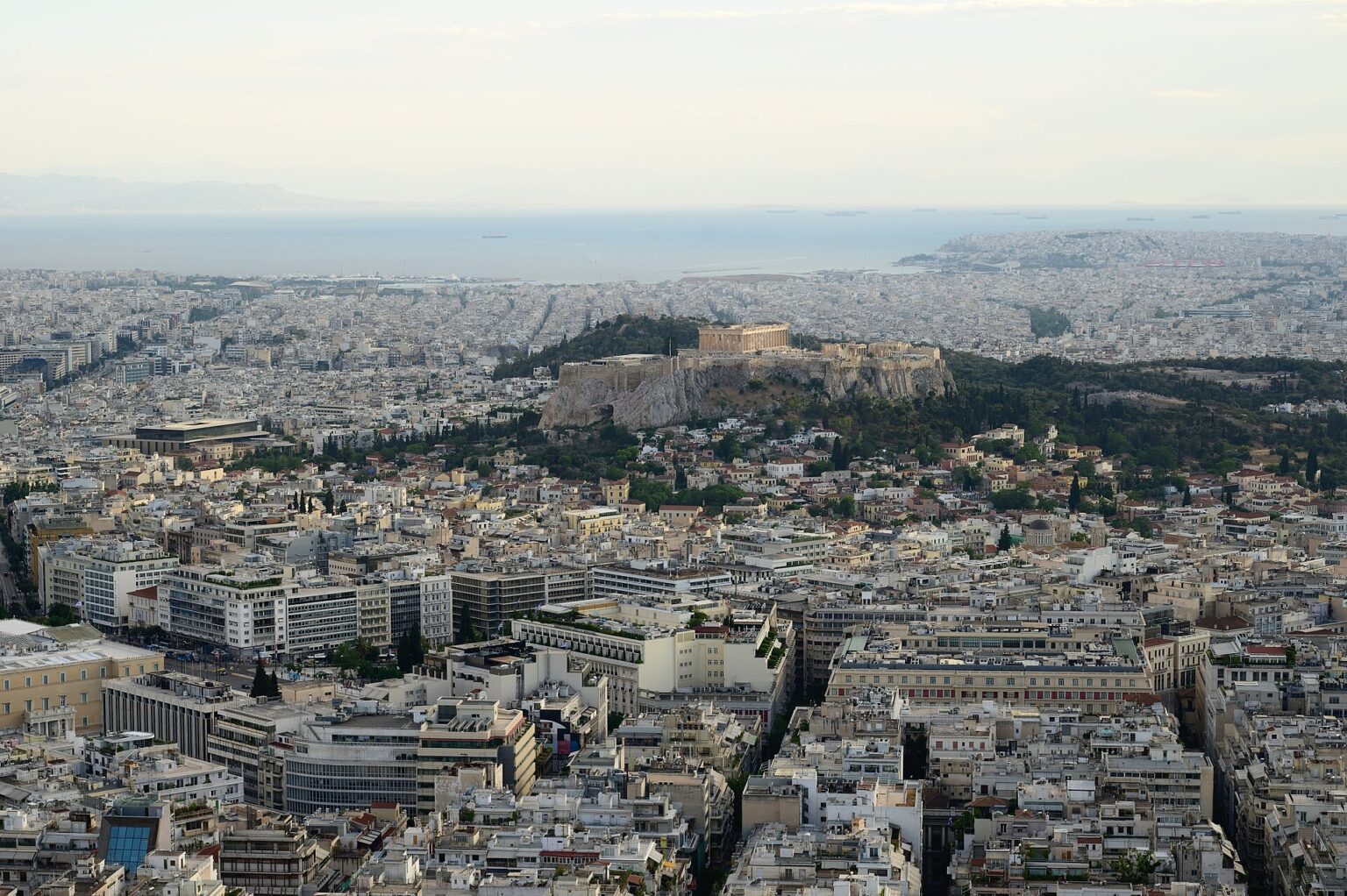
| The summit terrace | What you can actually pick out from up here: the Acropolis whole and below you, the port, and the mountains that close the basin. |
| The Lycabettus theatre | The open-air tiers set into an old quarry on the north flank, how many people fit in them, and what plays there now. |
| Athena’s crow | The story Athenians told to explain a loose mountain in the middle of their city, and the punishment the bird took for bringing the news. |
It is free: there is no ticket and no ticket office
This is worth saying plainly, because the big names in Athens all have a turnstile in front of them. Lycabettus does not. It is a green public space of the City of Athens, 41.65 hectares with a perimeter of 2.7 km according to the Region of Attica’s listing for the hill, and there is no ticket office anywhere on it. Walking up costs nothing.
Nor does the hill publish opening hours: what has a timetable and a price is the funicular, and the 2 things are easy to confuse.
So the money question has a short answer and a long one. Short: €0.00 to walk, €10.00 or €13.00 if you take the funicular. Long: there are 3 ways up, and they are not interchangeable.
| Way up | Cost | How long |
| On foot, from the lower station at Aristippou 1 | Free | About 711 m of path and roughly 100 m of climb; allow 20 to 30 minutes |
| Funicular, from Aristippou 1 | €10.00 one way · €13.00 return | About 3 minutes, all of it inside a tunnel |
| On foot from the theatre car park, by taxi or shuttle bus | Free once you are there | 5 to 10 minutes |
The funicular: €10.00 one way, €13.00 return
A single ride costs €10.00 per person and a return €13.00, the price charged on 18 September 2026 by the company that operates it. There are no reduced fares published and no online sales: you buy at the lower station before you go down to the platform.
The timetable is the part that changes how you plan the day. It runs every day of the year from 09:00 to 02:30, with departures every 30 minutes and up to every 10 minutes when it is busy. The operator’s own warning is worth carrying into January: in the winter months it may stop earlier.
| One-way ticket | €10.00 per person, checked 18-09-2026 |
| Return ticket | €13.00 per person, checked 18-09-2026 |
| Hours | 09:00 – 02:30, 365 days a year; earlier closing possible in winter |
| Frequency | Every 30 minutes, up to every 10 at peak times |
| Lower station | Aristippou 1, Kolonaki, 106 76 Athens — at the top of Ploutarchou street |
| Phone | +30 210 721 0701 |
| The ride | 210 m, entirely in tunnel, about 3 minutes |
The machine itself is a good story. Those 210 m are bored straight through the hill, so there is no view at all on the way up. There are 2 cars of 34 passengers each; they leave both ends at the same moment, pass midway and counterweight each other. Around 300,000 passengers a year go through.
It opened on 18 April 1965 and was built by the Greek National Tourism Organisation. Since 2002 the funicular and the restaurant on the summit have been run together by a restaurant group, and that same year the mechanical and electrical installations were overhauled and both cars replaced. The restaurant, Orizontes, opens every day from 12:30 to 00:30.
One practical warning: the lower station is marked as not wheelchair accessible in the open map data. The address, given the same way by the city’s official visitor guide and by the operator, is Aristippou 1, Kolonaki, 106 76.

Walking up: where the path starts and how long it takes
The walk starts from the same corner as the funicular. From the lower station at Aristippou 1 to the summit there are about 711 m of path and roughly 100 m of climb — figures we measured on the map rather than took from a timetable, and the map does not know how steep a street is. Allow 20 to 30 minutes at a normal pace.
Getting to that corner is the other half of it. The metro station to aim for is Evangelismos on line 3, the blue one from the airport: about 650 m, all of it uphill through Kolonaki. From Syntagma it is about 1,000 m, and from Ampelokipoi about 1,600 m, which is why Ampelokipoi is not the alternative it looks like on a map. These distances are ours, measured on the map, and none of them counts the gradient.
The shortest walk on the hill is the one hardly anyone takes: from the Lycabettus theatre car park to the summit is 5 to 10 minutes on foot, and it is the operator of the summit who says so. That is the route if you come by taxi, or by the shuttle bus on a concert night.
The paths themselves have been rebuilt. In 2026 the City of Athens replaced 2,000 m of wooden fencing along them with 500 m more under way — 2,500 m in total — repaired 300 m² of paving at the theatre entrance and put 15 new benches along the route. You are not going cross-country: the way up is fenced, surfaced and has somewhere to sit.
_-_2022-03-26_-_10.jpg)
Is it worth it if you have already seen the Acropolis?
Yes, and the reason is geometric rather than sentimental. Everywhere else in Athens you look up at the Acropolis. From 277 m you look down on it, and the whole rock — the slopes, the shape of it, the Parthenon on the crown — fits into a single glance instead of filling the sky above your head. This is the highest point in central Athens and the second highest in the whole basin, behind the Tourkovounia.
The 2 places are also tied together by the oldest story told about this hill: Athena was carrying the rock towards the Acropolis when she dropped it here. Go up with the Acropolis already behind you and that myth stops being decorative — you can see exactly what she was aiming at.
Then there is the budget, which in Athens adds up fast. The Acropolis ticket is €30.00 and the one for the Ancient Agora of Athens, spread out at the foot of the same rock, is €20.00. Lycabettus has no ticket at all, and no closing time to race: the archaeological sites shut in the evening, and the funicular here keeps running until 02:30. It is the one big view in the city you can add after the day is over.
The chapel of Agios Georgios on the summit
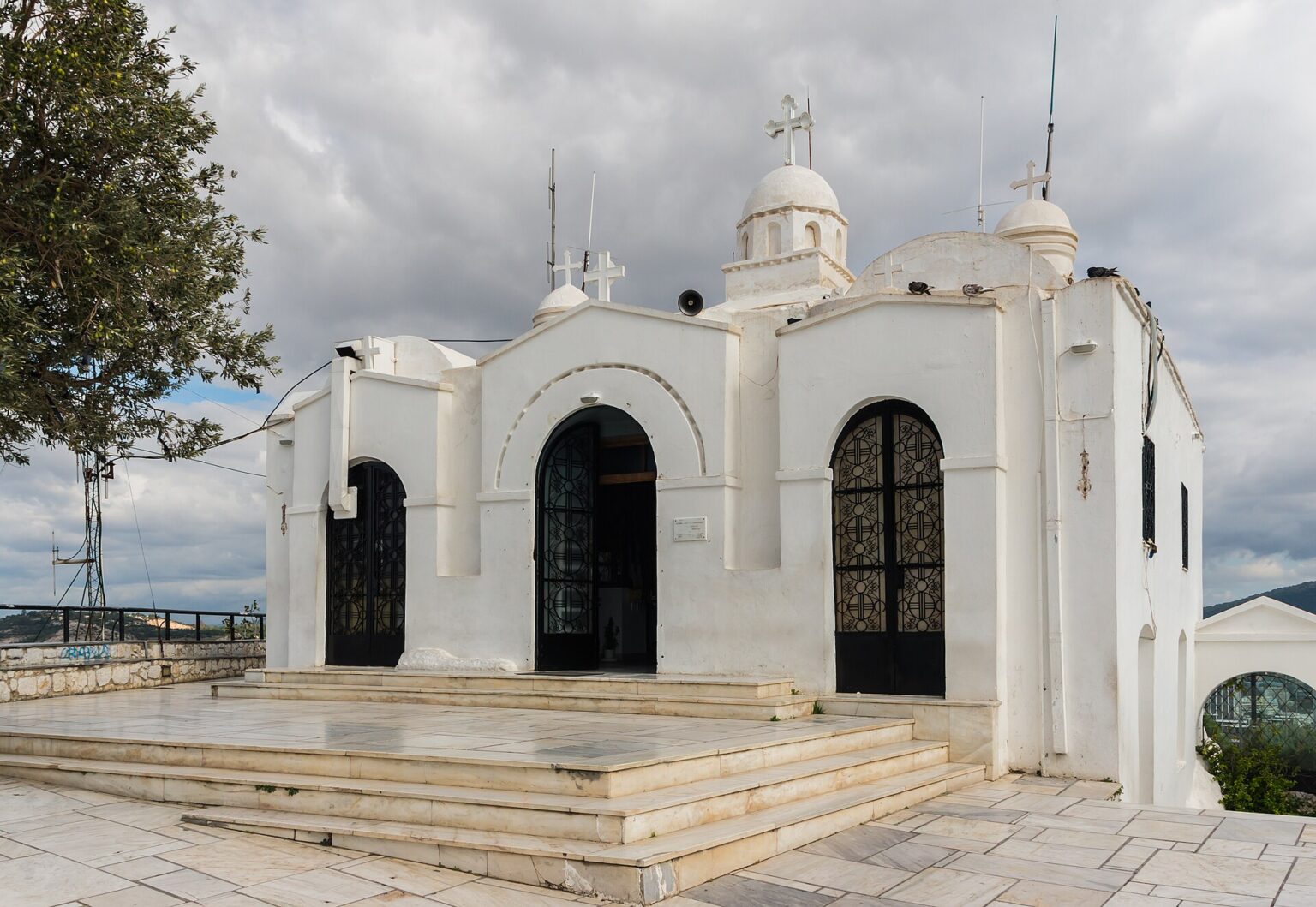
The white shape half of Athens can see from its balconies is the chapel of Agios Georgios, a single-nave basilica with a dome, built in the 18th century — the date given both by the city’s official guide and by the Region of Attica. It is small, lime-washed and standing on the literal high point: the bell tower reaches 285 m, 8 m above the ground the church sits on.
There is more history under it than building on it. The official listings of the City and of the Region put an altar of Zeus Akraios — Zeus of the summits — on this crown in antiquity, with traces of a temple found alongside it; the same god’s great sanctuary down on the flat is the Temple of Olympian Zeus. After that cult came a church of the Byzantine period, and the chapel you walk into today was raised on top of all of it.
The chapel is already drawn on a plan of Athens made by Capuchin monks in 1670, and travellers describe it in 1678 and 1687. The side chapels of the Prophet Elijah and Saint Constantine were added around 1885. The bell tower went up in 1902, paid for by Nikolaos Thon, a wealthy landowner of King Othon’s court, and its large bell was cast in Russia.
Beside the church stands a hermit’s cell of the 19th century, built by a Cretan monk who founded the church here and stayed on the summit for the rest of his life — when this was a bare cone you climbed, not a terrace with a restaurant on it.
And there is a version of this chapel that never got built. Ernst Ziller proposed redesigning it as a miniature replica of the National Observatory, and the plan was dropped as too expensive. Ziller turns up twice on this hill — he also signed the study that put the trees on it — so Lycabettus owes him its wood and owes him a church that does not exist.
The chapel does not publish opening hours; the number is 210 72 12 206. Its feast is Saint George, 23 April, a movable feast in the Orthodox calendar that in some years shifts to Easter Monday. On Good Friday night the candle-lit Easter procession sets off from here, as the city’s official guide records.
Lower down the flank there is a second church that most people walk straight past: the Agioi Isidoroi, cut into the rock itself, of the 15th and 16th centuries, dedicated to 3 saints and opened for a single liturgy a year, on 13 September.

The theatre is open again, and the season has an end date
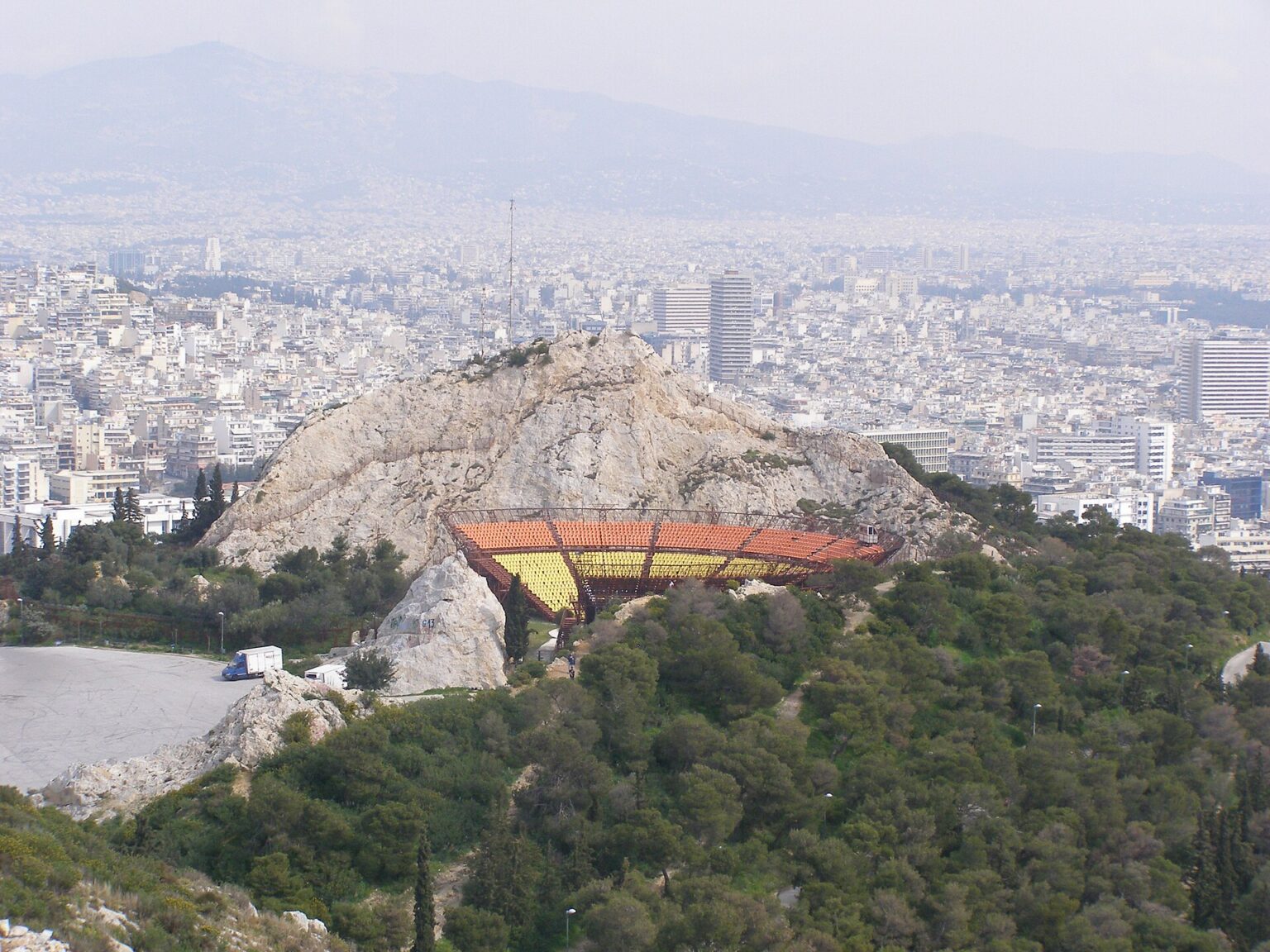
On the north flank, dropped into the hollow an old quarry left behind, is an open-air amphitheatre: the City of Athens Lycabettus Theatre. It was inaugurated on 12 June 1965, spent more than a decade shut, and reopened on 15 September 2023 after the City of Athens restored it. It is run today by Technopolis, the city’s cultural agency.
It is big: 3,000 seats, and up to 6,000 spectators once you count the standing audience. The 2026 season ran from 15 May to 23 July and from 30 August to 5 October, with Greek tragedy and comedy — the Persians, Lysistrata, Medea, Antigone — alongside concerts. The venue’s official page carries the programme, and tickets are sold through More.com and its resellers, at a price that changes with every show.
That second date matters more than it looks: the 2026 season closes on 5 October. Outside those months the tiers are simply part of the walk, and what you get is the shape of the quarry rather than a concert.
On performance nights the city runs its own arrangement, and it is worth knowing before you buy a seat. Access on foot and on 2 wheels is free. Cars may only reach the theatre car park carrying disabled visitors or people over 60, or as taxis dropping off and picking up. And there is a free shuttle bus from 19:00 to 21:30 leaving from Sarantapichou 3, running back again when the show ends, with priority for older people, pregnant women and anyone with difficulty walking.

Athena, the crow and the rock that landed here
A cone of rock standing alone in a flat urban basin demands an explanation, and the Athenians had one. It is told by Antigonus of Carystus in his collection of marvellous tales, at § 12, and he says himself that he owes it to Amelesagoras, an earlier Athenian writer. The text is still there to read.
Athena had left the daughters of Cecrops a chest with the child Erichthonius inside it and an instruction not to open it. They opened it. A crow flew off to tell the goddess, who at that moment was carrying a mountain through the air to add to the rock of the Acropolis. On hearing the news, Athena flung the mountain down where it now stands — this hill — and ruled that the crow, for the news it had brought, would never again be allowed to approach the Acropolis. The bird broke the story and lost the citadel.
The name pulls in a different direction. It is usually explained by wolves — λύκος in Greek — said to have prowled these slopes, which would make Lycabettus something like “the hill walked by wolves”. There is also a proposal of pre-Greek origin, far older, with the sense of a breast-shaped hill. Neither has been settled.
A 277-metre hill that was once bare
The summit stands at 277 m above sea level, and 285 m if you measure to the tip of the chapel’s bell tower. The hill covers 41.65 hectares with a perimeter of 2.7 km. Athens has other hills with a past — the Areopagus, and the Agoraios Kolonos that carries the Temple of Hephaestus inside the Ancient Agora — but none of them steps out of the city the way this one does.
What is underneath had consequences. The relief is full of natural cavities, shafts and caves, and there is an aquifer that still turns up in the foundations of the buildings of Kolonaki below. People cut into it, too: quarries worked on Lycabettus from 1831 to 1960, 129 years without a break. A good part of modern Athens is built out of this hill, and the theatre now occupies one of the bites they took.
The wood is not ancient either. At the start of the 19th century Lycabettus had no trees on it at all. Everything green on it today comes from replanting works based on a study by Ernst Ziller that began in 1865 on the north face — which has been called Pefkakia, “the little pines”, ever since — and finished in 1896, the year of the first modern Olympic Games. It took 31 years to dress the hill. The work has not stopped: the City of Athens has planted 1,472 new trees in the last 2 and a half years and rebuilt the irrigation network across most of the hill.
Before you go: the day the hill can be shut
Here is the piece of planning that no timetable carries, because it is not a timetable at all: on days of very high fire risk the City of Athens can close the entire hill. This is not a theoretical power. In 2026 the hill was closed during the July heatwave, and the City announced its reopening at midnight on 1 August, with the other hills of Athens open under increased surveillance the same weekend. These closures come with little notice and apply to the city’s green hills together. In July and August, check the day’s announcement before you set off.
The rest is detail that saves an evening. The hill publishes no hours — what has hours is the funicular, 09:00 to 02:30, and it may finish earlier in winter. The summit restaurant opens 12:30 to 00:30. The chapel publishes no opening hours, so finding it open is luck rather than planning. And the climb is short but relentless: about 100 m of ascent in a little over 700 m, under pines, with 15 benches along the way to stop at.
As for when: late afternoon. The funicular runs until 02:30 every day of the year, so sunset and the lit city afterwards are covered without hurrying. In daylight, the first hour of the morning gives the cleanest light and the least punishing climb.
Nearby, with their own free audio guides
The natural pairing is the Acropolis, which you can see whole from up here and which Athena was carrying this rock towards; its main building, the Parthenon, has a guide of its own. Below the same rock lies the Ancient Agora of Athens, with its own small hill, and out on the flat ground stands the Temple of Olympian Zeus — the city sanctuary of the god whose altar once stood on this summit. All of them, and the rest of the city, are on the free audio guides of Athens page.
Reading this in Spanish? The same guide, written for a Spanish-speaking visitor and narrated in Spanish, is at Monte Licabeto en vozviajera.com.
Tickets and the funicular
| Ticket | Price | What it covers |
|---|---|---|
| Walking up | Free | Open access on the hill's paths. No ticket and no ticket office |
| Funicular, one way | €10.00 | A single ride. Price checked 18-09-2026 |
| Funicular, return | €13.00 | Both rides. Price checked 18-09-2026 |
| City of Athens Lycabettus Theatre | Varies by show | Tickets on More.com; the 2026 season ran 15 May to 23 July and 30 August to 5 October |
Swipe to see the other columns
Where to find it
FAQs · Lycabettus Hill
Is Lycabettus Hill free?
Yes. Walking up costs €0.00: the hill is a public open space of the City of Athens, with no ticket office and no posted opening hours. You can go up on foot at any time by the paths.
The only thing with a price on it is the funicular, and the theatre when there is a show. That is worth knowing if you are coming from the Acropolis at €30.00 or the Ancient Agora at €20.00: this one has nothing to buy.
How much is the Lycabettus funicular?
€10.00 per person one way and €13.00 return, the price charged on 18 September 2026 by the company that operates it.
There are no reduced fares published — no child, senior or group rate — and no online sales. You buy at the lower station, at Aristippou 1, Kolonaki, before going down to the platform.
What are the Lycabettus funicular opening hours?
It runs every day of the year, from 09:00 to 02:30, with departures every 30 minutes and up to every 10 minutes at peak times.
In the winter months it may finish earlier than 02:30. The ride is 210 m, entirely inside a tunnel, and takes about 3 minutes; the phone number is +30 210 721 0701.
Can you walk up Lycabettus Hill?
Yes, and it is free. From the lower station of the funicular at Aristippou 1 to the summit there are about 711 m of path and roughly 100 m of climb, measured on the map — allow 20 to 30 minutes at a normal pace.
The short cut is a different one: from the Lycabettus theatre car park to the summit is 5 to 10 minutes on foot. The paths are fenced and surfaced — the City of Athens replaced 2,000 m of wooden fencing in 2026 and put 15 new benches along the route.
Is Lycabettus worth it if you have already seen the Acropolis?
Yes, because it is the one place in Athens where you look down on the Acropolis instead of up at it. From 277 m the whole rock, its slopes and the Parthenon on top fit into a single view, with the port and the Saronic Gulf behind.
It is also the highest point in central Athens and the second in the whole basin, behind the Tourkovounia. And because the funicular runs until 02:30, it is the big view you can add after the archaeological sites have closed for the day.
How high is Lycabettus Hill?
277 m above sea level, and 285 m if you measure to the tip of the bell tower of the chapel of Agios Georgios.
The hill covers 41.65 hectares with a perimeter of 2.7 km, according to the Region of Attica's listing. At the start of the 19th century it had no trees on it: the wood comes from replanting works that ran from 1865 to 1896.
Is the Lycabettus theatre still open?
Yes. The City of Athens Lycabettus Theatre reopened on 15 September 2023, after more than a decade shut and a restoration by the City of Athens, and it is run by Technopolis, the city's cultural agency.
It has 3,000 seats and takes up to 6,000 spectators with the standing audience. The 2026 season ran from 15 May to 23 July and from 30 August to 5 October; tickets are sold through More.com and the price changes with every show.
When does Lycabettus Hill close?
The hill itself publishes no closing time, and there is no ticket office to shut. What closes is the funicular, at 02:30, and the summit restaurant, at 00:30.
There is one closure to plan around: on days of very high fire risk the City of Athens can close the whole hill. In 2026 it was shut during the July heatwave and reopened at midnight on 1 August. In July and August, check the day's announcement before setting off.
FAQs
How do the free audio guides work?
Our audio guides work through the website audioguidetravel.com; you don’t need to download any app. Just follow the instructions on the website to guide you through Lycabettus Hill while listening to our experts’ explanations.
Can I take the tour at my own pace?
Of course! Our free audio guides are designed so that you set the pace. You can pause, rewind, or listen as many times as you want without missing a detail. By visiting Lycabettus Hill your way, you’ll enjoy it even more.
If I'm in a group, can we use the same audio guide?
Yes, our website allows sharing the same free audio guide among multiple devices. This way, you can visit Lycabettus Hill as a group or family, listening to the explanations simultaneously. The quickest way to do this is to share the link via WhatsApp, email, or any method you like. I’ve included some buttons below for you to do that now.
Visitor information
As of 19 Sep 2026- Opening hours
- The hill is free to walk up and publishes no opening hours. The funicular runs every day from 09:00 to 02:30.The hours above are the funicular's, not the hill's: the hill is a public open space of the City of Athens with no ticket office and no posted timetable, so it is not something a schedule can describe. The funicular leaves every 30 minutes, and up to every 10 minutes at peak times; in the winter months it may finish earlier. The Orizontes restaurant on the summit opens every day from 12:30 to 00:30. The chapel of Agios Georgios publishes no opening hours. On days of very high fire risk the City of Athens can close the whole hill: in 2026 it closed it in July and reopened it at midnight on 1 August. Checked on 18 September 2026.
- Tickets
- Free on foot · Funicular: €10.00 one way, €13.00 returnWalking up costs nothing: the hill is a public open space of the City of Athens and there is no ticket and no ticket office. What is charged is the funicular, and it is charged by the company that operates it together with the summit restaurant: €10.00 for a single ride and €13.00 for a return, per person, checked on 18 September 2026 on the operator's own site. There are no reduced fares published and no online sales — you buy at the lower station on Aristippou. The Lycabettus theatre is ticketed separately, at a price that changes with every show.
- Best time to go
- Late afternoon, into the evening
- Getting there
- The nearest metro is Evangelismos (line 3), about 650 m uphill from the funicular's lower station at Aristippou 1, in Kolonaki. From Syntagma it is a little over 1 km.The lower station of the funicular is at the top of Ploutarchou street, where it meets Aristippou, in Kolonaki. From Evangelismos metro station (line 3) it is about 650 m; from Syntagma about 1,000 m; from Ampelokipoi about 1,600 m, which is why Ampelokipoi is not worth it. These distances are our own, measured on the map rather than taken from a timetable, and they do not account for the gradient, which in Kolonaki is steep. You can also walk all the way to the summit on the hill's paths, and from the Lycabettus theatre car park it is 5 to 10 minutes. On performance nights the City of Athens runs a free shuttle bus from 19:00 to 21:30 from Sarantapichou 3; cars may only reach the theatre car park carrying disabled visitors or people over 60, or as taxis dropping off and picking up. The lower station of the funicular is marked as not wheelchair accessible in the open map data for the site.
- Address
- Lycabettus Hill, Athens, Greece · funicular lower station: Aristippou 1, Kolonaki, 106 76
- Official website
- athensattica.com
Nearby
More free audio guides in Athens
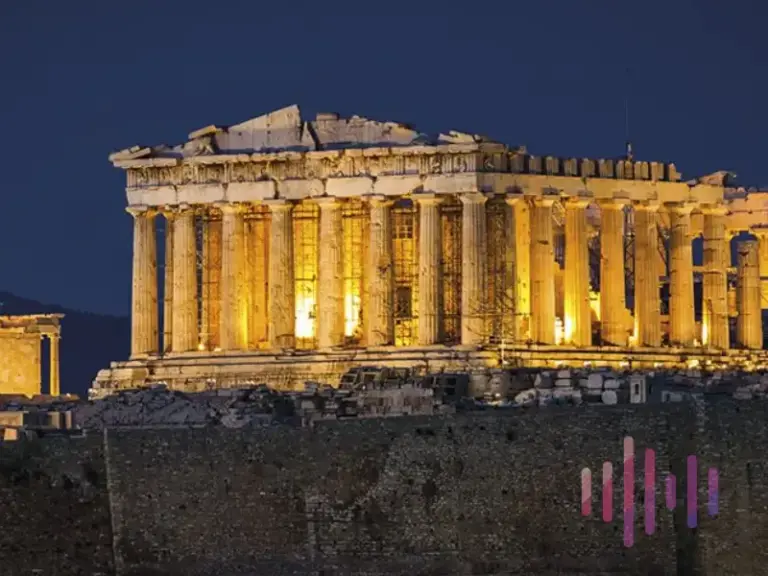
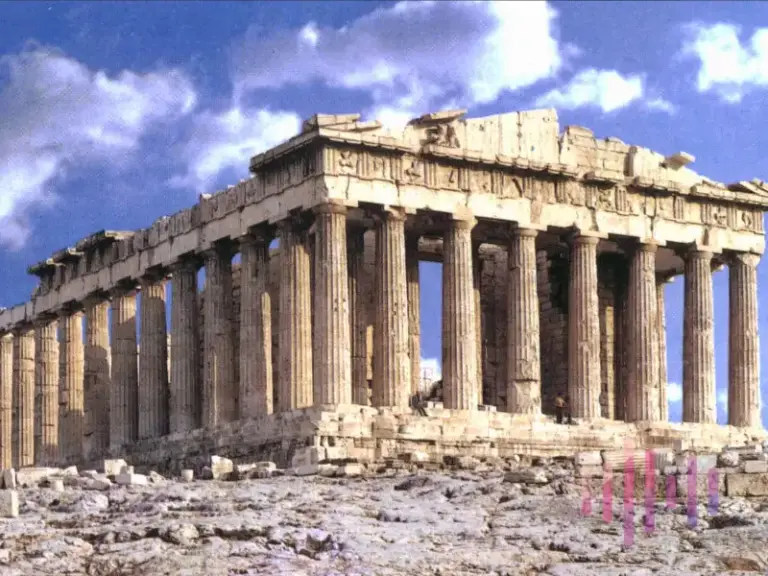 8:00AthensParthenonWelcome to the heart of Athens, where every stone tells a story! Imagine a place where ancient Greece…
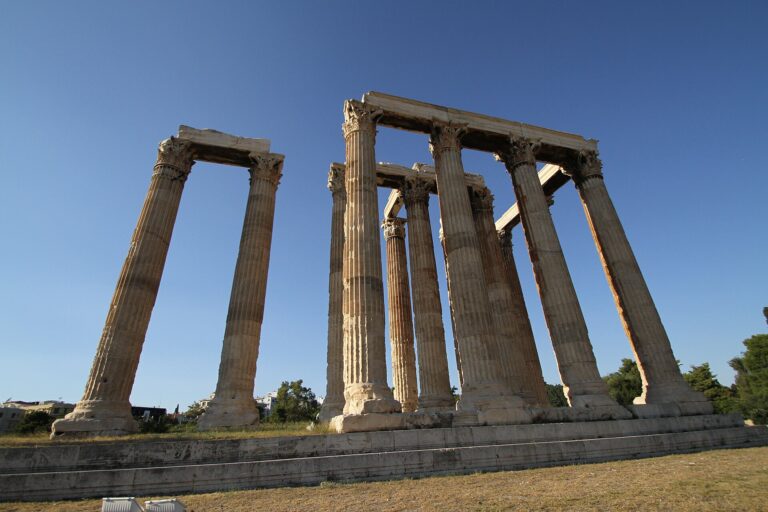 5:26AthensTemple of Olympian ZeusThis free audio guide to the Temple of Olympian Zeus plays straight from your phone — no app,…
 6:59AthensAcropolisUnquestionably, the crown jewel of Athens: the Acropolis. This ancient citadel rises majestically above the city, offering not…