
Discover Athens, Greece
Temple of Olympian Zeus of Athens, Greece Audio Guide
This free audio guide to the Temple of Olympian Zeus plays straight from your phone — no app, no sign-up — while you walk the enclosure. It tells you why it took 645 years to finish, where the column that fell in 1852 is lying and what the two inscriptions that argue with each other on the Arch of Hadrian actually say. Press play before you reach the gate.
You will enjoy the visit, especially if you are interested in Archaeology, Architecture, History, Ruins.
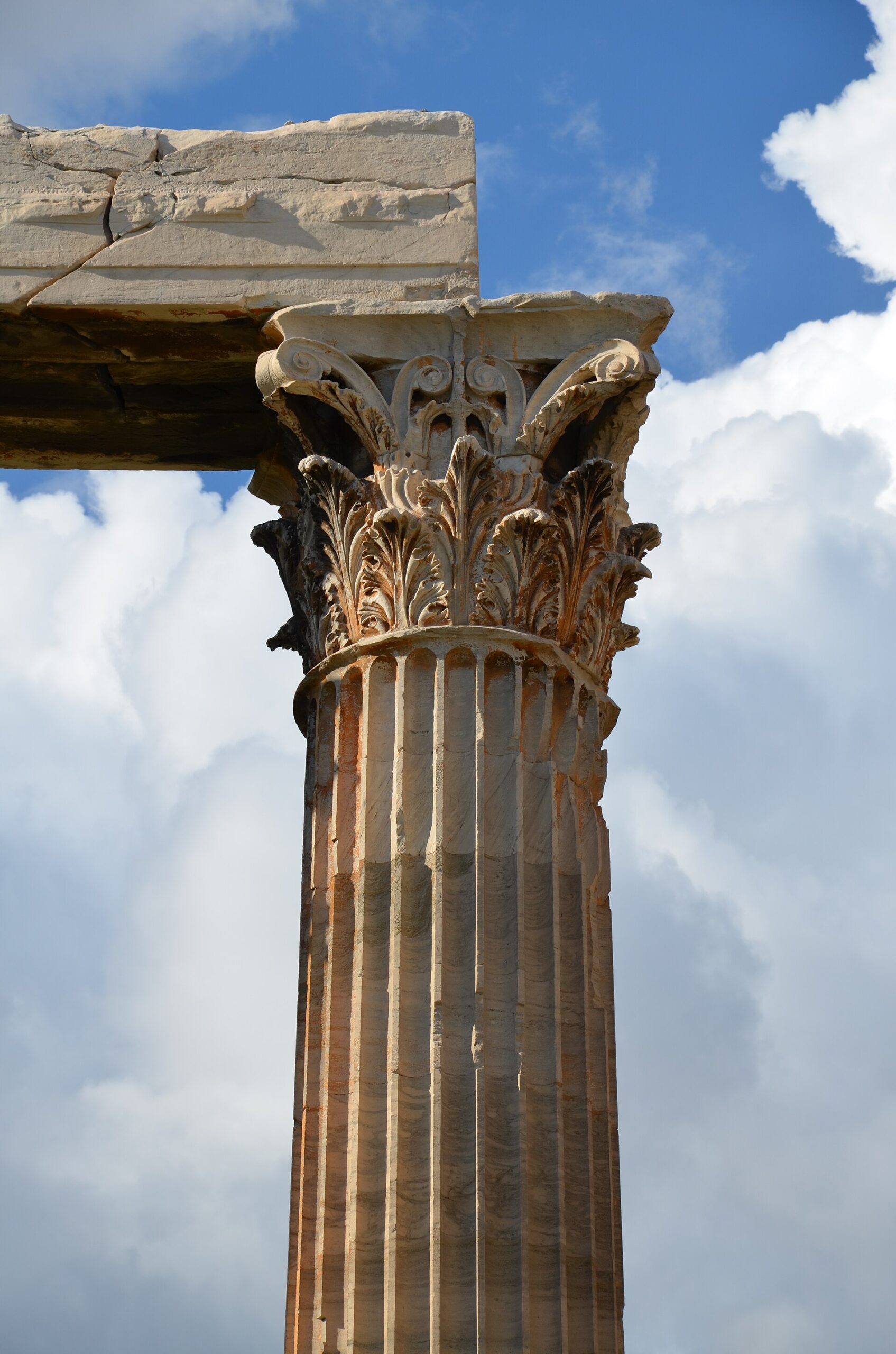
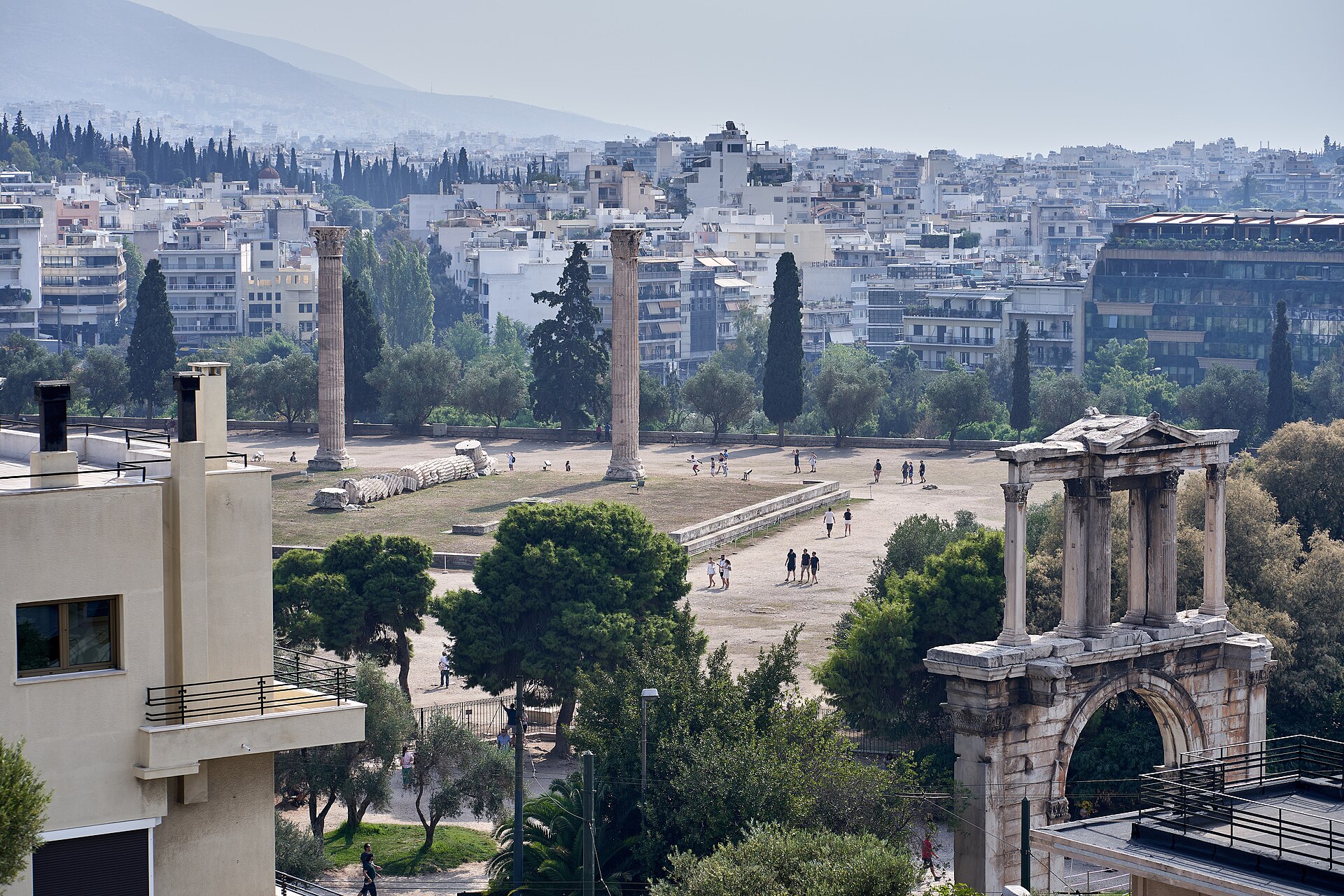
The Temple of Olympian Zeus — the Olympieion — is the largest temple ever begun in Greece, and for most of its life it was also the most famous building site in the ancient world. Fifteen Corinthian columns still stand on a flat open field between the Acropolis and the Ilisos, with a sixteenth lying on the ground exactly where it fell.
This page is the free audio guide, plus the practical information checked against the Greek Ministry of Culture on 13 September 2026 — including the ticket price that most English-language pages still get wrong.
.jpg)
What the audio guide tells you
The guide is free, it plays in your browser, and there is no app to install and no sign-up. Press play at the gatehouse on Vasilissis Olgas Avenue and walk: the stops follow the route you actually take inside the fence.
- The gatehouse and the field — why a temple this size ended up on the flattest, least dramatic ground in Athens.
- The southeast cluster — thirteen columns in one corner, and what the spacing tells you about the floor plan you are standing on.
- The fallen column — the night of 26 October 1852, and why its drums are still lying in a row.
- The capitals — how a Roman architect working for a Syrian king turned a Doric temple into a Corinthian one.
- The Roman baths and the Themistoclean gates — the parts of the enclosure that almost every visitor walks straight past.
- The Arch of Hadrian — the two inscriptions that contradict each other, read out where you can see them.
645 years to finish one temple
Peisistratos the Younger, grandson of the tyrant, began the temple in 515 BC. It reached the level of the crepidoma — the stepped platform — and then the tyranny fell, and the Athenians refused to continue it: a democracy was not going to finish a tyrant’s monument. The site sat half-built for roughly four hundred years. English-language guides usually explain the gap as a lack of funds; the ancient record is that it was a decision.
In 174 BC the Seleucid king Antiochus IV Epiphanes paid to restart it and hired a Roman architect, Cossutius, who threw out the original design: out went Doric columns in poros limestone, in came Corinthian columns in Pentelic marble. Antiochus died in 163 BC and the work stopped again, this time at the entablature. Sulla helped himself to some of the finished columns in 86 BC and shipped them to Rome for the Temple of Jupiter Capitolinus (Pliny, Natural History 36.45).
Hadrian was in Athens in AD 124–125 and decided to finish the job. The official T.A.P. leaflet sold at the ticket office says the temple was dedicated in AD 131; the scholarly consensus is AD 131–132. From 515 BC to AD 131 is 645 years. You will see three different figures in English and nobody explains where they come from, so here they are: 700 (or “over seven centuries”) is simply wrong and comes from rounding a ruin’s reputation rather than its dates — Lonely Planet, several travel guides and Google’s own AI summary all print it; 638 is Wikipedia’s count, and it is defensible if you take the start as roughly 507 BC instead of the 515 BC of the official leaflet; 645 is what the Ministry’s own dates give. Wycherley, writing in GRBS in 1964, put it as “finished six and a half centuries later by Hadrian”, which is the same arithmetic. Inside the cella stood a chryselephantine Zeus in gold and ivory and, beside him, a statue of Hadrian: Pausanias wrote that only the colossi of Rhodes and Rome were bigger. Vitruvius listed the building among the four most celebrated marble buildings in the world.
Fifteen columns standing, and a sixteenth on the ground
The finished temple had 104 columns: two rows of twenty down each long side and three rows of eight across each end. Each one is 17.25 metres tall and 1.70 metres across at the base, and the building measured 110.35 by 43.68 metres at platform level (official T.A.P. leaflet). You will read “17 metres tall and 2 metres in diameter” in a lot of places, and one site even prints 2.6 metres. The English Wikipedia gives both figures on the same page — “17 m high and 2 m in diameter” in one paragraph and “each 17.25 m high and 1.70 m in lower diameter” in another — so a reader citing it can come away with either. The ticket-office leaflet is the precise one: 17.25 and 1.70.
Sixteen columns survive: thirteen still joined at the southeast corner, and three more at the southwest — of which one is down. So the honest count is fifteen upright and one on the ground, and pages that simply say “fifteen columns remain” quietly drop the single most photographed piece of stone on the site.
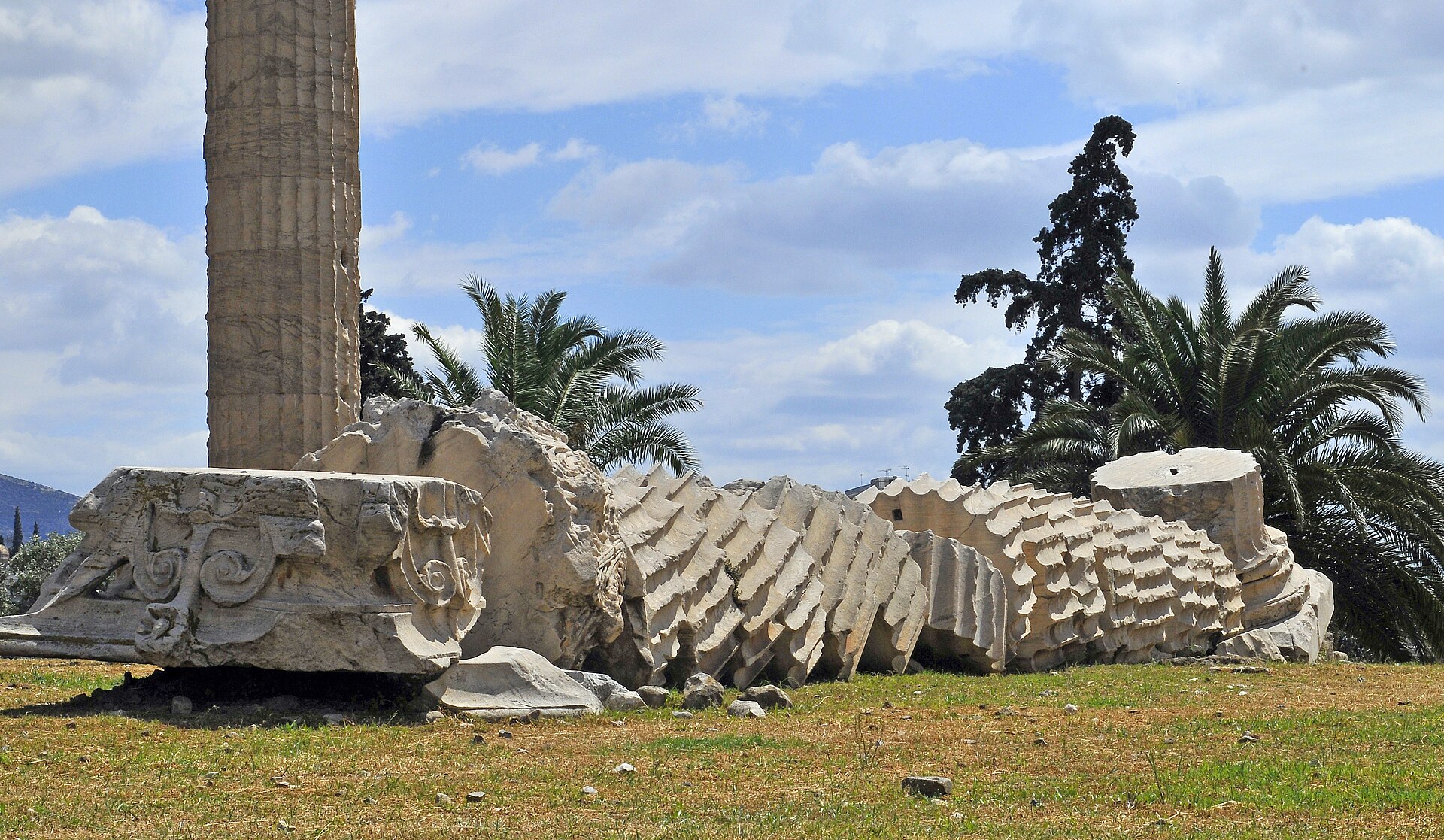

Most English pages will tell you, correctly, that a storm brought it down — and then stop. Here is the rest of the file, which nobody writing in English seems to have opened. The Ephorate of Antiquities of Athens records a thyella — a gale — in October 1852. The Athenaeum of 13 November 1852 and the Illustrated London News of 20 November date it to the night of 26 October 1852 (14–15 October in the Julian calendar then in use in Greece). The best witness is a letter written the following morning by the Finnish traveller Wilhelm Lagus: until last night there were sixteen standing; the middle one of the western three has gone, and so neatly that it looks as though someone laid its drums out in a row. Note that both newspapers are British, and the English-language pages on this monument do not use them. A couple of sites still blame an earthquake; no contemporary or official source mentions one.
The governor who burnt a column for lime, and the hermit who never was
Between 1753 and 1765, when seventeen columns were still standing, an Ottoman governor of Athens had one pulled down to burn for lime to build a mosque, and his superiors fined him heavily for it (Dodwell, reported by Wycherley, GRBS 1964). Earlier still, Cyriacus of Ancona visited in 1436, counted twenty-one columns upright and called the ruin “the palace of Hadrian”: the site was not correctly identified as the Olympieion until the eighteenth century.
And now the story you will be told that is not true. Almost every guide repeats that a stylite hermit lived in a cell on top of the architrave. The tale first appears in 1776 with Richard Chandler, who reports it as hearsay — “you are told that…”. Spon (1678) and Wheler (1682) describe the ruin in detail and mention nothing on top at all. Dodwell (1819) offers it as a guess and records that the actual local legend was about treasure guarded by a man who leapt from column to column. Baedeker (1889) and Murray (1883) turned the rumour into a fact without citing anyone, and that is the version still in circulation — more strongly in English than in any other language, which is only fair, since the Anglophone travel writers are the ones who built it. One popular Athens site even credits the story to Dodwell, who is precisely the author who flagged it as a guess. In 1996 Charalambos Bouras published a paper titled “The so-called cell of the Athenian stylite” and concluded it had never been a stylite’s cell at all; it looked far more like a watchtower. The Ministry’s own Greek-language page calls it a “medieval construction, perhaps an observation post”. The structure was demolished on 7 July 1870. What you can see on a few of the architraves today are modern caps over the iron beams with which Ernst Ziller braced three cracked architraves in 1892.
What else is inside the fence
The ticket buys you a six-hectare archaeological site, not just the columns, and Hadrian’s peribolos wall enclosed 205.85 by 128.72 metres of it. Walking the perimeter you pass Roman baths (AD 124–131), houses in use from the fifth century BC to the second century AD, a basilica of AD 450, the third-century Valerian wall, the Temple of Apollo Delphinios (450 BC), the Court of the Delphinion (500 BC), three gates of the Themistoclean city wall (479–478 BC), the temple of Panhellenian Zeus (AD 131–132) and the temple of Kronos and Rhea. In the tenth to twelfth centuries an entire Byzantine neighbourhood grew on top of all of it, with houses, tanneries and an oil mill.


The Arch of Hadrian is outside the fence — you can see it for free
The Arch of Hadrian stands 18 metres high, 13.50 wide and 2.30 deep, with a central opening of 6.20 metres, in Pentelic marble; the Athenians put it up around AD 131–132. It is outside the ticketed enclosure, which means you do not need an entry ticket to see it — useful to know, and not something the ticket pages tend to mention. Its two inscriptions answer each other across the same gateway: on one face, “This is Athens, the ancient city of Theseus”; on the other, “This is the city of Hadrian and not of Theseus”.
⚠️ Before you plan a photo stop. The Ephorate’s own page still carries an urgent notice, dated 1 April 2026, that the area surrounding Hadrian’s Gate is closed to the public for the “Redevelopment of Vasilissis Olgas Avenue”. Greek press has since reported that the avenue itself reopened in April 2026, so whether the hoarding is physically still up today we cannot confirm — what we can confirm is that the official closure notice has not been withdrawn. No English-language page we checked mentions it at all, and two state the opposite (“accessible 24/7”). The same official page also says the Ilisos (Parilissia) sanctuaries are not visitable at present, which is likewise absent everywhere else.

Opening hours, tickets and getting there in 2026
Everything in this table comes from the live Odysseus record of the Greek Ministry of Culture for the Olympieion (obj_id 2488) and from the Ministry’s admission PDF of 7 May 2025, checked on 13 September 2026.
| What | Checked figure |
|---|---|
| Admission | €20 full · €10 reduced, valid for the Olympieion archaeological site |
| Summer hours | 08:00–20:00, last admission 19:30 |
| Winter hours | 08:00–15:00, last admission 14:40 |
| Autumn taper | 1–15 Sep 08:00–19:30 (last 19:10) · 16–30 Sep 08:00–19:00 (18:40) · 1–15 Oct 08:00–18:30 (18:10) · 16–30 Oct 08:00–18:00 (17:40) |
| Closed | 1 Jan, 25 Mar, 1 May, Easter Sunday, 25 and 26 Dec · Good Friday 12:00–17:00 · Holy Saturday 08:30–15:30 |
| Free admission days | 6 Mar, 18 Apr, 18 May, last weekend of September, 28 Oct |
| Free entry | EU citizens under 25 with ID or passport · non-EU visitors under 18 with passport · visitors with disabilities, plus one companion where the disability is 67% or more |
| Reduced (50%) | Over-65s from Greece or the EU, but only from 1 October to 31 May |
| Entrance | One gate only: the gatehouse on Vasilissis Olgas Avenue |
| Accessibility | Wheelchair accessible “for the most part” from the main gate; accessible toilets; tactile plans and Braille leaflets in Greek and English at the ticket office; assistance dogs admitted |
| Official tickets | The Greek state box office, tickets.hh.gr |
| Contact | +30 210 9226330 · efaath@culture.gr (Ephorate of Antiquities of the City of Athens) |
About that €20, because this is where the English-language web will cost you money. Of the English pages that print a price for the Olympieion, most are wrong, and wrong in the same direction: €8/€4 (three travel sites and Google’s own AI summary), €6/€3 (two more), around €10 (one), or “included in the €30 combo” (Lonely Planet). The €6 is the tariff from the Greek official gazette ΦΕΚ 2916/Β of 31 December 2015, and the reason it will not die is worth knowing: the Ministry publishes two Odysseus records for this same monument, and the older one (obj_id 12863) has been frozen for years with the 2015 prices and an obsolete timetable. Much of the web copied the dead page. The live record (obj_id 2488) and the state box office both say €20 full and €10 reduced, checked on 13 September 2026. Budget from a guidebook figure and you will be around €14 per person short.
On the €30 combined ticket. Several widely-read pages — Lonely Planet, a visitor guide published in April 2026, and a couple of resellers that still list all seven sites — tell you the Olympieion is covered by a €30 combined Athens ticket valid five days; one site inflates it to €36, a figure that has never existed. It is gone. The package is described in the 2015 gazette, but the live Ministry record sells only a single-site ticket and says it is valid “for the Olympieio archaeological site”, and the state box office lists no package product at all — we checked both today. The quickest way to see that €30 is stale without reading any regulation: the Acropolis on its own now costs €30. Two English sites date the abolition to 1 April 2025; neither cites an official announcement, so treat the date as unconfirmed even though the abolition itself is not.
On how long to allow. No official source states a recommended duration — not the Ministry record, not the admission regulation, not the state box office. The English-language figures run from 20 minutes to two hours, and none of them admits to being a guess. Ours is a guess too, and we will say so: 30 to 45 minutes if you have come for the columns, 75 to 90 if you walk the whole enclosure — the Roman baths, the basilica of AD 450, the Valerian wall and the three Themistoclean gates. That is the whole reason the published range is so wide: those are not the same visit. The ground is flat and you can cover all of it without a single step.
Two fare details the English pages get wrong. The over-65 reduction is not year-round: the regulation gives 50% to over-65s from Greece or the EU only between 1 October and 31 May. And the widely repeated “free on the first Sunday of every month from November to March” does not appear in this monument’s official record, nor in the Acropolis or Ancient Agora records, though it does appear on other Odysseus pages — a conflict inside the Ministry’s own site, so we will neither promise it nor deny it.
On getting there. The Ministry lists only “Metro, bus, Tram” and publishes neither a station name nor a line number. “Akropoli, line 2” comes from third parties, not from the official source. What is official is that there is a single entrance, the Vasilissis Olgas gatehouse.
You do not have to pay for audio here. Resellers sell audio tours of this site from around $30. Meanwhile the official box office page states that “Access to Digital Guide app is included” with the entry ticket, the Ministry launched its own free audio-guide app in March 2026, and there are 19 marble plaques with QR codes installed around the site. None of the paid listings mentions any of that. The guide on this page is free too — and it is the one that will tell you what your own ticket actually costs.
Nearby, with their own free audio guides
Reading this in Spanish? The same guide, written for a Spanish-speaking visitor and narrated in Spanish, is at Templo de Zeus Olímpico en vozviajera.com.
The Acropolis is a ten-minute walk northwest, and the Parthenon stands on top of it: both have their own free audio guide on this site. Note that the Acropolis is ticketed separately, and on its own it costs more than the Olympieion.


Frequently asked questions
How much does it cost to visit the Temple of Olympian Zeus?
€20 full price and €10 reduced, checked on 13 September 2026 against the Greek Ministry of Culture’s live record for the site and the state box office at tickets.hh.gr.
Is the Temple of Olympian Zeus included in the Acropolis combined ticket?
Not according to any current official source. The live Ministry record sells only a single-site ticket and says it is valid “for the Olympieio archaeological site”; the state box office sells no package either.
How many columns are left?
Sixteen: fifteen standing and one lying on the ground since the gale of 26 October 1852.
Can I see the Arch of Hadrian without a ticket?
Yes — it stands outside the fence. But its immediate surroundings have been closed since 1 April 2026 for the Vasilissis Olgas works.
Is it worth visiting if I have already seen the Acropolis?
It is a different kind of visit: flat, open, quick, and it is the one place in Athens where you can stand inside the footprint of a temple that took 645 years to finish. If you only have one ticket to spend, spend it on the Acropolis.
Keep discovering Athens, Greece with free audioguides.
Discover Temple of Olympian Zeus with our tourist audio guide
Do you really want to get to know Temple of Olympian Zeus during your trip? Our free tourist audio guides on audioguidetravel.com are the best way to explore this incredible place. Learn about its history, anecdotes, hidden details, and much more as you leisurely stroll through its streets and corners.
Our expert guides will accompany you to show you the highlights, telling you curiosities and secrets that only a local would know. You’ll feel like you have a friend by your side revealing all the secrets.
Enjoy visiting Temple of Olympian Zeus at your own pace, without rushing, to truly appreciate its beauty and charm. With our free audioguides, you won’t miss any important details.
Don’t miss out on the opportunity to discover Temple of Olympian Zeus in-depth! Our free tourist audio tours on audioguidetravel.com are the best way to appreciate the magic of this place. Use them now and have an unforgettable experience.
FAQ
How do the free audio guides work?
Our audio guides work through the website audioguidetravel.com; you don’t need to download any app. Just follow the instructions on the website to guide you through Temple of Olympian Zeus while listening to our experts’ explanations.
Can I take the tour at my own pace?
Of course! Our free audio guides are designed so that you set the pace. You can pause, rewind, or listen as many times as you want without missing a detail. By visiting Temple of Olympian Zeus your way, you’ll enjoy it even more.
If I'm in a group, can we use the same audio guide?
Yes, our website allows sharing the same free audio guide among multiple devices. This way, you can visit Temple of Olympian Zeus as a group or family, listening to the explanations simultaneously. The quickest way to do this is to share the link via WhatsApp, email, or any method you like. I’ve included some buttons below for you to do that now.