
Park Güell audio guide: free, hours and tickets
Free audio guide in English · no app, no sign-up
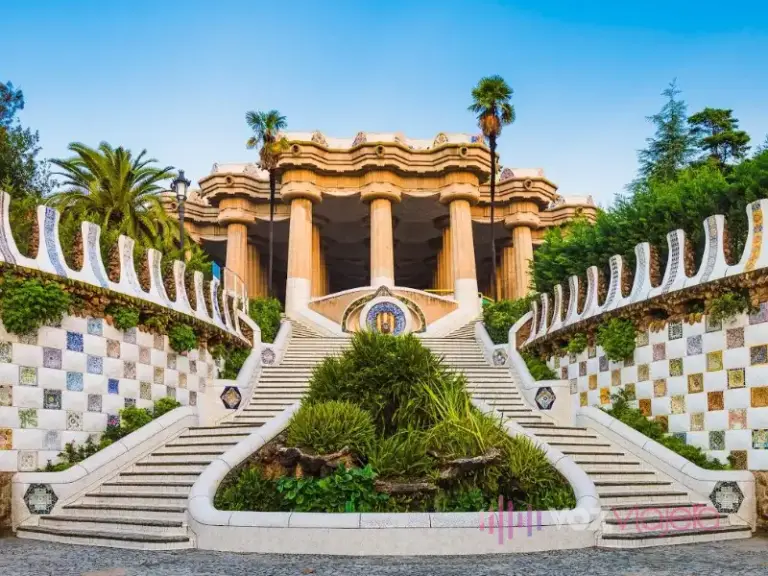
Park Güell is the estate Antoni Gaudí designed for Eusebi Güell on the hillside above Barcelona, begun in 1900 and a public park since 1926. The 6-minute audio takes you from the 2 entrance pavilions and the mosaic dragon to the Hypostyle Room, the great square with its winding bench, the viaducts and the Hill of the Three Crosses at the top.
 Audio guide
Eusebi Güell commissioned Antoni Gaudí to design a residential estate for wealthy families on this hillside above Barcelona; works began in 1900, and only 2 of the 60 planned houses were ever built. The City Council agreed to buy it in 1922 and opened it as a public park in 1926. This free audio guide in English, 6 min 11 s long, plays on this page with no app: it tells the story first, then the stops from the main gate up to the Three Crosses.
What this free Park Güell audio guide covers
The audio lasts 6 min 11 s, in English, and plays straight from this page, with no app and no sign-up. These are its parts and the minute where each one starts, so you can drag the bar of the player to the one in front of you:
- 0:00 · Welcome, and how the guide follows the park from the main gate on Carrer d’Olot upwards.
- 0:19 · The story of the estate: 60 planned plots, only 2 houses built, bought by the city in 1922 and opened as a park in 1926.
- 1:42 · The 2 entrance pavilions of the porter’s lodge, their trencadís roofs and the palm-leaf gates that came from Casa Vicens.
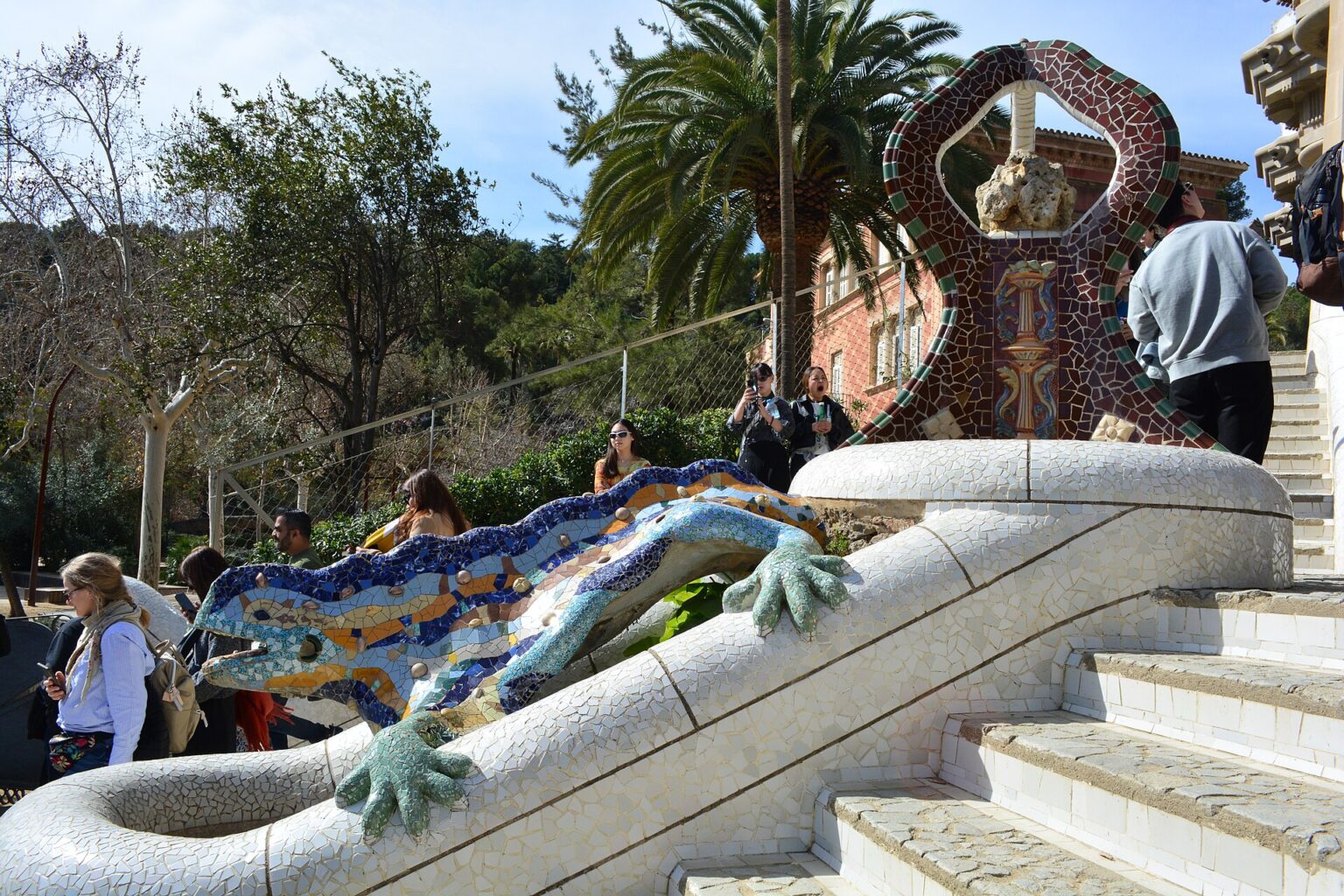
- 2:13 · The Dragon Stairway: the goblins on the first landing, the coat of arms of Catalonia and the mosaic dragon, with a question.
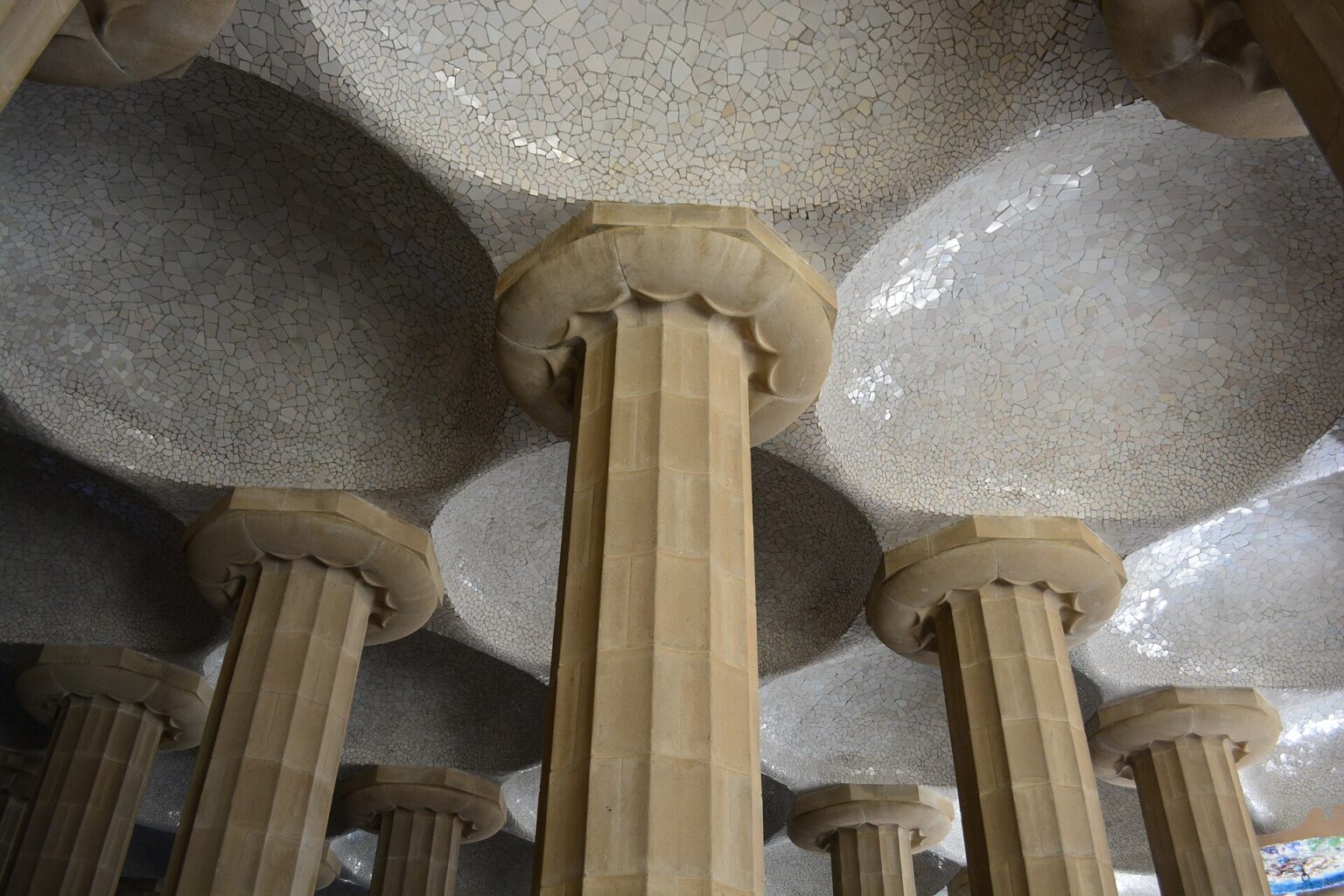
- 2:47 · The Hypostyle Room, designed as the market: 86 fluted columns and Jujol’s mosaics on the ceiling.
- 3:28 · Why the dragon has its mouth open: the rainwater tank under the square.
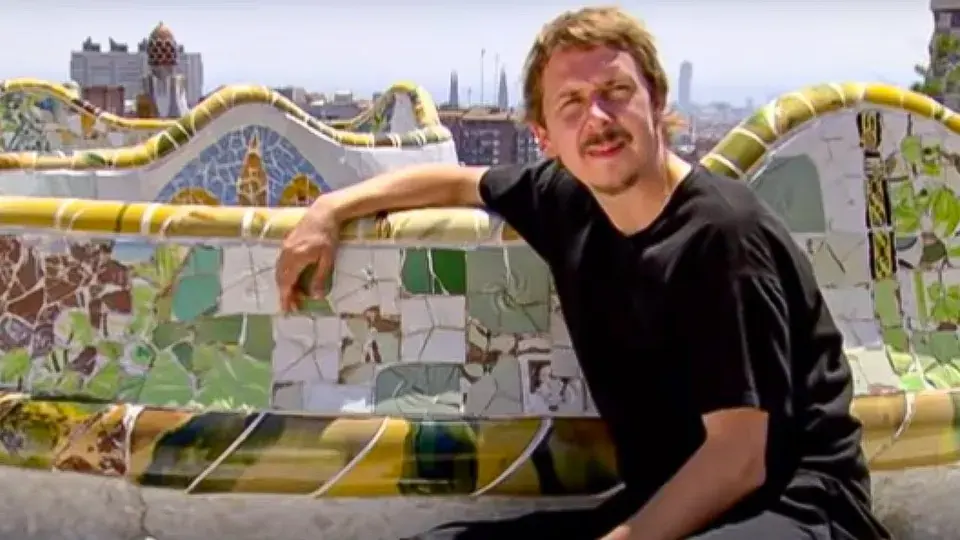
- 3:53 · Nature Square, the old Greek Theatre, and its winding bench, finished in 1914.
- 4:25 · The Laundry Room Portico, a wave of stone on leaning columns.
- 4:42 · The paths and viaducts: 3 bridges 5 m wide, built with stone from the park itself.
- 5:05 · The Hill of the Three Crosses, the highest point of the park, at 182 m.
- 5:23 · The Gaudí House Museum, where Gaudí lived from 1906 to 1925, and the Trias house.
From minute 0:19 to minute 1:42 it tells the story of the estate. In short, as the park tells it on its official history page: in 1900 Eusebi Güell gave Antoni Gaudí the job of designing a residential estate for wealthy families on the Muntanya Pelada, the «bare mountain», with views over the sea and the city, modelled on British residential parks, which is why it carries the English word «park». Some 60 plots were planned, but hardly any buyers came, and the works stopped in 1914 with only 2 of the 60 houses built. Gaudí himself moved in 1906 into the show house designed by his assistant Francesc Berenguer, today the Gaudí House Museum. Eusebi Güell died in 1918, the City Council agreed to buy the estate on 26 May 1922 and opened it as a municipal park in 1926. It has been UNESCO World Heritage since 1984.
The order is the one you walk from the main entrance on Carrer d’Olot. The park’s recommended routes take in all the signposted points of the monumental zone, whichever entrance you use, so if you come in another way, start with the stop in front of you and use the times above. To listen without mobile data, download the MP3 (5.9 MB) to your phone before you go: it is the same audio as the player, and once saved it plays with no connection.
Tickets, time slots and prices
Entry to the monumental zone works by time slot, with a cap of 1,400 visitors per hour, and the park advises buying online and in advance on its official website, up to 3 months ahead and up to 7 tickets per purchase. Each ticket carries a name that must match your ID, which staff may check at the gate. You can show the QR code on your phone, with no need to print it. You have 30 minutes from the time on your ticket to go in: a 09:30 ticket is valid until 10:00. Once inside you can stay as long as you like, but there is no re-entry. Bookings cannot be cancelled; the date and time can be changed up to 1 day before, if there is space.
- General ticket: €18.
- €13.50 for children aged 7 to 12, visitors over 65 and Targeta Rosa Reduïda holders, and for the companion of a visitor with disabilities.
- €14.50 with a MUHBA or Ruta del Modernisme ticket.
- Free for children up to 6, who still need a ticket, visitors with disabilities and Targeta Rosa holders.
The ticket covers all 12 hectares of the park, with its monumental, forest and panoramic areas, and also lets you into the Casa del Guarda, the porter’s lodge at the Carrer d’Olot entrance, which has its own timetable and limited capacity. It does not include the Gaudí House Museum. Proof of any discount is needed when you buy, and all prices include 21% VAT.
Opening hours and how long to plan
The park is open every day of the year. These are the time slots on sale, as published by the park and checked on 25 October 2026:
- 25 October to 31 December 2026: first slot 09:30, last slot 17:30.
- From 1 January 2027: the park has not published its slots yet.
From 07:00 to 09:30 and from 18:00 to 22:00 the park is kept for neighbours and Passi Verd bookings, the free same-day pass for registered Barcelona residents, and there are no tourist visits. The park suggests an architectural route of about 50 minutes past its best-known sites; add the 6 min 11 s of this guide and the walk up from the metro.
Getting there, accessibility and 1 tip
Take metro L3 to Lesseps and walk about 20 minutes to the entrance on Avinguda del Santuari de Sant Josep de la Muntanya, which has escalators. Buses H6 and D40 stop on Travessera de Dalt, 10 minutes’ walk away; from there, use the same escalator entrance or Carrer de Larrard. Driving is not a good idea: most parking around the park is for residents only.
Irregular paths and steep ramps make parts of the park hard going with reduced mobility. The park recommends the Carretera del Carmel entrance, at number 23, where 3 free parking places for accredited vehicles are kept in the coach car park opposite the gate. Wheelchairs can be booked in advance from the Visitor Support Service (parkguell@bsmsa.cat), and the free official app shows the most accessible areas and how to reach them. There are public toilets at the Carretera del Carmel gate and next to Nature Square.
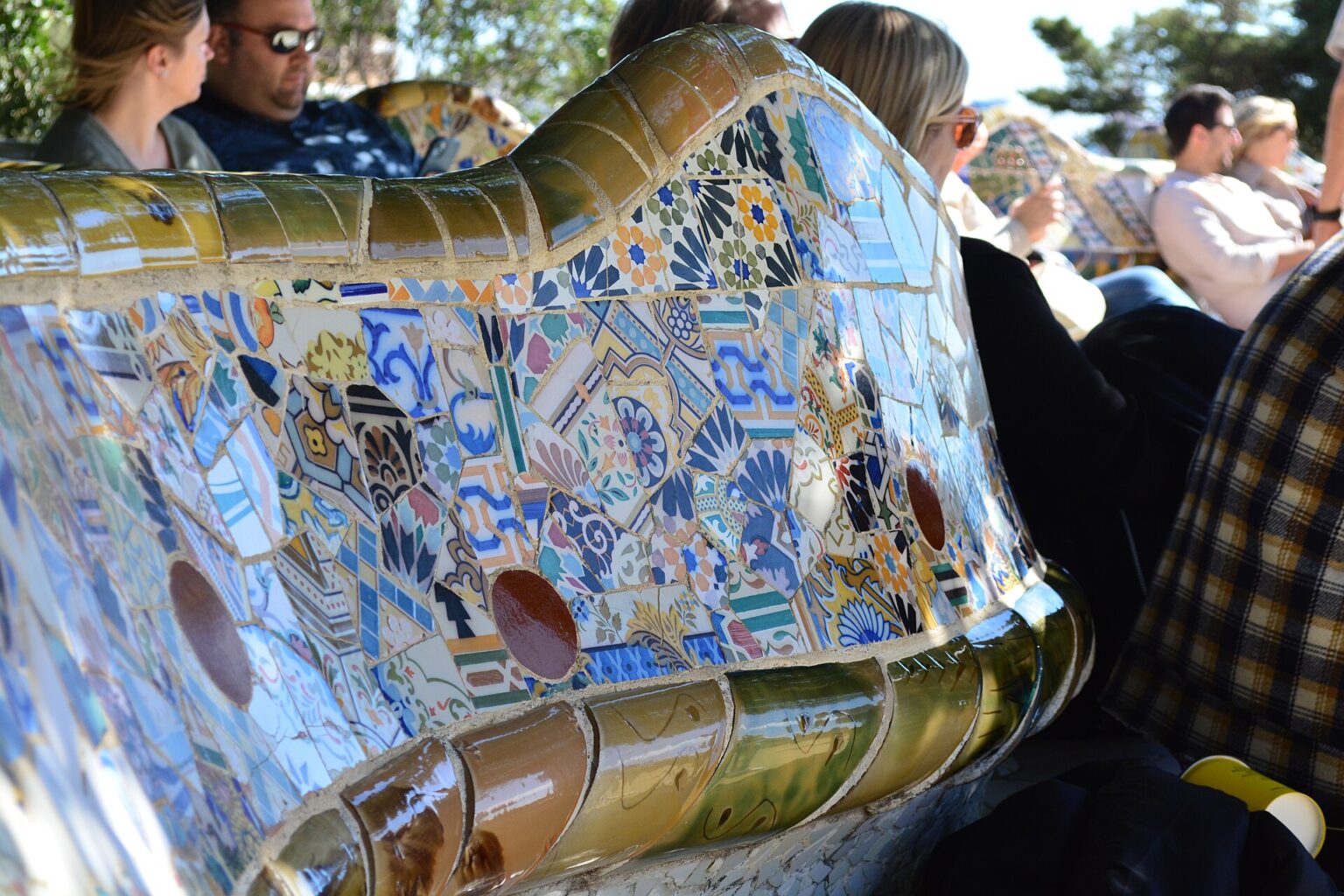
The tip: play the welcome and the story of the estate, up to minute 1:42, on the walk up from the metro, and keep the stops for inside. The audio follows the park from the main gate on Carrer d’Olot upwards: if you go in by another gate, drag the bar to the stop in front of you. Leave a margin: with 20 minutes on foot and a 30-minute window to go in, a slot is easy to miss. Bring water, as the park itself advises, above all in the hottest hours.
More Gaudí audio guides in Barcelona
Casa Vicens is 1.1 km away in a straight line, and Lesseps on L3 serves both. The Sagrada Familia is 2.1 km away and La Pedrera (Casa Milà) 2.2 km. Park Güell, Casa Vicens, La Pedrera and the Nativity façade and crypt of the Sagrada Familia all belong to the UNESCO site «Works of Antoni Gaudí». Each one has its own free audio guide, and you will find the rest in all our Barcelona audio guides.
 Free audio guideSagrada Familia
 Free audio guideLa Pedrera (Casa Milà)
If your trip goes on to Madrid or London, both cities have a great park with its own free audio guide. Retiro Park is 125 hectares and more than 15,000 trees next to the Puerta de Alcalá, a UNESCO World Heritage Site since 2021, with rowing boats on its lake. Hyde Park is 142 hectares in the middle of London, around the Serpentine lake, with Speakers’ Corner in one corner. Both are free to enter:
 Free audio guideRetiro Park, Madrid
 Free audio guideHyde Park
Where to find it
FAQs
How do the free audio guides work?
They play right here on audioguidetravel.com, with no app to download and no sign-up. Press play and listen as you walk round: a phone and a pair of headphones are all you need. The audio streams from this page, so you’ll need mobile data or Wi-Fi.
Can I take the tour at my own pace?
Of course! You set the pace: pause whenever you like, jump back or forward 15 seconds, or tap the bar to jump to any point, and listen as many times as you want so you don’t miss a thing.
If I'm in a group, can we use the same audio guide?
Yes. The same free audio guide opens on as many phones as you like, so you can go round together as a group or with your family, each person at their own pace and with their own headphones. The quickest way is to send the link via WhatsApp, Telegram or however you like: the buttons just below let you share it right now.
Visitor information
As of 18 Oct 2026- Opening hours
- Every day. First slot 09:30, last slot 17:30 from 25 October to 31 December 2026.
- Tickets
- €18 · €13.50 ages 7-12 and over 65 · free up to 6
- Time needed
- Architectural route about 50 min; stay as long as you like, but there is no re-entry
- Getting there
- Metro L3 to Lesseps, then about 20 minutes on foot to the escalator entrance
- Accessibility
- Use the Carretera del Carmel entrance; steep ramps in parts, wheelchairs bookable in advance
- Tip
- Download the MP3 before you go and it plays inside the park with no data or Wi-Fi
- Official website
- parkguell.barcelona
Nearby
More free audio guides in Barcelona
 7:57BarcelonaMontjuïc: free audio guide, castle, cable car and fountainFree audio guide to Montjuïc in Barcelona, in English: just under 8 minutes on the hill’s history, the…
 7:51BarcelonaTibidabo: free audio guide, tickets and viewsFree audio guide to Tibidabo in Barcelona, in English: just under 8 minutes on the name of the…
 5:43BarcelonaPalau de la Música Catalana: free audio guide and ticketsFree audio guide to the Palau de la Música Catalana in Barcelona, in English: just under 6 minutes…