
Ancient Agora of Athens: free audio guide, hours and tickets
Free audio guide in English · no app, no sign-up
This free audio guide to the Ancient Agora of Athens plays straight from your phone — no app, no sign-up — while you walk the site. It tells you which gate is open while the main entrance is rebuilt, where the 50 men who ran Athens by rota ate and 17 of them slept every night, and why the Temple of Hephaestus is still roofed when everything around it is foundations. Press play at the gate.
 Audio guide
Before you go in
The few things that change your visit.
- Entry and exit are through the Thiseio Square gate, not Adrianou 24, since 1 July 2025
- Between 1 November and 31 March it closes at 16:30, last entry 16:10
- €20.00 covers the site and its museum — and from outside the EU you pay it in full from age 18
- The upper floor of the Stoa of Attalos and the Church of the Holy Apostles have been closed since 1 November 2025
- Do the flat ground first and climb to the Temple of Hephaestus last
On this page
- What the audio guide tells you
- The gate that is open: Thiseio Square, not Adrianou 24
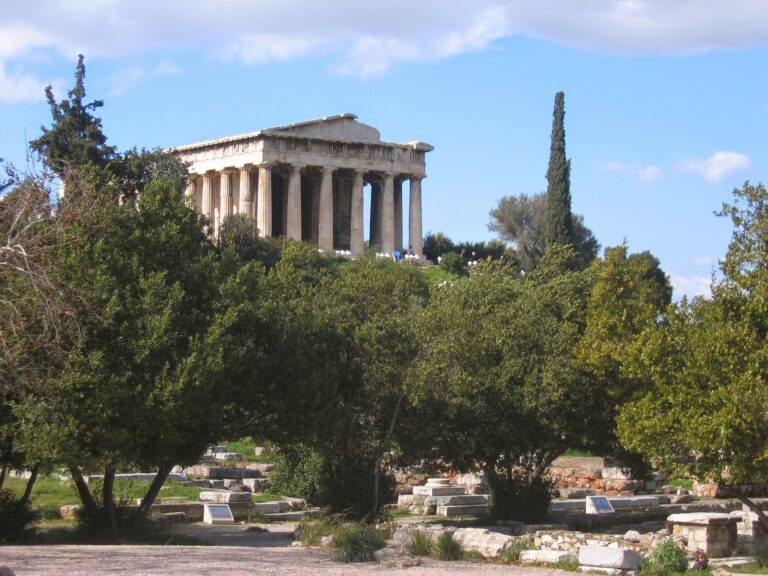
- The Temple of Hephaestus, whole on the hill
- The Stoa of Attalos and the museum inside the site
- Where the democracy actually worked: the Tholos and the Bouleuterion
- The giants, the church and 25 centuries on the same ground
- Opening hours, tickets and when to go
- Where to find it
The Ancient Agora of Athens was the city’s public square: its market, its council chambers, its law courts and its meeting ground, on the flat land below the Acropolis. Inside the fence stand the Temple of Hephaestus, still whole on its hill, and the Stoa of Attalos, which houses the site museum. One €20.00 ticket covers the lot, and this page is its free audio guide.

What the audio guide tells you
It plays in your phone’s browser, with no app and no sign-up. Press play at the gate: the route runs along the Panathenaic Way from north to south, and it leaves the climb to the temple for the end, when you already know what you are looking down on.
| The Thiseio Square gate | Which door is in use, and why it pays to do the flat ground first and climb last. |
| The Panathenaic Way | The road that cuts diagonally across the square, the one the procession for Athena climbed to the Acropolis. |
| The Stoa of Attalos | The 2-storey arcade a king of Pergamon paid for, rebuilt from the foundations up in the 1950s as the site museum. |
| The Tholos and the Bouleuterion | The round building where the 50 men on duty ate and 17 of them slept, next to the council’s hall. |
| The Monument of the Eponymous Heroes | The base of 10 bronze statues that worked as the city’s noticeboard: call-up lists, draft laws, summonses. |
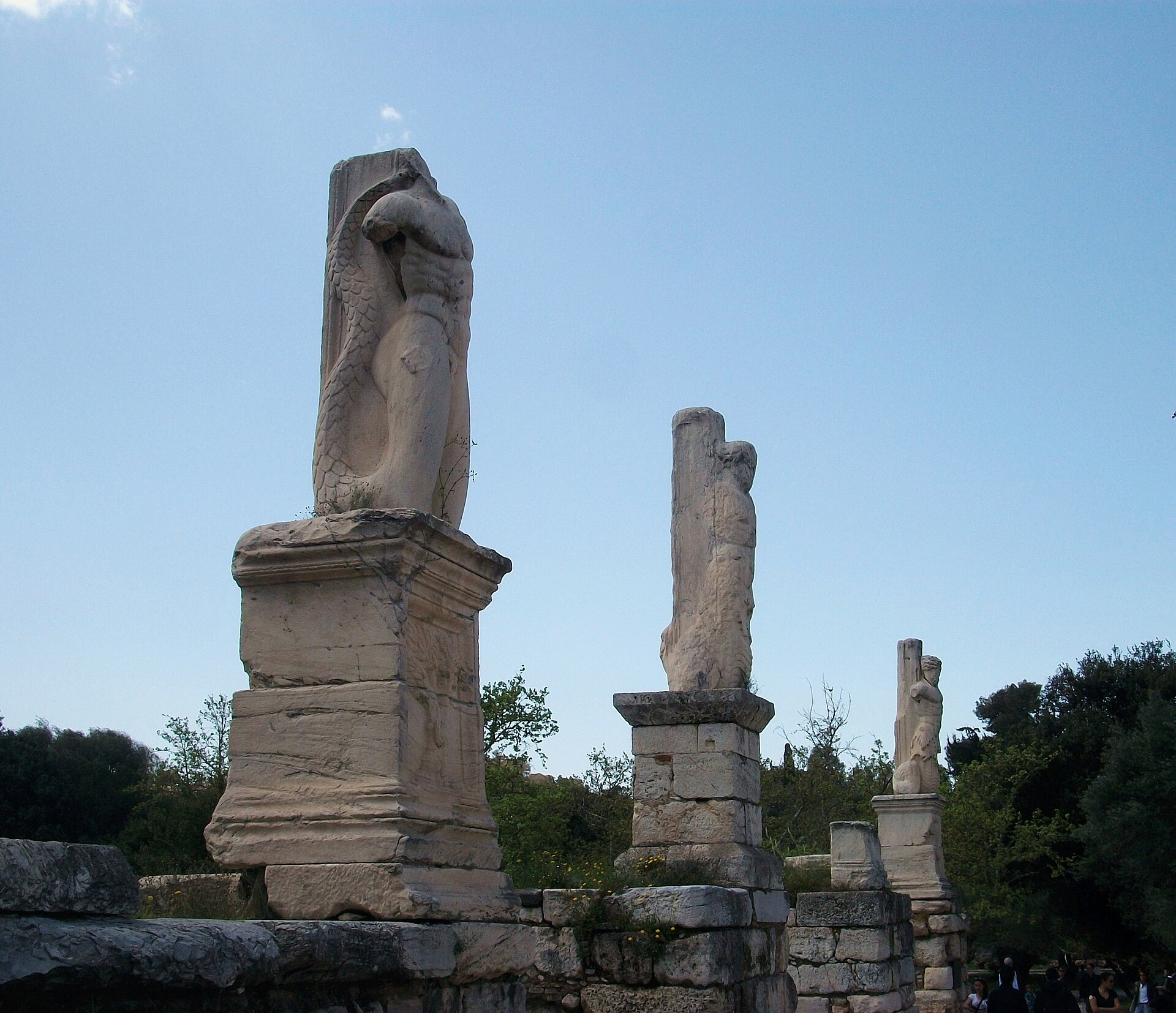
| The giants of the Odeon of Agrippa | The 3 carved pillars in the middle of the site, and the building they are the last piece of. |
| The Church of the Holy Apostles | The only medieval building left inside the Agora, and what stood here between antiquity and the digs. |
| The Temple of Hephaestus | The climb, why this temple is still roofed when the rest is foundations, and what its carved panels say. |
The gate that is open: Thiseio Square, not Adrianou 24
The site’s address is Adrianou 24, and that is where the main entrance stands, but it is being rebuilt: from 1 July 2025, and until the works are finished, visitors enter and leave through the gate on Thiseio Square — Jacqueline de Romilly Square. Metro Thiseio (line 1) is about 5 minutes’ walk from that gate, and Monastiraki (lines 1 and 3) about 11; buses 025 and 026 stop at Monastiraki.
That changes where your visit starts: the Thiseio gate puts you on the west side, at the foot of the temple hill. Go down into the flat ground first, walk it, and save the climb for last.
Mind which agora you are heading for. Athens has 2, about 5 minutes’ walk apart, each with its own gate and ticket: this is the classical one, and the Roman Agora in Plaka, around the Tower of the Winds, is the later market square. The Acropolis is a third site up the slope, with its own €30.00 ticket.
Both floors of the Stoa of Attalos are wheelchair accessible and there is a lift, which the wardens operate on request; the information desk has tactile plans and braille leaflets in English and Greek. To reach the Temple of Hephaestus area by wheelchair you use the Thiseio Square gate, off Apostolou Pavlou street, ringing ahead on +30 210 3214824.
The Temple of Hephaestus, whole on the hill
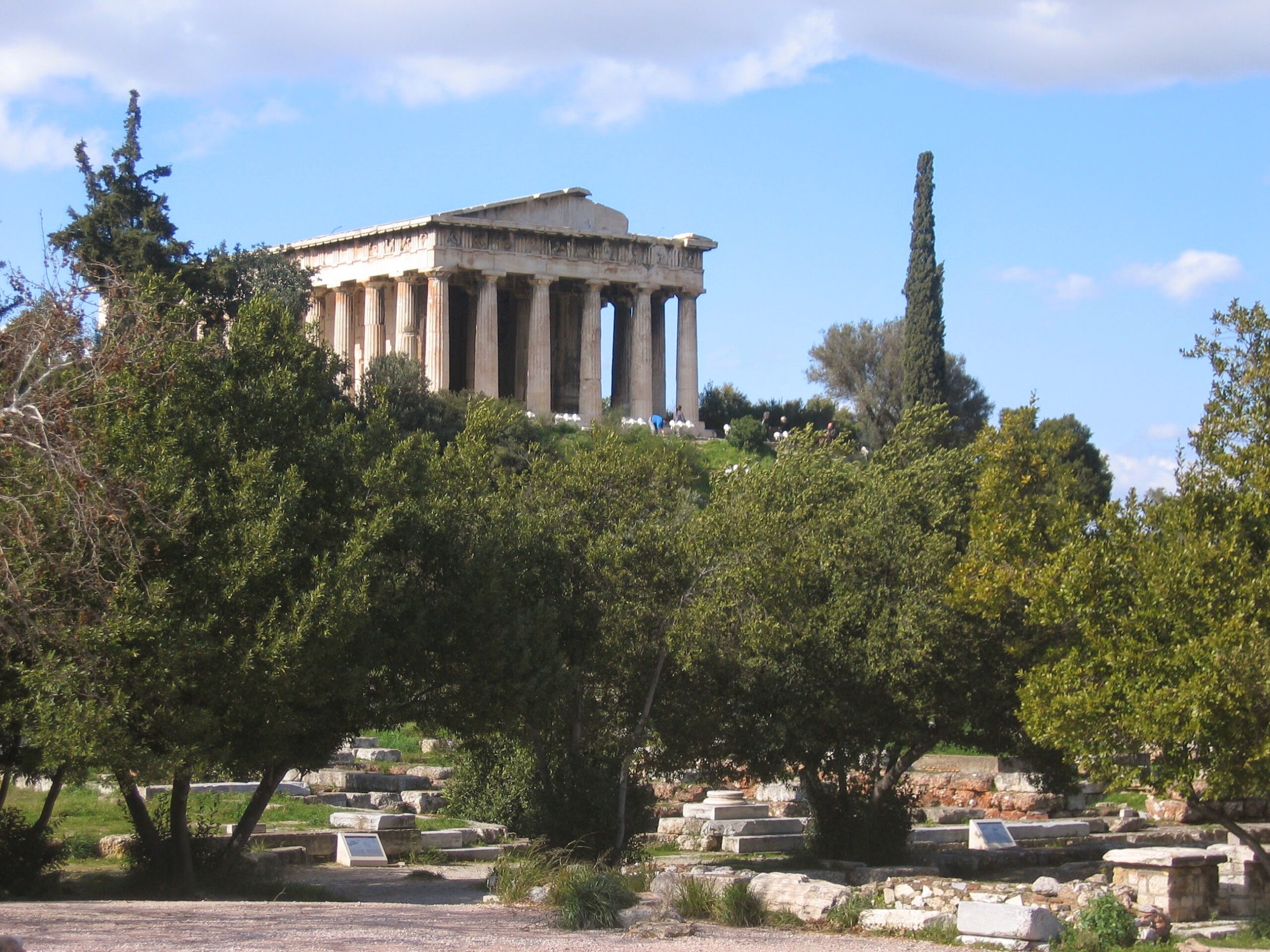
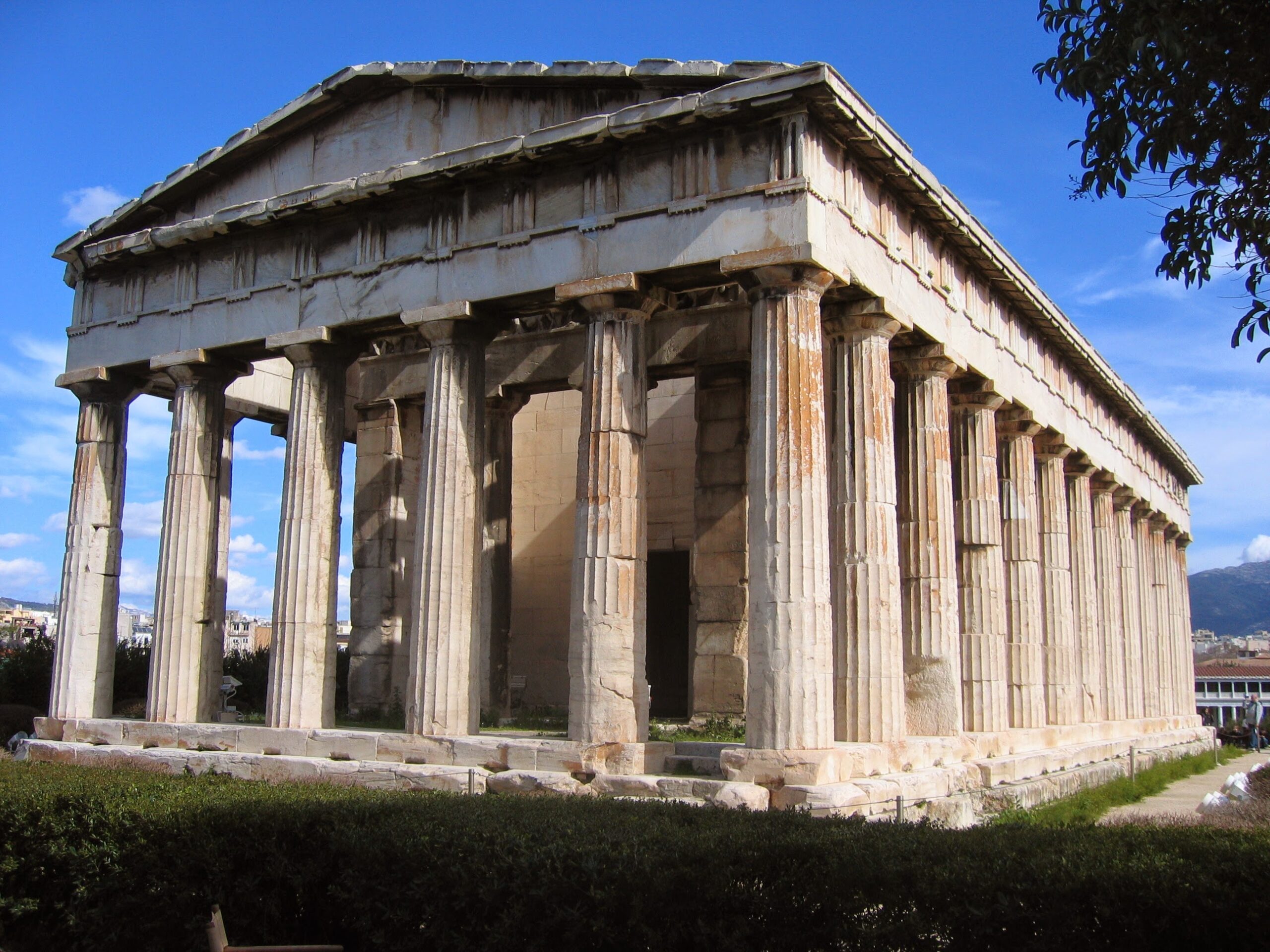
It stands on top of Agoraios Kolonos, the hill that closes the Agora on its western side, and you climb to it on the same ticket. It went up between 460 and 420 BC as a temple to 2 deities: Hephaestus, god of fire and patron of metalworkers, and Athena Ergane, patron of potters and craft. The excavation backed that up in the best way available — metalworking workshops came out of the ground all round the hill.
It is Doric, with 34 columns of Pentelic marble, and it is still standing for one very practical reason: in the 7th century it became the church of St George Akamates and stayed in use as a church until Greek independence. A building with a use is a building nobody quarries for lime.
The carved panels explain its other name: the 10 metopes facing the Agora tell 9 labours of Herakles, and on the north and south sides there are 4 deeds of Theseus — which is where Theseion comes from.

The Stoa of Attalos and the museum inside the site
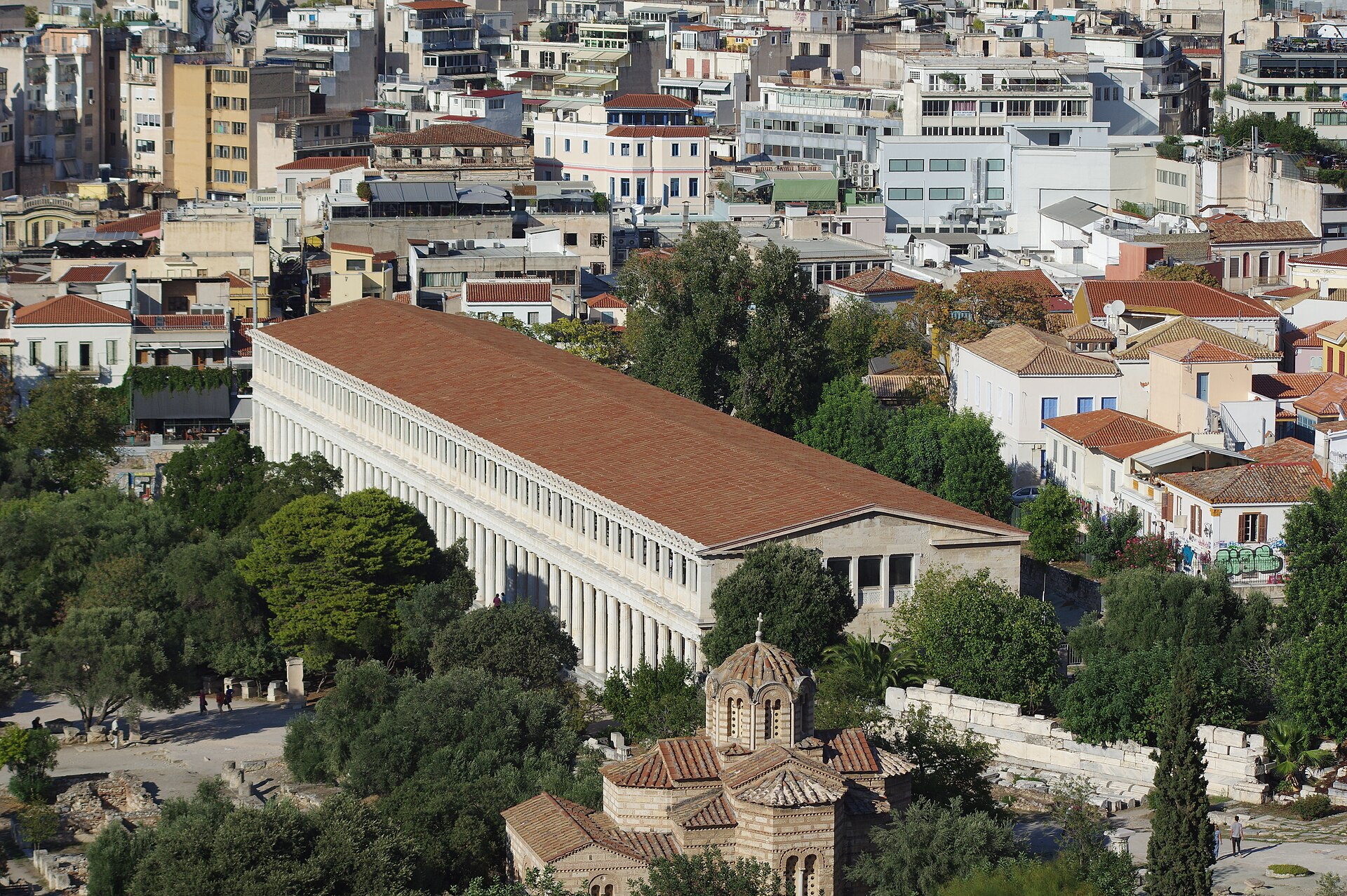
The Stoa of Attalos went up between 159 and 138 BC, a gift from Attalos II, king of Pergamon — the Ministry describes it as a king’s donation “to the cradle of philosophy”. It was a 2-storey arcade with shops at the back. What you see today is not a ruin, and it is not the ancient building either: it is a reconstruction, built between 1953 and 1956 by the American School of Classical Studies so that the site would have a museum on its own ground.
Inside is the reason to go in even on a hot day: the hardware of the democracy, dug out of the square outside. A marble fragment of a kleroterion, the machine that drew jurors by lot. The clay water clock that timed the speeches, the bronze ballots jurors voted with, and potsherds with the names of 5th-century politicians scratched on them — the ballots of ostracism. And a marble stele carrying the law against tyranny that the Athenians passed in 336 BC.
Plan round 2 closures: since 1 November 2025 the display on the upper floor of the Stoa and the Church of the Holy Apostles are closed to the public. What is open is the ground-floor gallery, the portico between the columns, where the sculpture and most of the cases are; the church you see from outside, which is where its interest is anyway.

Where the democracy actually worked: the Tholos and the Bouleuterion
The most interesting part of the Agora is the part that shows worst, because only the foundations are left. Along the west side stood the buildings where Athens was actually run.
The Bouleuterion was the hall of the Boule, the council of 500 citizens drawn by lot every year, 50 from each of the 10 tribes. It prepared the motions that the assembly of all citizens then voted on. Next to it, the round Tholos holds the hardest idea in Athenian democracy to believe. The 50 prytaneis, the council’s executive committee, had their seat here for their turn of 35 or 36 days. They ate here, and 17 of them slept inside every night, so that the city was never, at any hour, without someone answerable on duty.
Opposite stood the Monument of the Eponymous Heroes: a long base carrying the 10 bronze statues of the heroes the tribes were named after, and the city’s noticeboard. Under your own tribe’s statue went the call-up lists, the draft laws and the summonses — if you wanted to know whether you were going to war, you came here and read.
The giants, the church and 25 centuries on the same ground
In the middle of the site stand 3 colossal carved pillars: giants with serpent tails and tritons with fish tails. They are what is left of a monumental façade raised over the ruins of the Odeon of Agrippa, the concert hall that Marcus Vipsanius Agrippa gave the Athenians around 15 BC.
The Church of the Holy Apostles was built shortly before the year 1000, and it is the only medieval monument surviving inside the Agora, with a dome and an outside skin of worked ceramic. It is the only one because for centuries there was a neighbourhood here, and to uncover the Agora about 400 modern buildings had to come down. The systematic excavation began in 1931, and it is still going.
One object sums up the whole place: a marble post inscribed “I am the boundary stone of the Agora”, from about 500 BC, which marked where public space began. It came out of the ground beside a house full of cobbler’s nails and a cup with the name Simon on it — the house of Simon the cobbler, where Socrates met his pupils.

Opening hours, tickets and when to go
From 1 November to 31 March the site is open 08:00 to 16:30, and the last entry is at 16:10. From 1 April to 31 August it closes at 19:30.
The full ticket is €20.00 and the reduced one €10.00, and it covers the site and its museum. Entry is free for under-18s from any country and for 18 to 25-year-olds from Greece and the EU; the reduced ticket goes to over-65s from Greece and the EU, and only between 1 October and 31 May. So a visitor from the United States, the United Kingdom, Canada or Australia pays the full €20.00 at any age from 18 upwards. Online tickets carry a time slot and are not refundable.
Everybody walks in free on the first and third Sunday of each month from November to March, with tickets only at the counters, so come for the 08:00 opening.
Allow 1 hour 30 to 2 hours for the site and the ground-floor museum. The site is open air, with shade only under the trees, the portico of the Stoa and the temple itself, and it is not flat. The first hour after 08:00 is the one with the low sun on the Hephaisteion and the one that makes the climb easy.
The Acropolis is the obvious next stop and the one you can see from here: the Panathenaic Way joins the two. Its main event has a guide of its own, the Parthenon, and on the far side of the rock is the Temple of Olympian Zeus. All of them, and the rest of the city, are on the free audio guides of Athens page.
Reading this in Spanish? The same guide, written for a Spanish-speaking visitor and narrated in Spanish, is at Ágora de Atenas en vozviajera.com.
Where to find it
FAQs
How do the free audio guides work?
They play right here on audioguidetravel.com, with no app to download and no sign-up. Press play and listen as you walk round: a phone and a pair of headphones are all you need. The audio streams from this page, so you’ll need mobile data or Wi-Fi.
Can I take the tour at my own pace?
Of course! You set the pace: pause whenever you like, jump back or forward 15 seconds, or tap the bar to jump to any point, and listen as many times as you want so you don’t miss a thing.
If I'm in a group, can we use the same audio guide?
Yes. The same free audio guide opens on as many phones as you like, so you can go round together as a group or with your family, each person at their own pace and with their own headphones. The quickest way is to send the link via WhatsApp, Telegram or however you like: the buttons just below let you share it right now.
Visitor information
As of 1 Nov 2026- Opening hours
- 1 November – 31 March: 08:00–16:30, last entry 16:10.
- Tickets
- €20.00 (site and museum) · reduced €10.00 · free for under-18s
- Time needed
- 1 hour 30 – 2 hours
- Getting there
- Thiseio Square gate: metro Thiseio (line 1) 5 minutes' walk; Monastiraki (lines 1 and 3) 11
- Accessibility
- Stoa of Attalos: wheelchair access and a lift on request; Temple of Hephaestus area: ring ahead
- Tip
- Come for the 08:00 opening: the site is open air with little shade, and the climb is easiest then
- Official website
- www.hh.gr
Nearby
More free audio guides in Athens
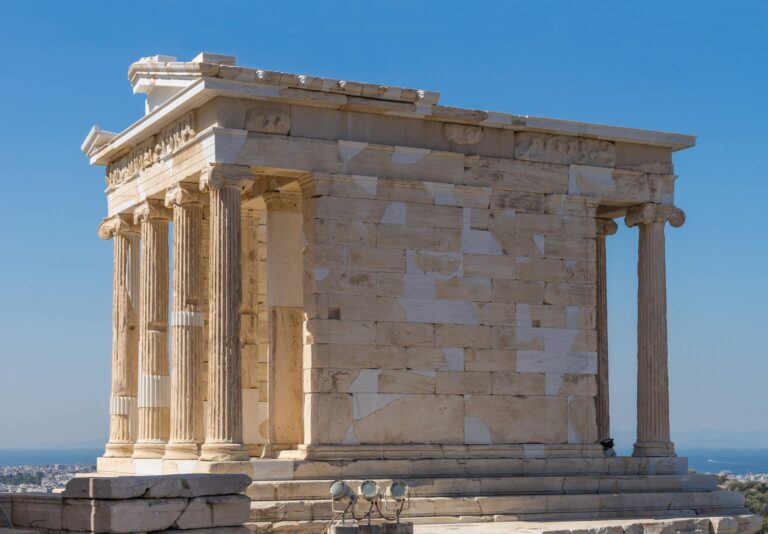 4:55AthensTemple of Athena Nike: free audio guide, hours and ticketsThis free audio guide to the Temple of Athena Nike plays straight from your phone, with no app…
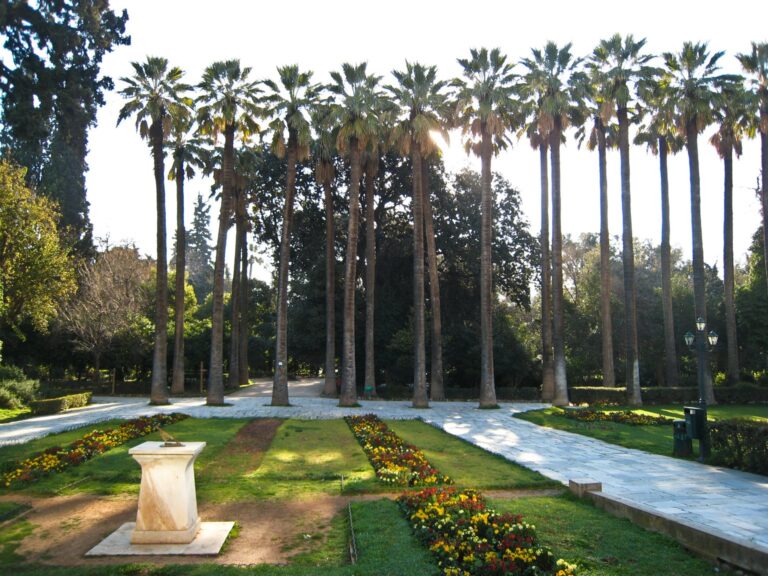 3:36AthensNational Garden of Athens: free audio guide and hoursThe National Garden of Athens is Queen Amalia’s old Royal Garden: 156,000 m² behind the Parliament, with the…
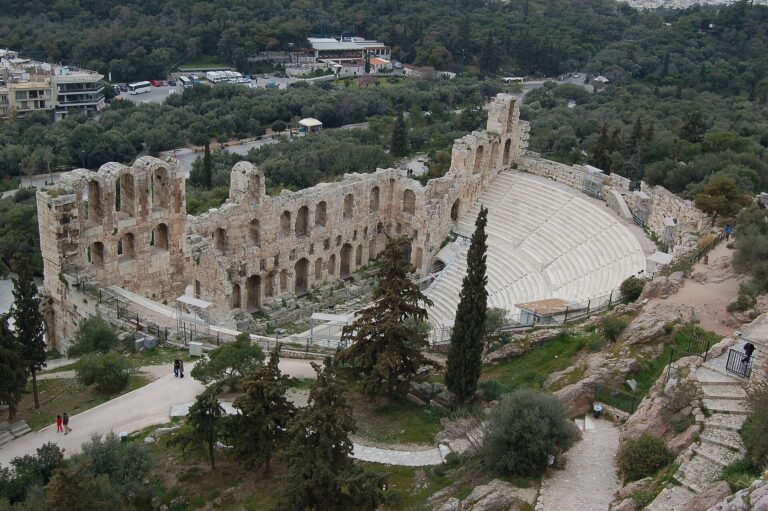 5:59AthensOdeon of Herodes Atticus: free audio guide, closed for worksThis free audio guide to the Odeon of Herodes Atticus plays straight from your phone — no app,…