
Plaza Mayor, Salamanca: free audio guide, medallions and tips
Free audio guide in English · no app, no sign-up
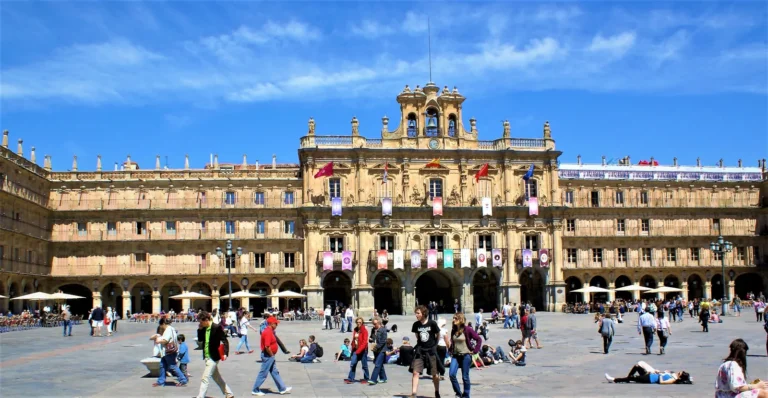
Salamanca’s Plaza Mayor is the city’s Baroque main square, built between 1729 and 1755 and ringed by 88 arches with carved medallions. This free audio guide lasts about 4 minutes and takes you clockwise from City Hall to the Royal Pavilion, the San Martín Pavilion, the Petrineros side and Café Novelty.
 Audio guide
Before you go in
The few things that change your visit.
- The square is open 24 hours, every day, and entry is free
- The tourist office at Plaza Mayor 32 opens Mon-Fri 9am-7pm, Sat 10am-7pm, Sun 10am-2pm
- Step-free: 6 of 9 entrances are level; only the 3 on the east side have steps
- The medallions: kings east, soldiers south, culture west, 20th-21st century north; 21 were empty in August 2023
Salamanca’s Plaza Mayor is the city’s main square: a Baroque square of golden stone built between 1729 and 1755, ringed by 88 arches and open to everyone, day and night, for free. No 2 of its sides are the same length, and between the arches runs a gallery of carved portraits of kings, soldiers and writers. This free audio guide lasts about 4 minutes and takes you round all 4 sides.
What the Plaza Mayor audio guide covers
Press play standing in the middle of the square, then walk round it clockwise: City Hall first, then the east, south and west sides. Each part tells you where to look and where to walk next. There are 7 parts:
| The centre of the square | Where to stand to take in all 4 sides, and how a medieval market became a bullring and then a granite square. |
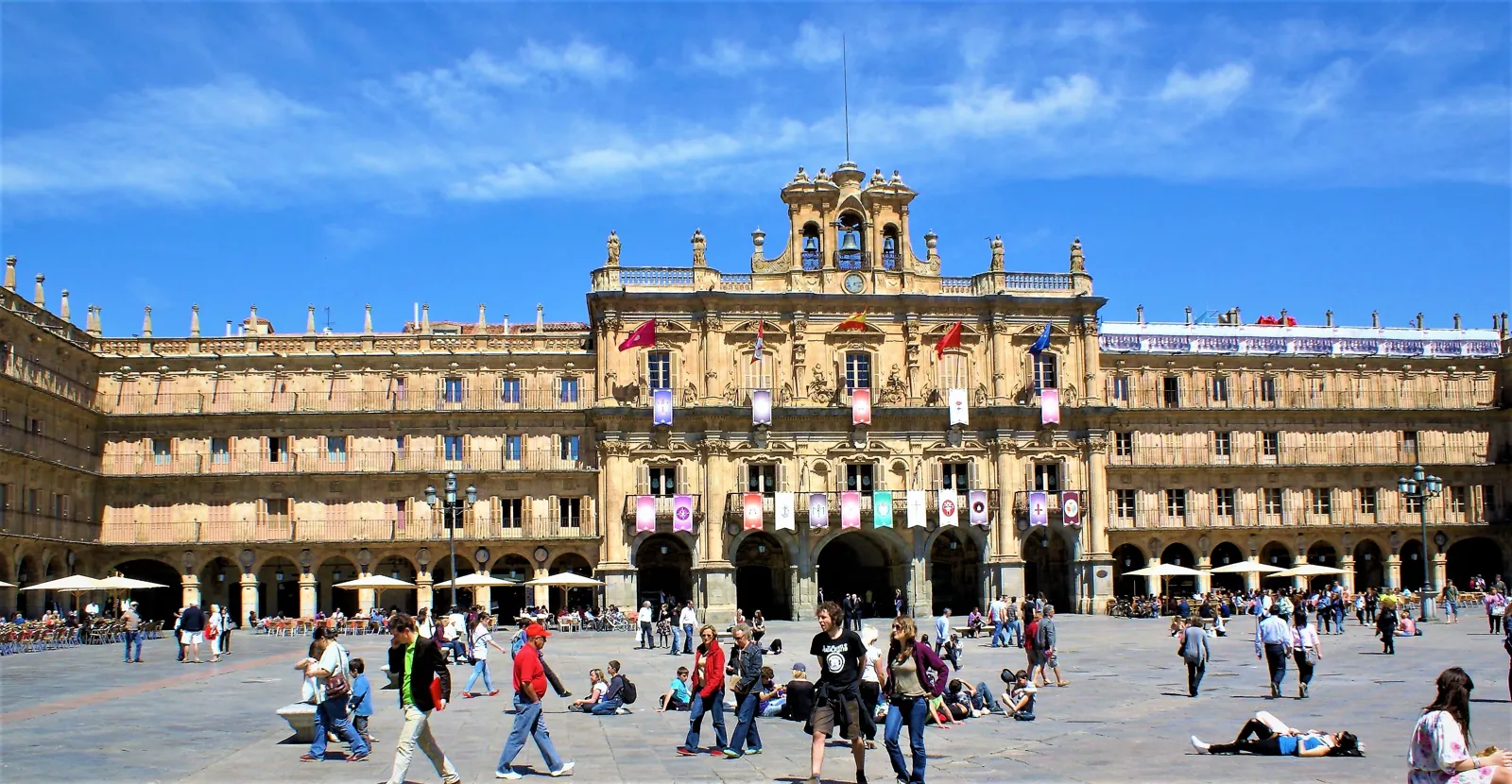
| City Hall, north side | The Baroque facade by Andrés García de Quiñones, the 1852 belfry with its 3 bells and 4 allegorical figures, and the 2 founders carved over the central arch. |
| The Royal Pavilion, east side | The first stretch to be built, from 1729: the Arch of San Fernando, the arms of Philip V and the kings of Spain in date order. |
| The San Martín Pavilion, south side | The “General Headquarters”: Columbus, Cortés, Pizarro and the other soldiers and conquistadors. |
| The Petrineros side, west | Writers and thinkers, the Duke of Wellington, and Alfonso IX of León, the medallion added in 2023. |
| Café Novelty | The oldest café on the square, opened in 1905, where Unamuno and Torrente Ballester held court. |
| The tourist office, no. 32 | Where the daily guided walks set off, and which way to head next. |
Plaza Mayor opening hours, entry and the tourist office
The Plaza Mayor is a pedestrian public square, so there’s no ticket and no gate: it’s open 24 hours a day, every day, and entry is free. Allow 20 to 30 minutes to walk all 4 sides at an easy pace with your head tilted up at the medallions (longer with a coffee).
The city’s tourist office is inside the square itself, at Plaza Mayor 32. As of 20 October 2026, it opens:
- Monday to Friday: 9am to 7pm.
- Saturday: 10am to 7pm.
- Sunday: 10am to 2pm.
The phone number is 923 21 83 42. The office has material adapted for visitors with disabilities, and it’s also the starting point of the city’s daily guided walks. You buy your place from the guide at the meeting point, 5 minutes before the start; the price depends on the walk, and entry to any monuments on the route is paid on top.
How to read the medallions
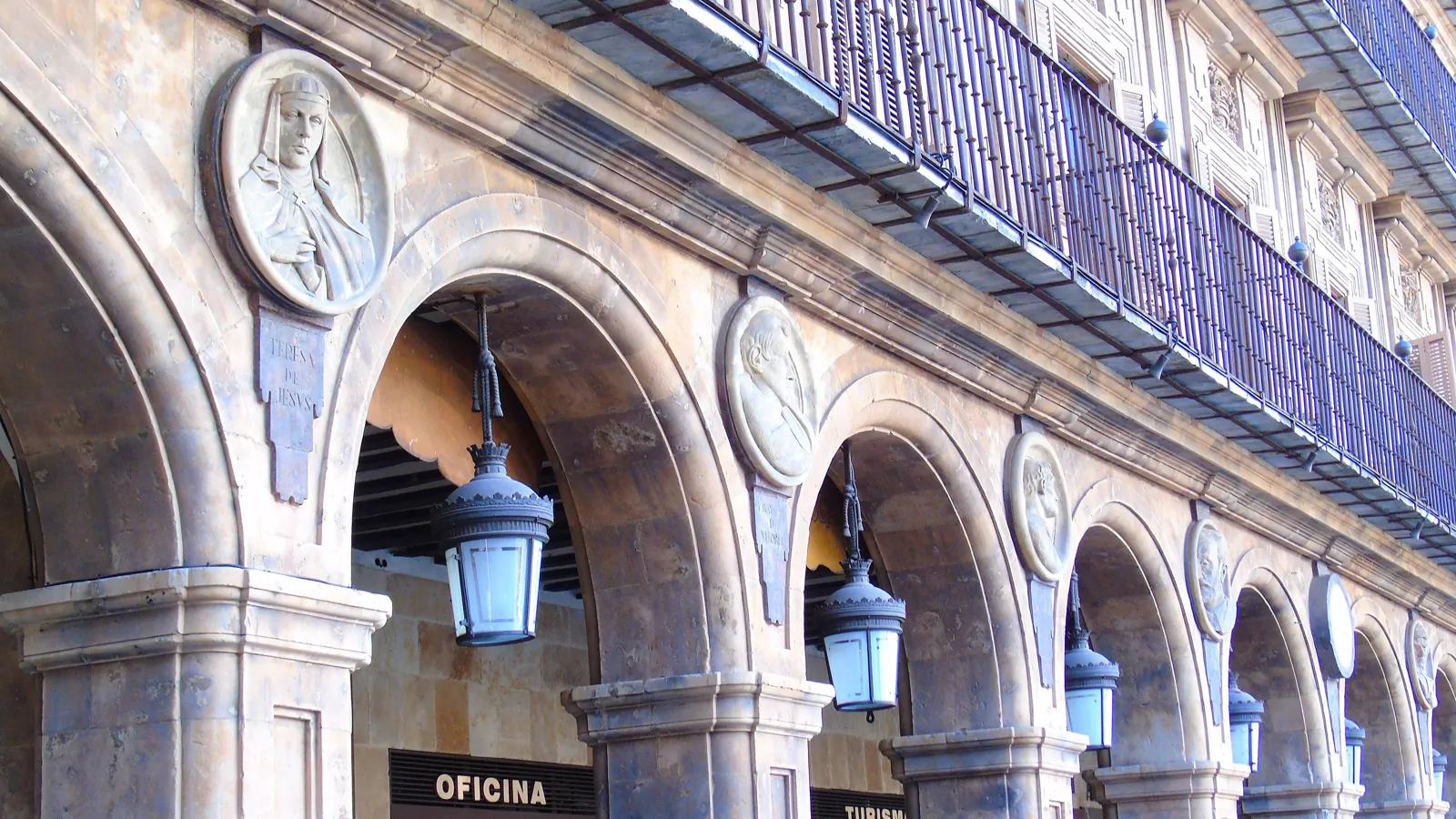
Look up at the curved space between any 2 arches. In each sits a stone roundel, a medallion with the bust of a figure from Spanish history. There are 88 arches, so 88 spaces, and the idea behind them came from the man who pushed for the square in the first place, the city magistrate Rodrigo Caballero y Llanes. His plan sorted them by theme: monarchs on the Royal Pavilion, soldiers on San Martín, scholars on Petrineros and saints on the City Hall side.
Things didn’t quite go to plan. The sculptor Alejandro Carnicero carved the first medallions between 1730 and 1733, but building stalled from 1735 to 1750 and only about half of the original plan was carved. From the second half of the 20th century, and especially from 1967, the City Council commissioned new ones from artists with links to Salamanca. That’s why the square reads like a timeline: walk round it and you get a version of Spanish history in stone, with the saints once planned for the north side replaced by the 20th and 21st centuries.
The quick key, side by side:
- East: kings and queens, in date order from Alfonso XI to Charles III.
- South: soldiers and conquistadors.
- West: writers, thinkers and figures from the Peninsular War.
- North: the 20th and 21st centuries, many of them added in 2005.
The 4 sides of the Plaza Mayor
At first glance the square looks perfectly regular, but it isn’t. The plan is an irregular four-sided shape, none of its sides the same length, covering about 6,400 m² not counting the arcades. The buildings rise 3 floors, except City Hall, which has 2; City Hall and the Royal Pavilion stand taller than the rest. Count the exits and you’ll find 9 leading out to streets and squares, plus 2 passageways on the west side that were once the way in for carriages.
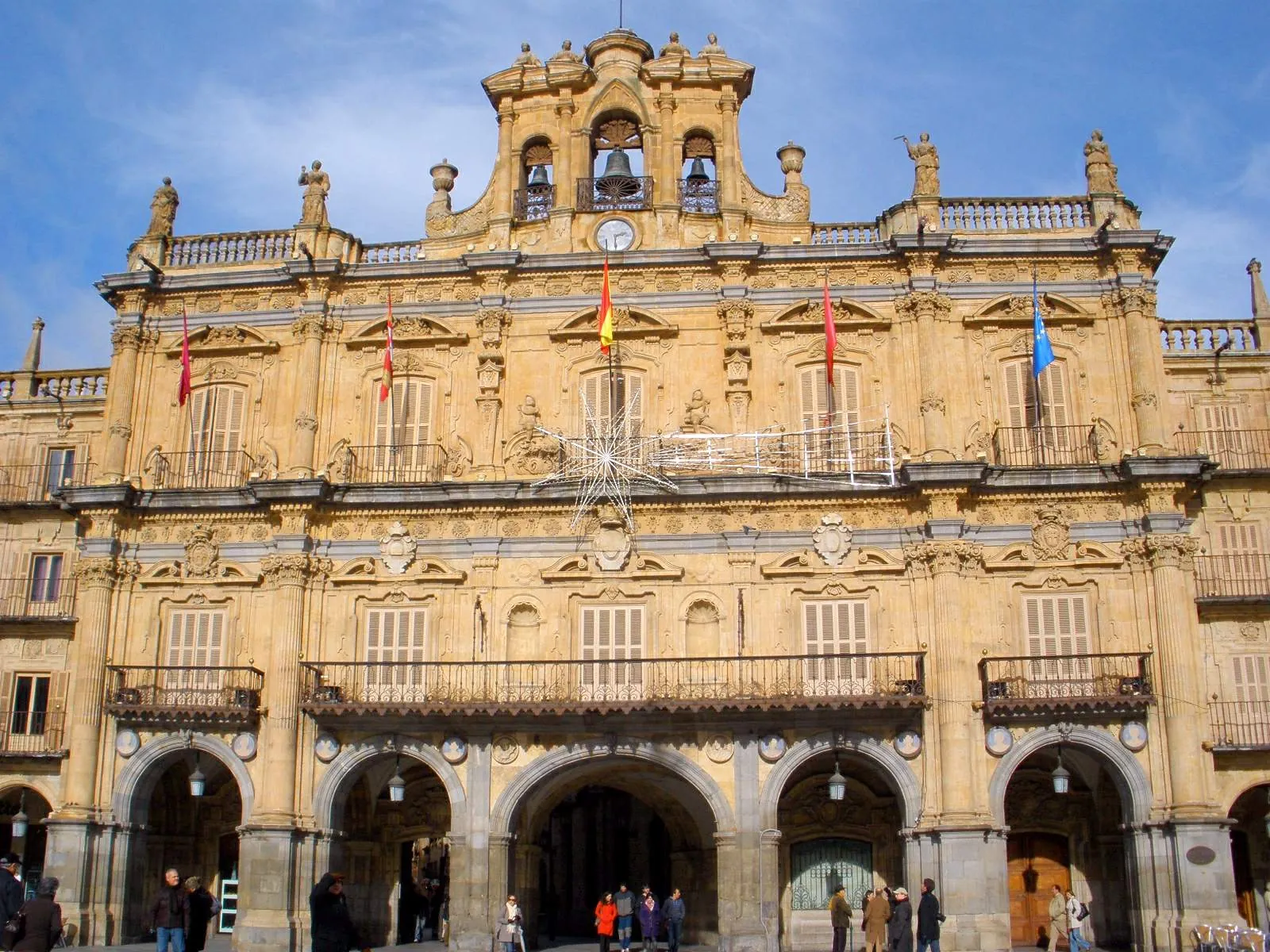
North: City Hall. The Baroque facade is the work of Andrés García de Quiñones, who drew up a new design for it when work resumed in 1741. The belfry on top came later, in 1852: it holds 3 bells and 4 figures standing for Industry, Agriculture, Music and Poetry, and a clock sits there too. Over the central arch, the 2 medallions are of the square’s founders, Rodrigo Caballero and the architect Alberto de Churriguera. Many of the others were added in 2005, with kings and the First and Second Republics.
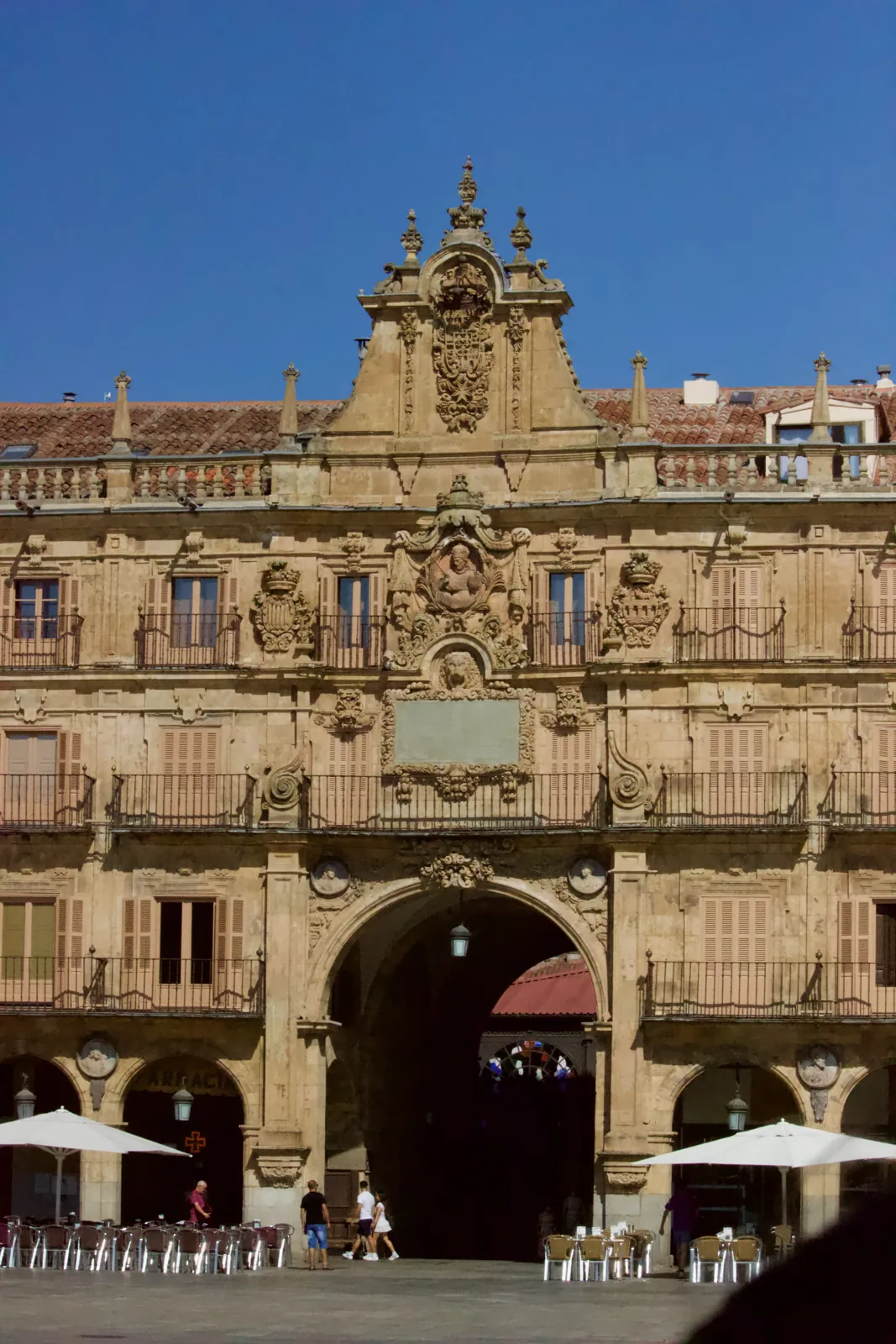
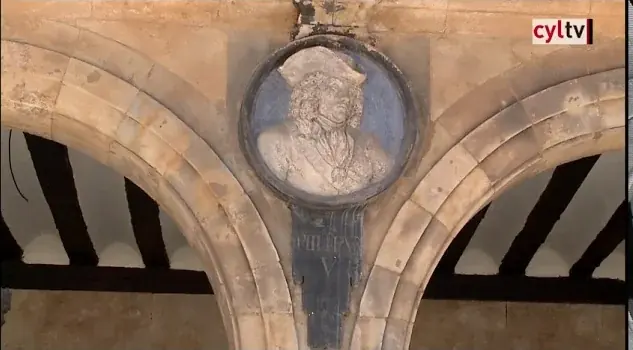
East: the Royal Pavilion (Pabellón Real). This was the first stretch to go up, from 1729 to 1733, on land the city already owned. It also works as a retaining wall for the slope, which is why its back, facing the Mercado, is taller. In the middle is the Arch of San Fernando, topped by the arms of Philip V together with the figure of Ferdinand III the Saint, and a slate plaque recording the start of the work. Philip V appears 3 times on this side: once over the central arch, as the king who authorised the square, and once for each of his 2 reigns. 3 of the 5 women on the whole square are here too: Isabella the Catholic, Joanna I of Castile and Elisabeth Farnese.
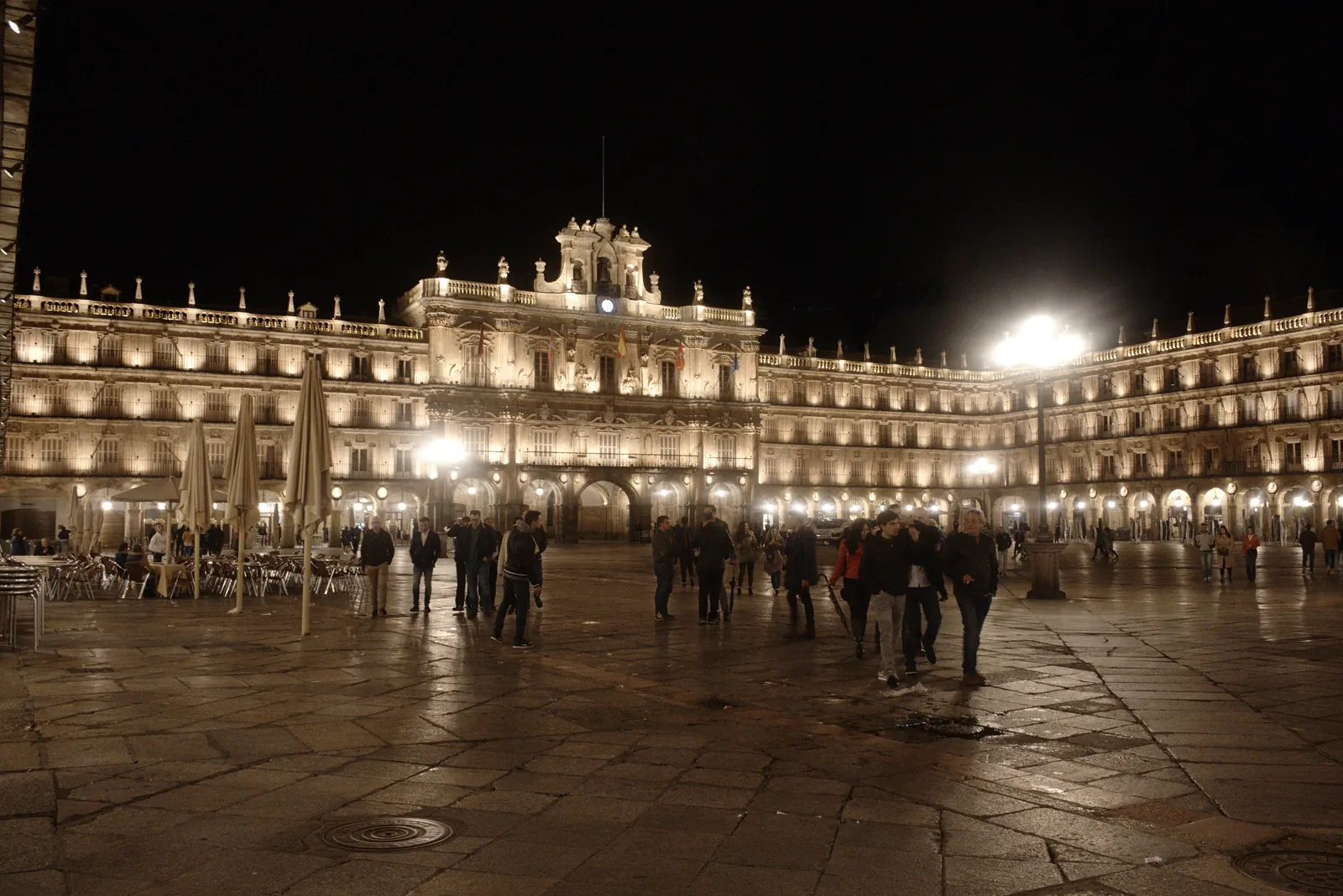
South: the San Martín Pavilion. Built from 1732 to 1735, it bends slightly out of line to respect the old medieval streets behind it. Its medallions earned it the nickname “General Headquarters”: Gonzalo Fernández de Córdoba, Christopher Columbus, Hernán Cortés, Francisco Pizarro and the Grand Duke of Alba.
West: the Petrineros side. Built from 1750, this is the culture side: Antonio de Nebrija, Fray Luis de León, Miguel de Cervantes, Teresa de Jesús, Francisco de Vitoria and Miguel de Unamuno. If you’re British, look out for Wellington, next to the local guerrilla fighter Julián Sánchez, known as “El Charro”. The first medallion here was of Manuel Godoy, removed when the Peninsular War began. Right in the centre is the newest, Alfonso IX of León, by the sculptor Óscar César Alvariño, unveiled on 4 August 2023 for the University’s 800th anniversary.
From market to bullring: Plaza Mayor history
Before there was a square, there was a market. The Mercado de San Martín filled this ground in the Middle Ages, and today’s square covers only about a quarter of it. The push for something grander came from the magistrate Rodrigo Caballero y Llanes, and work began in 1729, under Philip V, with Alberto de Churriguera as architect.
The first 2 pavilions went up fast. Then the owners of the remaining plots dug their heels in, most notably the Count of Grajal, and building stalled for about 15 years. Churriguera left the city. Things were unblocked in 1741, with Andrés García de Quiñones in charge, but real progress came from 1750 with the Petrineros side and City Hall, and the last house was finished in 1755. Take out the stoppages and the whole square took about 10 years of actual building.
Until the 1830s the square was used as a bullring; later it was laid out with gardens, and in 1954 those were cleared and the ground paved with the granite slabs you’re standing on. The bullfighting past still shows once a year: every 25 July a mast with a bull and the Spanish flag, known as la Mariseca, goes up on the City Hall belfry to announce the September festivities of the Virgen de la Vega.
In 1988 UNESCO inscribed the Old City of Salamanca, Plaza Mayor included, on the World Heritage List, and the square is also protected in Spain as a Bien de Interés Cultural.
Where to sit, and tips for a day trip
- Sit on a terrace and watch. The old shops under the arcades are now cafés and restaurants, and taking a table to watch the square go by is close to a local ritual. The classic is Café Novelty, opened in 1905 and the oldest on the square: Unamuno and the novelist Gonzalo Torrente Ballester met there, and a sculpture of Torrente by Fernando Mayoral keeps his memory alive.
- Join the evening stroll. The square was the city’s meeting place: tradition had men walking round clockwise and women the other way. Unamuno called it “the city’s main rumour mill”.
- Come back after dark. At night the facades are lit and the stone turns gold.
- Coming from Madrid for the day? Trains and buses connect the 2 cities every day. From the bus station (Av. Filiberto Villalobos 71) it’s about 1.4 km, an 18-minute walk; from the train station, allow 25 to 30 minutes on foot.
- Check what’s on. The square hosts the Antique Book Fair in autumn, the Book Fair in spring and concerts during the Virgen de la Vega festivities in September. It has also been a film set, for Vantage Point (2008) and Alejandro Amenábar’s While at War (2019).
From the square, the University is a 7-minute walk (about 540 m) and the New Cathedral 9 minutes (about 680 m). Keep going downhill past both and in about 14 minutes you reach the Roman Bridge over the Tormes. For more audio guides around the country, browse our free audio guides to Spain.
Where to find it
FAQs
How do the free audio guides work?
They play right here on audioguidetravel.com, with no app to download and no sign-up. Press play and listen as you walk round: a phone and a pair of headphones are all you need. The audio streams from this page, so you’ll need mobile data or Wi-Fi.
Can I take the tour at my own pace?
Of course! You set the pace: pause whenever you like, jump back or forward 15 seconds, or tap the bar to jump to any point, and listen as many times as you want so you don’t miss a thing.
If I'm in a group, can we use the same audio guide?
Yes. The same free audio guide opens on as many phones as you like, so you can go round together as a group or with your family, each person at their own pace and with their own headphones. The quickest way is to send the link via WhatsApp, Telegram or however you like: the buttons just below let you share it right now.
Visitor information
As of 20 Oct 2026- Opening hours
- Open 24 hours, every day. Tourist office (no. 32): Mon-Fri 9am-7pm, Sat 10am-7pm, Sun 10am-2pm.
- Tickets
- Free: it's a pedestrian public square. Guided walks from the tourist office are paid.
- Time needed
- Audio guide of about 4 min; 20-30 min to walk all 4 sides looking at the medallions.
- Getting there
- 7 min on foot from the University, 9 from the New Cathedral; bus station 18 min, train station 25-30.
- Accessibility
- 6 of its 9 entrances are at street level; only the 3 on the east side have steps. Flat, traffic-free.
- Tip
- Daily guided walks leave the tourist office at Plaza Mayor 32; buy your place from the guide.
- Official website
- www.salamanca.es
Nearby
More free audio guides in Spain
 7:51BarcelonaTibidabo: free audio guide, tickets and viewsFree audio guide to Tibidabo in Barcelona, in English: just under 8 minutes on the name of the…
 6:22BarcelonaSagrada Familia: free audio guide, hours and ticketsFree audio guide to the Sagrada Familia, in English: 6 minutes from the Nativity façade and the forest…
 2:46MadridPlaza de Cibeles, Madrid: free audio guide to the fountainPlaza de Cibeles is the Madrid roundabout where Calle de Alcalá crosses the Paseo del Prado. In the…