
Palau de la Música Catalana: free audio guide and tickets
Free audio guide in English · no app, no sign-up
Free audio guide to the Palau de la Música Catalana in Barcelona, in English: just under 6 minutes on how the Orfeó Català built its home, the iron structure, the façade and the concert hall. It plays on this page.
 Audio guide
The Palau de la Música Catalana is the concert hall that Lluís Domènech i Montaner built in Barcelona between 1905 and 1908 for the Orfeó Català choir. It is the only concert hall on the UNESCO World Heritage List, and inside you sit under a stained-glass skylight in a hall lit by daylight. This is its free audio guide, in English.
What the audio guide covers
It is free, plays on this page in your phone’s browser with no app and no sign-up, and lasts just under 6 minutes. The first part is the story of the building: who asked for it, where it was built, what the land cost and the day it opened. From minute 2:51 it becomes a walk, from the iron structure and the façade to the lobby and the concert hall, and it ends with a few tips for after your visit: a concert if you can get a ticket, the shop and a stroll through the Born, the old quarter next door.
Points of interest the audio guide stops at:
| Minute | Stop | What you hear |
|---|---|---|
| 0:00 | A building of Catalan modernism | Domènech i Montaner, the years 1905 to 1908, the façades with mosaics and sculpture, the glass skylight and a hall for more than 2,000 people. |
| 1:25 | The commission | The Orfeó Català looks for a home: its assembly approves the project on 31 May 1904 and buys the cloister of the convent of Sant Francesc, more than 1,350 m², for 240,322 pesetas. |
| 2:12 | First stone and opening | The first stone is laid on 23 April 1905, and the Palau opens on 9 February 1908. |
| 2:51 | The iron structure | An iron frame that frees the floor plan and lets glass close the walls, so the building fills with light. |
| 3:17 | The plot and the hall upstairs | How the wall shared with the neighbouring church was solved to give the hall its symmetry, and why the hall is on the first floor: the ground floor held the offices of the Orfeó. |
| 3:43 | Façade and lobby | Sculpture about music mixed with modernist and Baroque decoration, and the columns, mosaics and ceilings of the lobby. |
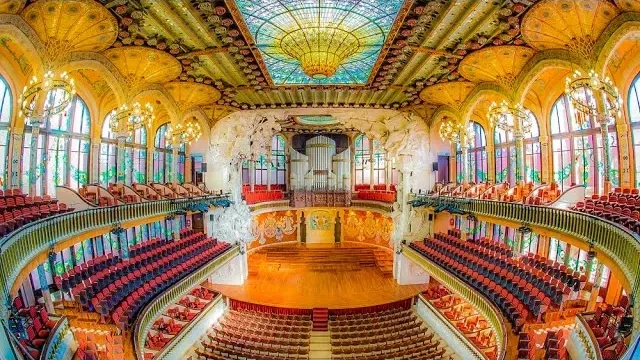
| 4:20 | The concert hall | The stage with its sculptures and, overhead, the stained-glass skylight. |
| 4:42 | After the visit | A concert, the Palau shop and the streets of the Born. |
A home for the Orfeó Català
The Orfeó Català is a choral society founded in 1891 by Lluís Millet and Amadeu Vives, and by the turn of the 20th century it needed a hall of its own. It gave the commission to Lluís Domènech i Montaner, the architect who also built the Hospital de Sant Pau, and the money came from a public subscription. Work started in 1905 in the Sant Pere quarter, and the Palau opened on 9 February 1908. The foundation stone is still in the building, in the rehearsal hall of the Orfeó, on the floor below the concert hall.
What made it new was how it stands up. UNESCO describes a steel frame that left large open floors and let a skin of glass take the place of load-bearing façades, so that daylight reaches the inside. That is why, by day, the hall is filled with natural light. Between 1982 and 1989 the architects Òscar Tusquets and Carles Díaz restored and extended the building, and the main entrance moved: until 1989 visitors came in from Carrer de Sant Pere Més Alt; today they come in from the square beside the Palau. On 4 December 1997 it was declared a UNESCO World Heritage Site, together with the Hospital de Sant Pau.
The façade: what to look for from the street
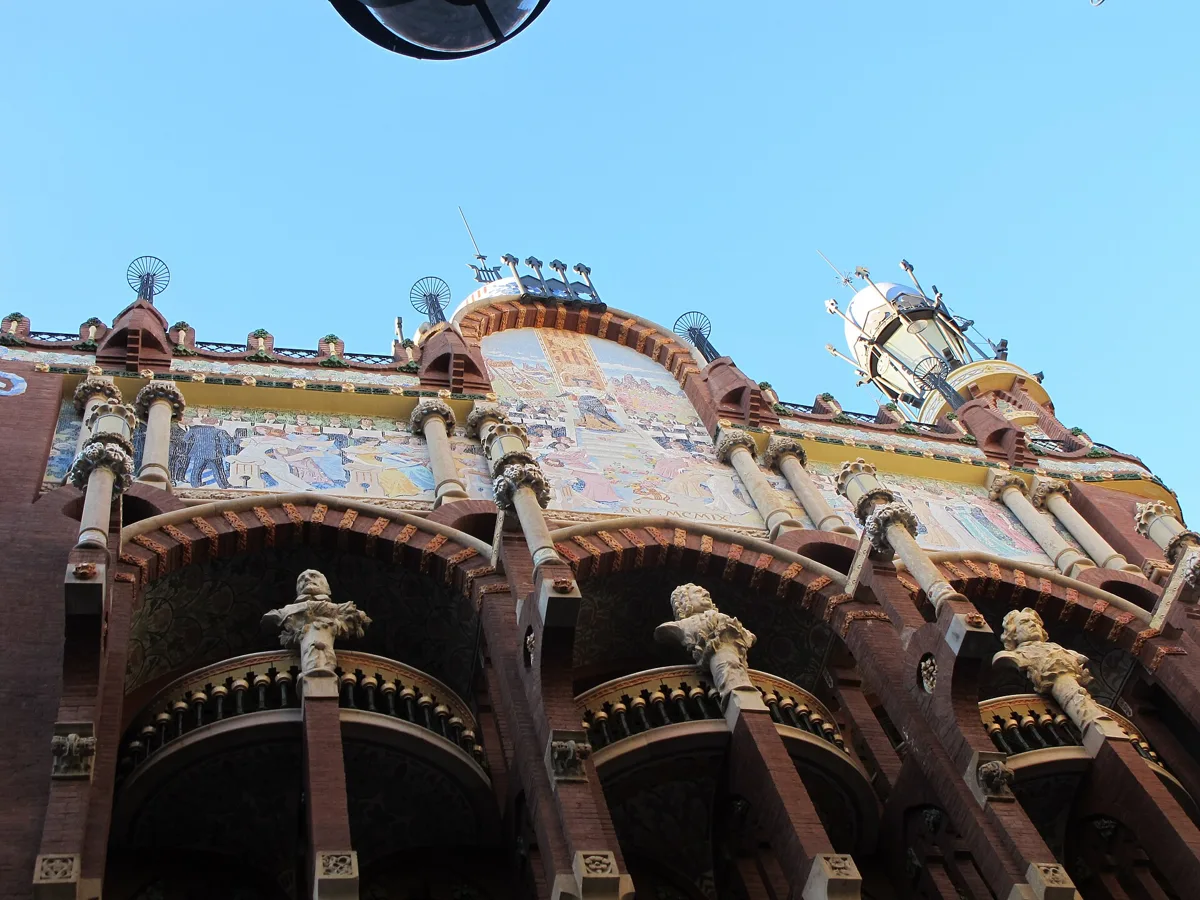
Start at the corner. The sculptural group La cançó popular catalana, by Miquel Blay, puts Saint George together with a large female figure at the centre, like the figurehead of a ship, who stands for music. Around her are the people who sing: a sailor, peasants, an old man and children.
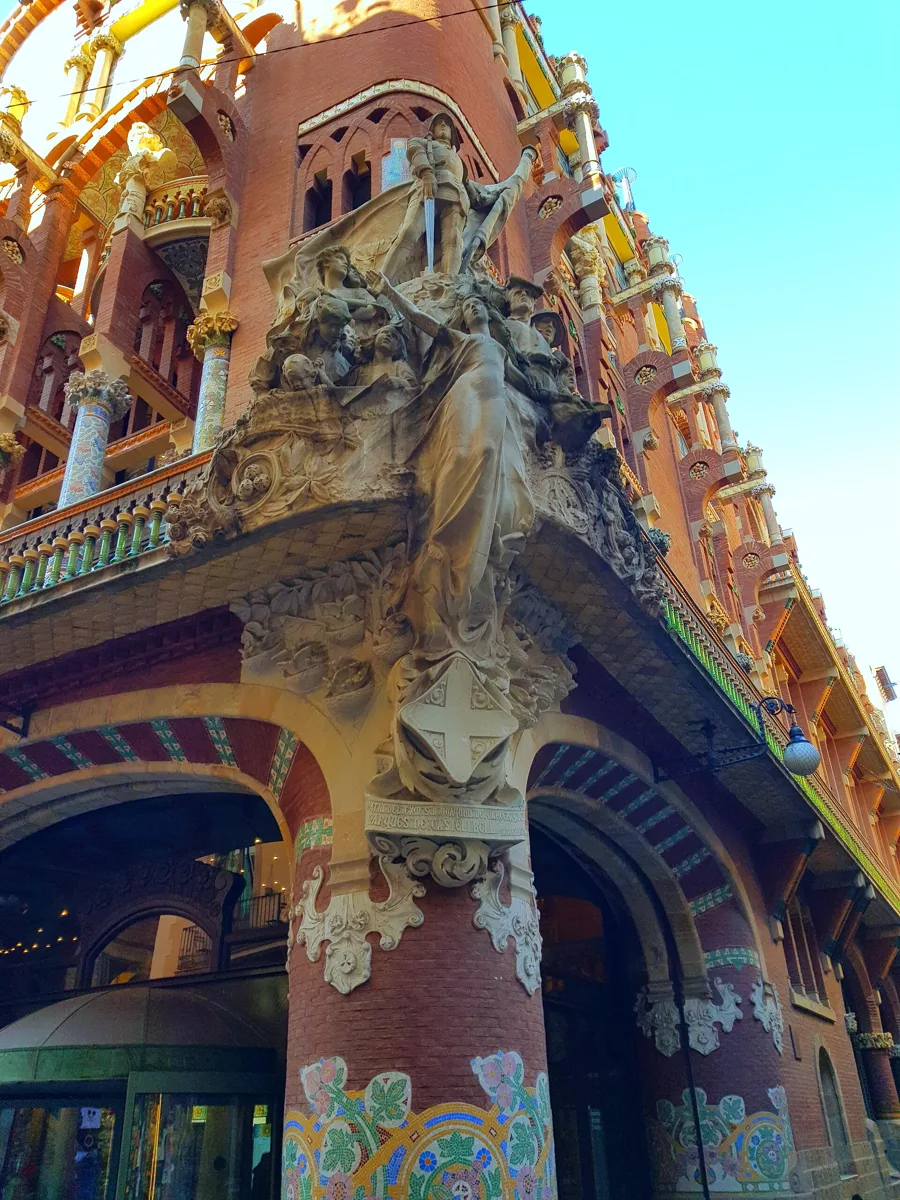
Along Carrer de Sant Pere Més Alt, the first-floor balcony is lined with 14 columns in pairs, each covered in a mosaic with a different design. Above them, on the second floor, are the busts of Palestrina, Bach and Beethoven by Eusebi Arnau, and round the corner, on Carrer d’Amadeu Vives, the bust of Wagner. At the very top, the mosaic pediment by Lluís Bru shows the flag of the Orfeó, with a queen at a spinning wheel in the centre: a nod to La Balanguera, a song the Orfeó performed often and, since 1996, the official anthem of Mallorca.
Inside: the foyer, the Sala Lluís Millet and the concert hall
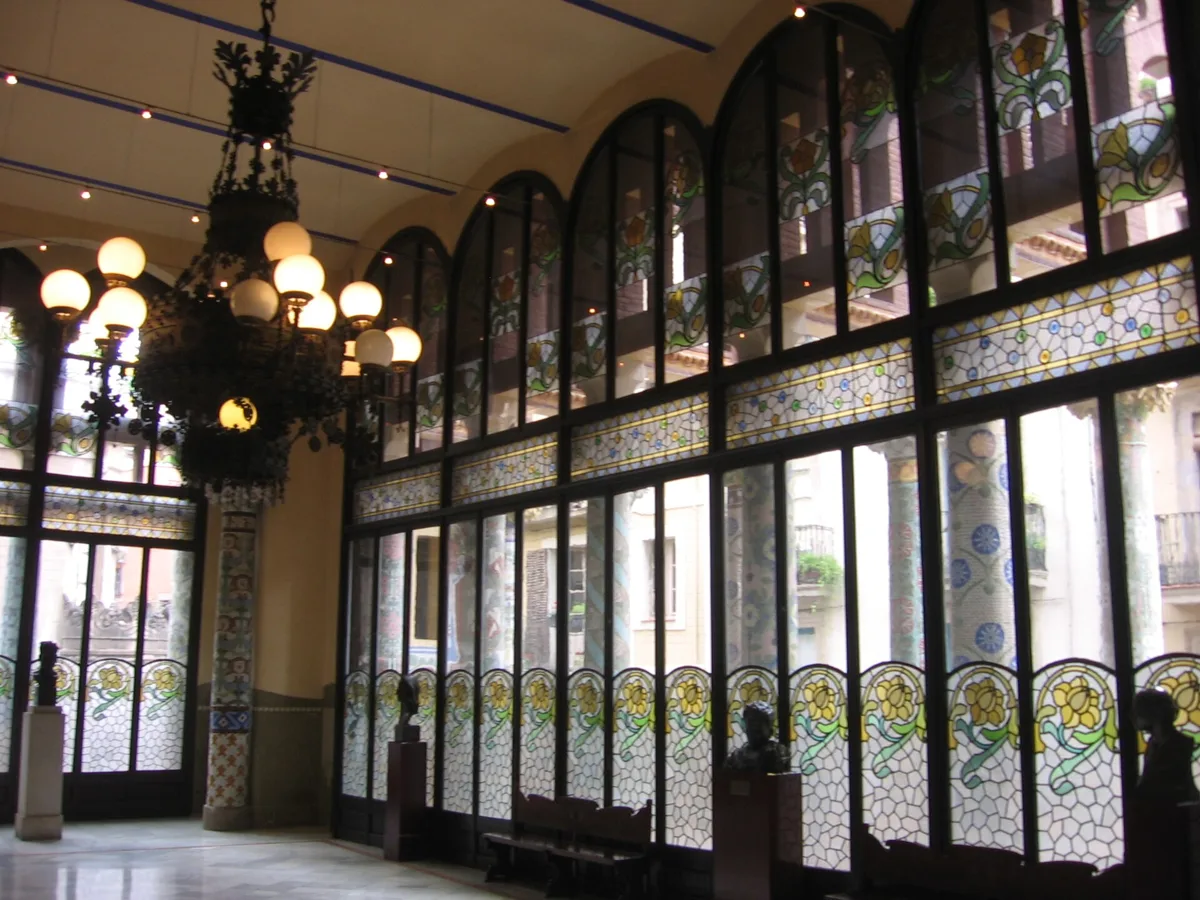
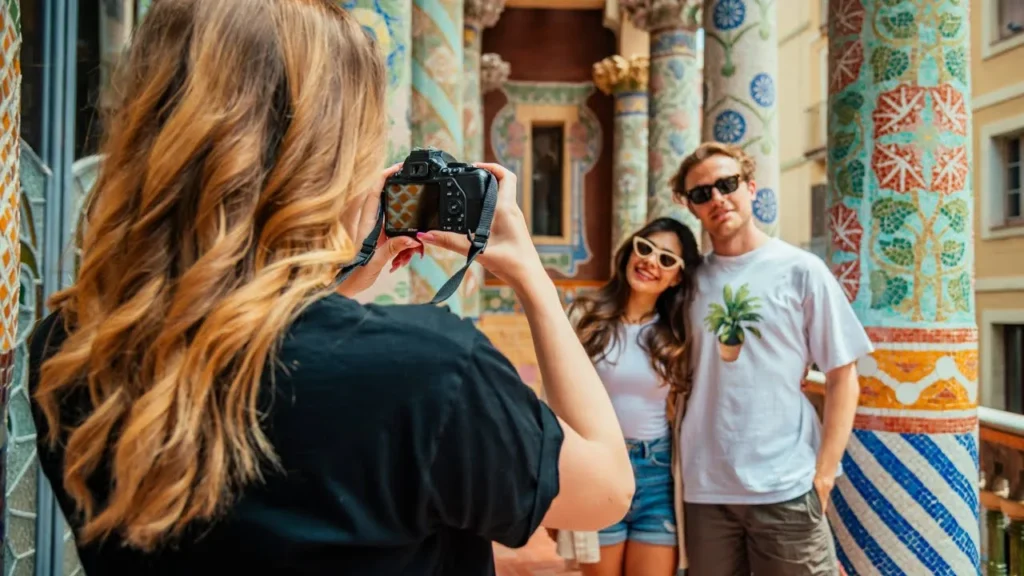
The visit takes in the concert hall, the grand staircase, the foyer and the Sala Lluís Millet. The foyer has wide brick arches, green glazed ceramics and floral decoration, and it doubles as the Cafè Palau. Upstairs, the Sala Lluís Millet, named after the founder of the Orfeó, rises 2 storeys behind large stained-glass windows with flowers; beyond them is a balcony with a double row of columns covered in colour.
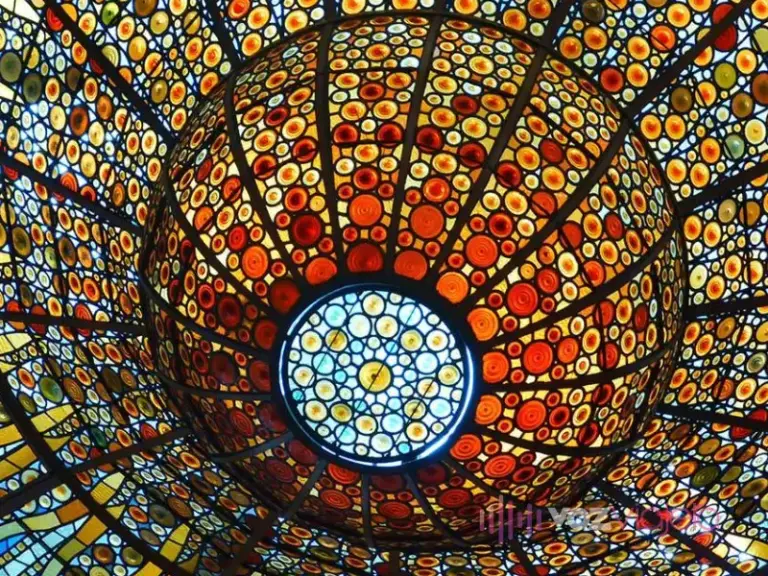
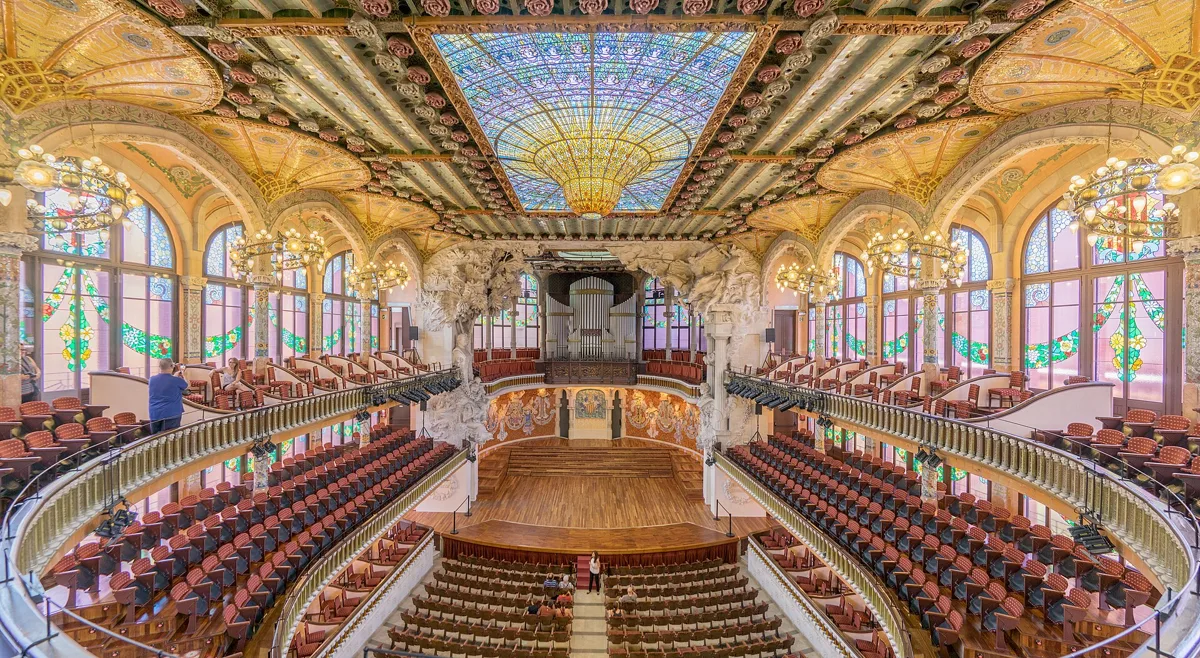
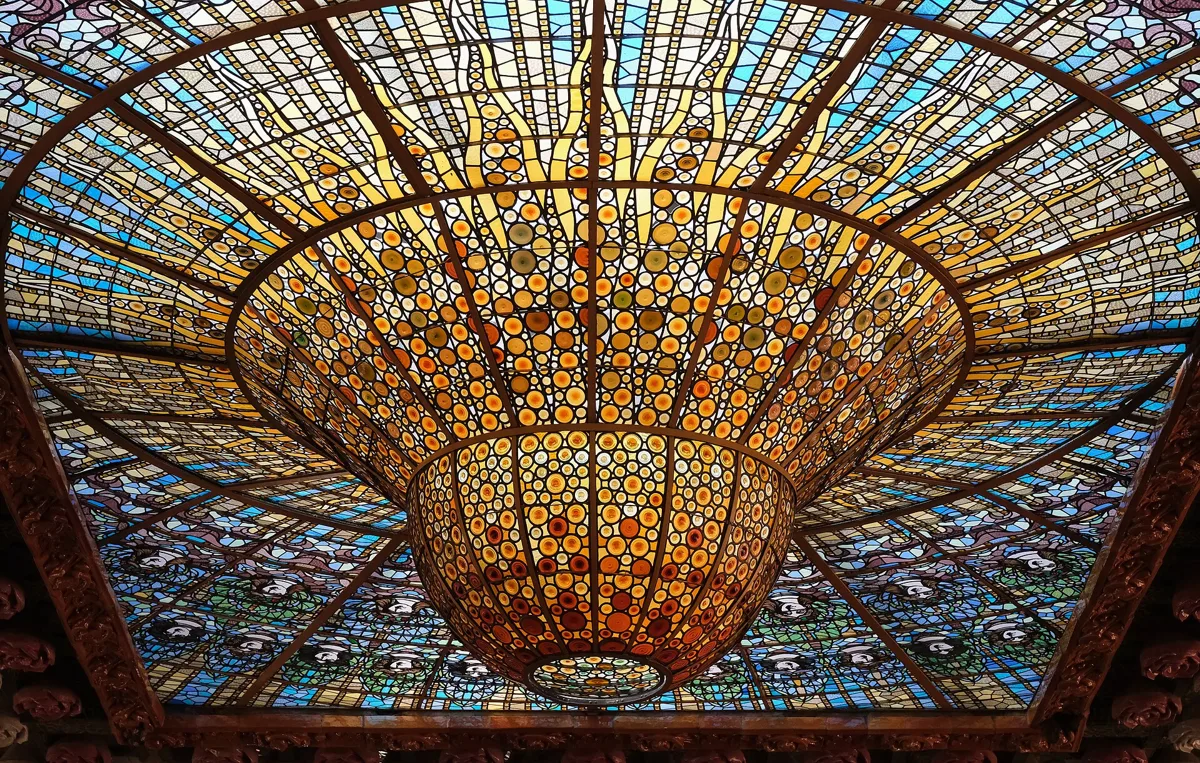
Then comes the concert hall, the reason for the visit. Over the stalls hangs the skylight that Antoni Rigalt i Blanch made for Domènech i Montaner, a great drop of golden glass that stands for the sun, with stained-glass windows on both sides of the room. On the stage, the organ presides at the back.
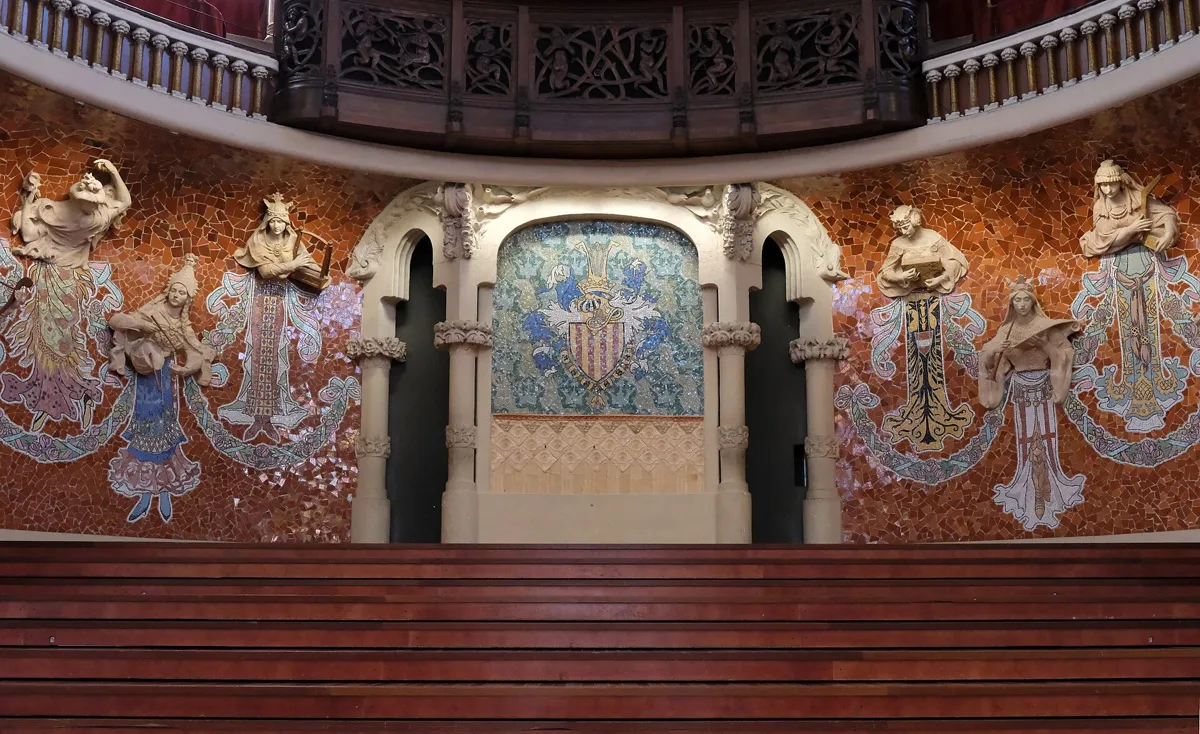
Look at the sculpture. The sculptural group above the stage, designed by Pau Gargallo, sets 2 kinds of music face to face: on the left, folk song, with the bust of the choir director Anselm Clavé under a stone tree and girls singing beneath it; on the right, Wagner’s Valkyries riding out of the ceiling above a bust of Beethoven. At the back of the stage, the 18 muses come out of the wall: their upper bodies are sculpted by Eusebi Arnau, their skirts are mosaic by Lluís Bru, and each one plays a different instrument.
Tickets, opening hours and which visit to choose
Visits run every day from 09:00 to 15:30, in time slots, and last about 50 minutes. The Palau asks you to check for changes when you book. The box office opens Monday to Saturday from 08:30 to 21:00, and on Sundays and public holidays from 08:30 to 15:30 and 2 hours before concerts; it only sells tickets for the same day. Over Christmas the box office keeps special hours: 24 December 08:30-19:00, 25 December closed in the morning and 31 December 08:30-18:00.
There are 3 regular ways in. The guided tour, with an expert guide in 6 languages, costs €24. The audio-guided tour, with the Palau’s own audio guide in 10 languages, also costs €24. The self-guided visit costs €20. The reduced ticket, €20, is for people over 65 and under 35; people with a disability under 65% pay €13; residents in Catalonia, €14. Children under 10 with an adult and people with a disability over 65% go in free.
If you have more time, 2 combined tickets link the Palau with other modernist buildings: with La Pedrera, from €42, and with the Hospital de Sant Pau, from €32. The Palau Exclusive, from €25, is a small-group guided visit before the general opening.
Rules, accessibility and getting there
Be on time: once a visit has started, latecomers cannot join it. Photos are allowed without flash or tripod. Food and drinks are not allowed, and neither are suitcases or large bags, so travel light. Tickets cannot be changed or refunded.
The building has lifts to every floor, a stair lift in the foyer for the balconies, a ramp in the Sala Lluís Millet to its balcony, adapted toilets and wheelchairs on request. Visits with a Spanish Sign Language interpreter and tours for blind visitors can be arranged for groups (minimum 15 and 12 people).
The Palau is at Carrer del Palau de la Música, 4-6, in the old town, about 5 minutes on foot from Plaça de Catalunya. The nearest metro is Urquinaona, on lines L1 and L4; Renfe and FGC trains stop at Catalunya, and buses V15, V17 and 47 stop nearby. The Palau recommends going in from Plaça del Palau.
It fits well with a walk through the old town: the Barcelona Cathedral is a short walk away, and La Pedrera is on Passeig de Gràcia. You can see all our free audio guides to the city on the Barcelona page.
 Free audio guideBarcelona Cathedral
 Free audio guideLa Pedrera (Casa Milà)
 Free audio guideSagrada Familia
Where to find it
FAQs
How do the free audio guides work?
They play right here on audioguidetravel.com, with no app to download and no sign-up. Press play and listen as you walk round: a phone and a pair of headphones are all you need. The audio streams from this page, so you’ll need mobile data or Wi-Fi.
Can I take the tour at my own pace?
Of course! You set the pace: pause whenever you like, jump back or forward 15 seconds, or tap the bar to jump to any point, and listen as many times as you want so you don’t miss a thing.
If I'm in a group, can we use the same audio guide?
Yes. The same free audio guide opens on as many phones as you like, so you can go round together as a group or with your family, each person at their own pace and with their own headphones. The quickest way is to send the link via WhatsApp, Telegram or however you like: the buttons just below let you share it right now.
Visitor information
As of 28 Oct 2026- Opening hours
- Visits every day 09:00-15:30 · box office Mon-Sat 08:30-21:00
- Tickets
- Self-guided €20 · guided or audio-guided €24 · +€1 at the box office
- Time needed
- About 50 min
- Getting there
- Metro L1 and L4 to Urquinaona; 5 minutes on foot from Plaça de Catalunya.
- Accessibility
- Lifts to every floor, adapted toilets and wheelchairs on request
- Tip
- Book the €20 self-guided visit and play this free audio guide as you walk round
- Official website
- www.palaumusica.cat
Nearby
More free audio guides in Barcelona
 5:01BarcelonaLa RamblaLa Rambla is Barcelona’s central artery, a bustling pedestrian promenade lined with trees, street performers and flower stalls.…
 4:06BarcelonaCamp NouThe imposing Camp Nou is the stadium of FC Barcelona, with capacity for 100,000 spectators. Touring this mythical…
 7:51BarcelonaTibidabo: free audio guide, tickets and viewsFree audio guide to Tibidabo in Barcelona, in English: just under 8 minutes on the name of the…