
This free audio guide to the Odeon of Herodes Atticus plays straight from your phone — no app, no sign-up — standing in front of the stage wall on Dionysiou Areopagitou. It tells you why a Roman consul built the finest theatre in Greece for a wife he was then tried for killing, how a roof spanning 38 metres of radius stood on nothing at all, what the fire of 267 AD left, and where the monument stands today, closed for restoration since 1 July 2026. Press play at the gate.
 Audio guide
Before you go in
The few things that change your visit.
- The Odeon has been closed since 1 July 2026, for at least 3 years, with no reopening date published
- The last performance was John Legend, on 30 June 2026, programmed as the closing ceremony
- The interior is not part of the archaeological visit: it only ever opened with a performance ticket
- The South Slope costs €30.00 and the ticket is single use with the Acropolis
- Today it opens 08:00 to 19:00, last entry 18:30; the hours change on 1 October
- Free entry on 26 and 27 September 2026, the last weekend of the month
On this page
- What the audio guide tells you
- Closed since 1 July 2026, for at least 3 years
- The last night: John Legend, on 30 June 2026
- What the restoration will actually do
- You do not go inside on an archaeological ticket
- Tickets: €30.00 for the Acropolis and its Slopes
- Opening hours and last entry on the South Slope
- Getting there, and where to stand
- The numbers: 76 metres, 32 rows and 2 capacities
- Herodes, Regilla and the cedar roof
- From the Herulians to Maria Callas
- Nearby, with their own free audio guides
- Tickets and prices
- Where to find it
- FAQs
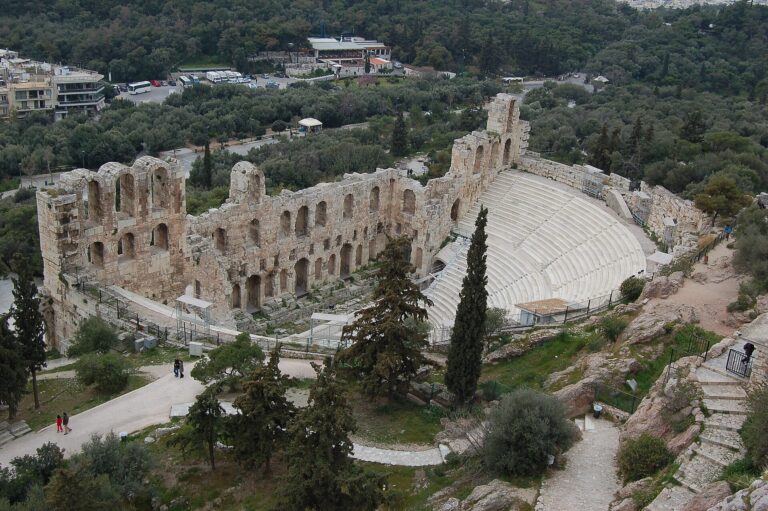
The Odeon of Herodes Atticus is the marble theatre at the western end of the Acropolis’s South Slope, raised by Herodes Atticus in memory of his wife Regilla between 160 and 174 AD. It has been closed since 1 July 2026 for a restoration that will last at least 3 years, with no reopening date published. Its 3-storey stage wall is still there to see from the street.
This page is the free audio guide, plus the practical detail read on 22 September 2026 from the Greek Ministry of Culture, the state ticket office and the Athens Epidaurus Festival, which runs the venue: what the closure means in dates, what the surrounding archaeological site costs, what time it shuts tonight, and where to stand to see the monument.

What the audio guide tells you
It is free, it plays in your phone’s browser, and there is no app to install and no sign-up. Press play on the pedestrian street of Dionysiou Areopagitou, in front of the facade, and carry it with you into the South Slope site. These are the stops:
| The gate on Dionysiou Areopagitou | Where the entrance is, why it does not open with an archaeological ticket, and what is on the other side of it. |
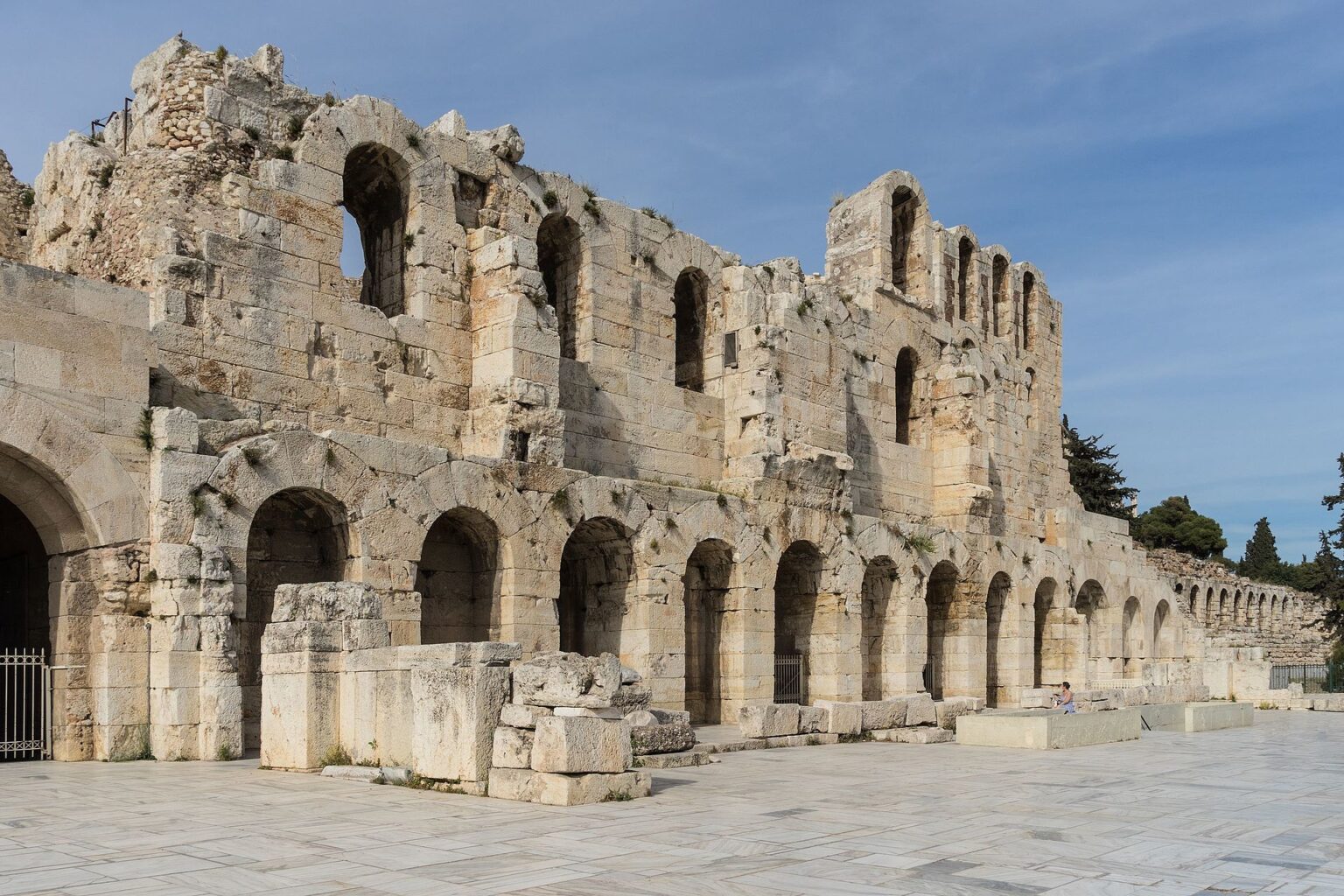
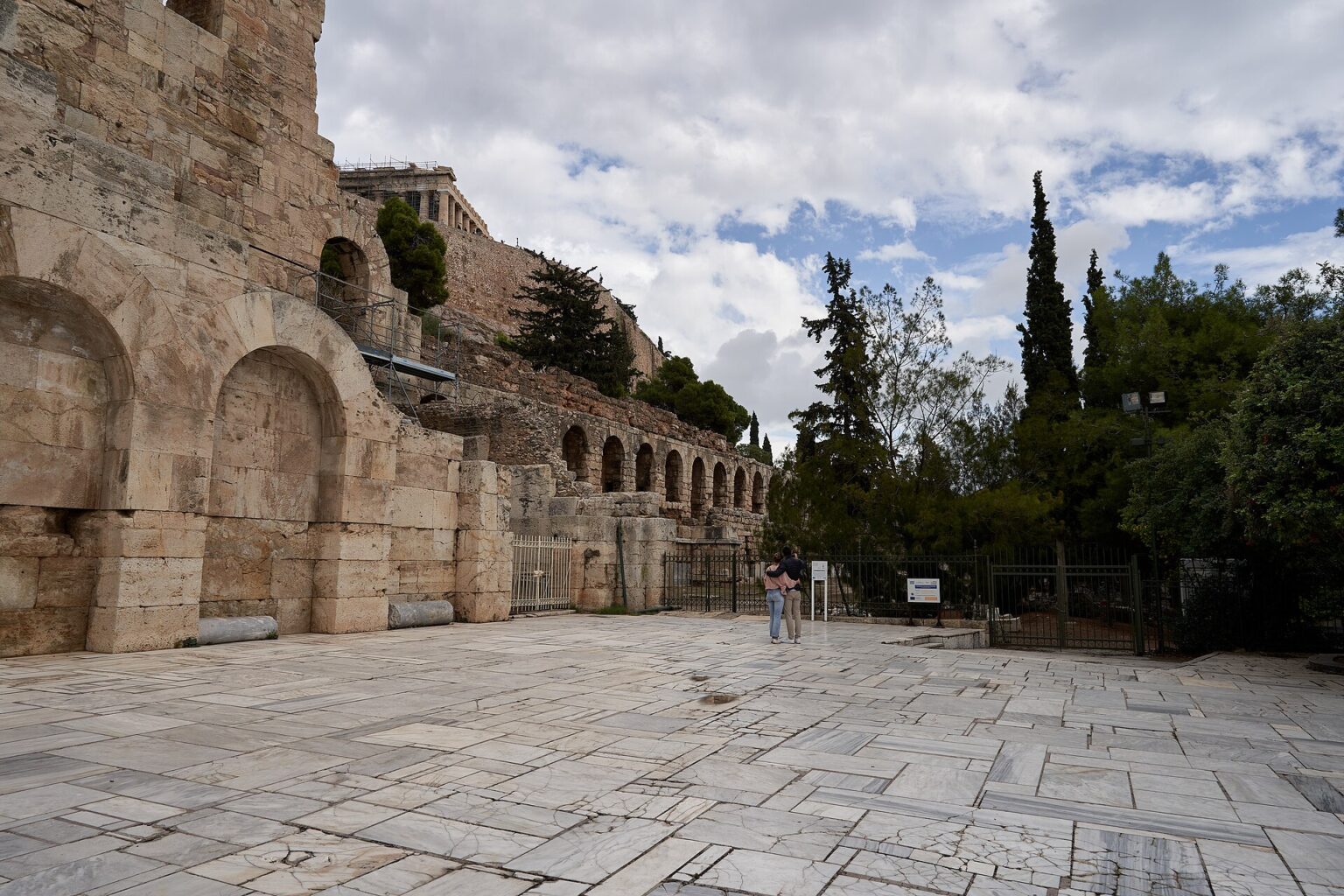
| The stage wall | The 28 metres still standing, its 3 storeys, the arched openings along the top and the niches that held statues. |
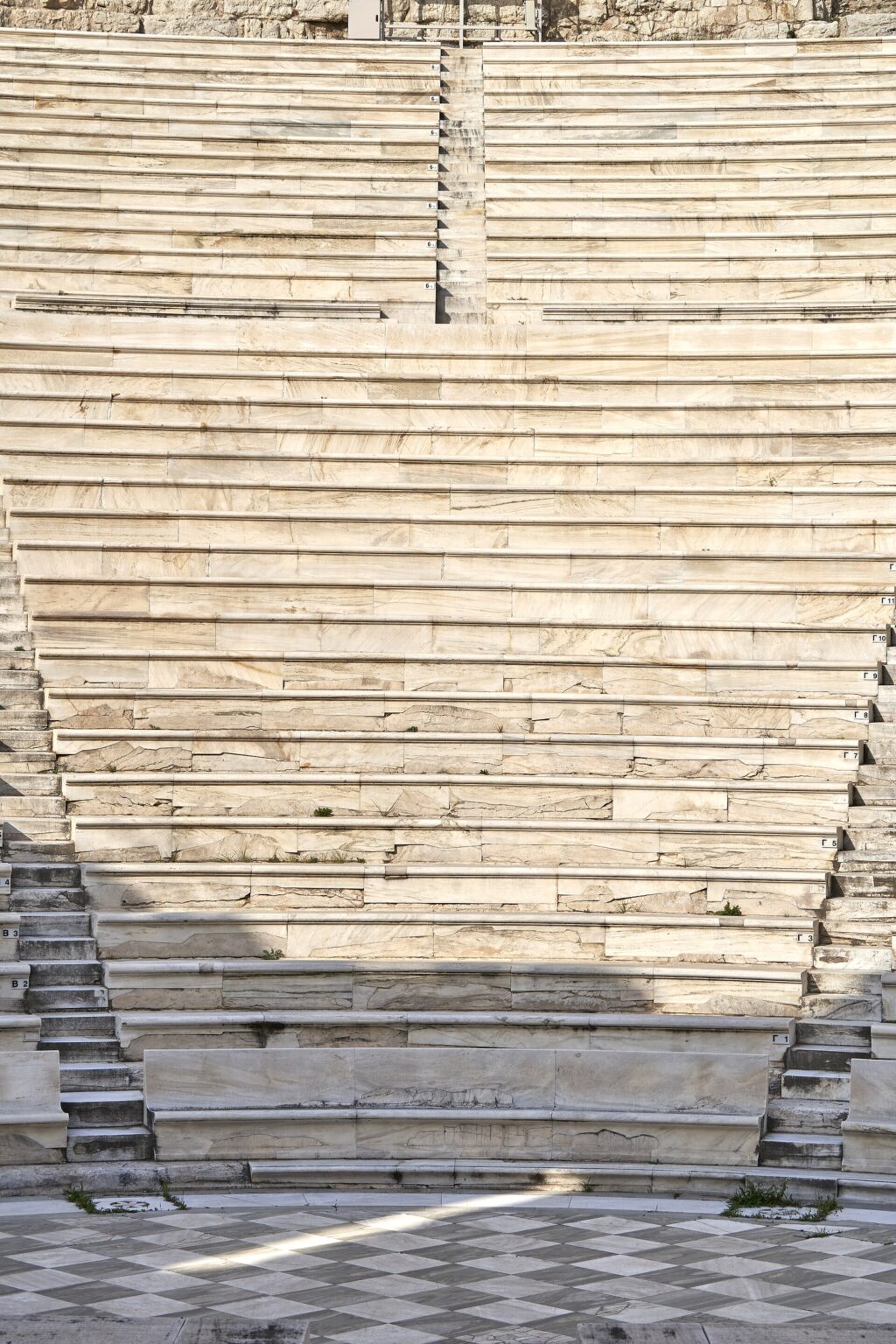
| The cavea of 76 metres | The 32 rows of marble seats hewn out of the rock, the 2 tiers, and the 1.20 metre walkway that divides them. |
| The orchestra | The paved semicircle of 19 metres across, and what a roofed odeon was for that an open theatre was not. |
| The roof that rested on nothing | A span of 38 metres of radius with no internal supports, and the cedar that Philostratus records. |
| Regilla | The woman the building is dedicated to, the murder trial that followed her death, and the epithet an Athenian inscription gives her. |
| The fire of 267 | The Herulian raid, why this building alone was never rebuilt, and the 17 centuries it spent buried. |
| The Stoa of Eumenes | The long portico running east along the slope, and the connection the restoration now wants to give back. |
| The last summer | What happened here in June 2026, and what the Ministry of Culture is about to do to the stone. |
Closed since 1 July 2026, for at least 3 years
The single fact that governs a visit today: the Odeon of Herodes Atticus is shut. The Greek Ministry of Culture has taken it out of service for a full restoration, and the Minister of Culture, Lina Mendoni, put the length of it in writing in the Ministry’s announcement of 23 February 2026: the conservation, restoration and upgrade works “will last at least 3 years from the time they begin, during which the monument will remain closed”.
Read that sentence closely, because it is precise in one direction and open in the other. It fixes a minimum of 3 years. It does not fix a start date, and it gives no reopening date at all. As of 22 September 2026 the Ministry has published none, and neither has the Festival that used the building. Anyone planning a trip around a performance here should treat the building as unavailable and nothing more precise than that.
What can be dated exactly is the closing. The venue’s own programme ran its last night on 30 June 2026, and from 1 July 2026 there has been nothing on it. The Festival’s call for its 2027 programme, published on 5 August 2026, states that the Odeon “remains unavailable due to ongoing restoration works” and lists the 3 venues that will carry the season instead: the Ancient Theatre of Epidaurus, the Little Theatre of Ancient Epidaurus and Peiraios 260. So the second summer of the closure is already settled too. The Greek National Opera has moved its summer productions to Epidaurus for the same reason.
The last night: John Legend, on 30 June 2026
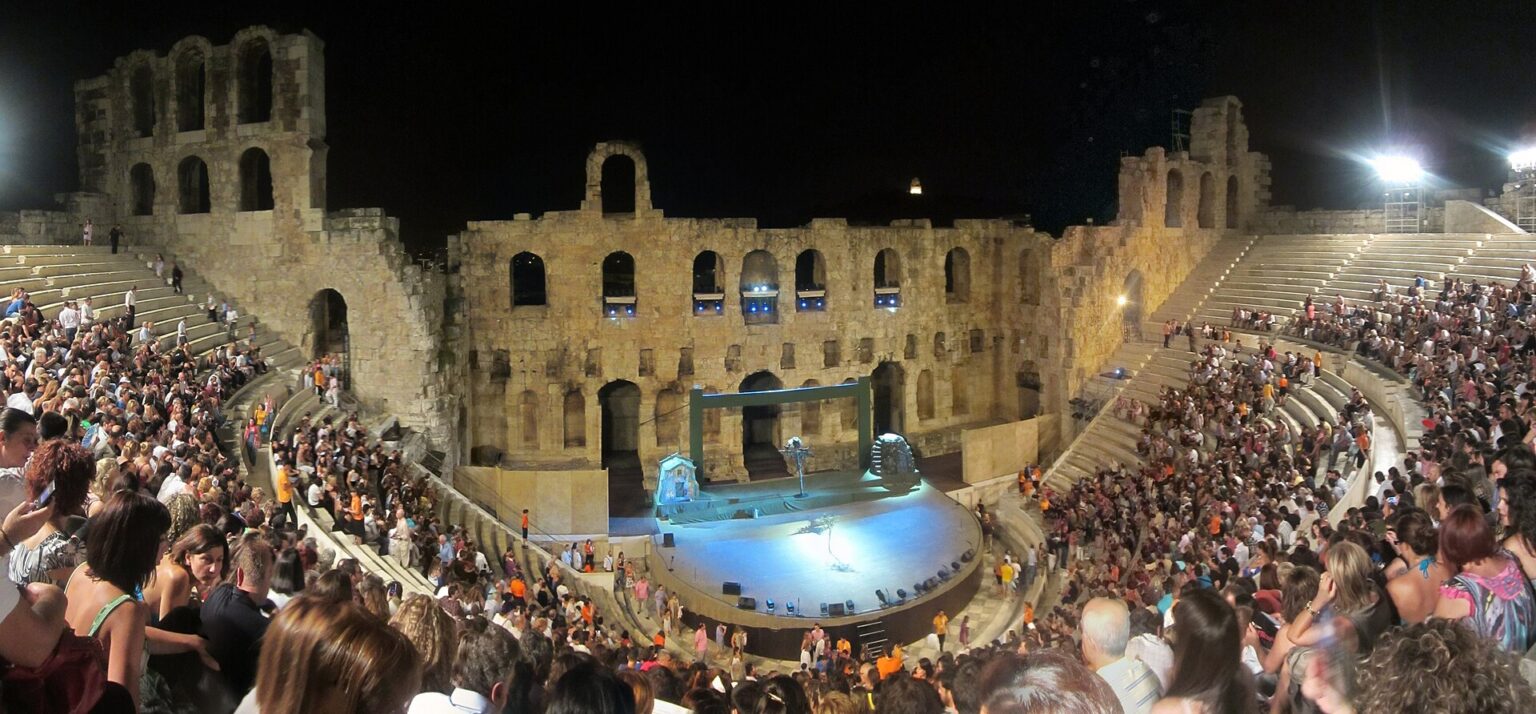
The 2026 season at the Odeon lasted 28 days. There were 18 performances, all at 21:00, between 3 and 30 June 2026 — and nothing before or after in the whole year. The Festival did not treat that month as an ordinary programme. It called it the Farewell Celebrations, and on 6 April 2026 its artistic director, Michail Marmarinos, wrote that the Odeon, “before it is sealed and retreats into silence for a few years”, would open “for only one month — this special June — its gates”.
The month opened on 3 June with Víkingur Ólafsson making his Greek debut with a Bach, Beethoven and Schubert programme, an evening the Festival’s press kit lists under the heading opening ceremony. It closed on Tuesday 30 June 2026 with John Legend, Evening of Songs & Stories, listed under the heading closing ceremony and described there as the last cultural event to take place on the theatre’s stage before its closure and the start of the restoration works. The night before, on 29 June, the Athens State Orchestra under Michał Nesterowicz had played Mahler’s Eighth.

What the restoration will actually do
The Ministry’s announcement is unusually detailed about the condition of the building, and it explains why 3 years is a floor rather than a ceiling. The monument shows structural problems: decay concentrated in the upper arcade of the facade, loss of mass and cracking in the stone blocks, small deformations and localised areas in danger of collapse. There is biocorrosion where micro-organisms grow in hollows that hold standing water, root systems working into the joints, and failure of earlier interventions. The interdisciplinary studies were commissioned from the National Technical University of Athens in July 2025 by the Ministry’s Directorate for the Restoration of Ancient Monuments, and they cover architecture, structural adequacy, mechanical services and acoustics.
Two items on the work list are worth a visitor’s attention, because they change what there will be to see afterwards. The first: the stage building and its mosaic floors, which the Ministry states “today remain unseen”, are to be uncovered and displayed. The second: the proscenium is to be made safe and, in the Ministry’s own word, visitable — a plain admission that it is not visitable now. Beyond that, the plan restores the eastern staircase and the ascending path towards the Peripatos so as to give back the Odeon’s original working connection with the Stoa of Eumenes, replaces the present scaffolding with a free-standing semicircular lighting support, rebuilds the external drainage and extends the forecourt with a raised platform over a covered space for a café and ticket offices.
There is also a piece of research here that had never been done anywhere. The acoustic study had to work out whether the sound of performances, natural and amplified, is damaging the south wall — and since no established method and no accepted safety limits existed for that question, the team developed an original methodology of its own. Nobody yet knew how much a concert costs a monument that is roughly 1,900 years old. And for the first time the monument will get a written code of operation, drawn up by a panel of scientists and artists, to govern what may be staged in it.
You do not go inside on an archaeological ticket
This part was true long before the closure and will still be true after it, so it is worth separating from the news. The interior of the Odeon is not part of the archaeological visit. The Ministry of Culture files it as a monument rather than as a site: its official record carries an address and a bibliography but publishes no ticket price, no opening hours and no visiting information, which every site record does carry.
The South Slope of the Acropolis, the enclosure the Odeon stands in, lists 7 monuments as its visitable ones — the Stoa of Eumenes, the sanctuary of Dionysos Eleuthereus, the Asklepieion, the chapel of Agia Paraskevi, the choregic monument of Nikias, the Theatre of Dionysos and the choregic monument of Thrasyllos. The Odeon is not among them. The site’s own description of the accessible route says the same thing from another angle: the visit runs “as far as the West Passageway (parodos) of the Theatre of Dionysus”, and the Odeon sits at the far western end, past where the route stops.
What did open the gate was a performance ticket from the Athens Epidaurus Festival, bought for a specific night. That is the only way anyone has walked into the auditorium in modern times, and since 30 June 2026 there have been no nights to buy. The practical answer today, then, is short: you look at it from outside, and that costs €0.00.

Tickets: €30.00 for the Acropolis and its Slopes
To walk the ground the Odeon stands on you need the ticket for the South Slope, and there is no such thing as a South Slope ticket. What exists is a single ticket called “Acropolis and its Slopes”: €30.00 full and €15.00 reduced, valid for the rock of the Acropolis, the South Slope and the North Slope together. That is the price charged on 22 September 2026 by the state ticket office, where the only product for the whole area is that one. It is the same €30.00 you pay for the Acropolis itself — one ticket covers both, which is the point of the next paragraph.
The trap is in a single sentence on the site’s official record, and it costs people an afternoon: “the ticket ‘Acropolis and Slopes’ is used only once and in case of exit from either the Acropolis Site or the South Slope, the visitor cannot re-enter any Site with the same ticket”. In other words, the €30.00 ticket is single-use across both. If you come down off the rock, walk out of the gate and then try to come back in at the South Slope, that ticket is spent. Do the rock and the slope in one continuous visit, and if you are coming down from the top, follow the signage after the Beulé Gate to the South Exit, which delivers you straight into the South Slope without leaving the site.
Three more things about the ticket. It carries a compulsory time slot, changeable up to 2 hours before your visit and up to 2 times per ticket, and the money is not refundable. It includes access to the Ministry’s official digital audio guide app, free since March 2026. And there are days when everyone walks in for nothing: 6 March, 18 April, 18 May, the last weekend of September and 28 October, plus the first and third Sunday of each month between 1 November and 31 March. In 2026 that September weekend falls on Saturday 26 and Sunday 27 September.
| Ticket | Price | What it covers |
| Acropolis and its Slopes, full | €30.00 | The rock, the South Slope and the North Slope. Single use. Checked 22-09-2026 |
| Acropolis and its Slopes, reduced | €15.00 | The same. Checked 22-09-2026 |
| Saturday 26 and Sunday 27 September 2026 | Free | Last weekend of September, free entry for everyone |
| Visitors with a disability, and 1 companion from 67% | Free | On presentation of ID or passport and a disability certificate |
| Entry inside the Odeon | Not sold | Only ever with a Festival performance ticket; closed since 01-07-2026 |
Opening hours and last entry on the South Slope
The South Slope does not have a summer timetable and a winter one. It has 6, and 3 of the changes fall inside 6 weeks of autumn, which is exactly when most people misplan the end of the day. Today, 22 September 2026, it opens at 08:00 and closes at 19:00, and the last entry is at 18:30.
| Dates | Open | Close | Last entry |
| 1 April – 31 August | 08:00 | 20:00 | 19:30 |
| 1 – 15 September | 08:00 | 19:30 | 19:00 |
| 16 – 30 September | 08:00 | 19:00 | 18:30 |
| 1 – 15 October | 08:00 | 18:30 | 18:00 |
| 16 – 31 October | 08:00 | 18:00 | 17:30 |
| 1 November – 31 March | 08:00 | 17:00 | 16:30 |
So the timetable steps down on 1 October, again on 16 October, and again on 1 November, when it settles at 08:00 to 17:00 for the winter. The site is shut altogether on 1 January, 25 March, 1 May, Easter Sunday, 25 and 26 December, and it keeps special hours on Good Friday, 12:00 to 17:00, and Holy Saturday, 08:30 to 15:30. Two details that catch people out: the North Slope keeps different hours, 08:30 to 15:30 since 1 November 2025, and the site’s museum shop remains closed until further notice. All of it checked on 22 September 2026.
Getting there, and where to stand
The metro is Akropoli, on line 2, and from the exit everything is flat. The South Slope has its own gate at the junction of Thrasyllou street with the Dionysiou Areopagitou pedestrian street, about 320 metres from the station, roughly 5 minutes; keep walking west along the same pedestrian street and the Odeon is at about 800 metres, roughly 10 minutes. Those 2 distances are our own measurement on the map — no official source publishes a figure for either. Bus line 230 also stops here.
Where to stand is the practical question, and the answer is the pedestrian street itself. The Odeon’s entrance and its facade both face Dionysiou Areopagitou, and that is the address the Ministry gives the monument; from there you get the stage wall head-on, all 3 storeys of it, which is the face the building has kept. From inside the South Slope enclosure you reach its western end, against the Stoa of Eumenes, though the marked route stops short of the monument itself.
One accessibility note that saves a walk: the accessible toilets are outside the South Slope, at the Information Centre at Dionysiou Areopagitou 18-20, 50 metres east of the entrance. The enclosure itself is wheelchair-accessible from the main gate as far as the west parodos of the Theatre of Dionysos, with a companion recommended.

The numbers: 76 metres, 32 rows and 2 capacities
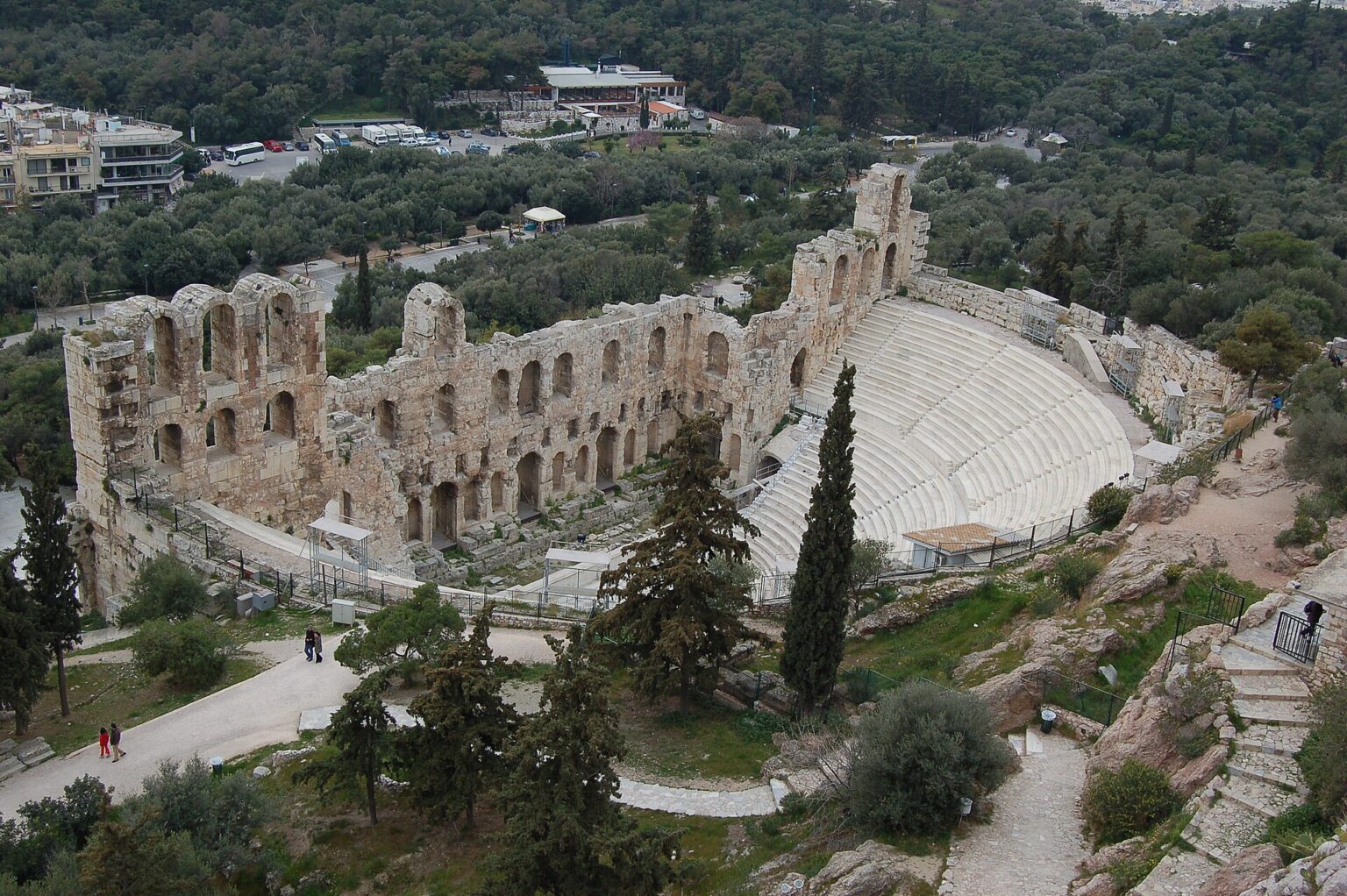
The Ministry of Culture’s record, signed by an archaeologist of the Ephorate, gives the measurements. The cavea is a semicircle of 76 metres in diameter, hewn out of the rock, with 32 rows of white marble seats in 2 tiers separated by a walkway of 1.20 metres. The orchestra is 19 metres across, paved in white marble slabs — that 19 is the orchestra, not the stage. The stage wall survives to 28 metres in height and had 3 storeys: arched openings along the upper part, porticoes of 3 columns and niches for statues below. Its masonry was not solid — poros blocks on both faces with quarry-faced rubble filling the middle.
The roof is the part that engineers still stop at. It spanned a radius of 38 metres with no internal fixings — in the Ministry’s phrase, “a unique construction achievement even in our days”. A roofed odeon of that size is why the building was used above all for musical contests, and why the ancient sources single out the cost of its timber.
Capacity comes with 2 owners and they should not be mixed. For antiquity, the Ministry of Culture gives a total of about 5,000. For the modern auditorium, the Athens Epidaurus Festival, which ran the venue, publishes 4,680 seats — the figure it reached once the re-marbling was finished and the ruined areas above the parodoi had been cleared. One is an archaeological estimate of the ancient building; the other is a seat count of the working theatre, after a 20th-century restoration. There is no single number that means both.

Herodes, Regilla and the cedar roof
The man who paid for it was Tiberius Claudius Atticus Herodes, from a leading Athenian family and a serial benefactor of the city, and he built it in memory of his wife Regilla, who died in 160 AD. It was the third odeon in Athens, after the odeon of Pericles on this same slope in the 5th century BC and the odeon of Agrippa down in the Ancient Agora of Athens in 15 BC.
As for when: the Ministry of Culture states plainly that the exact date of construction is unknown, and brackets it between Regilla’s death and 174 AD, the year the traveller Pausanias visited Athens and wrote about the building with great admiration. The bracket is 160 to 174 AD, and no dedicatory inscription for the Odeon survives.
Pausanias is worth quoting for what he does and does not say. At VII.20.6 he calls the Athenian odeon unrivalled in size and magnificence, built by an Athenian named Herodes “in memory of his dead wife”, and he explains why it is missing from his own book on Attica: he had finished writing about the Athenians before Herodes began the building. He does not name Regilla.
The famous detail — the roof of cedar — comes from somewhere else. It is Philostratus, in the Lives of the Sophists, who writes that Herodes dedicated the theatre to the Athenians in memory of Regilla “and he made its roof of cedar wood, though this wood is considered costly even for making statues”. A nice terminological wrinkle sits in that sentence: Philostratus calls the building a theatre, while Pausanias calls it an odeon. Two contemporaries, two words, one building. The Byzantine Suda, centuries later, independently records that Herodes built the Athenians a stadium “and a roofed theatre”.
Philostratus also tells the story the marble does not. Regilla died in her eighth month of pregnancy after being struck by a freedman of the household, and her brother Braduas brought a charge of murder against Herodes. Herodes was acquitted, and part of his defence, as Philostratus reports it, was the building itself: he would never have dedicated so fine a theatre to her memory had he been guilty. Herodes went further and turned his house into a mourning object, blackening its paintings and rooms with hangings, dyes and the dark marble of Lesbos — which drew from the sophist Lucius the line that he was insulting Regilla by eating white radishes in a black house. An Athenian inscription of the time gives her a gentler epithet: “the light of the house”.
From the Herulians to Maria Callas
The Odeon burned in 267 AD, in the Herulian raid that flattened much of ancient Athens, and unlike other damaged buildings it was never rebuilt. Its south wall was absorbed into the late Roman wall of the 3rd century; in the 13th century the tall stage wall became part of the Rizokastro, the circuit that ringed the base of the Acropolis. By the 14th century the accumulated earth had buried the lower part of the south wall so completely that the entrances were gone, and the Italian traveller Niccolò da Martoni took the whole thing for a bridge.
It stayed useful as masonry. In 1826, during the Ottoman siege of the Acropolis, the French philhellene general Charles Fabvier and his men got into the citadel through the Odeon, carrying supplies and gunpowder to the Greeks holding out above. By 1857 the cavea lay under 12 metres of earth, with crops growing on top of it. The Archaeological Society, with the archaeologist K. Pittakis, cleared it between 1848 and 1858 — 10 years of nothing but shifting earth — and what emerged was in poor condition, only a few rows of seats in place and heavily calcined by the fire.
The theatre came back to life in stages. The first performance of ancient drama in the excavated Odeon was in 1867; repairs followed in 1898, 1900 and 1922. In September 1920, Kalomiris’s Symphony of Valour had its triumphant premiere here in the presence of the Prime Minister, Eleftherios Venizelos. In 1936 wooden seats went into the lower tiers for a state season of ancient drama. And during the German occupation the newly founded Greek National Opera sang on this stage with a young Maria Callas — then still Maria Kalogeropoulou — in Beethoven’s Fidelio and in Kalomiris’s The Master Builder.
The restoration that made the modern venue was decided by the Archaeological Council in 1947, in the middle of the civil war, and directed by Professor Anastasios Orlandos; the present entrance, with its monumental marble and irregular flights of steps down from Dionysiou Areopagitou, was designed by the architect Dimitris Pikionis. The marble work on the monument itself the Ministry dates to 1952-1953, using marble from the Dionysus area. Not everyone approved: the architect and planner Konstantinos Doxiadis publicly opposed re-clading the whole theatre in marble, and the argument slowed the work down. From the middle of the 1950s the Odeon has been the home of the Athens Festival — the run of summers that ended, roughly 7 decades later, on 30 June 2026.
Nearby, with their own free audio guides
The obvious pairing is the Acropolis, because it is literally the same €30.00 ticket and the same visit: come down from the rock through the Beulé Gate and the South Exit and you are on the slope. Below it lies the Ancient Agora of Athens, which holds the odeon of Agrippa — the second of the 3 Athenian odeons, and the one this building came after. And for a working open-air theatre rather than a closed one, Lycabettus Hill has a 3,000-seat amphitheatre in an old quarry, free to walk up to. All of them, and the rest of the city, are on the free audio guides of Athens page.
Reading this in Spanish? The same guide, written for a Spanish-speaking visitor and narrated in Spanish, is at Odeón de Herodes Ático en vozviajera.com.
Tickets for the Acropolis and its Slopes
| Ticket | Price | What it covers |
|---|---|---|
| Acropolis and its Slopes, full | €30.00 | The rock of the Acropolis, the South Slope and the North Slope. Single use. Checked 22-09-2026 |
| Acropolis and its Slopes, reduced | €15.00 | The same. Checked 22-09-2026 |
| Saturday 26 and Sunday 27 September 2026 | Free | Last weekend of September: free entry for everyone |
| Visitors with a disability, and 1 companion from 67% | Free | On presentation of ID or passport and a disability certificate |
| Entry inside the Odeon | Not sold | Only ever with a Festival performance ticket; closed since 01-07-2026 |
Swipe to see the other columns
Where to find it
FAQs · Odeon of Herodes Atticus
Is the Odeon of Herodes Atticus closing?
It has already closed. It has been shut since 1 July 2026, and the Greek Ministry of Culture states the works will last at least 3 years from the time they begin.
The last performance was on 30 June 2026. The Ministry has published no reopening date, and the Athens Epidaurus Festival has already announced a 2027 programme that runs without this venue. Checked on 22 September 2026.
Can you visit the Odeon of Herodes Atticus?
You can see it, but you cannot go inside. The facade and the 3-storey stage wall are in full view from the Dionysiou Areopagitou pedestrian street, and looking at them costs €0.00.
The interior has never been part of the archaeological visit: the Odeon is not among the 7 monuments the Ministry lists as visitable on the South Slope, and the marked route through the enclosure ends at the west parodos of the Theatre of Dionysos. The only way in was a performance ticket, and there are no performances.
Is the Odeon of Herodes Atticus included in the Acropolis ticket?
The ground around it is; the building is not. The €30.00 "Acropolis and its Slopes" ticket gets you into the South Slope enclosure, at whose western end the Odeon stands, and into the rock of the Acropolis and the North Slope.
It does not open the Odeon itself, which has no ticket of its own and is not sold as a visit. Price checked on 22 September 2026 at the state ticket office.
Do you need tickets for the Odeon of Herodes Atticus?
Not to look at it from the street — that is free and always has been. For the surrounding archaeological site you need the "Acropolis and its Slopes" ticket: €30.00 full, €15.00 reduced.
Two things to know about it. It carries a compulsory time slot, changeable up to 2 hours before and up to 2 times, and it is single use: leave either the Acropolis or the South Slope and the same ticket will not let you back into either.
What are the opening hours of the Acropolis South Slope?
Today, 22 September 2026, 08:00 to 19:00, with last entry at 18:30.
There are 6 bands across the year: 1 April to 31 August, 08:00-20:00; 1 to 15 September, 08:00-19:30; 16 to 30 September, 08:00-19:00; 1 to 15 October, 08:00-18:30; 16 to 31 October, 08:00-18:00; and 1 November to 31 March, 08:00-17:00. Last entry is 30 minutes before closing. The site shuts on 1 January, 25 March, 1 May, Easter Sunday, 25 and 26 December.
When will the Odeon of Herodes Atticus reopen?
No reopening date has been published. What the Ministry of Culture has stated, in the words of the Minister of Culture Lina Mendoni on 23 February 2026, is that the works "will last at least 3 years from the time they begin", without dating that beginning.
What is known about the seasons ahead: the Athens Epidaurus Festival's call for its 2027 programme, published on 5 August 2026, states the Odeon "remains unavailable due to ongoing restoration works" and lists Epidaurus, the Little Theatre of Ancient Epidaurus and Peiraios 260 as the venues instead.
FAQs
How do the free audio guides work?
Our audio guides work through the website audioguidetravel.com; you don’t need to download any app. Just follow the instructions on the website to guide you through Odeon of Herodes Atticus while listening to our experts’ explanations.
Can I take the tour at my own pace?
Of course! Our free audio guides are designed so that you set the pace. You can pause, rewind, or listen as many times as you want without missing a detail. By visiting Odeon of Herodes Atticus your way, you’ll enjoy it even more.
If I'm in a group, can we use the same audio guide?
Yes, our website allows sharing the same free audio guide among multiple devices. This way, you can visit Odeon of Herodes Atticus as a group or family, listening to the explanations simultaneously. The quickest way to do this is to share the link via WhatsApp, email, or any method you like. I’ve included some buttons below for you to do that now.
Visitor information
As of 22 Sep 2026- Opening hours
- You cannot go inside: the Odeon has been closed for restoration since 1 July 2026. The Acropolis South Slope, the site it stands in, opens today 08:00 to 19:00, last entry 18:30.The interior of the Odeon has never been part of the archaeological visit: it only ever opened with a performance ticket from the Athens Epidaurus Festival. Since 1 July 2026 there are no performances either — the Greek Ministry of Culture has closed the monument for a full restoration which, in the words of the Minister of Culture Lina Mendoni on 23 February 2026, will last at least 3 years from the time it begins. No reopening date has been published, and the Festival has already announced its 2027 programme without this venue. What is open is the archaeological enclosure of the South Slope, on these hours: 1 April to 31 August, 08:00-20:00; 1 to 15 September, 08:00-19:30; 16 to 30 September, 08:00-19:00; 1 to 15 October, 08:00-18:30; 16 to 31 October, 08:00-18:00; 1 November to 31 March, 08:00-17:00. Last entry is 30 minutes before closing. The site shuts on 1 January, 25 March, 1 May, Easter Sunday, and 25 and 26 December, and keeps special hours on Good Friday, 12:00 to 17:00, and Holy Saturday, 08:30 to 15:30. The North Slope is different: 08:30 to 15:30 since 1 November 2025. Checked on 22 September 2026.
- Tickets
- €30.00 (“Acropolis and its Slopes” ticket) · Reduced €15.00The Odeon has no ticket of its own. What you buy is the “Acropolis and its Slopes” ticket, €30.00 full and €15.00 reduced, which covers the rock of the Acropolis, the South Slope and the North Slope. It is sold at the state ticket office, tickets.hh.gr, with a compulsory time slot: changeable up to 2 hours before the visit and up to 2 times per ticket, and not refundable. One thing worth carrying with you: the ticket is single use, so if you leave the Acropolis you cannot then enter the South Slope on it, or the other way round. It includes access to the Ministry's official digital audio guide app. Entry is free for everyone on 6 March, 18 April, 18 May, the last weekend of September and 28 October, and on the first and third Sunday of each month between 1 November and 31 March; in 2026 that September weekend is Saturday 26 and Sunday 27. Price checked on 22 September 2026 at the official ticket office.
- Best time to go
- Late afternoon, from Dionysiou Areopagitou
- Getting there
- The metro is Akropoli (line 2). From the exit it is about 320 metres of flat pedestrian street to the South Slope gate, at the junction of Thrasyllou and Dionysiou Areopagitou; the Odeon is at the far end of that same street, about 800 metres.Metro Akropoli, line 2, then along Dionysiou Areopagitou and Thrasyllou street: that is the route the Ministry of Culture's own record gives. Bus line 230 also stops here. The 2 distances above are measured on OpenStreetMap and are not published by any official source. You can enter the South Slope by its own gate, at the junction of Thrasyllou with Dionysiou Areopagitou, or come down from the Acropolis: after the Beulé Gate, signage leads south to the South Exit and the South Slope entrance. The accessible toilets are outside the enclosure, at the Information Centre at Dionysiou Areopagitou 18-20, 50 metres east of the entrance. The enclosure is wheelchair-accessible from the main gate as far as the west parodos of the Theatre of Dionysos.
- Address
- Odeon of Herodes Atticus, Dionysiou Areopagitou pedestrian street, Athens, Greece · South Slope entrance: junction of Thrasyllou street and Dionysiou Areopagitou
- Official website
- odysseus.culture.gr
Nearby
More free audio guides in Athens
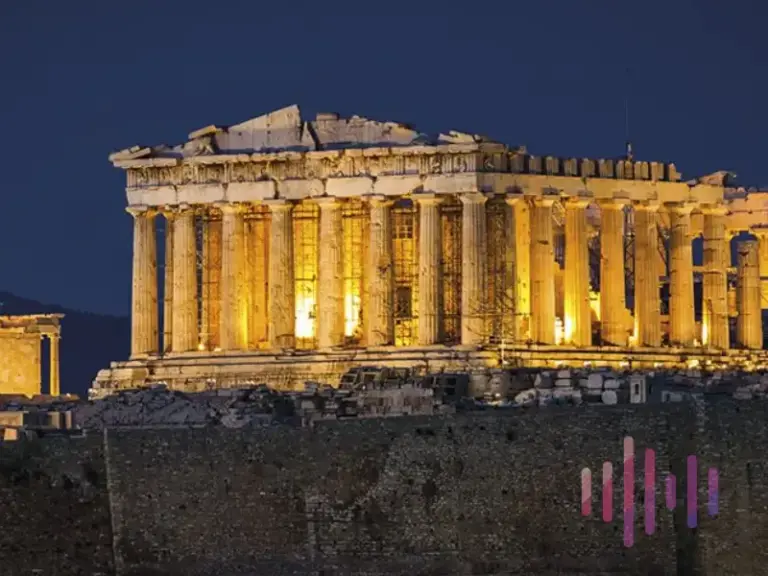 6:59AthensAcropolisUnquestionably, the crown jewel of Athens: the Acropolis. This ancient citadel rises majestically above the city, offering not…
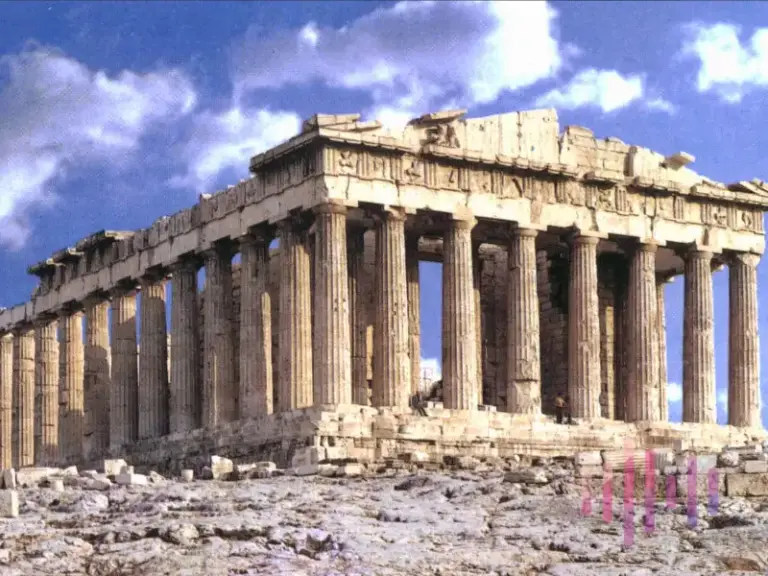 8:00AthensParthenonWelcome to the heart of Athens, where every stone tells a story! Imagine a place where ancient Greece…
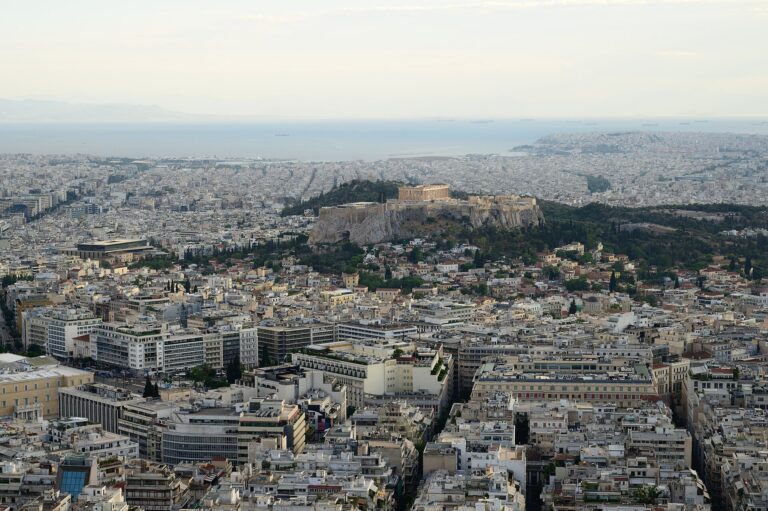 7:00AthensLycabettus HillThis free audio guide to Lycabettus Hill plays straight from your phone — no app, no sign-up —…