
Louvre Museum: free audio guide, tickets and opening hours
Free audio guide in English · no app, no sign-up
The Louvre Museum is the former palace of the kings of France, a museum since 1793: about 35,000 works on show, from the Mona Lisa to the Winged Victory of Samothrace. This free audio guide lasts about 4 minutes and takes you from the pyramid to its 3 most famous works.
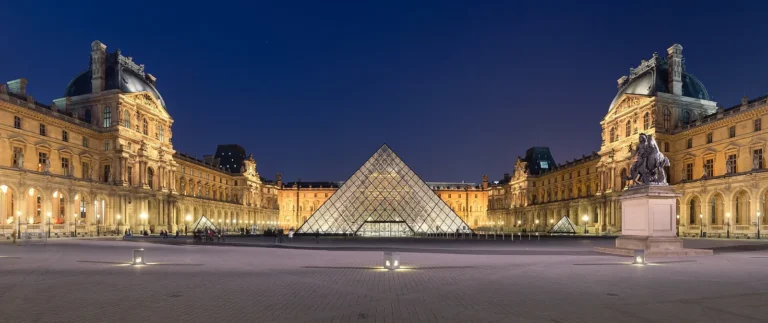 Audio guide
Before you go in
The few things that change your visit.
- Open 9:00 to 18:00, until 21:00 on Wednesdays and Fridays; closed on Tuesdays
- Tickets are €32 for visitors from outside the European Economic Area and €22 for EEA citizens and residents
- The first Friday of every month is free from 6pm, except in July and August
- 4 entrances: the Pyramid is the main one; Carrousel and Porte des Lions are for ticket holders only
- About 35,000 works on show; the Mona Lisa hangs in the Salle des États
The Louvre Museum fills the former palace of the kings of France on the Seine and shows around 35,000 works, from the Mona Lisa to the Winged Victory of Samothrace. It opens every day except Tuesday from 9am, and a ticket costs €22 or €32 depending on your citizenship or residence. This free audio guide runs about 4 minutes and takes you from the pyramid to the 3 works everyone comes for.
What the Louvre audio guide covers
Press play in the courtyard by the pyramid and keep it running as you go up: each part tells you where to look. There are 5 parts:
| A castle under the museum | Philip Augustus’s fortress from the late 12th century, and how it became a palace. |
| From palace to museum | Why the kings left for Versailles and how the museum opened in 1793. |
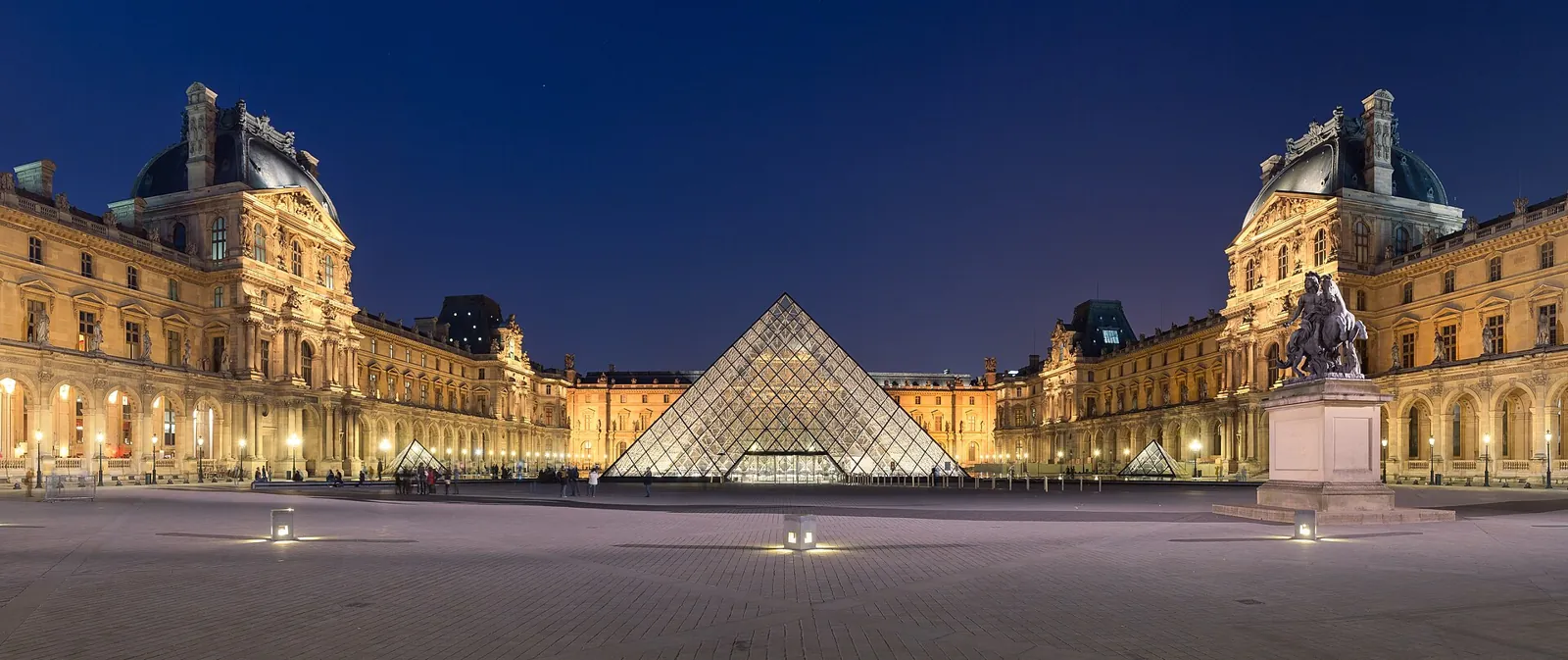
| The pyramid | The glass entrance that opened in 1989 and changed the way you walk in. |
| The Winged Victory | The winged goddess at the top of the Daru staircase. |
| The Mona Lisa | The portrait Francis I bought, and the day it vanished from its room. |
Louvre opening hours and ticket prices
The Louvre is open 9am to 6pm on Monday, Thursday, Saturday and Sunday, and 9am to 9pm on Wednesday and Friday. It is closed on Tuesdays, and on 1 January, 1 May and 25 December. Last entry is 1 hour before closing, and staff start clearing the rooms 30 minutes before.
Since 14 January 2026 the price depends on your citizenship or residence. If you are not a citizen of the European Economic Area, or a resident with a residence permit or a visa of more than 3 months (the EU plus Iceland, Liechtenstein and Norway), which covers visitors from the US, the UK, Canada and Australia, the ticket is €32. Citizens and residents of the EEA pay €22. There are no concession tickets: you either pay the full price or get in free.
Admission is free for everyone under 18, whatever their nationality, and for EEA citizens and residents under 26, with photo ID (residents also need a residence permit of more than 90 days). Disabled visitors and the person with them also go free. Even if you don’t pay, the museum advises you to book a time slot online and pick the free option that applies to you, and on some busy dates booking is required for everyone: check the official website before you go. Your ticket also covers the temporary exhibitions (Hall Napoléon exhibitions need their own time slot) and the Musée Eugène-Delacroix on the same day or the next.
Tickets can’t be exchanged or refunded, and you can’t change the date or time once booked. At the museum ticket desk, when tickets are left, you can pay by card, in cash or with Chèques-Vacances holiday vouchers, in euros only. The museum’s own audio guide costs €6; this one is free and lives on your phone.
Which entrance to use and getting there
The nearest metro station is Palais-Royal / Musée du Louvre, on lines 1 and 7; Pyramides, on line 14, is close too. Buses 21, 27, 39, 67, 68, 69, 72, 74, 85 and 95 stop nearby, and the Batobus river shuttle stops at Quai François-Mitterrand.
The museum has 4 entrances, and not all of them are open to everyone:
- The Pyramid is the main entrance, with 3 lines: green for visitors with a ticket or a Paris Museum Pass, orange for those without one, and blue, the priority line, for disabled visitors. The lift inside the pyramid is for disabled visitors, wheelchair users and people with strollers.
- The Carrousel entrance, at 99 rue de Rivoli, is for visitors who already have a ticket.
- The Porte des Lions, on Quai François-Mitterrand, only lets in visitors with a ticket. It closes at 6pm, last entry is 5pm, and it is shut on Tuesdays.
- Passage Richelieu is for groups, members and some card holders, not for individual visitors, unless they are joining a museum activity or an auditorium event.
Everyone goes through a security check, as the museum follows France’s Vigipirate security plan. Plan what you want to see before you head out: leaving is final, and your ticket won’t get you back in.
From fortress to museum: a short history of the Louvre
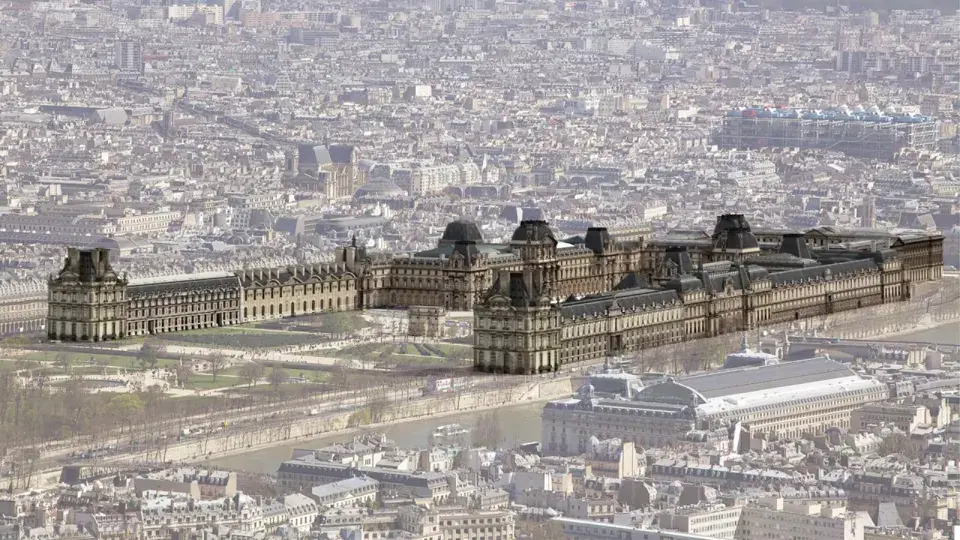
The Louvre started out as a castle. King Philip Augustus built it in the late 12th century to guard Paris from the west, at a time when the English still held Normandy. In the 14th century Charles V turned it into a royal home, and in 1546 Francis I began rebuilding it in Renaissance style.
For more than a century the kings kept adding to it. Then in 1682 Louis XIV moved his household to Versailles, and the Louvre became the place where the royal collection was kept and the art academies met. The Revolution did the rest: the museum opened on 10 August 1793 with 537 paintings, 3 in 4 from the royal collections and the rest seized from the Church and from émigré nobles.
The last big change came under President Mitterrand. The architect I. M. Pei moved the entrance underground, beneath the Cour Napoléon, and capped it with a glass pyramid. The underground lobby opened on 30 March 1989. Today the museum holds around 500,000 objects and shows about 35,000 of them in 8 departments, from Egyptian antiquities to French painting.
The Mona Lisa, the Winged Victory and the Venus de Milo
Most visitors come for the same 3 works, and they are close together: the first 2 in the Denon wing and the Venus in the Sully wing. A good order is the Victory first, then up to the Mona Lisa, then back down to the Venus.
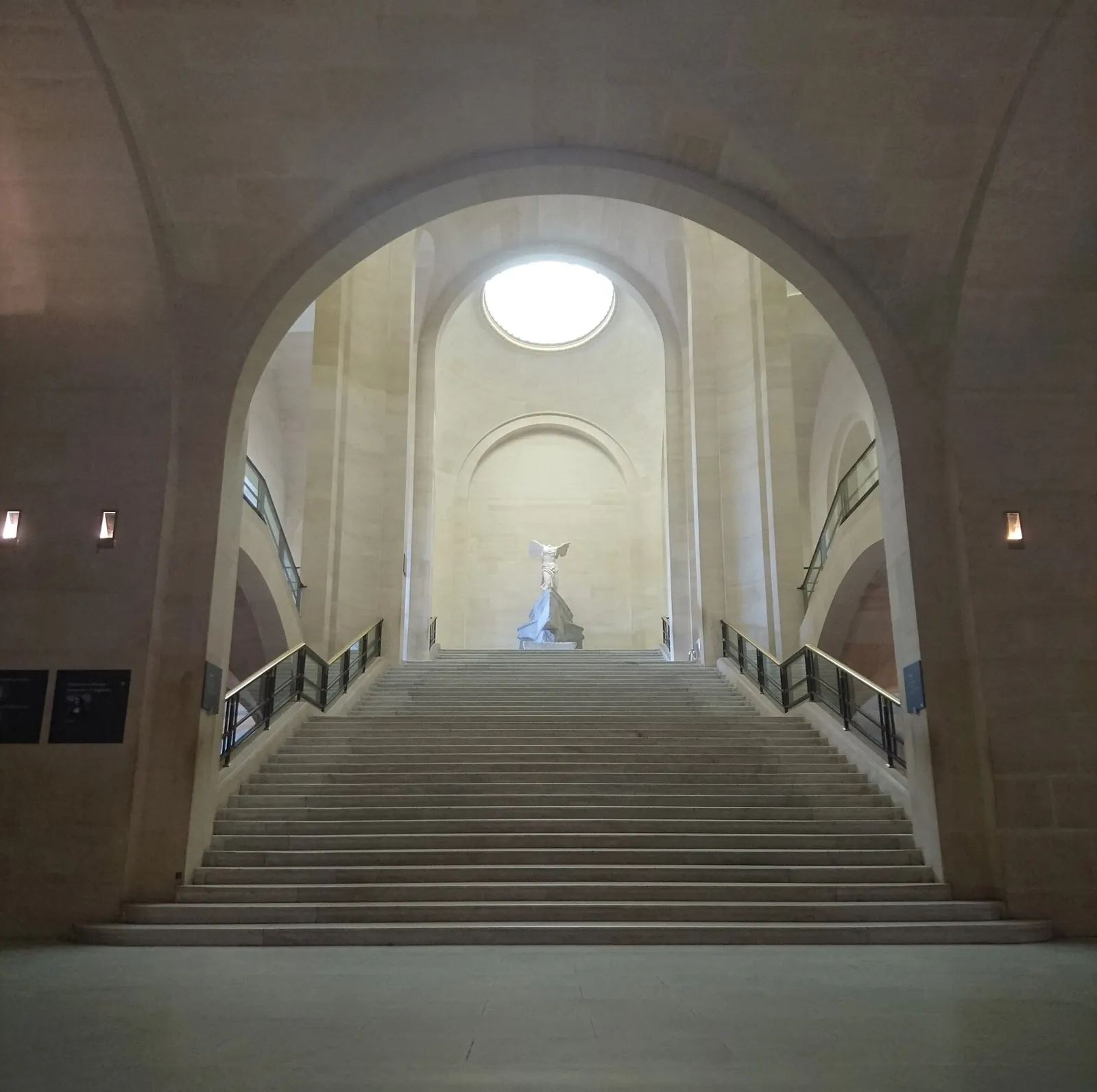
The Winged Victory of Samothrace is a marble goddess with wings, caught as if landing on the prow of a ship. She was found in 1863 on the island of Samothrace, in the Aegean, and has stood at the top of the Daru staircase since 1883. You see her from below as you climb, and that is how she looks her best.
Leonardo da Vinci’s Mona Lisa hangs in the Salle des États, facing Veronese’s huge canvas, The Wedding Feast at Cana. She belonged to the collection of Francis I, who acquired her around the time of Leonardo’s death. On 21 August 1911 she disappeared: Vincenzo Peruggia, an Italian glazier who wanted to take her back to Italy, walked off with her. She was found in Florence in December 1913 and returned to the Louvre in January 1914, and the theft made her more famous than ever.
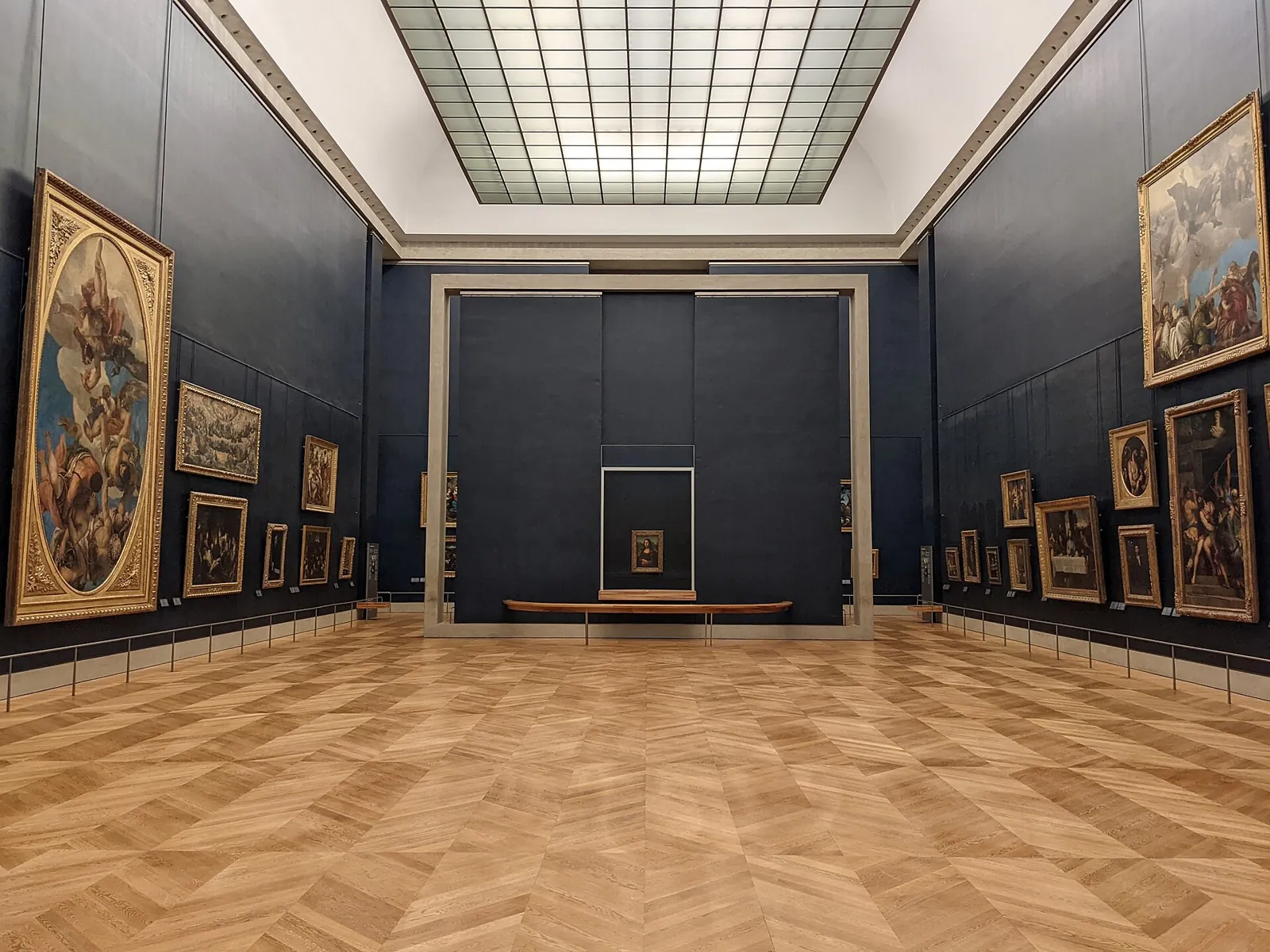
Be patient in this room: the Mona Lisa sits behind glass, at a distance, and there is always a crowd in front of her. Take time for the rest of the room too, which is full of 16th-century Venetian painting.
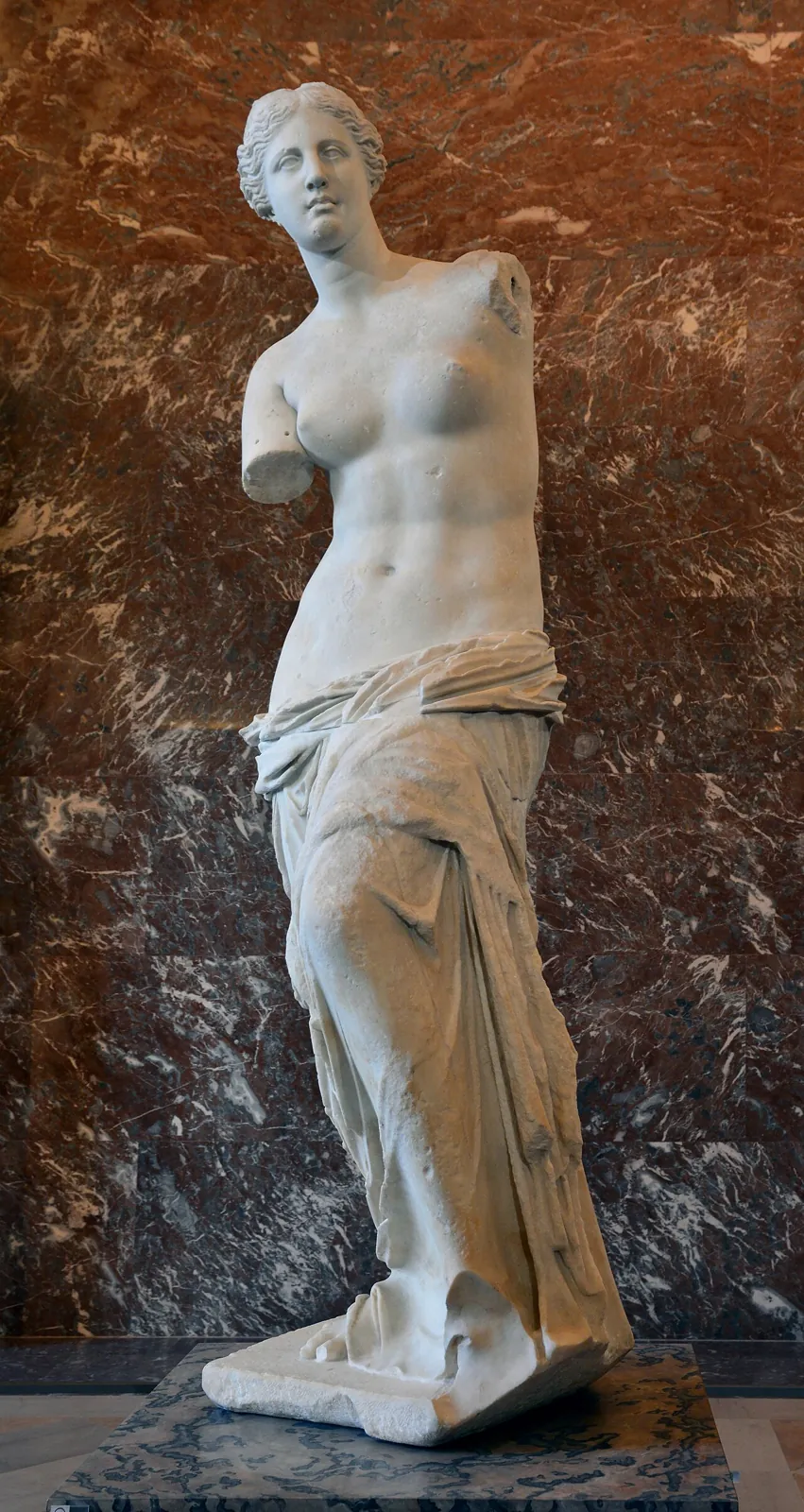
The Venus de Milo stands on the ground floor, in the Greek antiquities galleries. She is an armless marble Aphrodite, and she reached the Louvre under Louis XVIII, shortly after turning up on the Greek island of Milos. Walk all the way round her: she is worth seeing from the side and from behind as well.
How to plan your Louvre visit
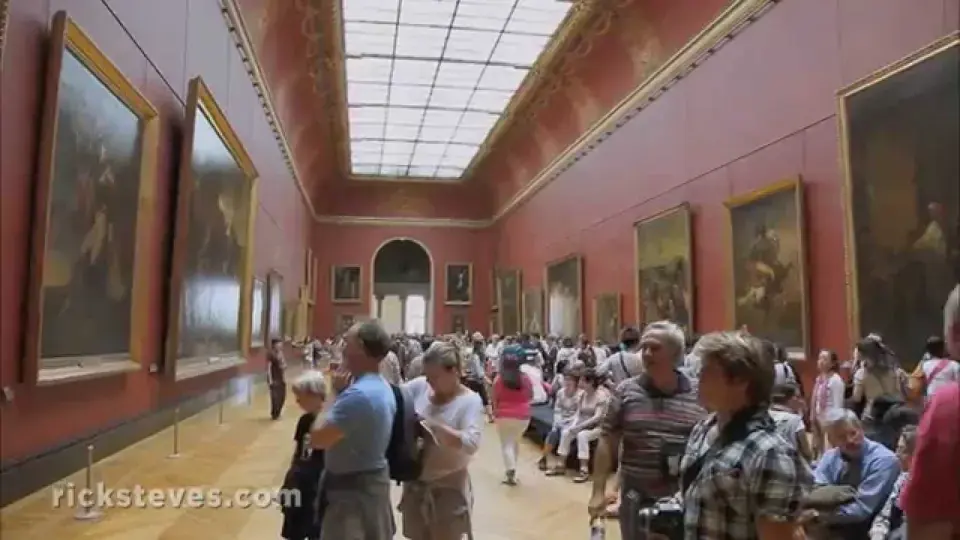
You can’t see the Louvre in a day, and there’s no need to try. Pick 1 or 2 wings and add the 3 famous works. A few ideas, all inside the same palace:
- The medieval Louvre moats, in the basement of the Sully wing: the walls of Philip Augustus’s castle, which you hear about in the first part of the audio guide.
- The Galerie d’Apollon, all gold, on the first floor of the Denon wing, right by the Winged Victory.
- The Grande Galerie, with the Italian paintings, next to the Salle des États.
- The Napoleon III Apartments, in the Richelieu wing, with their chandeliers and velvet.
- The Crypt of the Sphinx, the way into Egyptian art.
Because of renovation work, some rooms close on some days. Before you go, check the list of open galleries on the official website; at the museum, pick up a map at an information desk. It comes in 9 languages.
On Wednesdays and Fridays the museum stays open until 9pm, and an evening visit leaves your morning free. Outside, the Tuileries Garden, free to enter, runs along the palace axis to Place de la Concorde.
If you’re staying in the centre, Notre-Dame and the Sainte-Chapelle are on the Île de la Cité, a short walk along the Seine.
 Free audio guideNotre-Dame de Paris
 Free audio guidePalace of Versailles
Where to find it
FAQs
How do the free audio guides work?
They play right here on audioguidetravel.com, with no app to download and no sign-up. Press play and listen as you walk round: a phone and a pair of headphones are all you need. The audio streams from this page, so you’ll need mobile data or Wi-Fi.
Can I take the tour at my own pace?
Of course! You set the pace: pause whenever you like, jump back or forward 15 seconds, or tap the bar to jump to any point, and listen as many times as you want so you don’t miss a thing.
If I'm in a group, can we use the same audio guide?
Yes. The same free audio guide opens on as many phones as you like, so you can go round together as a group or with your family, each person at their own pace and with their own headphones. The quickest way is to send the link via WhatsApp, Telegram or however you like: the buttons just below let you share it right now.
Visitor information
As of 18 Oct 2026- Opening hours
- Mon, Thu, Sat and Sun 9:00-18:00; Wed and Fri 9:00-21:00. Closed on Tuesdays. Last entry 1 hour before closing.
- Tickets
- €32 for non-EEA visitors, €22 for EEA citizens and residents. Free under 18, and for EEA under-26s.
- Time needed
- Audio guide about 4 min; for the museum, set aside half a day and pick 1 or 2 wings.
- Getting there
- Metro 1 or 7 to Palais-Royal / Musée du Louvre; metro 14 to Pyramides. Main entrance through the Pyramid.
- Accessibility
- Blue priority line and a lift at the Pyramid. Free with proof for disabled visitors and one companion.
- Tip
- Leaving is final: your ticket won't let you back in, so decide what you want to see before you head out.
- Official website
- www.louvre.fr
Nearby
More free audio guides in Paris
 4:07ParisSainte-Chapelle: free audio guide, tickets and opening hoursThe Sainte-Chapelle is Louis IX’s Gothic chapel on the Île de la Cité, consecrated in 1248 to hold…
 5:02ParisPalace of Versailles: free audio guide, hours and ticketsThe Palace of Versailles was home to the French court from 1682 to 1789: the Royal Chapel, the…
 3:40ParisNotre-Dame de Paris: free audio guide, opening hours and towersNotre-Dame de Paris is the city’s great Gothic cathedral, on the Île de la Cité, begun in 1163…