
Barcelona Cathedral: free audio guide, hours and tickets
Free audio guide in English · no app, no sign-up
Free audio guide to Barcelona Cathedral, in English: 7 minutes from the facade and the crypt of Saint Eulalia to the choir, the cloister with its 13 geese and the rooftop, playing on this page.
 Audio guide
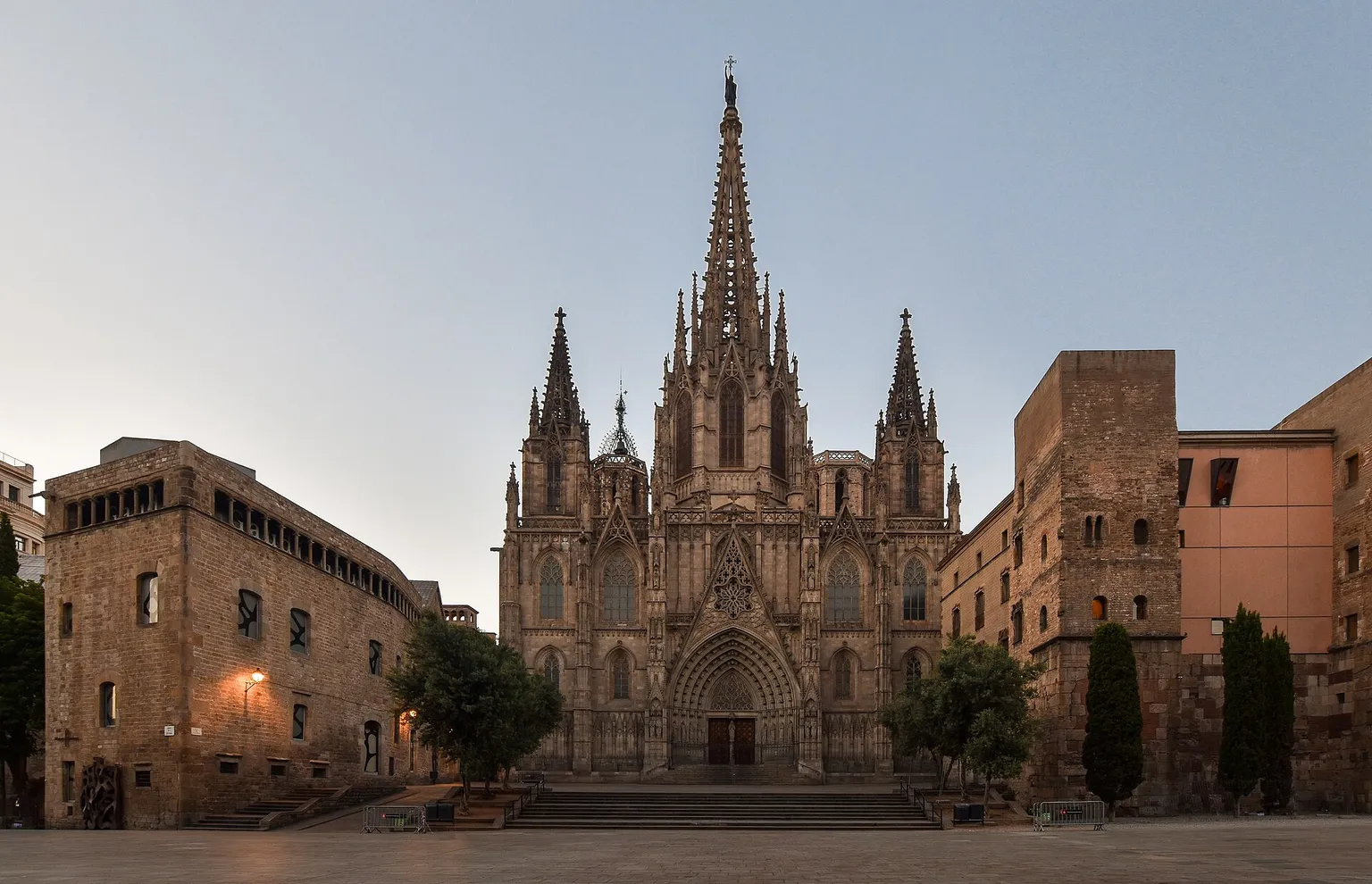
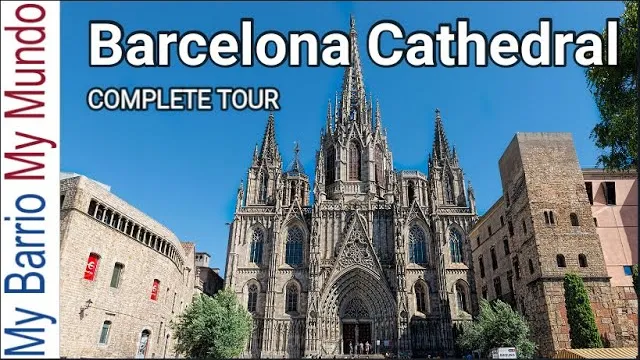
Barcelona Cathedral, the Cathedral of the Holy Cross and Saint Eulalia, is the Gothic cathedral of the Gothic Quarter, begun on 1 May 1298 on Pla de la Seu. Inside are the crypt of Saint Eulalia, a choir with Golden Fleece stalls, a rooftop reached by lift and a cloister with 13 white geese. A tourist ticket costs €16. This is its free audio guide, in English.
What the audio guide covers
It is free, it plays on this page in your phone’s browser, with no app and no sign-up, and it lasts about 7 minutes. It follows the visit in order: the main facade on Pla de la Seu and the 3 doors, the naves and their painted keystones, the choir of the Golden Fleece, the crypt of Saint Eulalia, the Chapel of the Holy Christ of Lepanto, the Noli me tangere window and the organ, the cloister with its fountain and 13 white geese, and the rooftop, reached by lift.
Some points of interest described in the Barcelona Cathedral audio guide:
| Point of Interest | Brief Description |
|---|---|
| Main facade and the 3 doors | The front on Pla de la Seu, undertaken by Manuel Girona; his children finished the work with the cimborio in 1913. |
| Naves and keystones | 3 naves and 215 carved keystones from the 14th and 15th centuries, found in 1970 to have once been painted. |
| Choir | Begun in 1390, with the coats of arms of the Knights of the Golden Fleece, who met in Barcelona in 1519. |
| Crypt of Saint Eulalia | The painted marble sarcophagus of 1339, whose reliefs tell the martyr’s story from left to right. |
| Chapel of the Holy Christ of Lepanto | Built by Arnau Bargués in 1407, with the Baroque tomb of Saint Olegarius. |
| Noli me tangere window and the organ | The most important stained glass, from drawings by Bartolomé Bermejo (1495), and the Grand Organ of 1537-1539. |
| Cloister | Finished in 1448: a Romanesque marble door, the fountain of the dancing egg and 13 white geese. |
| Rooftop | Reached by lift from beside the Sant Iu door, between 2 octagonal bell towers 54 metres high. |
Hours, tickets and the 3 doors
The tourist visit runs on 3 timetables. From Monday to Friday it is open from 09:30 to 18:30, with the last entry at 17:45. On Saturdays and on the eves of religious holidays it is open from 09:30 to 17:15, with the last entry at 16:30. On Sundays and religious holidays the visit is shorter: 14:00 to 17:00, with the last entry at 16:30.
The individual ticket is €16. Students up to the age of 25 and large or single-parent families pay €14, showing proof at the cathedral ticket office. Entry is free for visitors with a disability of 33% or more and for ICOM members, and groups pay €8 per person. One ticket covers everything that is open to visitors: the cathedral floor and the cloister, the rooftop, the choir, the Chapter Hall, the Jewish memory space and the Chapel of the Holy Christ of Lepanto.
There are 3 ways in. The main door faces Pla de la Seu. The Santa Eulàlia door, on Carrer del Bisbe, is the step-free entrance for visitors with reduced mobility. The third is the Sant Iu door; the lift to the rooftop leaves from next to it. (Hours and prices from the cathedral’s visiting-hours page, checked on 3 October 2026.)
The cloister and its 13 white geese
The cloister is Gothic, built in the 14th and 15th centuries and finished in 1448. It has 4 galleries of pointed arches, and the chapels along 3 of them were each dedicated to the patron saint of a guild or an institution, or to a family. The door between the cathedral and the cloister is older than the rest: a Romanesque door of white marble with geometric patterns on its arches, which is said to come from the earlier Romanesque cathedral. Look up at the pillars, too: their reliefs tell stories from the Old Testament, and the keystones of the vaults show scenes from the New.
In the middle there is a garden with palm trees, magnolias and an orange tree, a fountain from the mid-15th century and a large pond. The pond is home to 13 white geese, 1 for each year of Saint Eulalia’s age when she was martyred, as tradition has it.
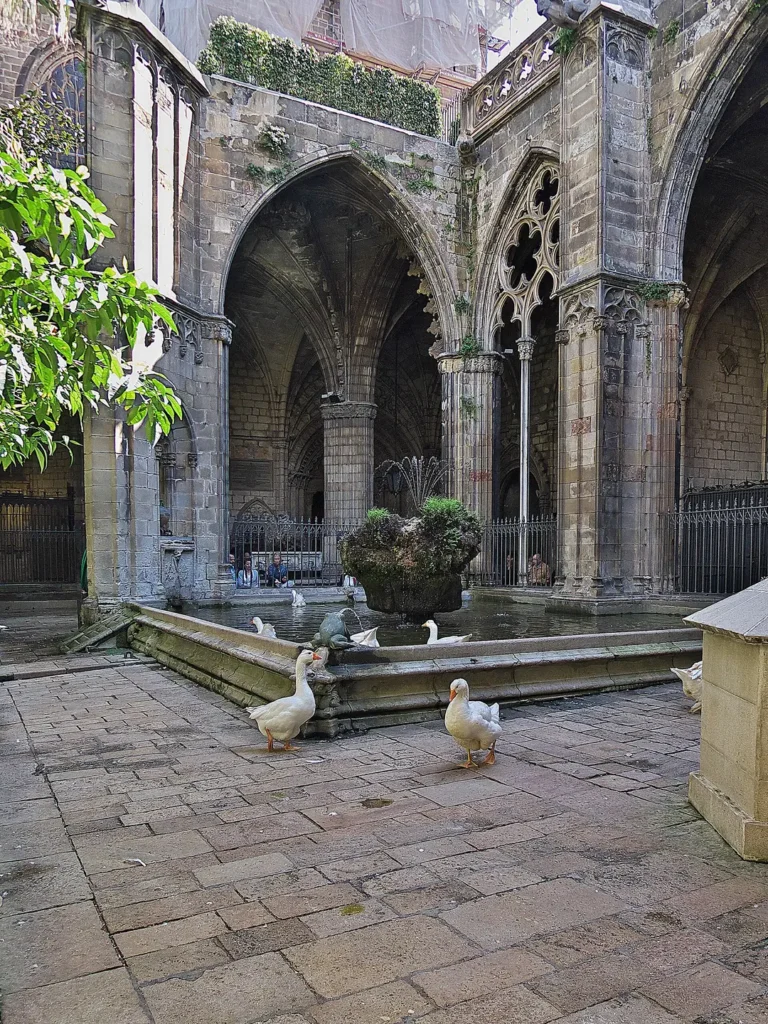
The fountain has its own day of the year. At Corpus Christi it is decorated with flowers and red cherries and an egg is set to “dance” on its jet of water: the ou com balla. The cathedral was the first place in Barcelona to do it, at least since 1636.
Inside: the crypt, the choir and the Chapter Hall
The Gothic church has 3 naves, a single apse with an ambulatory and a ring of side chapels. From outside it measures 93 metres long, 40 metres wide and 28 metres high at the central nave; the bell towers reach 54 metres. It has 215 carved keystones from the 14th and 15th centuries, and in the restoration of 1970 it was found that they had once been painted in colour.
Under the presbytery is the crypt of Saint Eulalia, the young martyr of Barcelona who, as tradition has it, was 13 when she died in 304. Her sarcophagus is of painted marble, by a sculptor from the area of Pisa, and was inaugurated in 1339. Its reliefs tell her story from left to right: her trial before the Roman prefect Dacian, her martyrdom, the search for her body and its transfer to this crypt, watched by the king and 4 bishops. Behind it is her original tomb, found in 878.
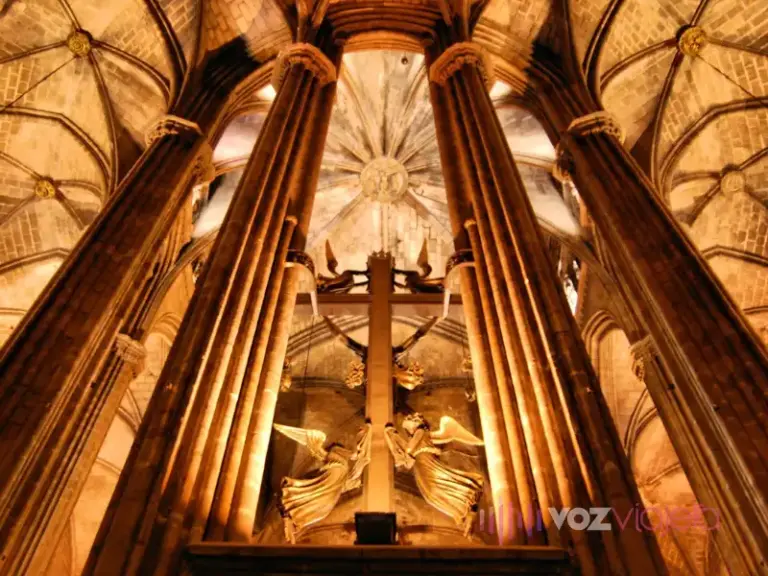
The choir was begun in 1390. Its wooden stalls are among the most important Catalan Gothic sculpture, with tall canopies and pinnacles carved by Michael Lochner and Johan Friedrich at the end of the 15th century. On the backs of the seats you can see the painted coats of arms of the Knights of the Golden Fleece, the order that the Emperor Charles V called to meet in Barcelona in 1519; Juan de Borgoña painted them in 1517 and 1518. The marble wall behind the choir, begun in 1519 by Bartolomé Ordóñez, has 4 reliefs of the life of Saint Eulalia.
Along the cloister, the old Chapter Hall is now a museum space. Of special interest are an 11th-century baptismal font from the Romanesque cathedral and the Pietà painted in 1490 by Bartolomé Bermejo. Bermejo also drew, in 1495, the cartoons for the Noli me tangere window, the most important stained glass in the cathedral, in the baptistery chapel. The Chapel of the Holy Christ of Lepanto keeps the 16th-century Holy Christ of Lepanto above the Baroque tomb of Saint Olegarius; it is a place of prayer, so do not enter or take photos during services.
The Grand Organ hangs in the upper gallery over the Sant Iu door, under the bell tower. It was built between 1537 and 1539, restored between 1985 and 1994, and since 1990 it has had its own cycle of organ concerts, held once a month.
Up on the rooftop
The lift to the rooftop leaves from the chapel of the Holy Innocents, next to the Sant Iu door, and it is included in the ticket. Up there you walk on the terraces between the 2 octagonal bell towers, the 2 side pinnacles and the cimborio, the tower over the main entrance, which is crowned by the Holy Cross held up by a figure of Saint Helena. Below you is the cloister, and around you the roofs of the Gothic Quarter.
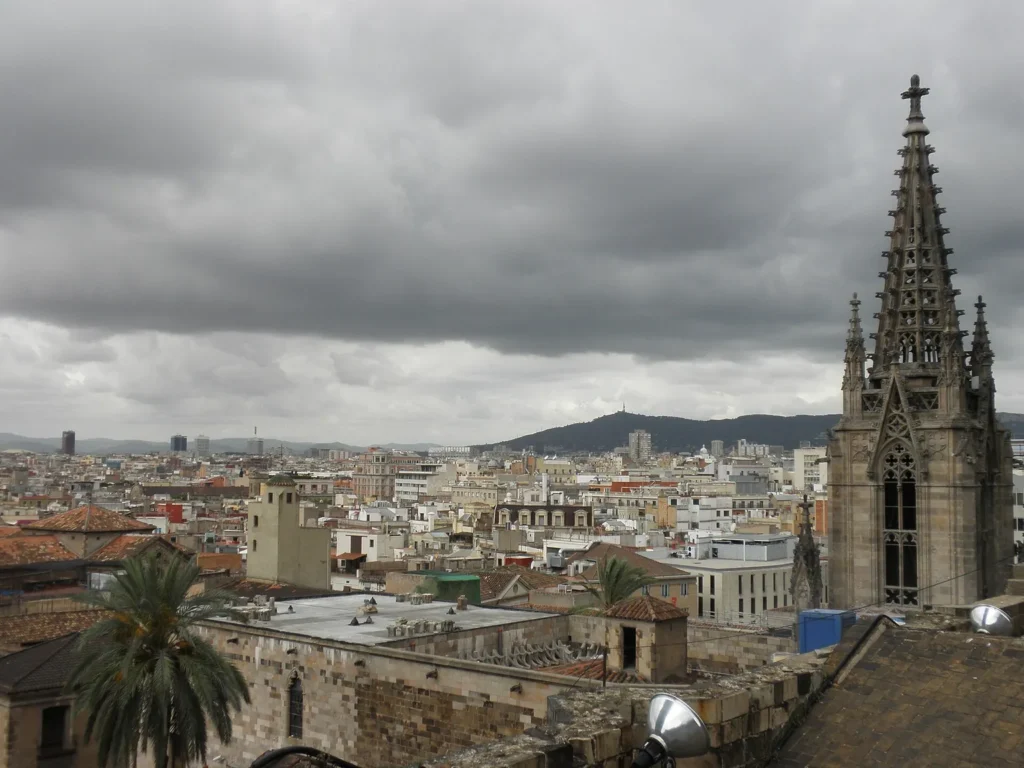
Every 3 May at 09:00, on the Day of the Holy Cross, the city is blessed from these rooftops, and anyone can come to watch.
 Free audio guideSagrada Familia
A short history in 6 dates
- 304 — Saint Eulalia is martyred during the persecution ordered by the Emperor Diocletian.
- 4th century — a first Christian basilica with 3 naves is built here; its remains have been found under Carrer dels Comtes, along the east wall of the cathedral.
- 1058 — on 18 November a Romanesque cathedral, begun in 1046 by Count Ramon Berenguer the Old and his wife Almodis, is consecrated.
- 1 May 1298 — the Gothic cathedral is begun, under Bishop Bernat Pelegrí and King James II; the building is almost complete by the middle of the 15th century.
- 1448 — the cloister is finished.
- 1913 — the cimborio is completed. The facade and its 2 side towers, on plans by the architect Josep O. Mestres inspired by the original 15th-century design, were undertaken by the industrialist Manuel Girona, and his children finished the work.
Getting there, and what is nearby
The cathedral is at Pla de la Seu, in the heart of the Gothic Quarter. The Metro station is Jaume I, on Line 4, a few minutes’ walk away through the old streets. Each of these places has its own free audio guide:
- Palau de la Música Catalana — the modernist concert hall, a short walk north-east through the old town.
- La Rambla — the city’s best-known boulevard, on the western edge of the Gothic Quarter.
- La Boqueria Market — the food market on La Rambla.
- Basilica of the Sagrada Família — Gaudí’s basilica, a Metro ride away.
 Free audio guidePalau de la Música Catalana
All of them are on the free audio guides of Barcelona page. The same guide in Spanish is at Catedral de Barcelona en vozviajera.com.
Where to find it
FAQs
How do the free audio guides work?
They play right here on audioguidetravel.com, with no app to download and no sign-up. Press play and listen as you walk round: a phone and a pair of headphones are all you need. The audio streams from this page, so you’ll need mobile data or Wi-Fi.
Can I take the tour at my own pace?
Of course! You set the pace: pause whenever you like, jump back or forward 15 seconds, or tap the bar to jump to any point, and listen as many times as you want so you don’t miss a thing.
If I'm in a group, can we use the same audio guide?
Yes. The same free audio guide opens on as many phones as you like, so you can go round together as a group or with your family, each person at their own pace and with their own headphones. The quickest way is to send the link via WhatsApp, Telegram or however you like: the buttons just below let you share it right now.
Visitor information
As of 3 Oct 2026- Opening hours
- Tourist visits: Mon–Fri 09:30–18:30 · Sat and eves of religious holidays 09:30–17:15 · Sun and religious holidays 14:00–17:00.
- Tickets
- €16
- Getting there
- Metro L4, Jaume I station, a few minutes' walk through the Gothic Quarter. The main door faces Pla de la Seu.
- Accessibility
- Step-free entry through the Santa Eulàlia door on Carrer del Bisbe; free entry with a disability of 33% or more
- Tip
- Take the lift to the rooftop: it leaves from a chapel next to the Sant Iu door and is in the ticket
- Official website
- catedralbcn.org
Nearby
More free audio guides in Barcelona
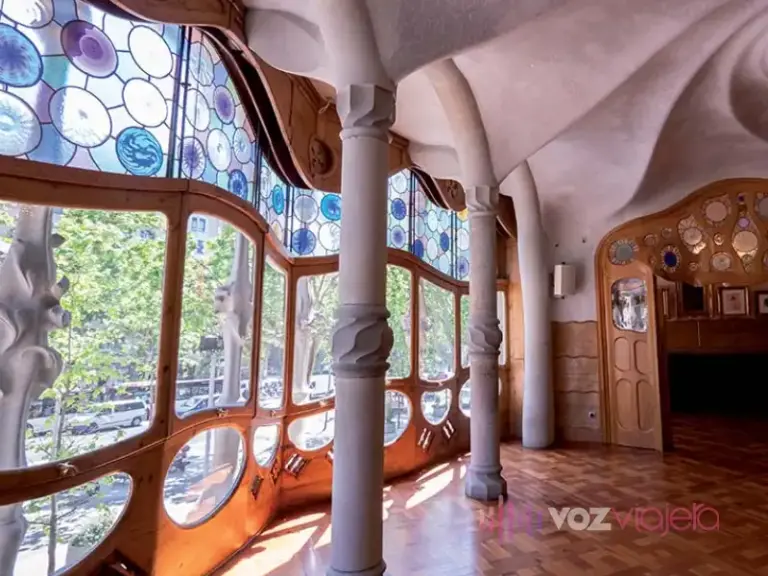 5:24BarcelonaBatlló HouseBatlló House is a masterpiece of Catalan modernism located in the heart of Barcelona. Built by Antoni Gaudí…
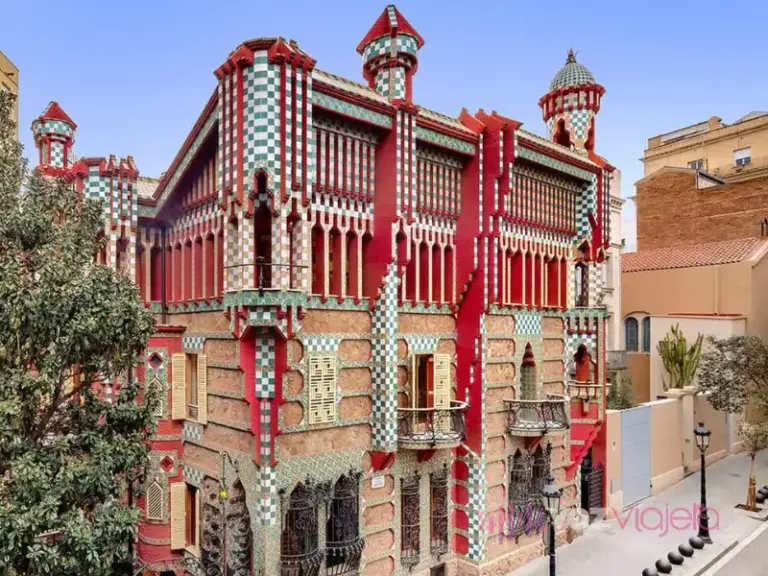 7:46BarcelonaCasa Vicens: free audio guide, hours and ticketsFree audio guide to Casa Vicens, the first house Gaudí designed, built from 1883 to 1885 in Gràcia:…
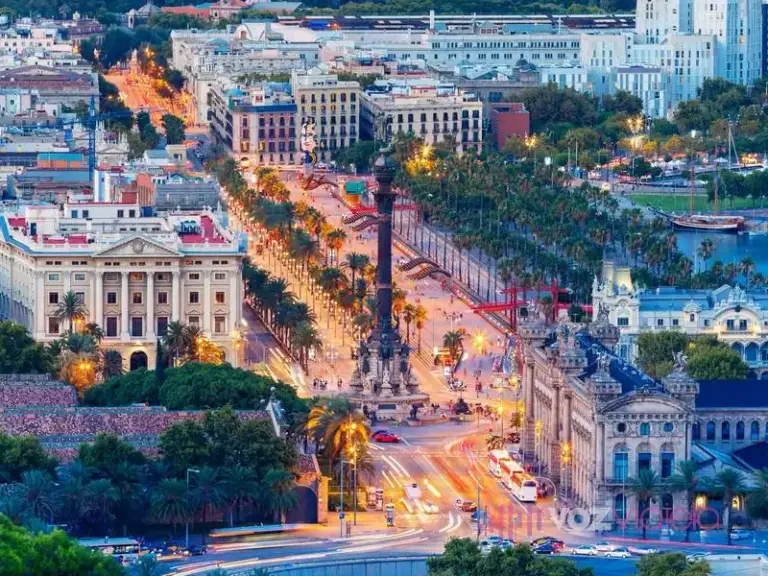 5:01BarcelonaLa RamblaLa Rambla is Barcelona’s central artery, a bustling pedestrian promenade lined with trees, street performers and flower stalls.…