
Tower Bridge: free audio guide, hours and tickets
Free audio guide in English · no app, no sign-up
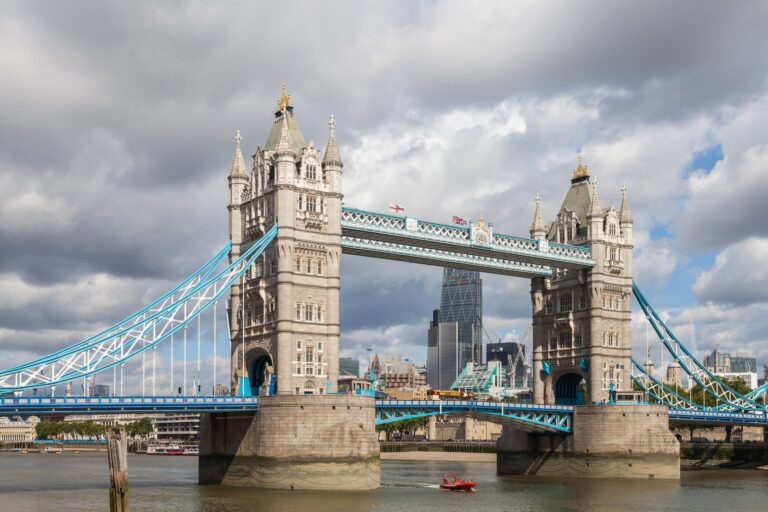
Tower Bridge is the bascule bridge that Horace Jones and John Wolfe Barry designed and that went up beside the Tower of London between 1886 and 1894. Its 2 halves still open about 800 times a year; inside you walk the glass-floored walkways and see the steam engines.
 Audio guide
Before you go in
The few things that change your visit.
- Crossing is free; going up costs £18 for an adult
- Open every day 09:30 to 18:00; closed 24, 25 and 26 December
- The carer of a disabled visitor goes in free; local residents pay £1
- Lift times change daily: check the official page on the day
- A lift in each tower and wheelchairs to borrow at the ticket office
On this page
Tower Bridge is the bridge in London whose road still splits and lifts to let ships through. It was built between 1886 and 1894 next to the Tower of London, and inside you can walk its high-level walkways, with glass floors, and see its Victorian steam engines. Crossing it is free; going up costs £18 for an adult, every day from 09:30 to 18:00. This is its free audio guide.
What the audio guide tells you
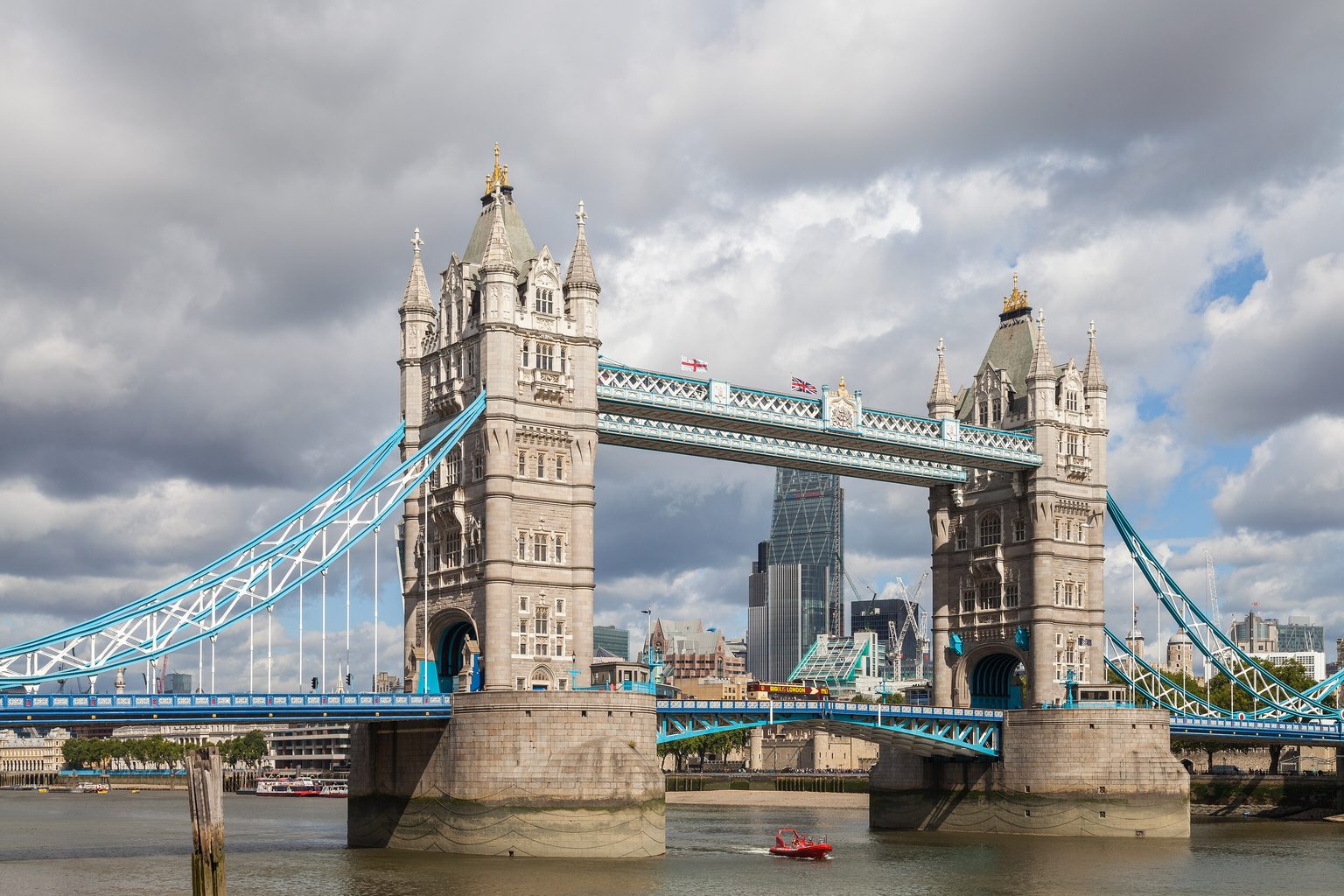
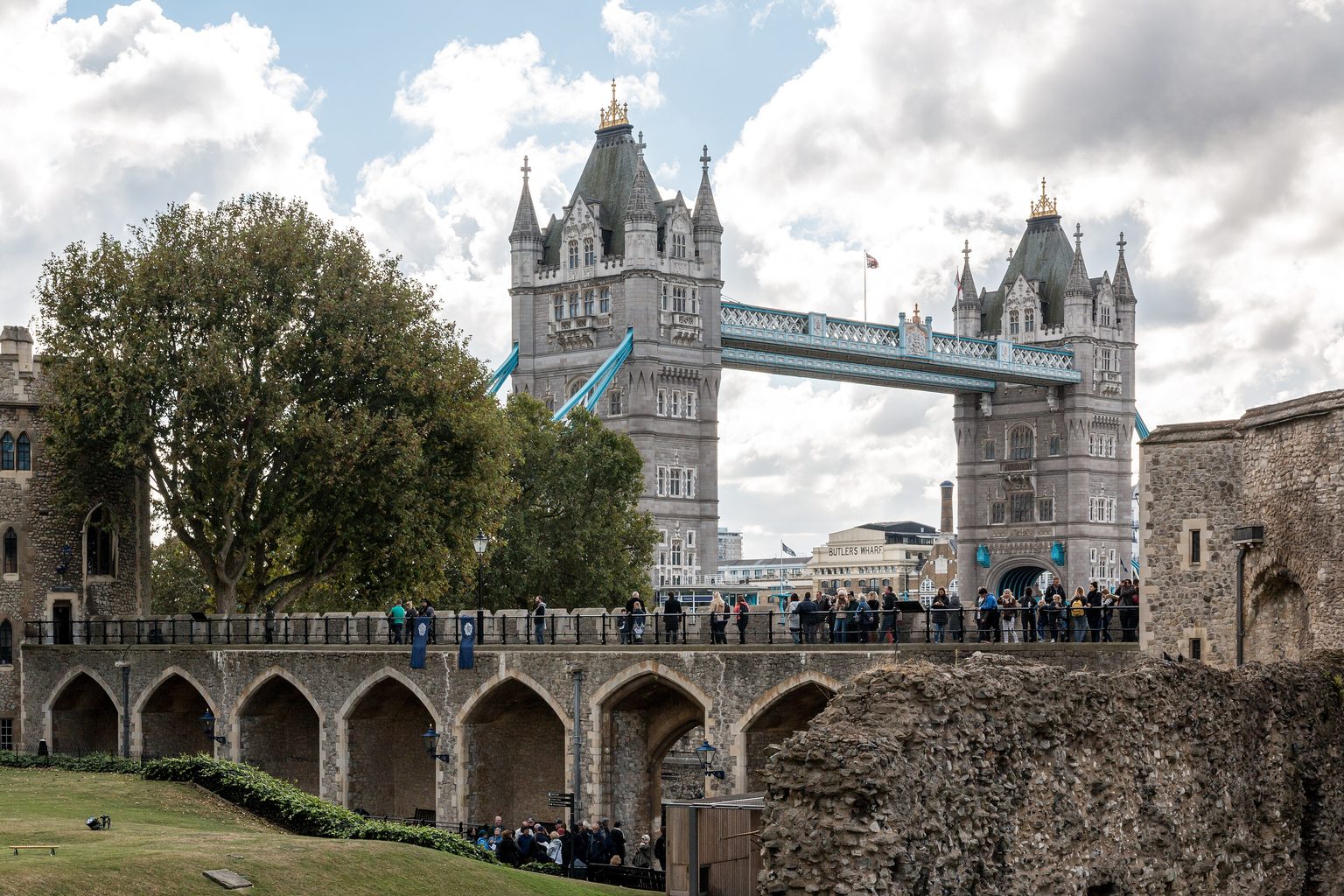
The audio guide lasts about 3 minutes and is made to be played on the north bank, between the Tower of London and the bridge, with both towers in front of you. No ticket needed: the roadway is open to everyone. These are its stops:
| Why London needed a bridge here | A new crossing east of the Tower in 1876, without shutting out the ships. |
| A castle made of steel | Horace Jones and John Wolfe Barry, and the steel frame dressed in stone to suit the White Tower. |
| The see-saw | How the 2 halves of the roadway open: no chains, just a balanced pivot. |
| Steam power | Coal, water under pressure and the engines that lifted it until 1976. |
| The bus that jumped | 30 December 1952, a number 78 bus and a roadway that starts to rise. |
| The walkways and the glass | Closed in 1910, back in 1982, with glass floors since 2014. |
If you go inside, the bridge has its own official audio tour, included in the ticket: you play it on your phone with a QR code or the Smartify app, it runs for about 45 minutes and headphones are not provided, so bring your own.
Tower Bridge opening hours, tickets and prices for 2026
Inside, Tower Bridge is open every day from 09:30 to 18:00, with last entry at 17:00. It is closed every year on 24, 25 and 26 December, and on 1 January it opens at 10:00. One-off changes to the opening time go up on the official plan-your-visit page, so check it the evening before.
On the 2nd Saturday of every month there is a Relaxed Opening from 09:30 to 11:30 (last entry 11:10), with fewer visitors at a time, designed for neurodivergent visitors.
| Adult (18 and over) | £18 |
| Concession: 60 and over with ID, students aged 18 and over, young people aged 16 and 17, and disabled adults | £13.50 |
| Child, 5 to 15 | £9 |
| Disabled child, 5 to 15 | £6.80 |
| Carer of a disabled visitor, and children under 5 | Free |
| Local ticket: residents of Southwark, Tower Hamlets or the City of London | £1 |
Crossing is free; going up is not. The roadway is open to traffic and people on foot at no cost. What you pay for is the inside: the North and South Towers, the high-level walkways with their glass floors and the Victorian Engine Rooms, plus the official audio tour.
You can book online up to 8 weeks ahead to secure your time slot, but it does not buy fast-track entry: everyone joins the same outdoor queue and the same bag search. Backpacks can be no bigger than 45 × 35 × 20 cm, and suitcases and wheeled bags are not allowed. You may eat your own food inside, but there is no café and no water fountain, so bring water.
Plan on about 1 hour 30 minutes in all, queue and bag search included.
Bridge lift times: when Tower Bridge opens for ships
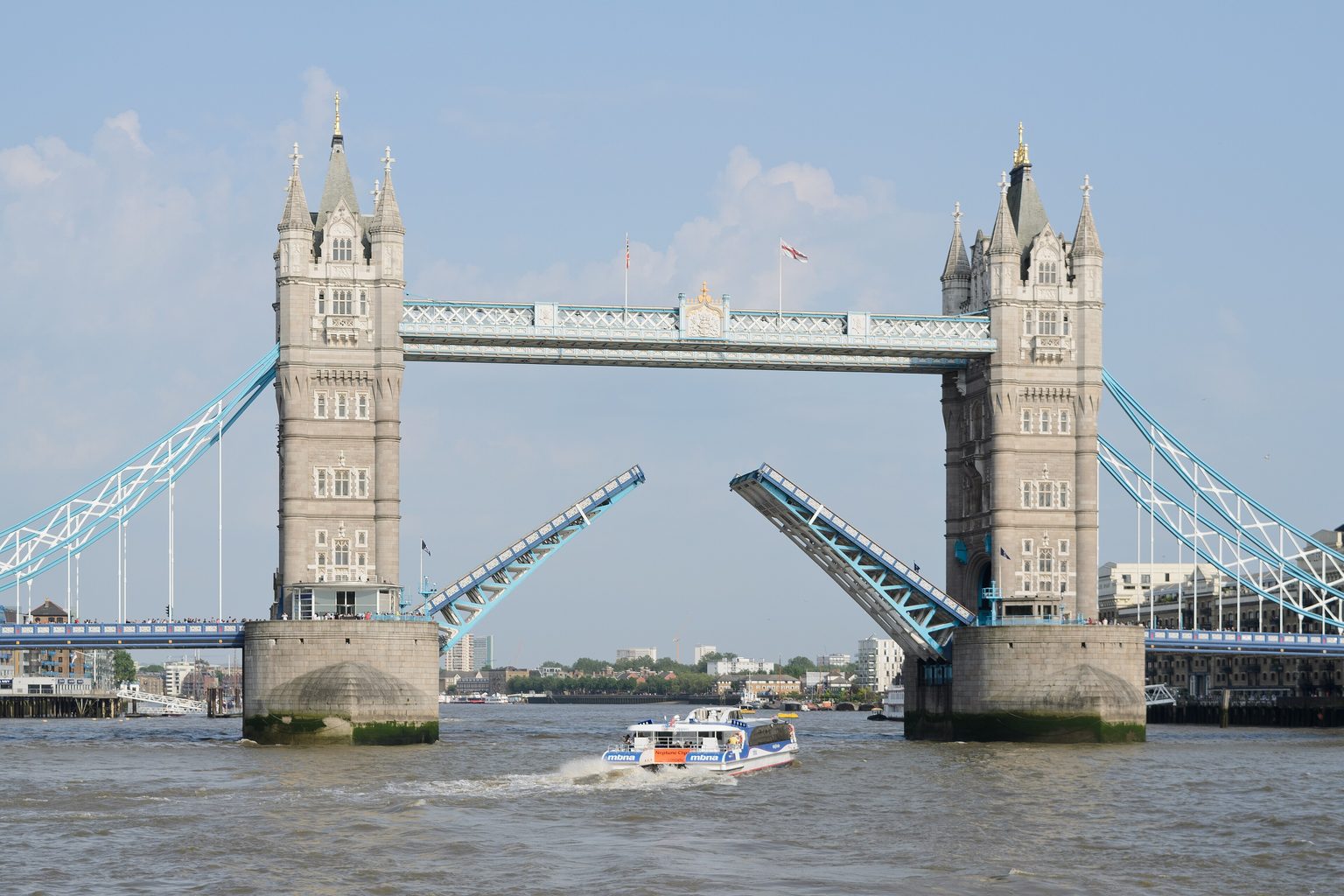
Yes, it still goes up and down. Tower Bridge lifts about 800 times a year, and always free of charge: the Act of 1885 that allowed it to be built obliges it to open for river traffic without a fee and gives ships priority over the road. The record is 64 lifts in a single day.
The times change every day, so they are not listed here: they are published on the official Tower Bridge lift times page, which lists each date with the time, the name of the vessel and whether it is going upriver or downriver, and lets you filter by vessel. Extra lifts can be added at short notice for maintenance, so check it on the day.
If a lift comes while you are inside, the best place to be is the glass floor of a walkway: you watch the roadway split open under your feet. A bale of hay hanging from the bridge is no decoration: by law it warns ships of works under the bascules and less headroom.
What you see inside: walkways, glass floors and the Engine Rooms
The visit follows a set route. You go in through the North Tower, where you meet the people who built the bridge, and go up to the high-level walkways, which join the 2 towers 43.5 m above the Thames at high tide. They were meant for crossing on foot while the bridge was open, but few people wanted the stairs: they closed in 1910 and reopened in 1982.
Each walkway has a glass floor, 11.5 m long, laid in 2014. Look down and the buses are 33.5 m below you. Look out and you have the Tower of London, St Paul’s Cathedral and the Monument, HMS Belfast, the Shard and Canary Wharf.
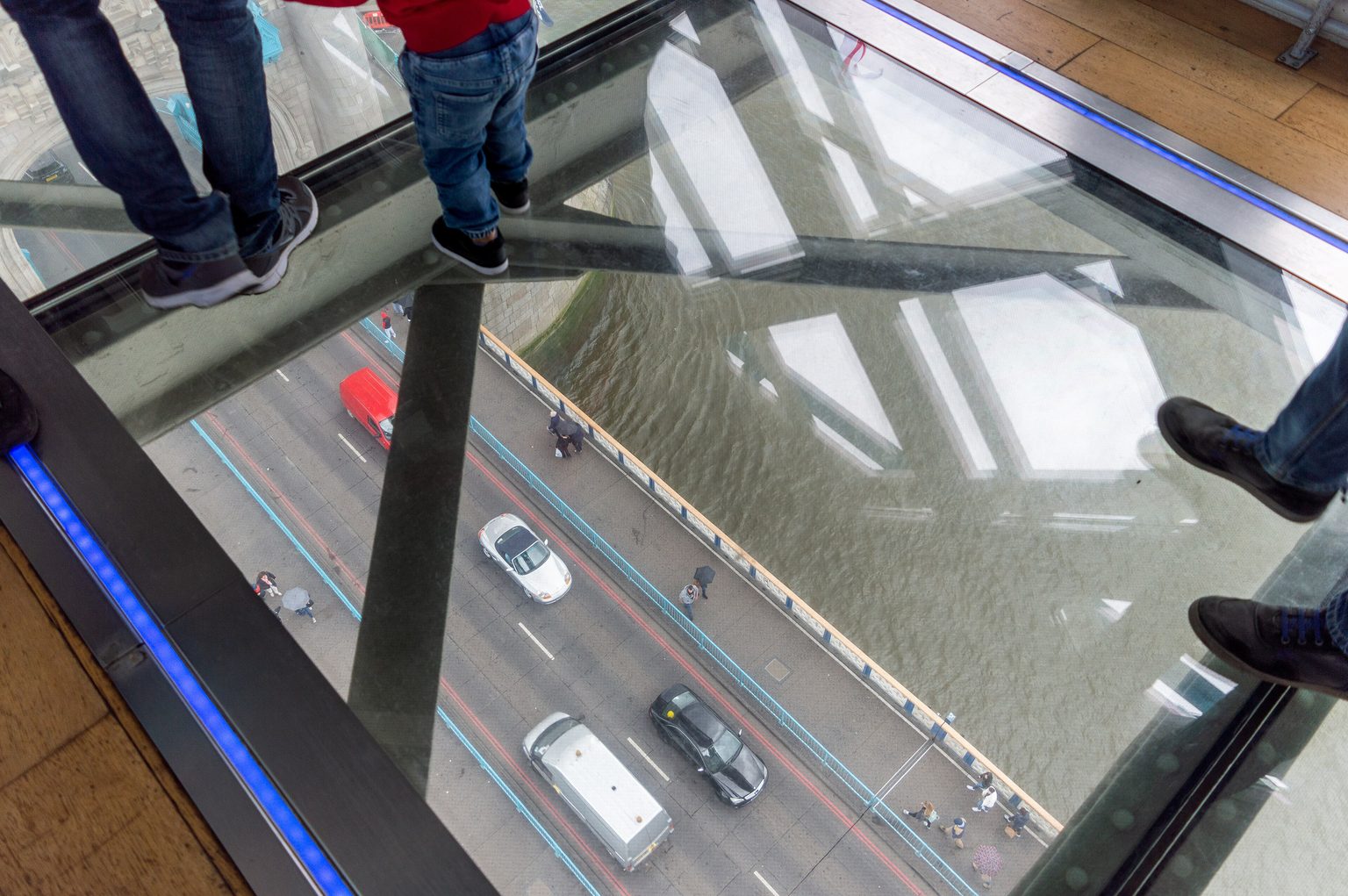
On the staircases inside the towers you can still see the original bright chocolate brown, said to be Queen Victoria’s favourite colour, and the South Tower hides 7 statues of workers in its roof. Then you go down and follow the Blue Line: 80 bronze plaques in the pavement with drawings and the names of people who worked on the bridge, like John Chalk, who started as a rivet boy at 14.
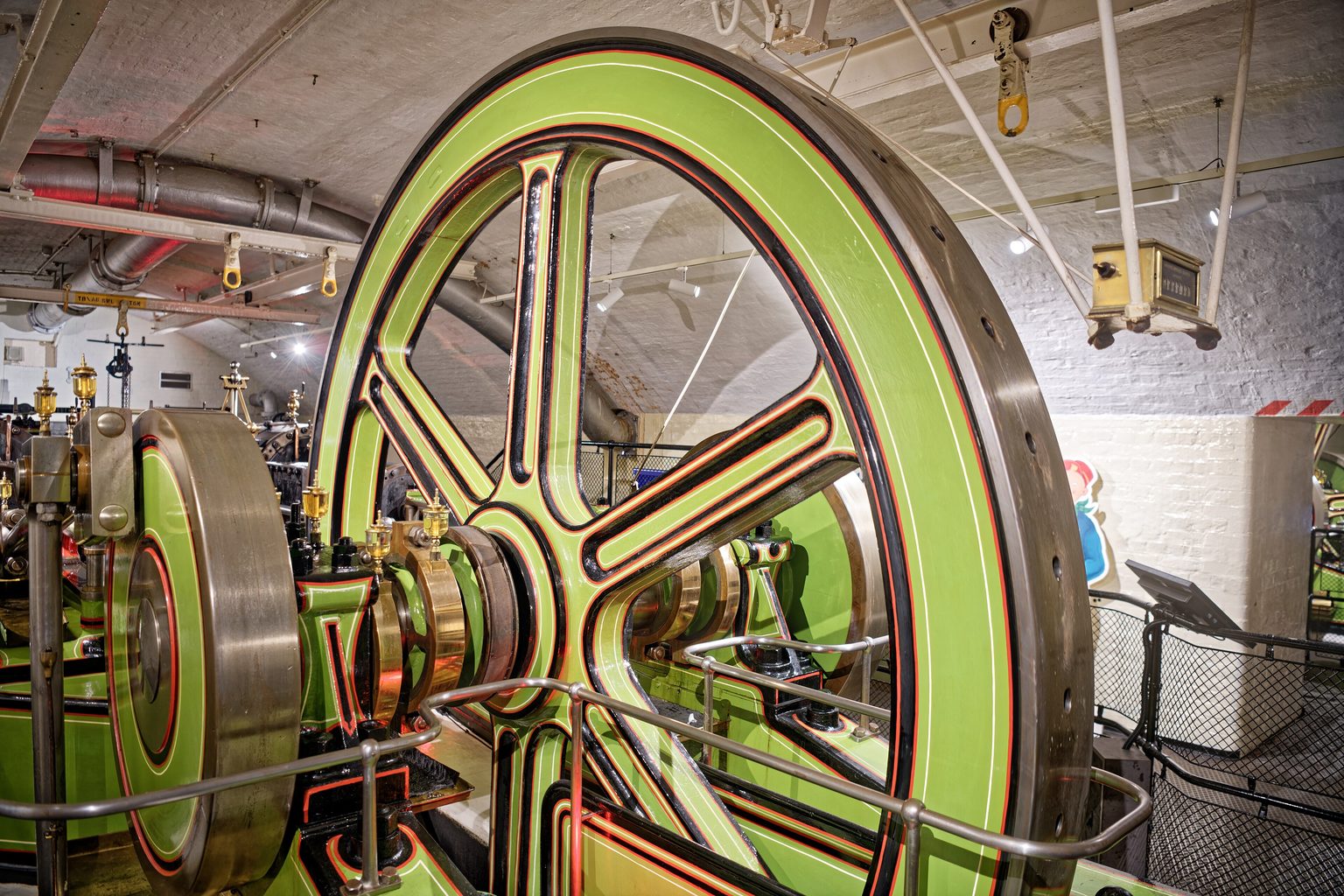
The line takes you to the Victorian Engine Rooms, in a separate building under the southern approach. Here, 3 coal-fired boilers, kept burning around the clock, drove steam engines that pumped water under pressure into 6 accumulators, which stored it like batteries. That water drove the engines that turned the gears at the tail of each bascule, and the bridge rose in 60 seconds. The stokers shovelled more than 20 tonnes of coal a week. The green of the flywheels was chosen by William Armstrong, whose engineers ran the first test lifts in April 1894: it is the colour of his family crest. Since 1976 the bridge has run on oil and electricity; the steam engines stayed here.
Tower Bridge history: from 1876 to 1894
In 1876 the City of London asked for a new crossing east of the Tower of London, because the old bridges were jammed with traffic. The catch was the river: ships sailed up this stretch to the city’s port. A competition drew more than 50 designs and came to nothing. In November 1884 the City architect, Horace Jones, and the engineer John Wolfe Barry brought the answer: a bridge with a central span that opens. It is a bascule bridge, from the French word for see-saw. Parliament passed the Tower Bridge Act on 14 August 1885, and it still governs how the bridge is used.
Work began on 22 April 1886 and took 8 years, 5 main contractors and 432 workers a day. Jones died a year after it started and never saw it finished; Barry completed it with Henry Marc Brunel, son of Isambard Kingdom Brunel, as his assistant. Under the stone there is a steel frame held together by more than 13 million rivets. The outside is Cornish granite and Portland stone, in a Gothic Revival style chosen so that the bridge would sit well beside the White Tower.
The Prince of Wales opened it at noon on 30 June 1894, with Princess Alexandra and the Duke of York, the future George V. When it opened to people on foot, on 9 July, about 141,760 of them crossed it that day, and it lifted 13 times for 15 vessels. Today it is Grade I listed, the highest level of protection for a historic building in England.
Its most famous story came on 30 December 1952, when the bascule began to rise under a number 78 bus with 20 passengers. The driver, Albert Gunter, put his foot down and jumped the gap. He was given £10 and a day off.
Getting there and step-free access
The ticket office and the entrance are on the west side of the North Tower, on the Tower of London bank. The easiest Tube station is Tower Hill (District and Circle lines), 500 m from the ticket office, about 7 minutes on foot and step-free. From London Bridge station (Northern and Jubilee lines) it is 1 km to the Engine Rooms entrance on the south bank. Buses 15, 42, 78, 100 and 343 stop nearby; the Tower Bridge City Hall stop (42, 78 and 343) is 280 m from the ticket office, step-free.
The route is step-free. There is a lift in each tower up to the walkways, and an outdoor lift on the south-east side down to the Engine Rooms. Wheelchairs and walking frames can be borrowed at the ticket office and at the Engine Rooms entrance, there are accessible toilets in both towers and in the Engine Rooms, and if you cannot queue you get priority entry. The lifts can break down without warning: if you depend on them, check at bookings@towerbridge.org.uk or 020 7407 9191 (Monday to Friday).
The natural pairing is the Tower of London, about 300 m away in a straight line, some 5 minutes on foot: together they fill a morning. Do the Tower first and finish at the bridge, which takes its last visitors at 17:00. More London guides will be on the free audio guides of London page.
Reading this in Spanish? The same guide, written for a Spanish-speaking visitor and narrated in Spanish, is at Tower Bridge en vozviajera.com.
Where to find it
FAQs
How do the free audio guides work?
Our audio guides work through the website audioguidetravel.com; you don’t need to download any app. Just follow the instructions on the website to guide you through Tower Bridge: free audio guide, hours and tickets while listening to our experts’ explanations.
Can I take the tour at my own pace?
Of course! Our free audio guides are designed so that you set the pace. You can pause, rewind, or listen as many times as you want without missing a detail. By visiting Tower Bridge: free audio guide, hours and tickets your way, you’ll enjoy it even more.
If I'm in a group, can we use the same audio guide?
Yes, our website allows sharing the same free audio guide among multiple devices. This way, you can visit Tower Bridge: free audio guide, hours and tickets as a group or family, listening to the explanations simultaneously. The quickest way to do this is to share the link via WhatsApp, email, or any method you like. I’ve included some buttons below for you to do that now.
Visitor information
As of 26 Sep 2026- Opening hours
- Every day, 09:30 to 18:00; last entry 17:00. Closed 24 to 26 December; 1 January from 10:00.
- Tickets
- Adult £18; concession £13.50; child 5 to 15, £9; under 5 and 1 carer per disabled visitor free.
- Time needed
- 1 hour 30 minutes with the queue and bag search; the official audio tour inside is about 45 minutes.
- Getting there
- Tube: Tower Hill (District, Circle), 500 m step-free; London Bridge (Northern, Jubilee), 1 km.
- Accessibility
- A lift in each tower and an outdoor lift to the Engine Rooms; wheelchairs lent at the ticket office.
- Tip
- Check the official lift times for the day and be on a glass floor just before the bridge opens.
- Official website
- www.towerbridge.org.uk