
Piccadilly Circus: free audio guide, the Eros statue and the lights
Free audio guide in English · no app, no sign-up
Piccadilly Circus is the West End junction famous for its giant curved screen and for the fountain topped by the winged archer everyone calls Eros, who is really Anteros. It is a public space, free and open at any hour. This free audio guide lasts about 4 minutes and is made to be heard sitting on the steps of the fountain.
 Audio guide
Before you go in
The few things that change your visit.
Piccadilly Circus is the busy junction in London’s West End where Regent Street, Piccadilly, Shaftesbury Avenue and the Haymarket meet, known for its giant curved advertising screen and for the fountain topped by the winged archer everyone calls Eros. It is a public space, free and open at any hour. This free audio guide lasts about 4 minutes and is made to be heard beside the fountain.
What the Piccadilly Circus audio guide covers
Start it on the steps of the fountain, facing the screen. It comes in 5 parts:
| Nash’s circus | Why it is called a circus, where the name Piccadilly comes from, and how a new street broke the circle. |
| The fountain | The memorial to Lord Shaftesbury and the aluminium figure on top, which is not Eros at all. |
| 8 cups, 1 night | What happened to the fountain’s drinking cups the morning after it was unveiled. |
| The lights | From the first electric signs to today’s single screen, and the nights it went dark. |
| Underground | The Tube station beneath your feet and a theatre whose auditorium is entirely below the street. |
Getting to Piccadilly Circus and when to go
There is nothing to book and no opening time: Piccadilly Circus is a road junction with a pedestrian area on its south side around the fountain, so you can come at any hour and it costs nothing. Allow 10 to 30 minutes for the circus itself, longer if you carry on into the streets around it. It looks its best after dark, when the screen is the brightest thing in the square.
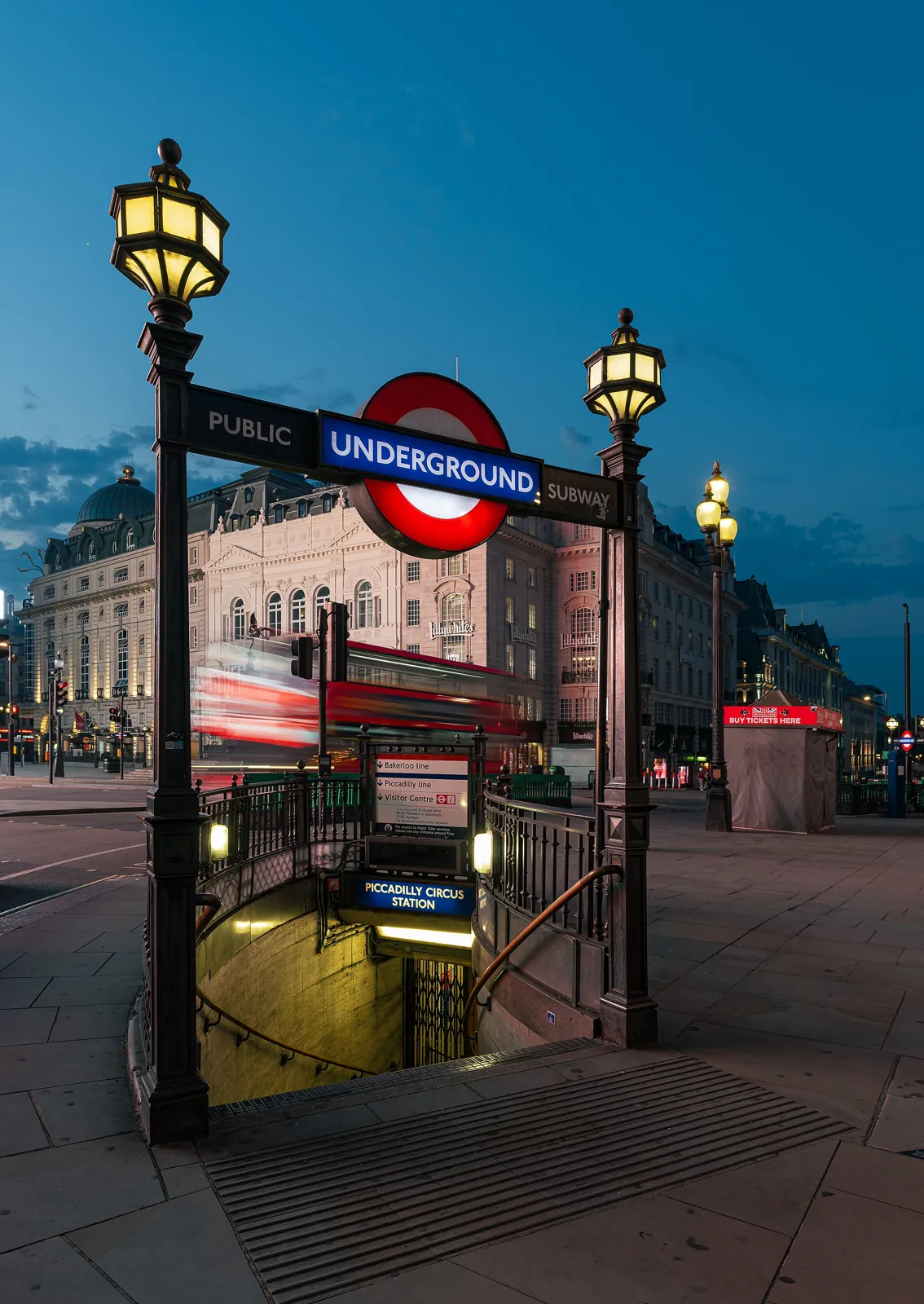
Piccadilly Circus Tube station sits directly beneath the junction, with entrances on the corners, and is served by the Bakerloo and Piccadilly lines; the Piccadilly line runs straight to Heathrow Airport. It is in Zone 1. Plenty of buses stop around the circus, on Regent Street, the Haymarket and Shaftesbury Avenue, among them routes 3, 6, 9, 12, 14, 19, 22, 29, 38, 88, 139 and 159.
The Shaftesbury Memorial: Anteros, not Eros
The fountain is the Shaftesbury Memorial Fountain, raised by public subscription to Anthony Ashley Cooper, 7th Earl of Shaftesbury, the Victorian reformer best remembered for his campaigns for working children. The sculptor Alfred Gilbert made it in 1892-93, and it was unveiled on 29 June 1893. Today it is listed at Grade I, the highest grade of protection in England.
The winged figure with the bow is Anteros, Eros’s brother and the god of selfless love, chosen by Gilbert as a fitting symbol for a philanthropist. Officially it represents the Angel of Christian Charity, but Londoners called it Eros anyway, and the name stuck. Gilbert had it cast in aluminium, probably the first time the metal had been used for a permanent free-standing sculpture: the leg it balances on is solid, the rest of the body hollow. His model was a teenager, his studio assistant Angelo Colarossi.
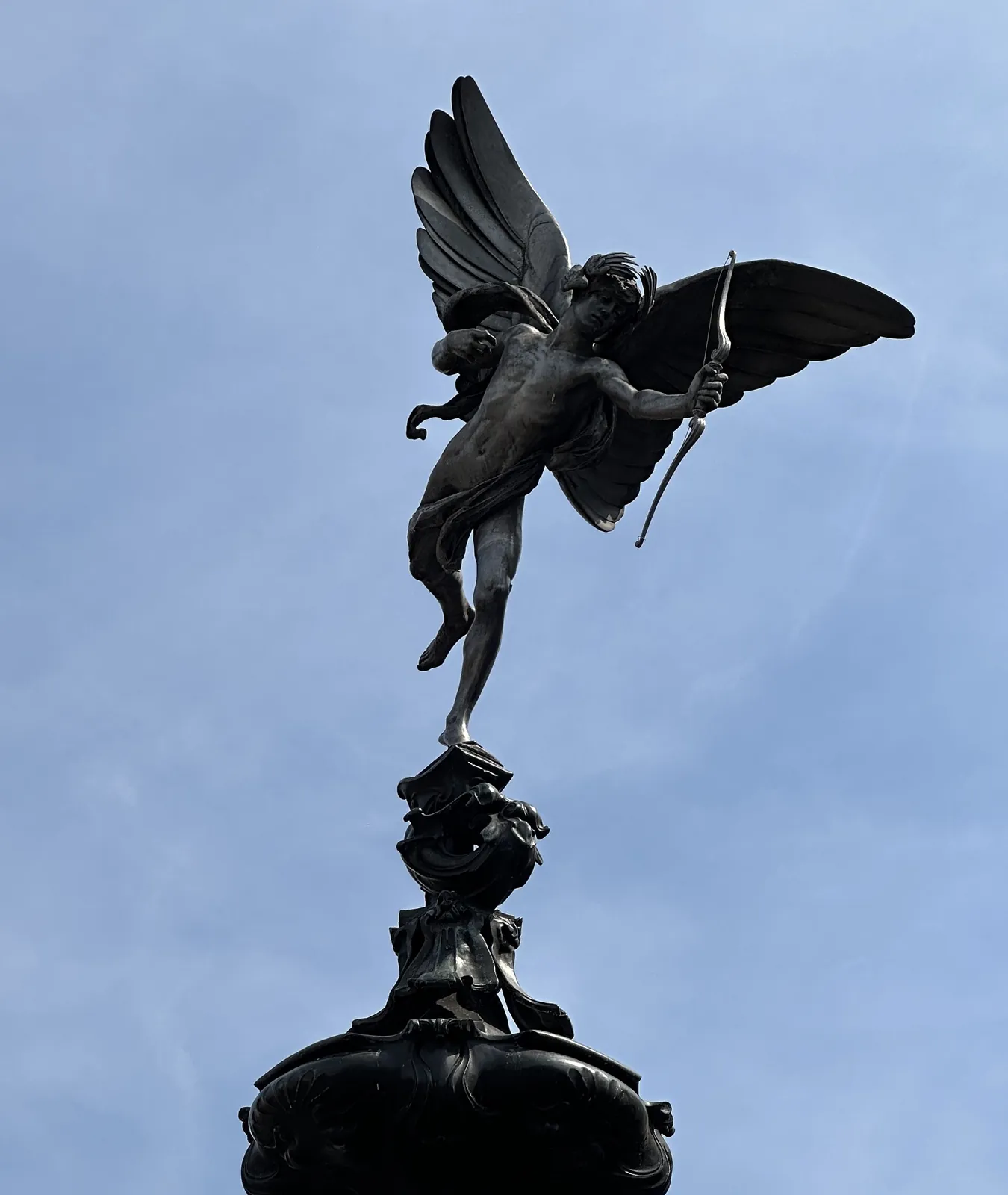
Take a close look at the bronze fountain below. It writhes with fish, shells, crabs, lobsters and other sea creatures among the scrolls, and it carries an inscription to the earl written by the Prime Minister, William Gladstone. The bow pointing down with no arrow has inspired a well-worn pun: the shaft has been buried in the ground. Shaft-esbury. Gilbert explained the joke to friends before the unveiling, yet in 1903 he called it “a silly pun”.
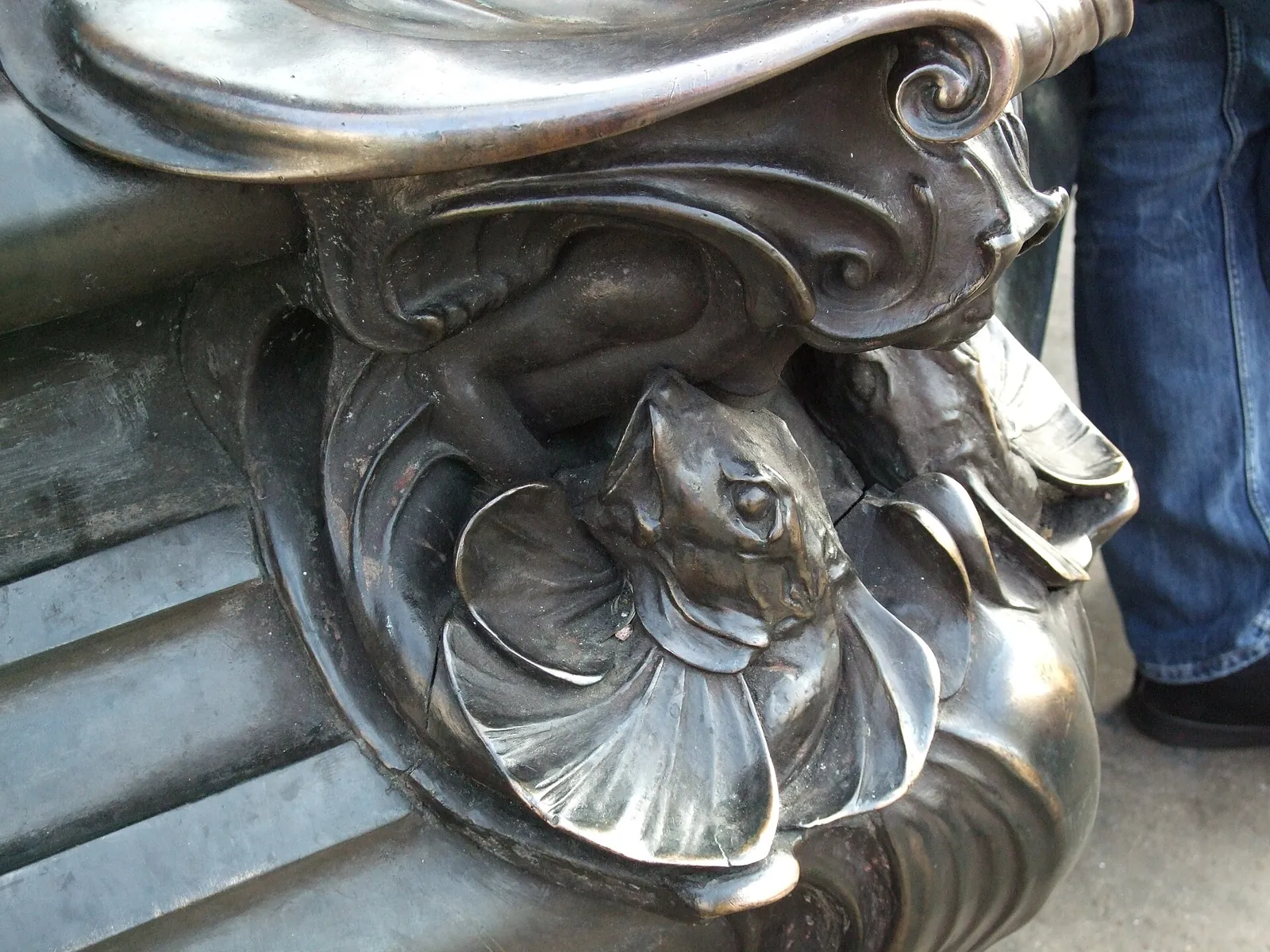
The fountain has moved more than the people who meet under it. It was taken down in February 1925 to build the new Tube station, and Anteros spent almost 7 years in the Embankment Gardens by the Thames before returning on 27 December 1931. When the Second World War broke out in 1939 the figure was taken to safety at Egham in Surrey, and it came back on 28 June 1947 in heavy rain, in front of several thousand people. In the 1980s, when the south side was pedestrianised, the fountain left the middle of the junction for the spot where it stands now.
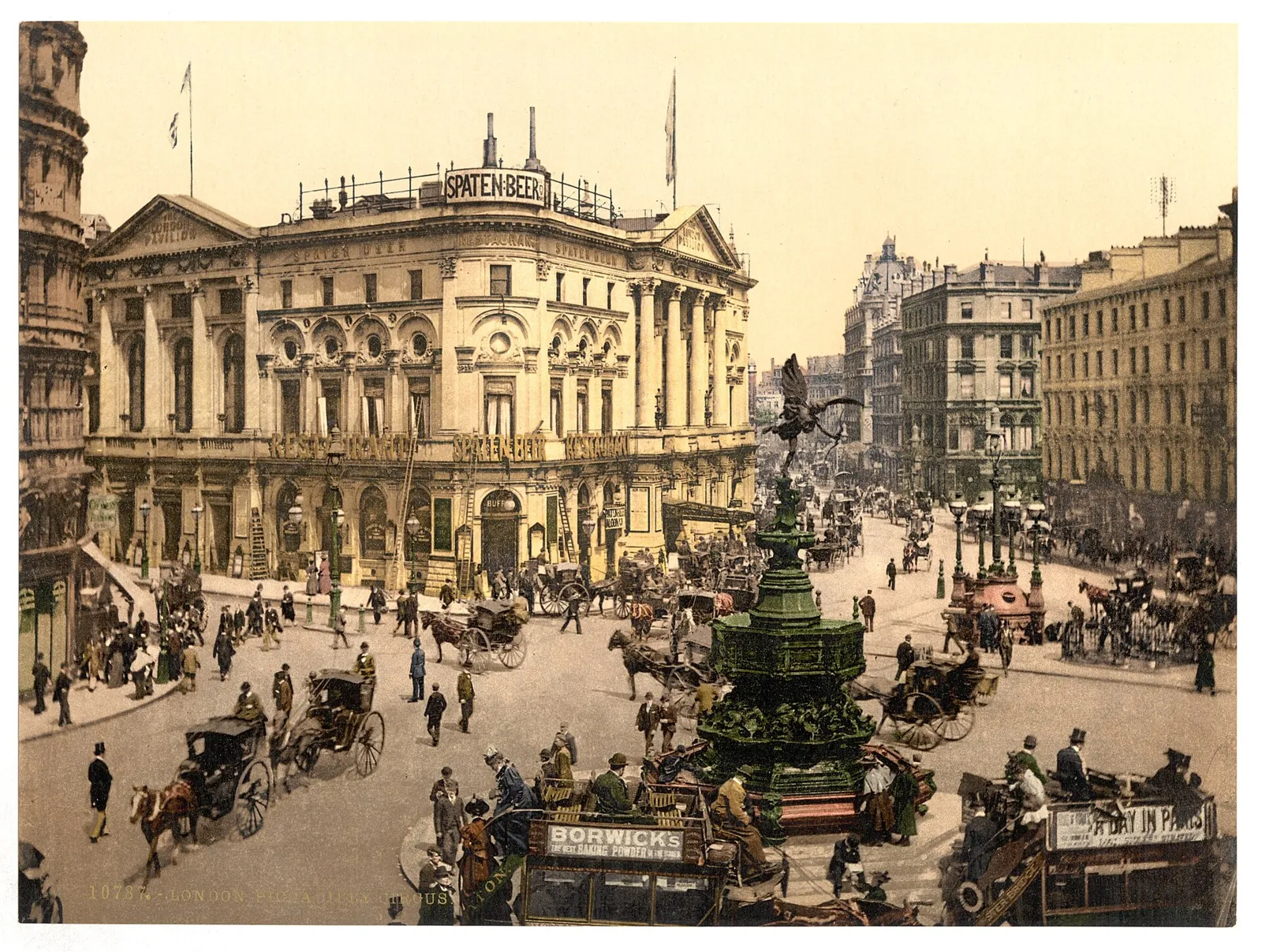
The Piccadilly Lights, from 1908 to one curved screen
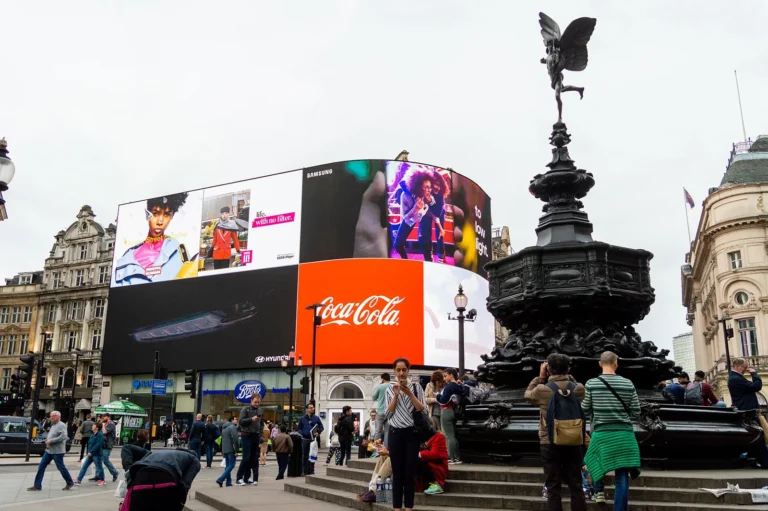
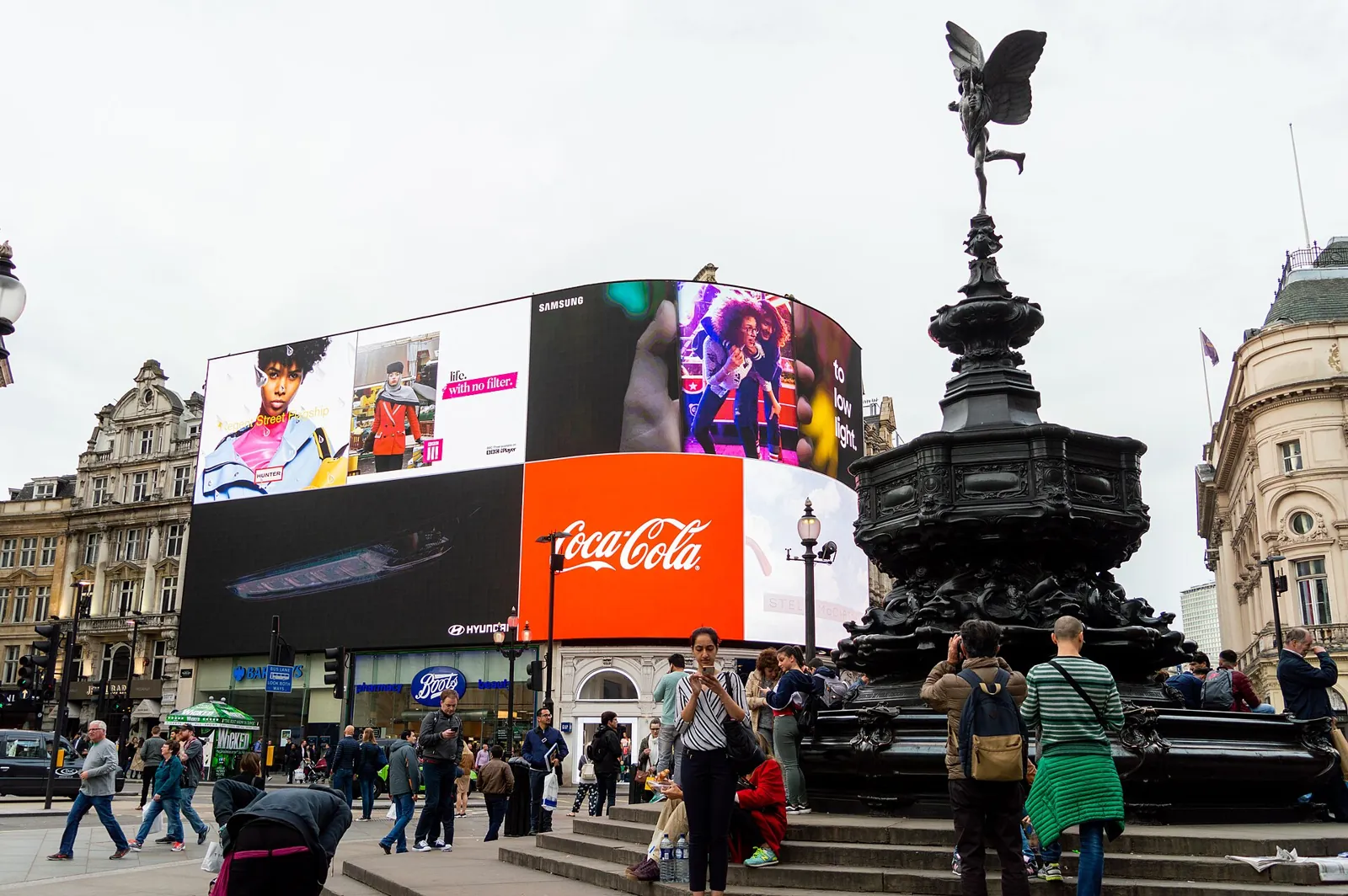
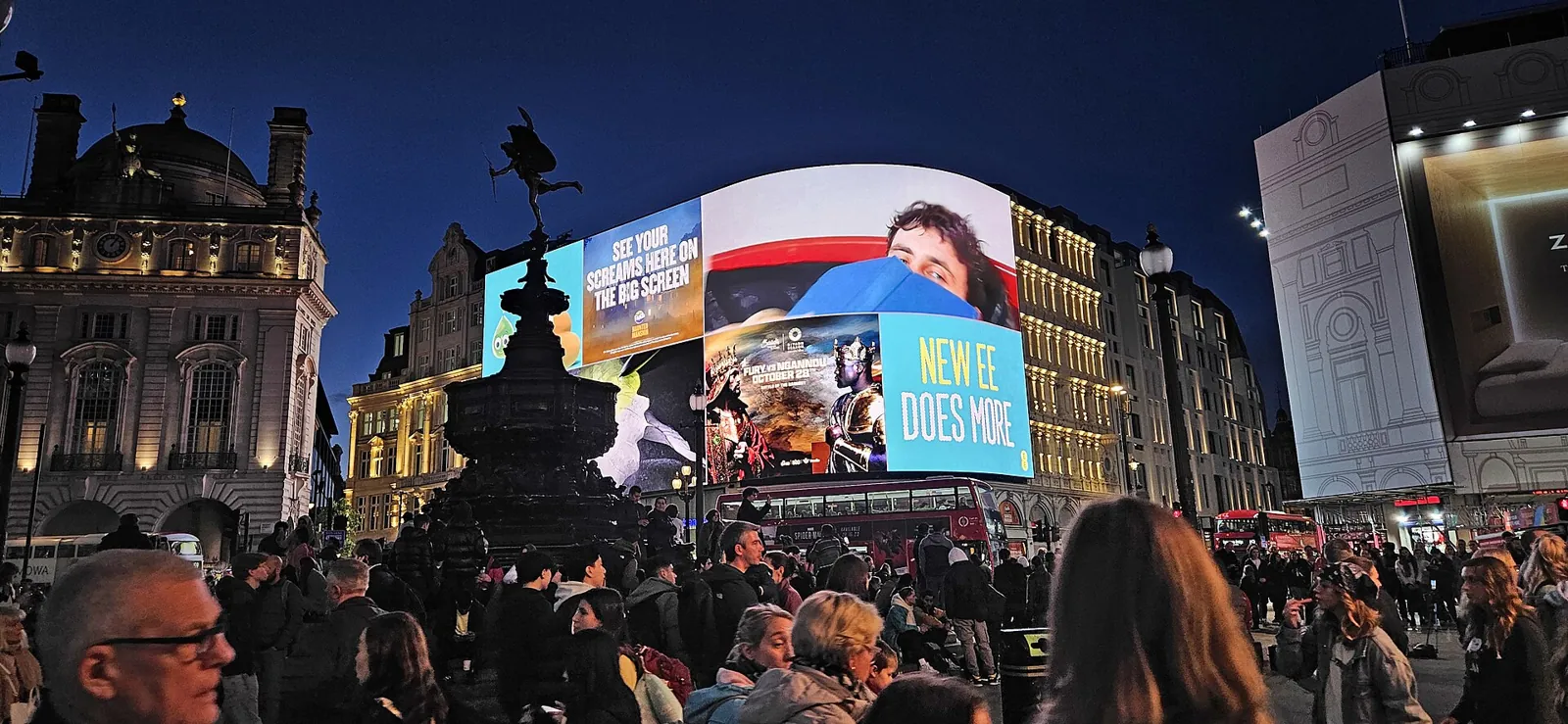
In 1908 a Perrier sign was already lighting up the circus, and the first neon one was for Bovril. There was a giant Guinness clock at one stage, and Coca-Cola has had a sign here since 1954. Several buildings once carried adverts; today they are concentrated on the building on the north side, between Shaftesbury Avenue and Glasshouse Street. Since 2017 it has been wrapped in a single curved screen, the Piccadilly Lights: 783.5 m², larger than a tennis court, and able to change what it shows with the weather and the traffic below.
The lights go out only on special occasions: for the deaths of Winston Churchill in 1965 and Diana, Princess of Wales, in 1997, and for 1 hour on 21 June 2007 for the Lights Out London campaign. After the death of Elizabeth II in 2022, the adverts gave way to an image honouring the Queen.
Nash’s circus and what lies beneath it
Piccadilly Circus was laid out in 1819, when John Nash drove his new Regent Street across Piccadilly; it was first known as Regent Circus South, with Oxford Circus as its northern twin. A circus, from the Latin for “circle”, is a round open space where streets meet. Piccadilly is older and odder: the name first appears in 1626 as Piccadilly Hall, the house of Robert Baker, a tailor famous for selling piccadills, a kind of collar. The circle was lost when Shaftesbury Avenue opened in January 1886 and left the junction with the lopsided shape it has today.
Under your feet is the Tube station, one of the few on the network with no building at all above ground. It opened on 10 March 1906 on the Bakerloo line, and the Piccadilly line followed that December. In 1928 it was rebuilt around a large ticket hall below the road to cope with growing crowds; that concourse is now listed too.
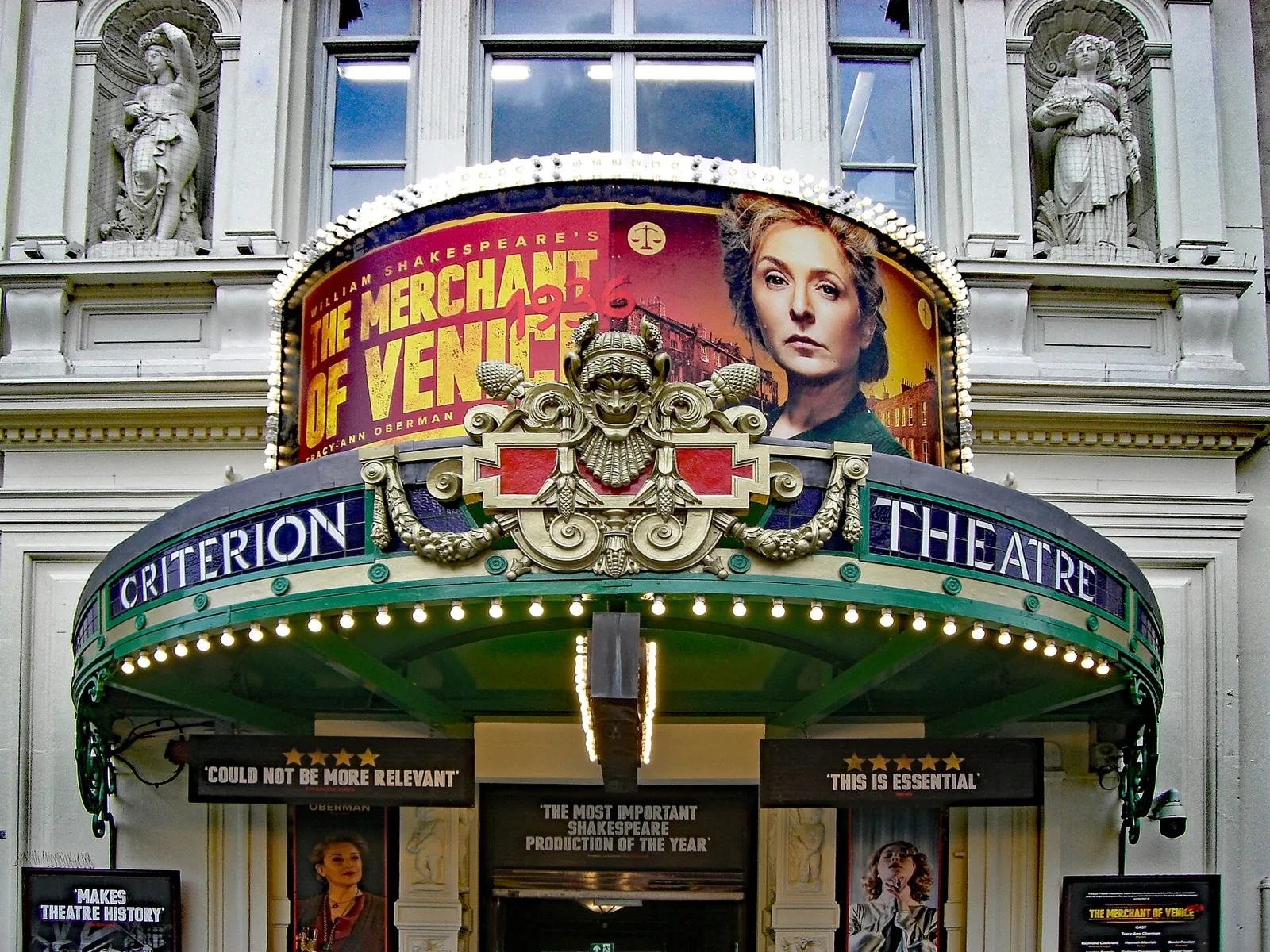
On the south side stands the Criterion Theatre, opened on 21 March 1874. Apart from the box office, the whole theatre, with nearly 600 seats, is underground, reached by a tiled stairway. Across the circus, on the corner of Shaftesbury Avenue and Coventry Street, the London Pavilion keeps its 1885 façade: it began as a music hall, became a cinema, and hosted the premieres of Dr. No in 1962 and the Beatles’ A Hard Day’s Night in 1964. And on the roof of the County Fire Office, on the north side, a statue of Britannia keeps watch.
“It’s like Piccadilly Circus” is what people in Britain say of anywhere packed with people, and legend has it that if you stand here long enough you will bump into everyone you know. In the Second World War, “Piccadilly Circus” was the code name for the assembly area in the English Channel where the D-Day invasion fleet gathered.
What to see near Piccadilly Circus
Everything around here is walkable. Regent Street, Nash’s grand shopping street, curves away to the north, and Soho, with its bars and restaurants, is right next door. Coventry Street takes you to Leicester Square, with its cinemas and the free Scenes in the Square trail of bronze statues, and Trafalgar Square, with the free National Gallery, is a short walk away.
Heading west, Piccadilly itself runs past the Royal Academy of Arts and the Burlington Arcade, a covered shopping arcade opened in 1819, then along Green Park, which reaches all the way to Buckingham Palace, and ends at Hyde Park Corner, the gateway to Hyde Park. Both have their own audio guide:
 Free audio guideBuckingham Palace
 Free audio guideHyde Park
Every audio guide in the city is in London.
Where to find it
FAQs
How do the free audio guides work?
They play right here on audioguidetravel.com, with no app to download and no sign-up. Press play and listen as you walk round: a phone and a pair of headphones are all you need. The audio streams from this page, so you’ll need mobile data or Wi-Fi.
Can I take the tour at my own pace?
Of course! You set the pace: pause whenever you like, jump back or forward 15 seconds, or tap the bar to jump to any point, and listen as many times as you want so you don’t miss a thing.
If I'm in a group, can we use the same audio guide?
Yes. The same free audio guide opens on as many phones as you like, so you can go round together as a group or with your family, each person at their own pace and with their own headphones. The quickest way is to send the link via WhatsApp, Telegram or however you like: the buttons just below let you share it right now.
Visitor information
As of 10 Oct 2026- Opening hours
- Public space, open 24 hours a day, every day.
- Tickets
- Free: it is a road junction with a pedestrian area, no ticket needed.
- Time needed
- A 4-minute audio guide; the circus itself, 10 to 30 minutes.
- Getting there
- Tube: Piccadilly Circus (Bakerloo and Piccadilly lines), under the junction. Buses incl. 9, 14, 19, 22, 38.
- Accessibility
- Street-level square; the Tube station has no lifts (11 escalators), so the bus is easier.
- Tip
- Come at dusk: the screen glows brightest and Anteros stands in silhouette against it.
- Official website
- www.visitlondon.com
Nearby
More free audio guides in London
 3:51LondonCamden Market, Camden Town: free audio guide, hours and getting thereCamden Market is the sprawling market of vintage clothes, vinyl, crafts and street food beside Regent’s Canal in…
 2:44LondonTower Bridge: free audio guide, hours and ticketsTower Bridge is the bascule bridge that Horace Jones and John Wolfe Barry designed and that went up…
 3:03LondonHyde Park: free audio guide, opening times and what to seeHyde Park is central London’s great public park: 142 hectares with the Serpentine lake in the middle. Charles…