
Palacio de Cristal, Madrid: free audio guide to the Crystal Palace
Free audio guide in English · no app, no sign-up
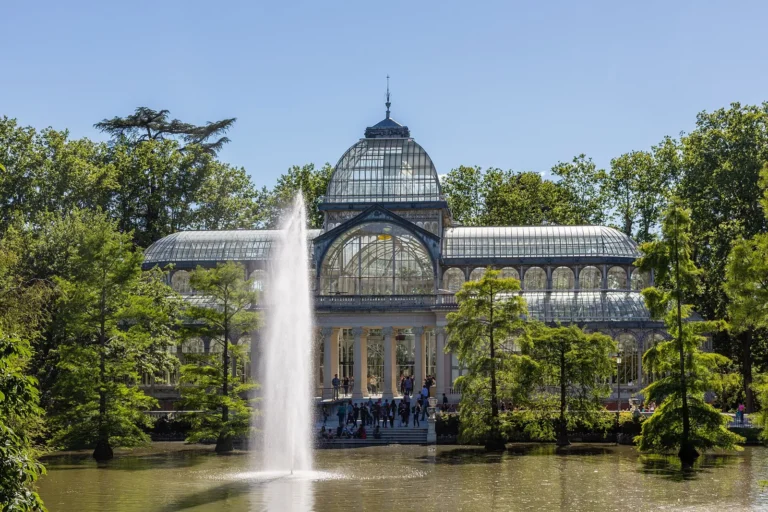
The Palacio de Cristal, Madrid’s Crystal Palace, is the iron and glass pavilion that Ricardo Velázquez Bosco built in 1887 beside the lake in Retiro Park, as a greenhouse for the Philippines Exhibition. Today it is one of the Museo Reina Sofía’s venues. In 2026 it is closed for restoration and wrapped in Fardo, a canvas by Andrea Canepa that you can see for free. This free audio guide tells its story in about 3 minutes.
 Audio guide
Before you go in
The few things that change your visit.
- Inside closed for works, no reopening date yet
- Outside and canvas free, in Retiro Park hours
- Fardo canvas by Andrea Canepa, until 1 January 2027
- Built in 1887 in 5 months for the Philippines Exhibition
- Glass dome 24 m high and tiles by Daniel Zuloaga
- Metro Retiro (line 2) or Ibiza (line 9)
On this page
- What the Palacio de Cristal audio guide covers
- Opening times, tickets and works: closed inside until 2027
- Fardo: Andrea Canepa's canvas wrapping the palace in 2026
- History: a greenhouse for the 1887 Philippines Exhibition
- Iron, glass and tiles: what to look at from outside
- How to get to the Palacio de Cristal, and what is nearby
- Where to find it
The Palacio de Cristal, Madrid’s Crystal Palace, is the iron and glass pavilion that Ricardo Velázquez Bosco built in 1887 beside the lake in Retiro Park, as a greenhouse for the Philippines Exhibition. Today it is one of the Museo Reina Sofía’s venues. In 2026 it is closed for restoration and wrapped in Fardo, a canvas by Andrea Canepa that you can see for free. This free audio guide tells its story in about 3 minutes.
What the Palacio de Cristal audio guide covers
Start it on the edge of the lake, facing the stone steps, then keep it playing as you walk round the building. These are its stops:
| By the lake | What this palace is, and why you find it wrapped up. |
| A greenhouse from 1887 | The Philippines Exhibition and the London model. |
| Built in 5 months | Prefabricated parts, a 24 m dome and a stone portico. |
| The tiles | Daniel Zuloaga’s ceramic friezes around the base. |
| 1936 | The day its glass walls were hidden behind curtains. |
| The 2026 canvas | What Fardo is about, and why you should walk round it. |
Opening times, tickets and works: closed inside until 2027
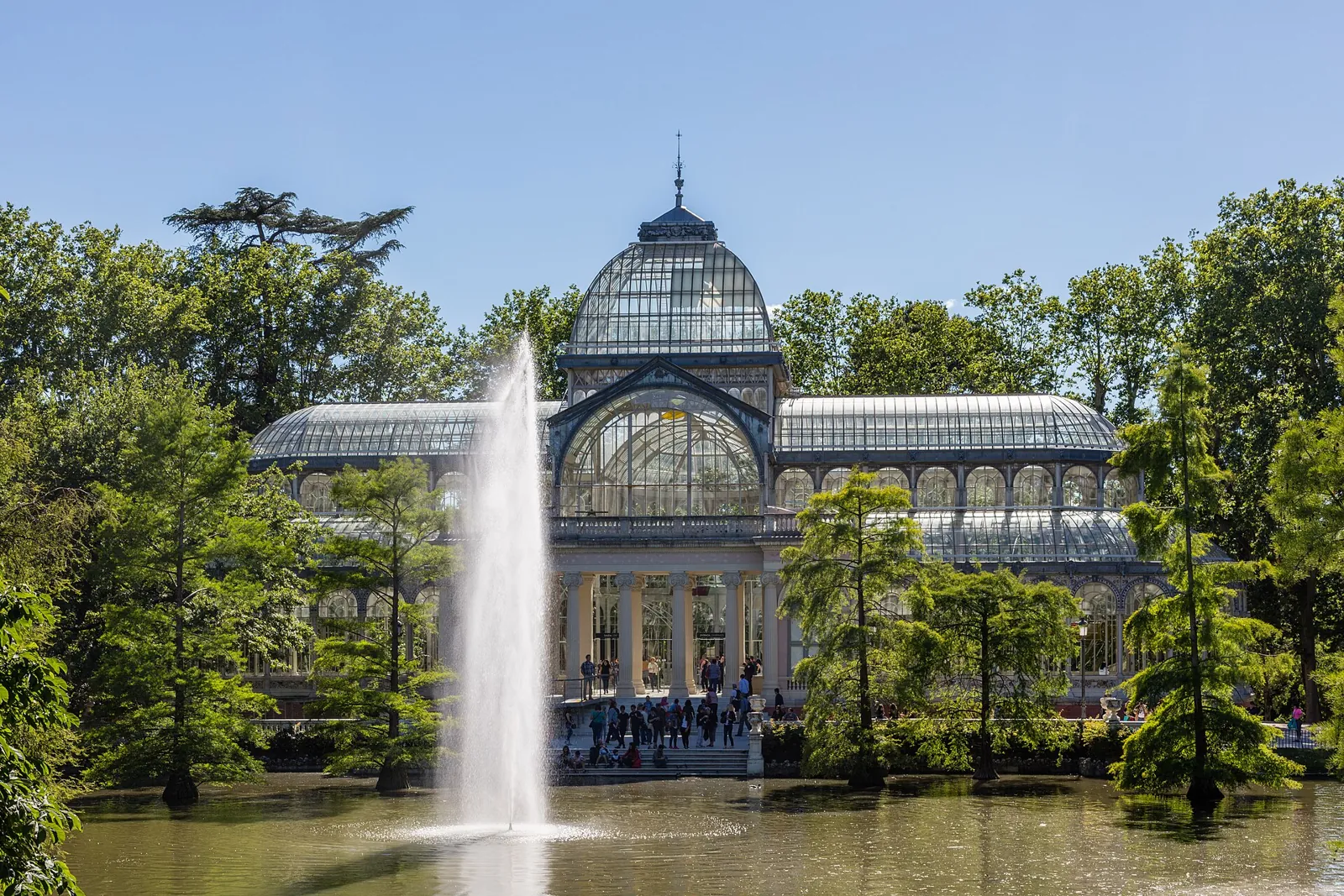
The Palacio de Cristal is one of the Museo Reina Sofía’s 2 venues in Retiro Park, and entry is always free. Right now, though, you cannot go in: the museum has it temporarily closed for restoration work, and Madrid’s official tourist board lists it as closed until 2027. What you can visit is the outside, with the art installation that covers it, during park opening hours.
| Inside | Closed for works, no reopening date yet (Madrid’s tourist board: until 2027). |
| Outside and canvas | Every day, during Retiro Park hours: October to March, 6:00 to 22:00; April to September, 6:00 to midnight. |
| Price | Free. |
| Address | Paseo de la República de Cuba, 4, 28009 Madrid (Retiro Park). |
| Time | The 3-minute audio guide and a full walk round the building. |
Fardo: Andrea Canepa’s canvas wrapping the palace in 2026
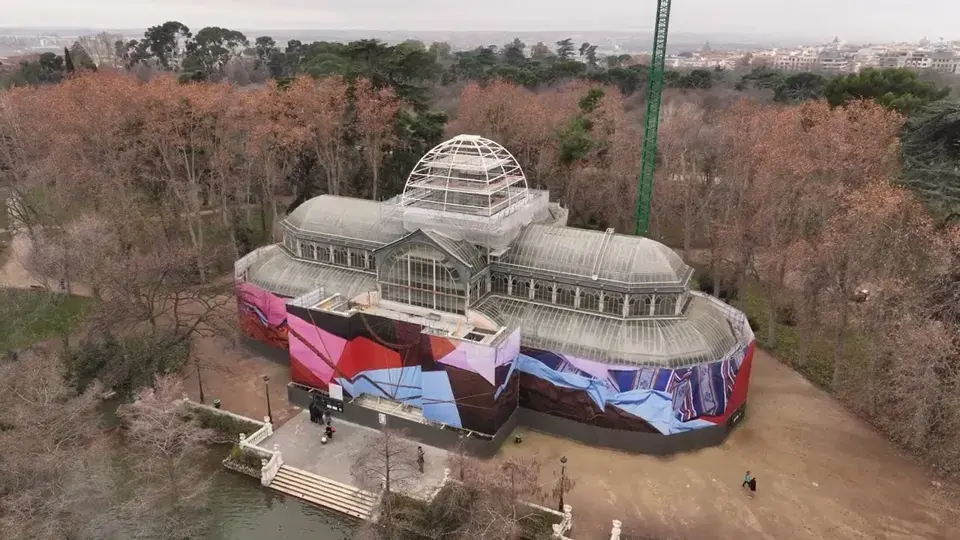
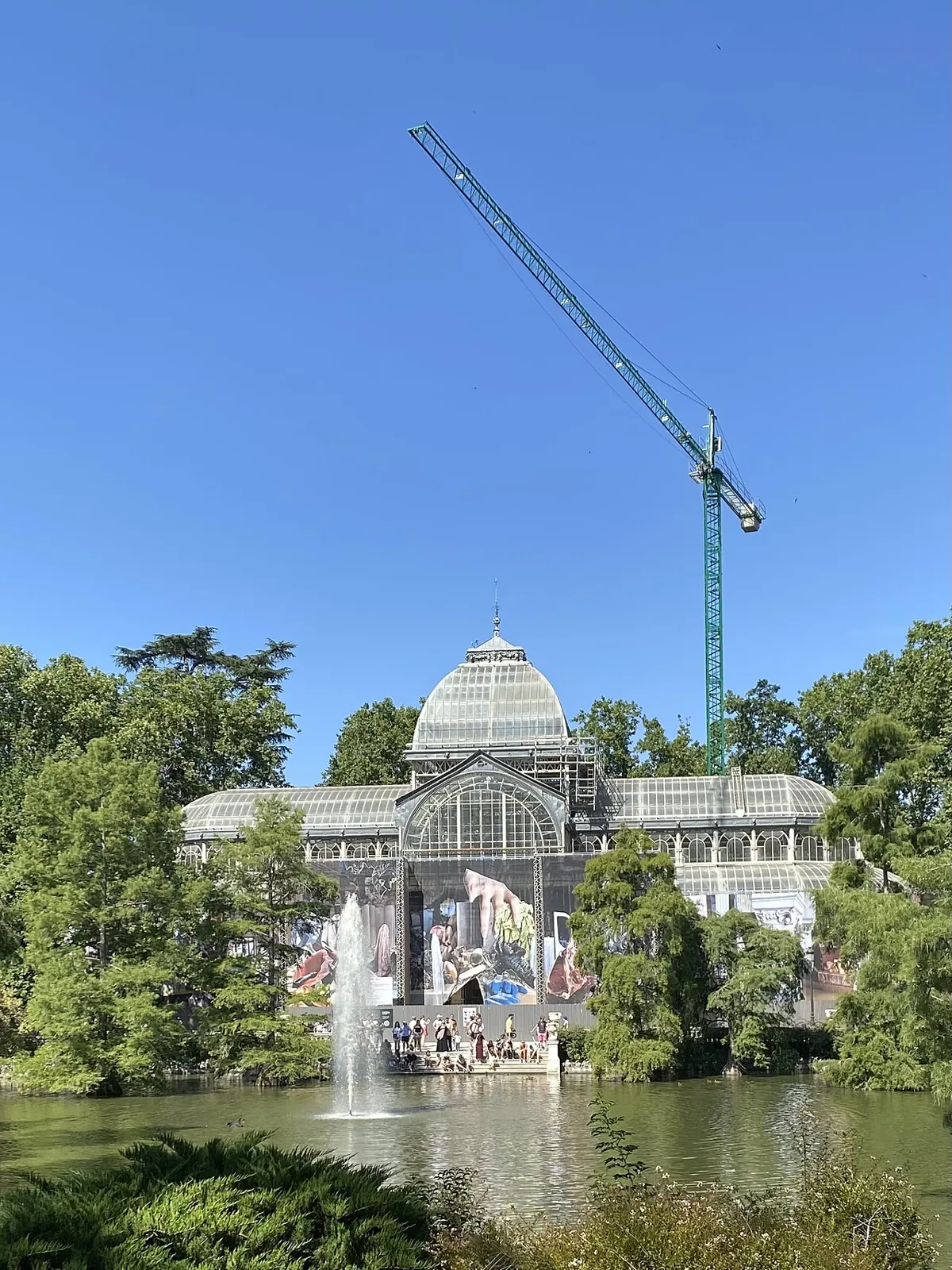
Since 13 January 2026, the canvas covering the palace during the works has been a work of art: Fardo (“bundle”), by the Peruvian artist Andrea Canepa (Lima, 1980). It is the Museo Reina Sofía’s second artistic intervention on that canvas, and it stays up until 1 January 2027.
The idea comes from the funerary bundles of Paracas, the pre-Columbian culture of southern Peru that wrapped its dead in many layers of finely worked textiles. On the canvas you see tied, overlapping fabrics: they are enlarged photographs of oil paintings the artist made first. It is a neat twist for a building designed to be transparent, which now has to be covered up.
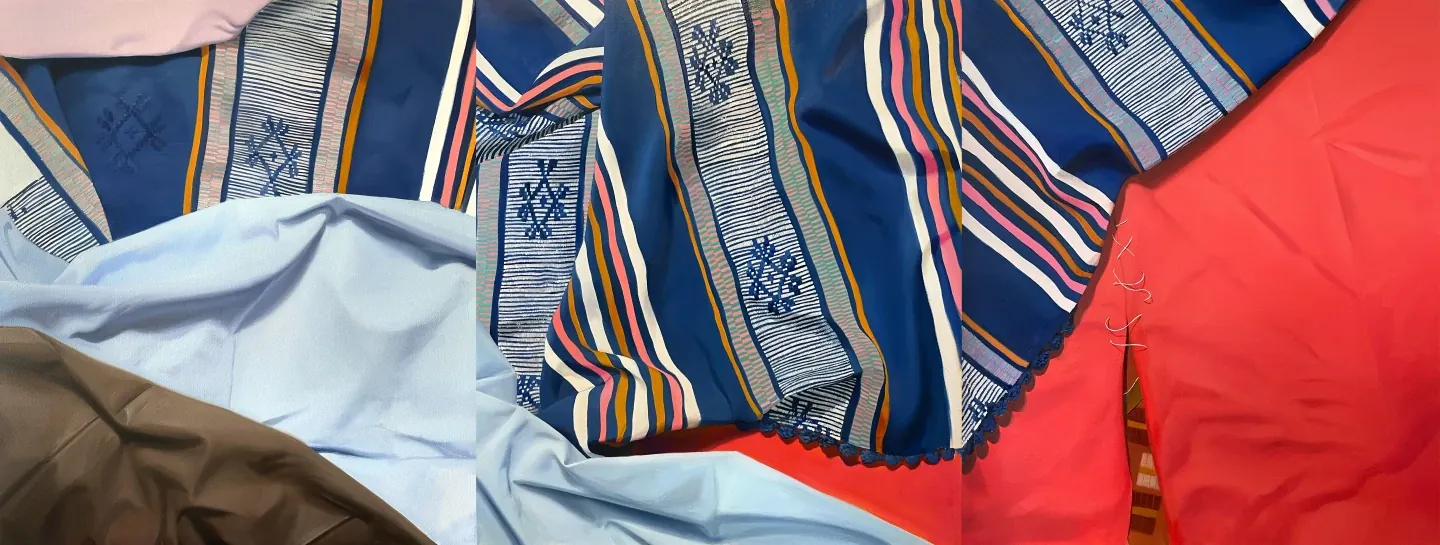
Do not stay on one side. Canepa turns the palace into a praxinoscope, one of those 19th-century optical devices that came before cinema: each panel of the canvas is a scene of fabrics being covered and uncovered, and the sequence only comes together as you walk round the building. This is how a video from January 2026 presented it:
History: a greenhouse for the 1887 Philippines Exhibition
The palace was built for the General Exhibition of the Philippine Islands, which opened in Retiro Park in 1887 under Spain’s Overseas Ministry. It was designed as a huge greenhouse for the plants brought from the archipelago, then a Spanish colony. The exhibition had a clear propaganda aim: to reinforce the empire’s image over its Pacific colonies. It did not only show objects: it also put on display a group of 40 to 50 people from the islands, Spain’s first “human zoo”, as the Museo Reina Sofía itself explains.
The architect was Ricardo Velázquez Bosco (Burgos, 1843 – Madrid, 1923), who also designed the neighbouring Palacio de Velázquez, working with the engineer Alberto de Palacio and the builder Bernardo Asins. Their model is obvious: the Crystal Palace that Joseph Paxton built in Hyde Park for London’s Great Exhibition of 1851. Like it, the Madrid palace was made from prefabricated parts, and it went up in just 5 months.
On 10 May 1936 the palace became a parliament chamber: Manuel Azaña was proclaimed President of the Second Spanish Republic here, and for the occasion its glass walls were covered with curtains. In the 1970s, around the time it was declared a National Historic Monument, it was restored in 1975 by the architect Ángeles Hernández-Rubio, who brought back its original look. In the 1990s it became an exhibition space of the Museo Reina Sofía, and between 1994 and 1998 José de la Dehesa refitted it again. Since 2021, Retiro Park and the Paseo del Prado have been a UNESCO World Heritage Site, the Landscape of Light.
Iron, glass and tiles: what to look at from outside
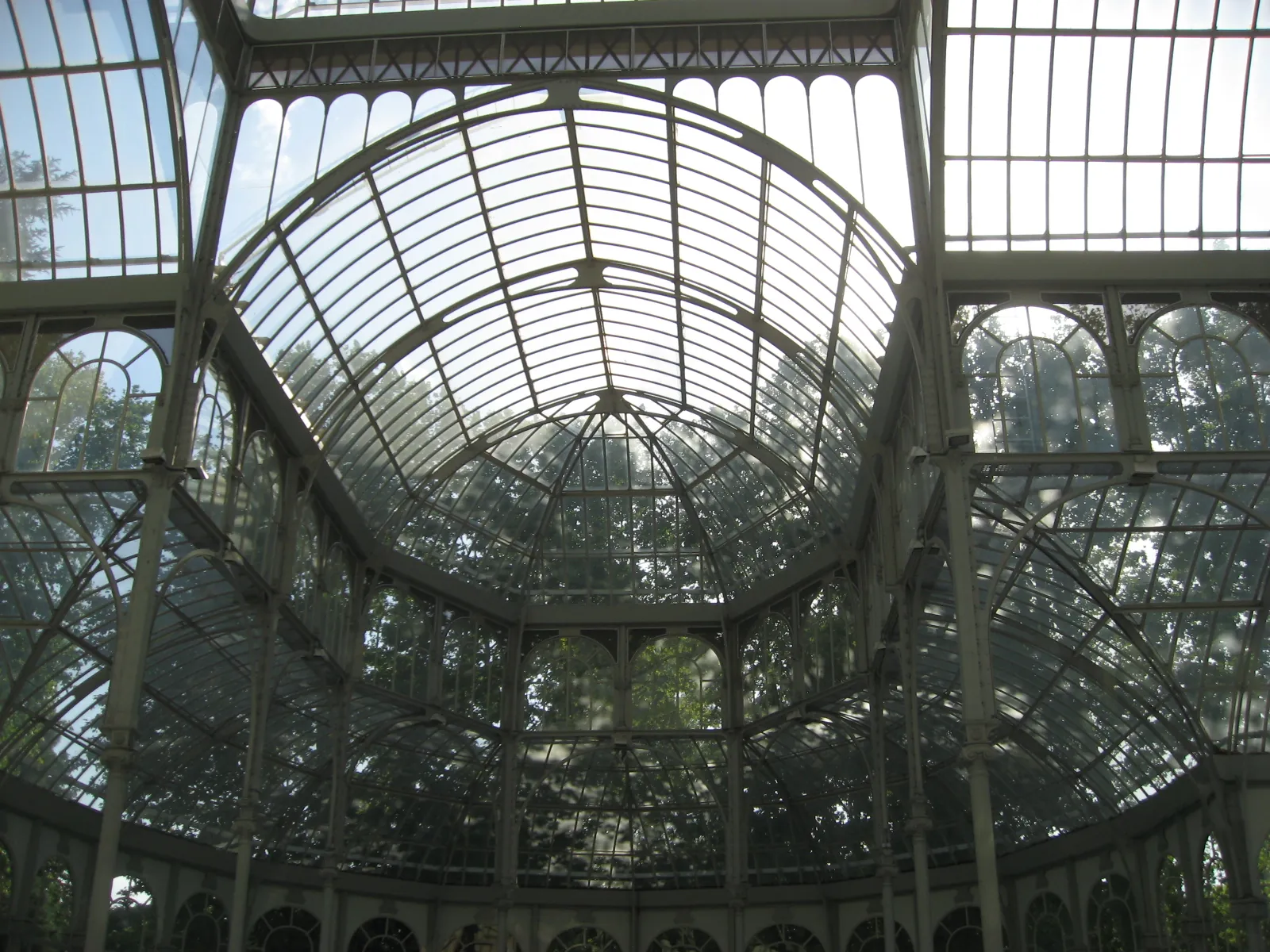
Even wrapped up, the shape of the building is easy to read. The plan is a Greek cross with one arm missing: in its place stands the entrance portico, with Ionic columns on a stone base and a wide granite staircase leading down towards the lake. It is the only part of the structure not made of iron. In the centre rises a glass dome 24 m high, above the barrel vaults, also of glass, that cover the rest. While the works last, you may see it under scaffolding.
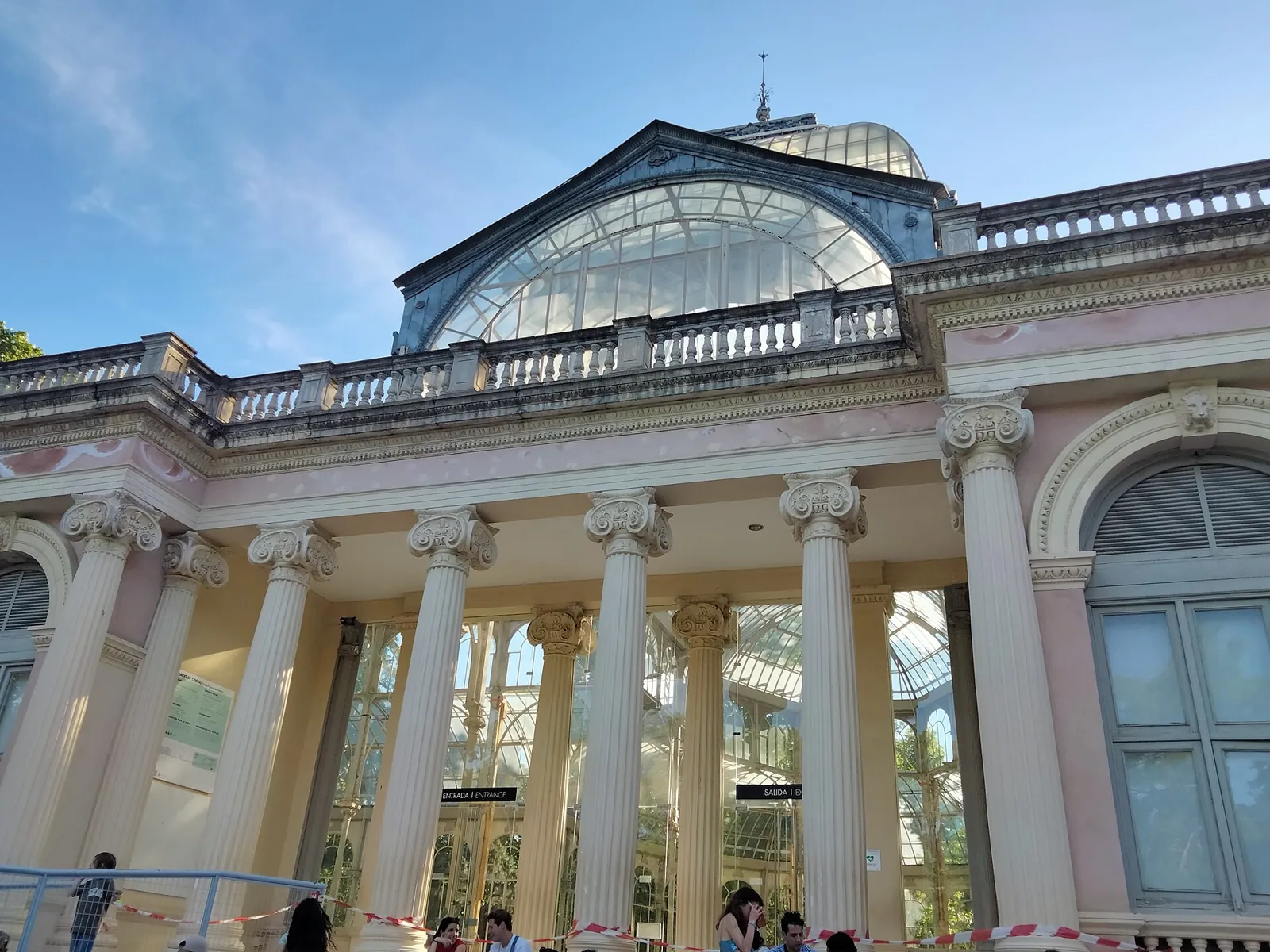
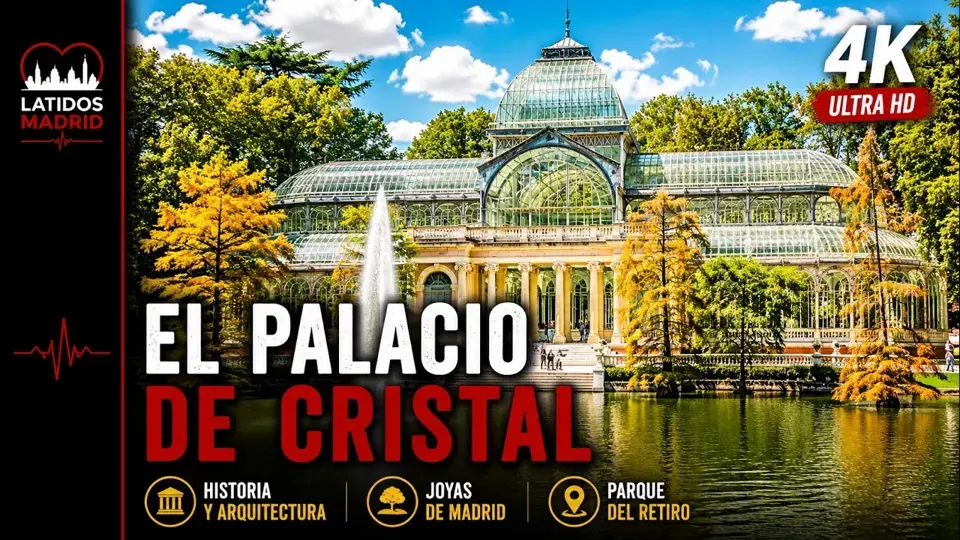
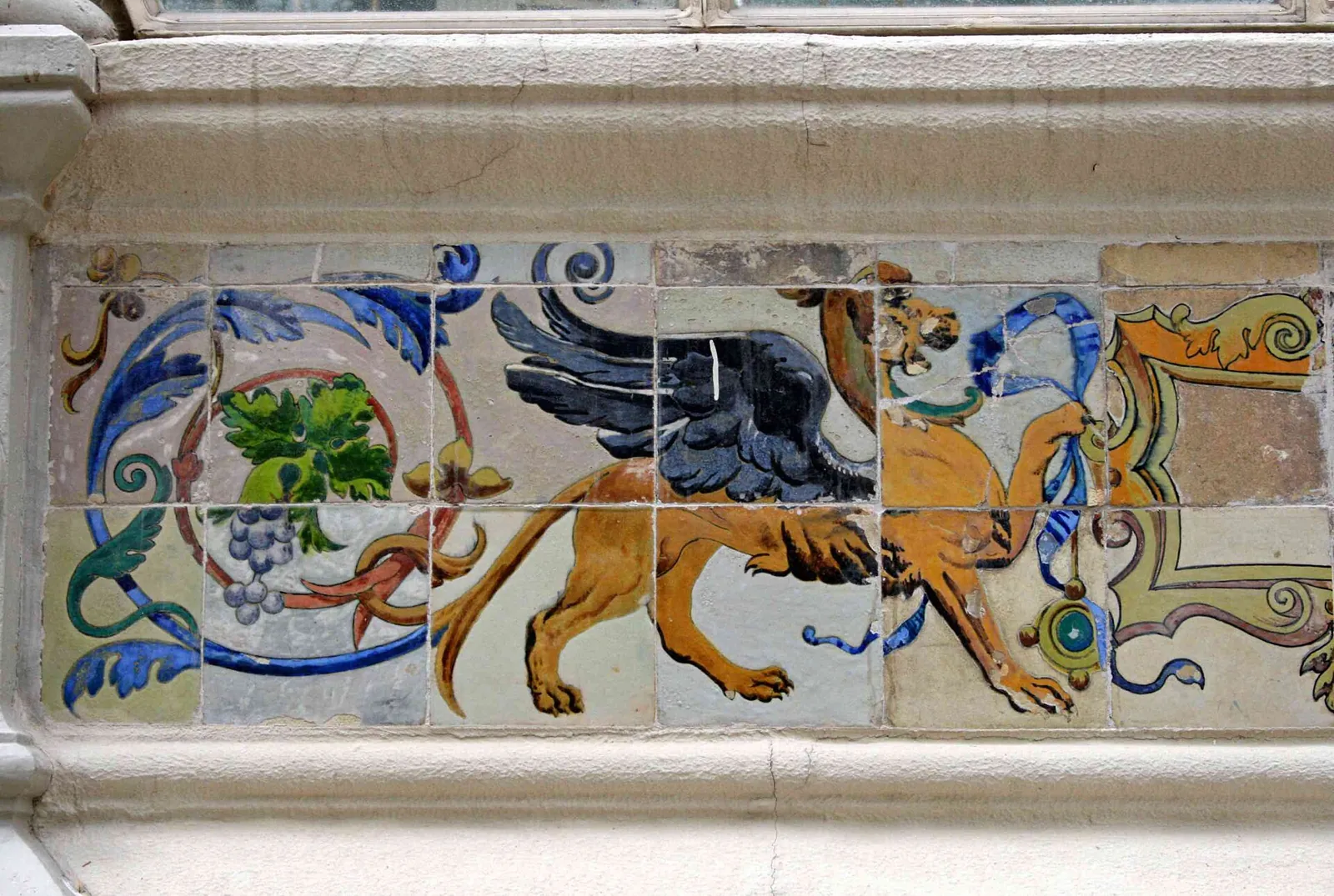
The building sits on a base of stone and brick decorated with tiles by Daniel Zuloaga, the great Spanish ceramicist of the time. In front lies the artificial lake with its fountain, and all around grow horse chestnut trees. To see it as it looked without the canvas, with the lake in front, here is a walk round it in 4K:
How to get to the Palacio de Cristal, and what is nearby
It sits in the heart of Retiro Park, about a 10-minute walk from the Puerta de Alcalá and 7 minutes from Avenida de Menéndez Pelayo. By metro, the nearest stations are Retiro (line 2), Ibiza (line 9) and Estación del Arte (line 1). City buses 1, 2, 9, 15, 19, 20, 28, 51, 52, 74 and 146, among others, serve the area around the park, and the closest Cercanías commuter-train station is Atocha.
Right next door is the Palacio de Velázquez, the museum’s other venue in the park, also free: from October to March it opens from 10:00 to 18:00, and until 8 March 2027 it hosts an exhibition by Fernando Sánchez Castillo. All our audio guides for the city are under Madrid. For another great Spanish monument with its own free audio guide, head north-west to Galicia:
 Free audio guideSantiago de Compostela Cathedral
Closer by, leave the park at Plaza de la Independencia and the Puerta de Alcalá is 1 km on foot from the Palacio de Cristal; from the arch, about 400 m down Calle de Alcalá, is Plaza de Cibeles, where the Mirador Madrid viewpoint in the tower of the Palacio de Cibeles gives you a 360° view of the city for €4, Tuesday to Sunday:
 Free audio guidePuerta de Alcalá, Madrid
 Free audio guidePlaza de Cibeles, Madrid
Find all our audio guides for the country under Spain.
Where to find it
FAQs
How do the free audio guides work?
Our audio guides work through the website audioguidetravel.com; you don’t need to download any app. Just follow the instructions on the website to guide you through Palacio de Cristal, Madrid: free audio guide to the Crystal Palace while listening to our experts’ explanations.
Can I take the tour at my own pace?
Of course! Our free audio guides are designed so that you set the pace. You can pause, rewind, or listen as many times as you want without missing a detail. By visiting Palacio de Cristal, Madrid: free audio guide to the Crystal Palace your way, you’ll enjoy it even more.
If I'm in a group, can we use the same audio guide?
Yes, our website allows sharing the same free audio guide among multiple devices. This way, you can visit Palacio de Cristal, Madrid: free audio guide to the Crystal Palace as a group or family, listening to the explanations simultaneously. The quickest way to do this is to share the link via WhatsApp, email, or any method you like. I’ve included some buttons below for you to do that now.
Visitor information
As of 2 Oct 2026- Opening hours
- Inside closed for works (tourist board: until 2027). Canvas: park hours, Oct-Mar 6:00-22:00.
- Tickets
- Free: the outside and the Fardo canvas; the museum galleries are free too when open.
- Time needed
- About a 3-minute audio guide by the lake, plus a full walk round the building.
- Getting there
- Metro Retiro (line 2), Ibiza (line 9) or Estación del Arte (line 1); inside Retiro Park.
- Accessibility
- You walk round it on the park paths; the inside is closed for restoration work.
- Tip
- Walk all the way round: the Fardo canvas tells its story panel by panel as you move.
- Official website
- www.museoreinasofia.es
Nearby
More free audio guides in Madrid
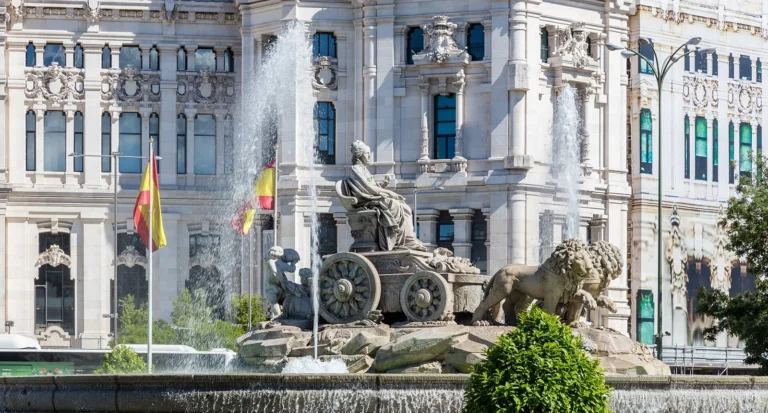 2:46MadridPlaza de Cibeles, Madrid: free audio guide to the fountainPlaza de Cibeles is the Madrid roundabout where Calle de Alcalá crosses the Paseo del Prado. In the…
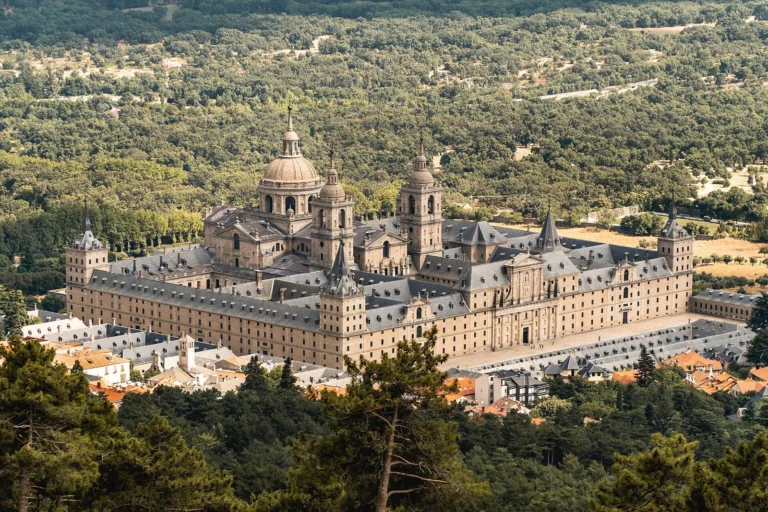 3:02MadridEl Escorial Monastery: free audio guide, tickets and opening timesThe Royal Monastery of San Lorenzo de El Escorial is Philip II’s statement in granite: a monastery, a…
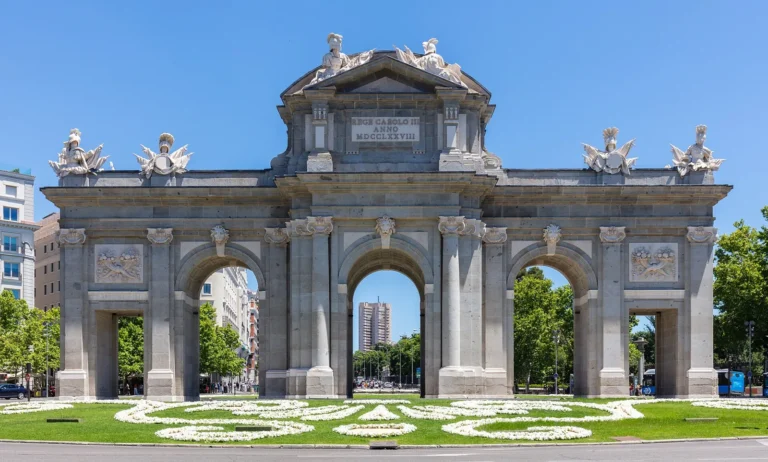 2:48MadridPuerta de Alcalá, Madrid: free audio guide, history and how to get thereThe Puerta de Alcalá, Madrid’s Alcalá Gate, is the granite triumphal arch that King Charles III built where…