
Free audio guide to Saint Mary Major in Rome, in English: just over 7 minutes on its history, the legend of the snow, the nave, the high altar and the Salus Populi Romani. It plays on this page.
 Audio guide
The Basilica of Saint Mary Major, Santa Maria Maggiore in Italian, is the great church of the Virgin Mary in Rome, on the Esquiline Hill, about 500 m from Termini station. It is the only early Christian basilica in the city that has kept its original look, with 5th-century mosaics, and it holds the icon of the Salus Populi Romani and the tomb of Pope Francis. This is its free audio guide, in English.
What the audio guide covers
It is free, plays on this page in your phone’s browser with no app and no sign-up, and lasts just over 7 minutes. Most of it is the story. It explains the names of the church, Saint Mary Major, Saint Mary of the Snow and the Liberian Basilica, and why it is one of the 4 major basilicas of Rome, then goes through the key moments: the earthquake of 1348, the years after the return of the popes from Avignon when they lived here, and the popes buried in the basilica, among them Paul V and Saint Pius V. It also reminds you that pilgrims visit it on the walk of the 7 churches of Rome.
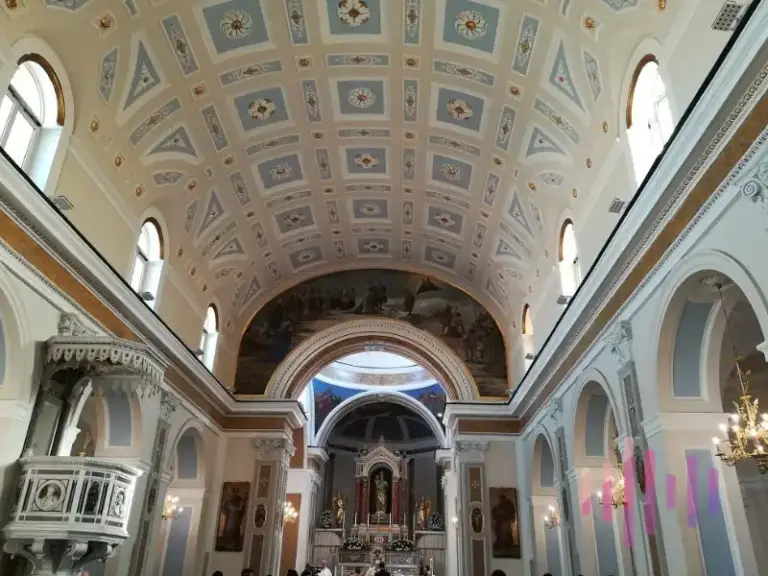
Then comes the legend that gives the church its other name: on the night of 4 to 5 August 358, the Virgin appeared in a dream to a Roman patrician called John and to Pope Liberius and asked for a church where they found snow. The next morning, in the middle of summer, snow covered a patch of the Esquiline. The audio guide tells how every 5 August the miracle is recalled with a shower of white petals falling from the ceiling. The walk then takes you from the main entrance down the nave to the high altar, the side chapels, the chapel of the Salus Populi Romani and the sacristy, and ends with a look up at the ceilings and down at the floor mosaics.
Points of interest the audio guide stops at:
| Point of Interest | Description |
|---|---|
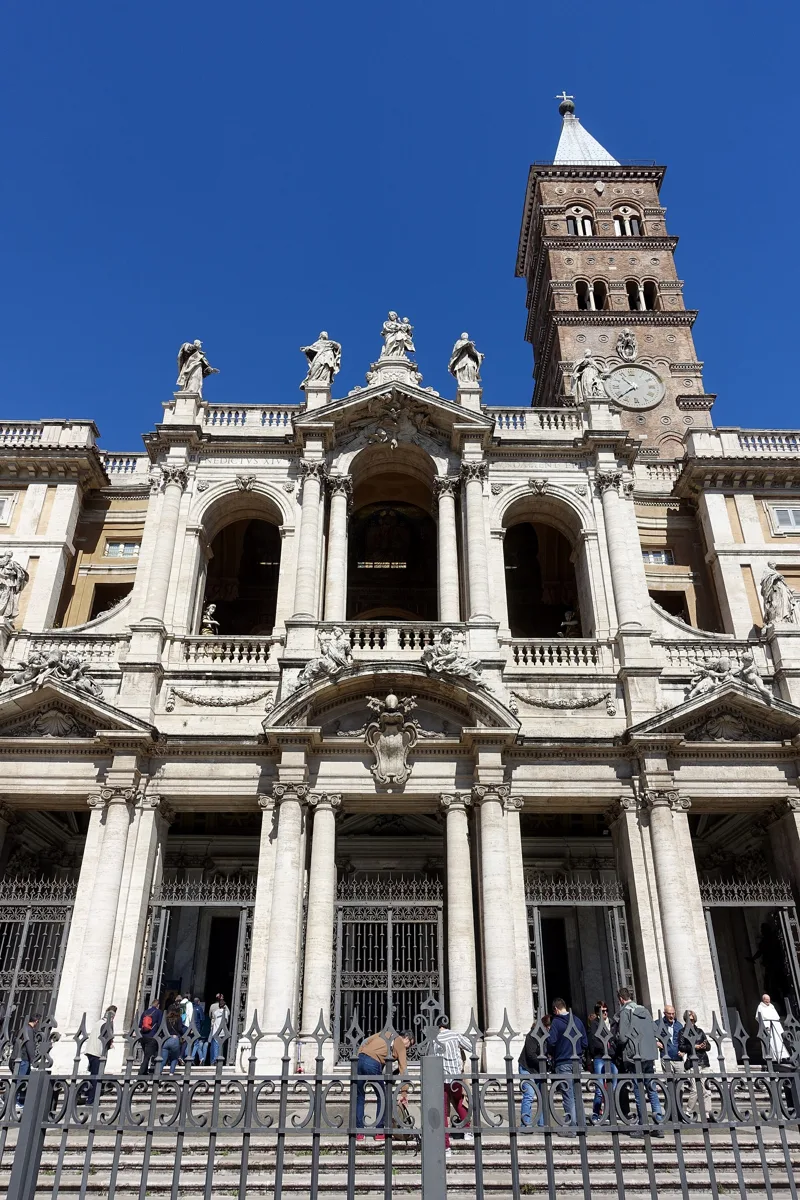
| Main Entrance | The portico and doors under the 18th-century facade, where the walk begins. |
| Side Chapels | The chapels along both aisles, each with its own frescoes, sculpture and history. |
| High Altar | The heart of the basilica, under the canopy designed by Ferdinando Fuga, where popes have celebrated Mass for centuries. |
| Salus Populi Romani Chapel | The Pauline Chapel, built by Paul V for the icon of the Virgin, protector of the Roman people. |
| Sacristy | The sacristy, which the audio guide pairs with the treasury of the basilica. |
| Domes of the chapels | The dome of the Pauline Chapel, painted by Lodovico Cigoli, and the drum of the Sistine Chapel. |
The nave and the mosaics
Walk in and the first thing that strikes you is the length of the nave. The columns of cipollino marble came from older buildings, warehouses and pagan temples pulled down in Christian times. Under your feet is a Cosmatesque floor of coloured marble, and above you a coffered ceiling of gilded wood designed by Giuliano and Antonio da Sangallo.
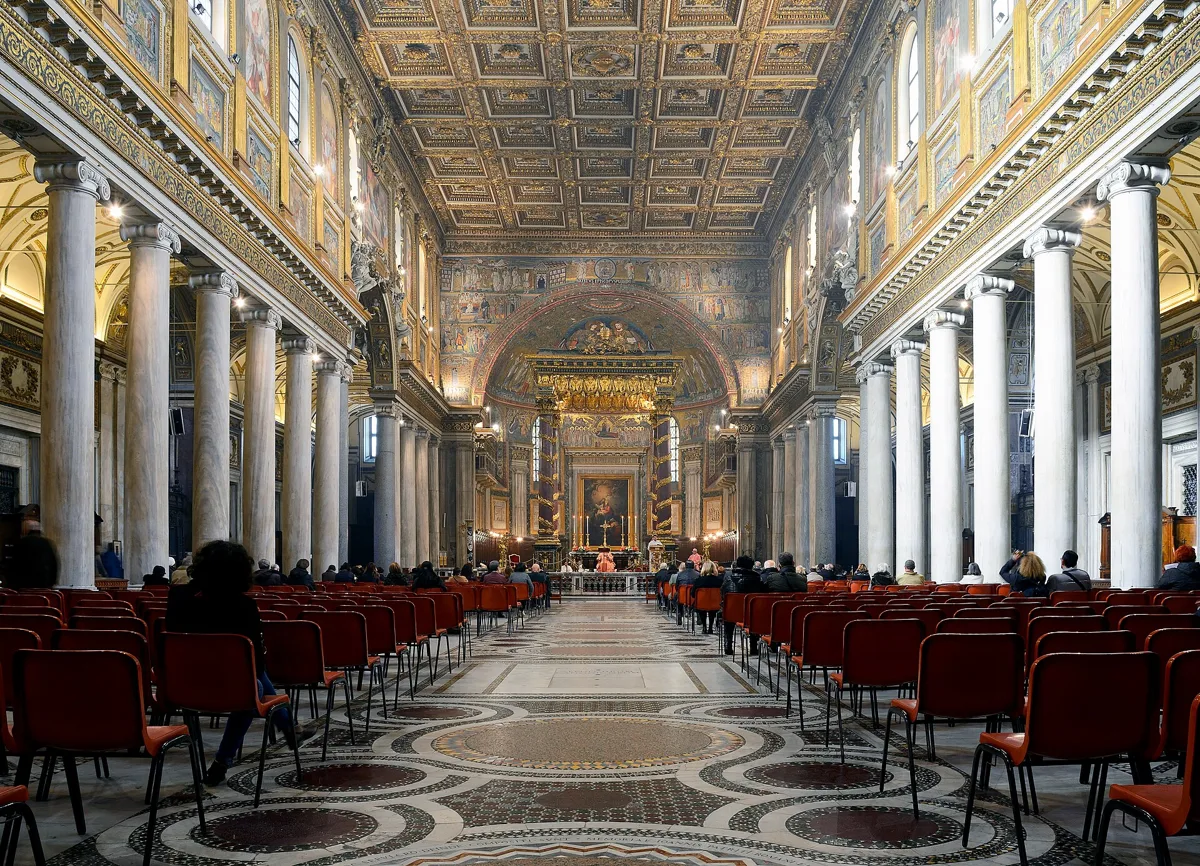
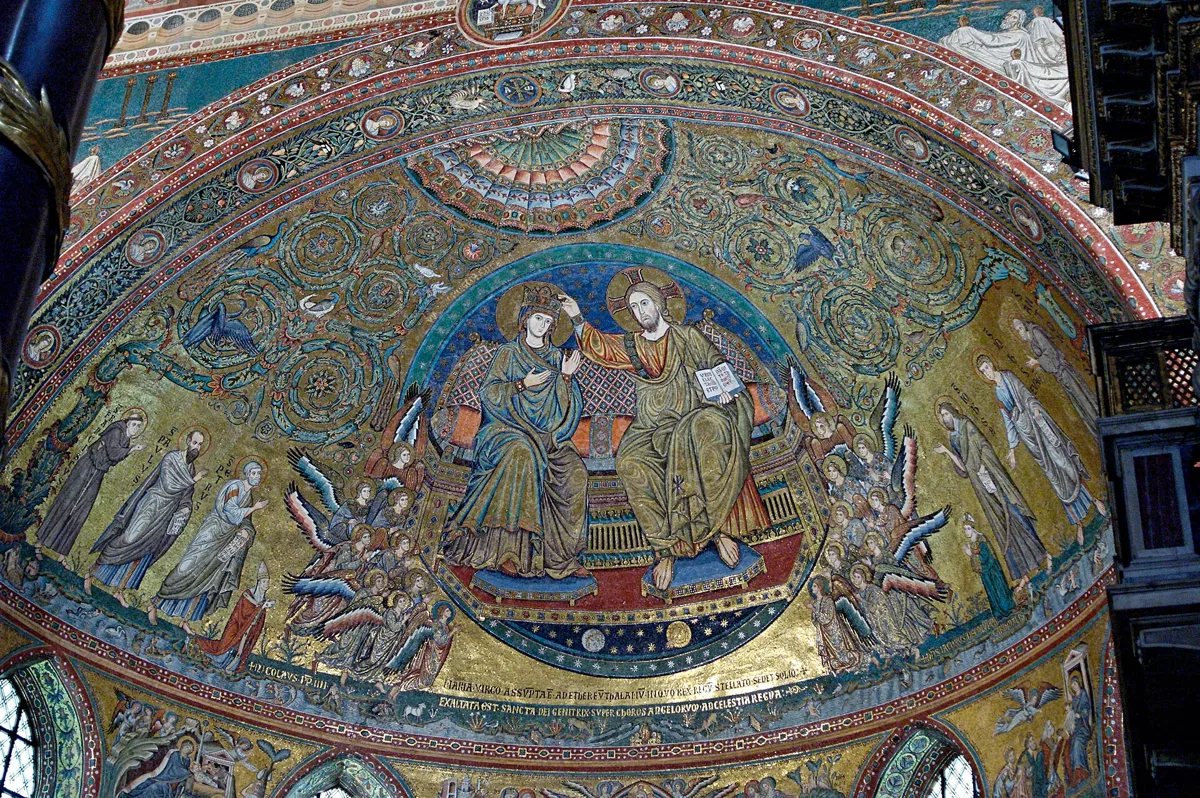
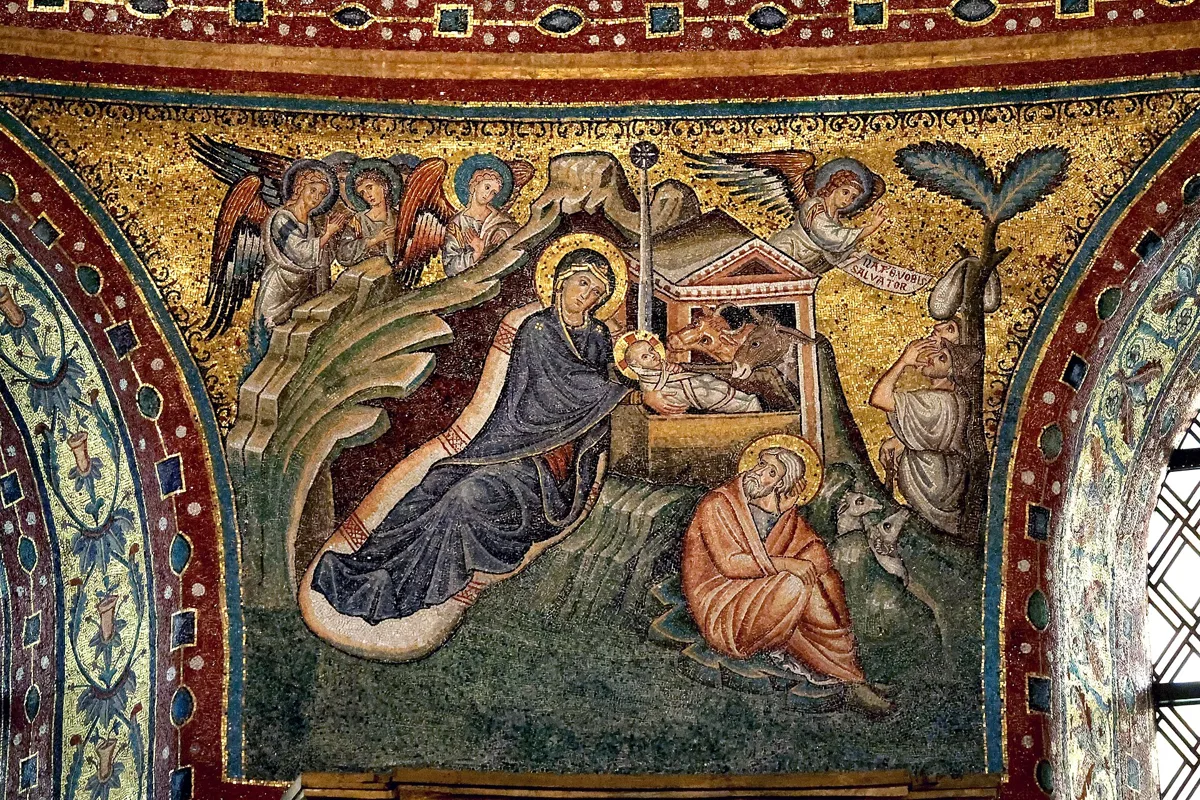
The oldest treasures are high on the walls. The mosaics of the nave and of the triumphal arch date from the time of Pope Sixtus III, between 432 and 440. The mosaics of the apse are medieval: Pope Nicholas IV, who reigned from 1288 to 1292, gave them to Jacopo Torriti, and at their centre Christ crowns the Virgin, with angels and saints on a gold ground. Among the scenes below it is the Nativity.
Over the papal altar stands the canopy designed by Ferdinando Fuga, the architect of the great renovation Benedict XIV ordered ahead of the Holy Year of 1750. The basilica also keeps the Relic of the Holy Crib, the wood of the manger of Jesus, the reason why Saint Mary Major is called the Bethlehem of the West.
The Salus Populi Romani and the tomb of Pope Francis
On the left side of the basilica opens the Pauline Chapel, which Pope Paul V built as a home for the most loved icon in Rome, the Salus Populi Romani, “protector of the Roman people”. Tradition says Saint Luke painted it. It is a cedar panel of 117 by 79 cm with the Virgin holding the Child, set in an altar of jasper columns covered in lapis lazuli. According to tradition, Pope Gregory the Great prayed before it for an end to the plague, and its arrival in the chapel is still remembered every last Sunday of January. The chapel frescoes, from 1610 to 1612, are by a team under the Cavalier d’Arpino that included Guido Reni.
Pope Francis prayed before the icon before and after every journey, and he chose Saint Mary Major as his resting place. His tomb is in the left aisle, between the Pauline Chapel and the Sforza Chapel, near the altar of Saint Francis of Assisi: a plain slab of stone from Liguria, the land of his family, with the single word FRANCISCVS, and an enlarged copy of the pectoral cross he wore on the front wall of the niche. A plaque unveiled on 21 April 2026, the first anniversary of his death, stands on the right-hand side of the Pauline Chapel.
Across the nave, the Sistine Chapel of Saint Mary Major, not the one in the Vatican, was built for Pope Sixtus V between 1585 and 1587 by Domenico Fontana, on the plan of a Greek cross. Below it lies the Oratory of the Nativity, a copy of the grotto in Bethlehem, and on its sides are the tombs of Sixtus V and Saint Pius V. In the right aisle, a simple Latin inscription marks the tomb of the Bernini family, Pietro and Gian Lorenzo, whose workshops were right behind the Pauline Chapel.

The museum, the Loggia and the 360° terraces
The official ticket office sells entry to the museum areas, not to the basilica. A ticket is what you need for the Liberian Museum complex, which takes in the museum rooms, the Loggia of the Blessings, the Hall of the Popes, Bernini’s staircase and the 360° panoramic terraces, and for the archaeological area under the church. You book on the official ticket office, which also sells entry with an audio guide and tours with an art historian.
The 3 museum rooms opened on 11 December 2024. The star of the first one is the first nativity scene in the history of art, carved in marble by Arnolfo di Cambio in 1291, shown in a case you can walk around. The route goes up the Great Staircase of the Canons’ Palace to the Loggia of the Blessings, where you stand face to face with the medieval mosaic of the facade.
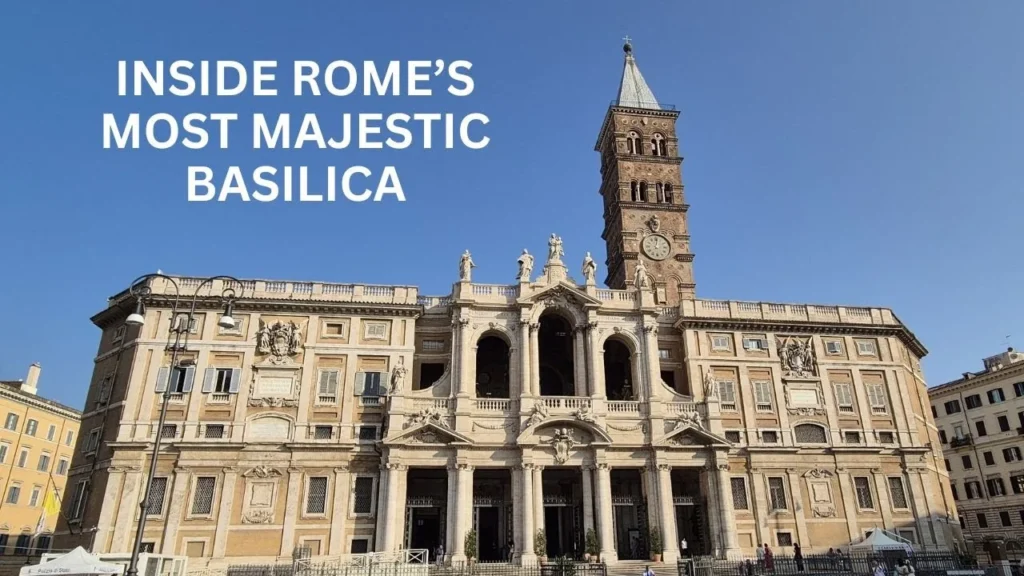
The facade itself is 18th-century: Ferdinando Fuga built the portico and the Loggia for Benedict XIV ahead of the Holy Year of 1750. The 4 white marble angels on top are by Pietro Bracci, the sculptor of the Ocean at the Trevi Fountain. In the square in front stands the Column of Peace, a fluted marble column taken from the Basilica of Maxentius in the Roman Forum, with a bronze of the Virgin from 1614. Underground, the archaeological area shows rooms around a hall of the imperial age, with a bath with mosaics and a fresco of a farming calendar.
Mass, dress code and accessibility
Saint Mary Major is a working church, and Mass is said several times a day. On weekdays it is in the Pauline Chapel at 07:00, 08:00, 09:00, 10:00, 11:00, 12:00 and 18:00. On Sundays and holy days there are Masses at the papal altar at 10:00, 12:00 and 18:00, plus 07:00, 08:00 and 09:00 in the Pauline Chapel, and a vigil Mass at 18:00 the evening before. During Mass, walk quietly along the aisles.
The basilica has a ramp for visitors in wheelchairs, toilets for visitors with reduced mobility, and mobile platforms to reach all the side chapels: ask the staff inside for them. The museum complex has a lift. For the 360° terraces and the archaeological area, the basilica asks visitors with disabilities to write first to visitemuseo.smm@basilica.va.
Getting there and what is nearby
The basilica stands on Piazza di Santa Maria Maggiore. The easiest way is metro lines A and B to Termini, about 500 m away; Cavour on line B and Vittorio Emanuele on line A are also close. At the far end of Via Merulana, the obelisk of Saint John Lateran answers the Column of Peace.
Saint Mary Major fits easily into a day in the heart of ancient Rome: the Colosseum is close by, and you can see all our free audio guides to the city on the Rome page.
FAQs
How do the free audio guides work?
They play right here on audioguidetravel.com, with no app to download and no sign-up. Press play and listen as you walk round: a phone and a pair of headphones are all you need. The audio streams from this page, so you’ll need mobile data or Wi-Fi.
Can I take the tour at my own pace?
Of course! You set the pace: pause whenever you like, jump back or forward 15 seconds, or tap the bar to jump to any point, and listen as many times as you want so you don’t miss a thing.
If I'm in a group, can we use the same audio guide?
Yes. The same free audio guide opens on as many phones as you like, so you can go round together as a group or with your family, each person at their own pace and with their own headphones. The quickest way is to send the link via WhatsApp, Telegram or however you like: the buttons just below let you share it right now.
Visitor information
As of 22 Oct 2026- Opening hours
- Museum areas Mon-Sat, entries every hour 08:00-18:00 · Sun only 13:30 and 15:00
- Tickets
- Tickets for the museum, Loggia, 360° terraces and excavations; none sold for the basilica
- Time needed
- Audio guide 7 min · museum and Loggia extra, by timed entry
- Getting there
- Metro lines A and B to Termini, about 500 m away.
- Accessibility
- Ramp, accessible toilets and mobile platforms to the chapels; lift in the museum
- Tip
- Look up at the moon Cigoli painted in the dome of the Pauline Chapel, after Galileo
- Official website
- www.basilicasantamariamaggiore.va
Nearby
More free audio guides in Rome
 8:15RomeSt. Peter’s Basilica: free audio guide and visiting hoursFree audio guide to St Peter’s Basilica in Rome, in English: about 8 minutes on the tomb of…
 6:30RomeRoman Forum: free audio guide, hours and ticketsFree audio guide to the Roman Forum, in English: 7 minutes along the Via Sacra, from the Curia…
 4:23RomeArch of TitusAnother testament to Roman greatness, the Arch of Titus celebrates the emperor’s victories over Jerusalem. It is a…