
Free audio guide to Plaza de España in Seville, in English: about 7 minutes on Aníbal González’s square for the 1929 Exposition, its province benches, bridges and medallions, its restoration and its life on screen, playing on this page.
 Audio guide
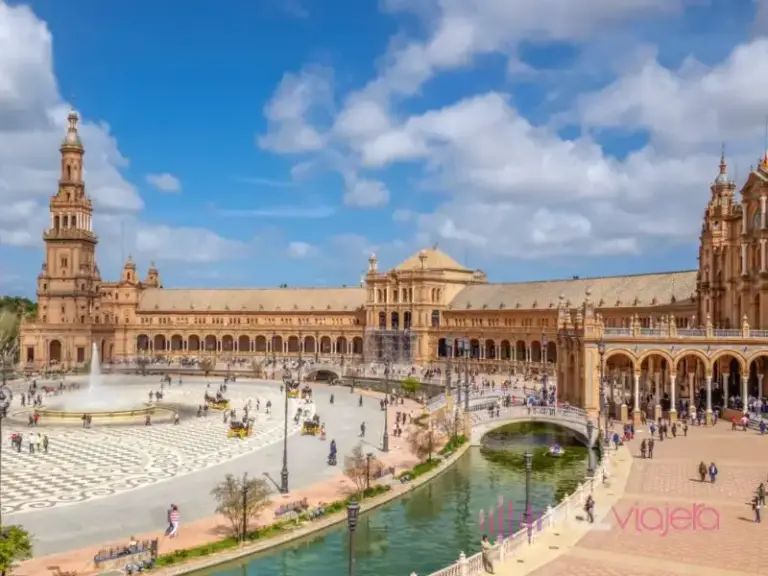
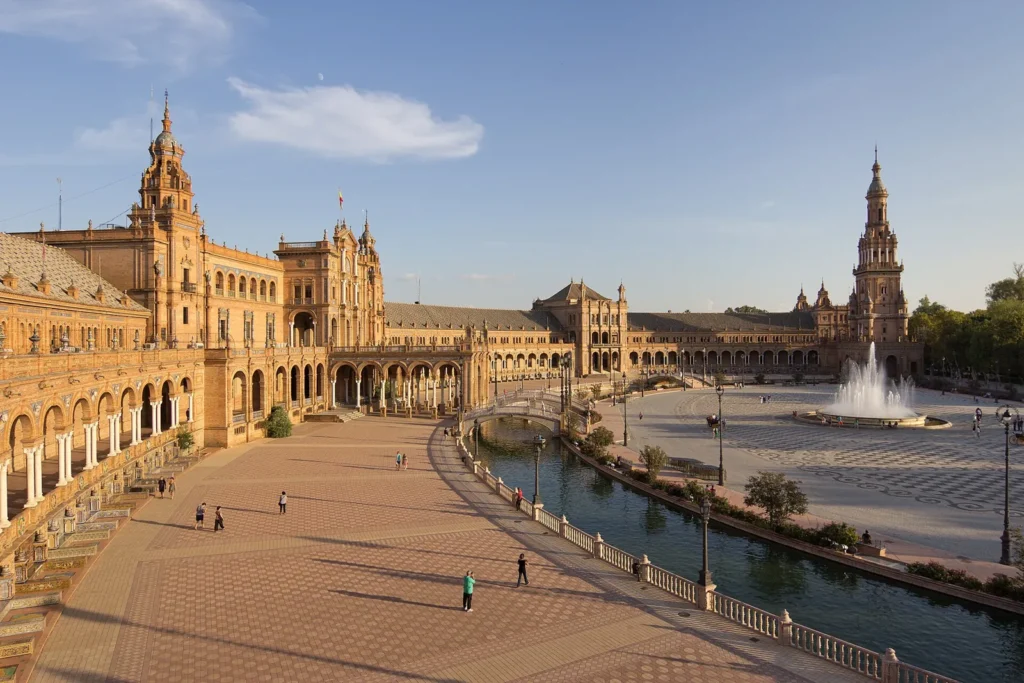
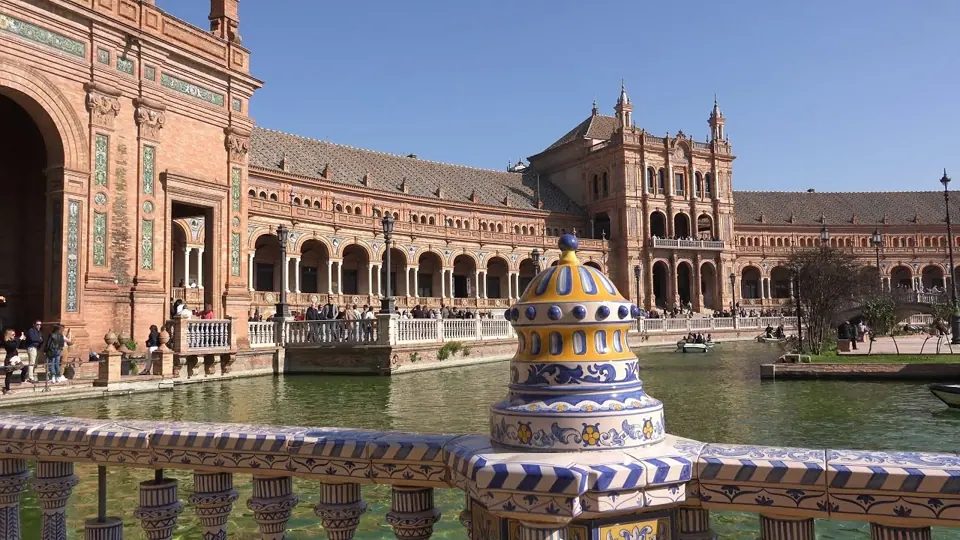
Plaza de España is the great semicircular square that Aníbal González designed for the Ibero-American Exposition of 1929, on the edge of the Parque de María Luisa in Seville. Around it run a brick building with 2 towers of 74 metres, a canal crossed by 4 bridges and 48 tiled benches dedicated to the provinces of Spain. Entry is free. This is its free audio guide, in English.
What the audio guide covers
It is free, it plays on this page in your phone’s browser, with no app and no sign-up, and it lasts about 7 minutes. It starts with the project: Aníbal González’s semicircular design, which opens its arms towards the Parque de María Luisa, built for the Ibero-American Exposition of 1929 in a regionalist style that mixes Spanish Renaissance forms with local ceramics. Then it takes you round the square: the tiled benches of the provinces, with scenes such as the Battle of Almansa or the conquest of Granada by the Catholic Monarchs; the ceramic medallions of famous Spaniards such as El Cid, Christopher Columbus and Saint Teresa of Ávila; the 4 bridges named after the old kingdoms; and the canal with its rowing boats. The last part is about the life of the square since then: the Army headquarters in the central building, concerts such as the Icónica festival, its scenes in Lawrence of Arabia and Star Wars: Episode II, and the restoration of 2002 to 2010.
Some points of interest described in the Plaza de España audio guide:
| Point of Interest | Brief Description |
|---|---|
| The semicircle | Aníbal González’s design for the Exposition of 1929, open towards the Parque de María Luisa. |
| Province benches | Tiled benches with scenes from the history of each province; Seville has none of its own. |
| Medallions | Ceramic busts of famous Spaniards set between the arches, from El Cid to Saint Teresa of Ávila. |
| The 4 bridges | Named after the old kingdoms of Aragon, Castile, León and Navarre. |
| The canal | The water that runs along the square, with rowing boats for hire. |
| On screen | Lawrence of Arabia (1962) and Star Wars: Episode II – Attack of the Clones. |
| Restoration | From 2002 to 2010: about 25% of the tiles of the province benches replaced with replicas, and the canal waterproofed. |
Opening hours, entry and when to go
Plaza de España is a public square and there is no ticket: walking round it, sitting on the benches and crossing the bridges are all free. It is open every day from 08:00; from October, with Seville’s winter park hours, the Parque de María Luisa around it closes at 22:00, so plan to finish your visit by then. The square opens onto the Parque de María Luisa, so the visit fits well with a walk among the park’s trees, fountains and statues.
The best moments are early in the morning and at sunset, when the light is at its best for photos and the walk is calmer. Give yourself time to follow the whole curve of the building at ground level, past the benches, and then to come back along the gallery above them.
The square has 3 levels. Ramps at the 2 ends lead in to the intermediate level, and there is also a step-free way in through the centre of the square. The upper level is reached by stairs, with a stair lift at the accesses by the north and south towers. There are no public toilets in the square.
 Free audio guideReal Alcázar of Seville (general)
The 48 benches of the provinces
Along the foot of the building, against the wall below the gallery, run 48 tiled benches, each one dedicated to a province of Spain and set in alphabetical order, with a few exceptions. Each has a tiled map of the province on the floor, the provincial shield above it and a large tile panel with a scene from the history of the province; on either side stands a small tiled bookcase.
Some details tell the story of when they were made. Seville has no bench of its own: as the host city it was considered already present in the whole monument, and it appears instead in tiled panels with scenes from the province. The Canary Islands have a single bench for the whole archipelago, because the islands were 1 province when the benches were planned. Ceuta and Melilla have none: at the time Ceuta belonged to the province of Cádiz and Melilla to that of Málaga.
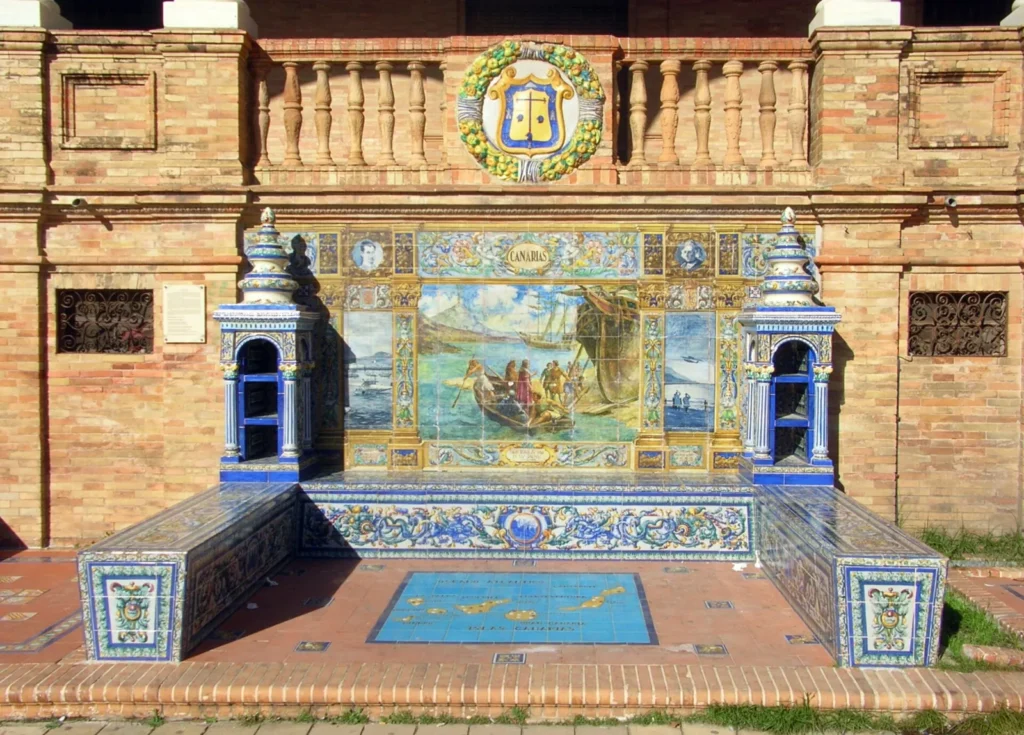
For many Spanish visitors, finding the bench of their own province and having their photo taken in front of it has become a ritual. Together, their painted scenes work as an open-air museum of the history of Spain’s provinces.
The bridges, the canal and the medallions
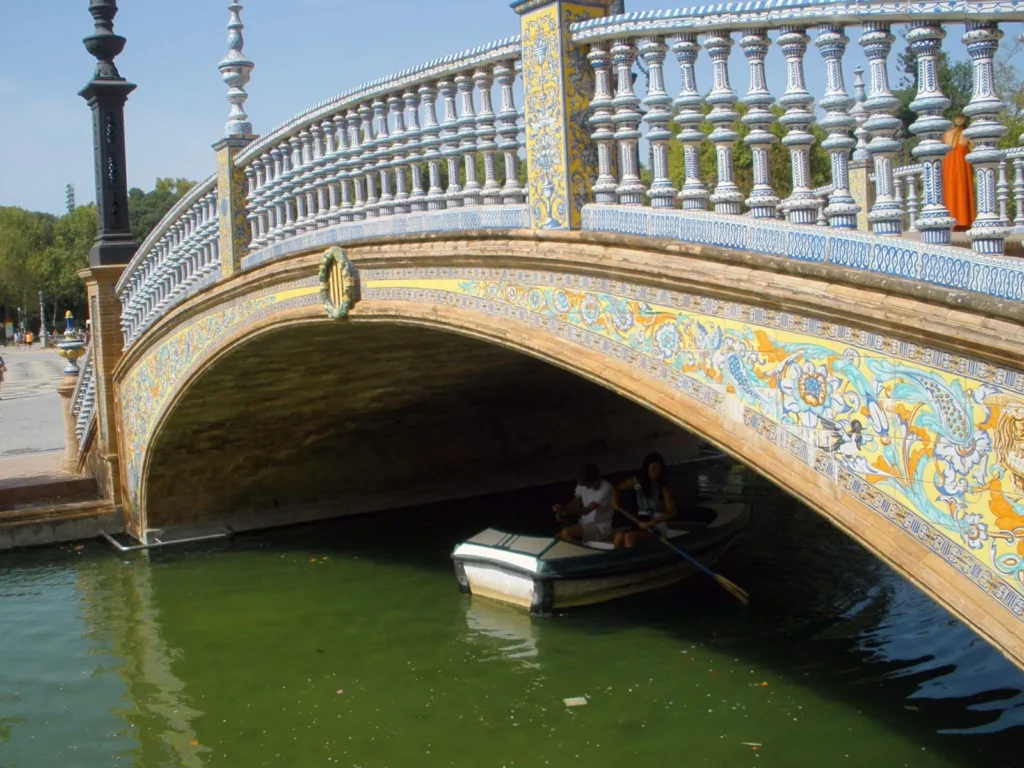
The canal, 510 metres long, follows the curve of the square and is crossed by 4 bridges, named after the old kingdoms of Spain: Castile, León, Aragon and Navarre. The bridges are faced with tiles and topped by ceramic balustrades, and rowing boats can be hired to go along the water and under them. In the middle of the square stands the fountain by Vicente Traver.
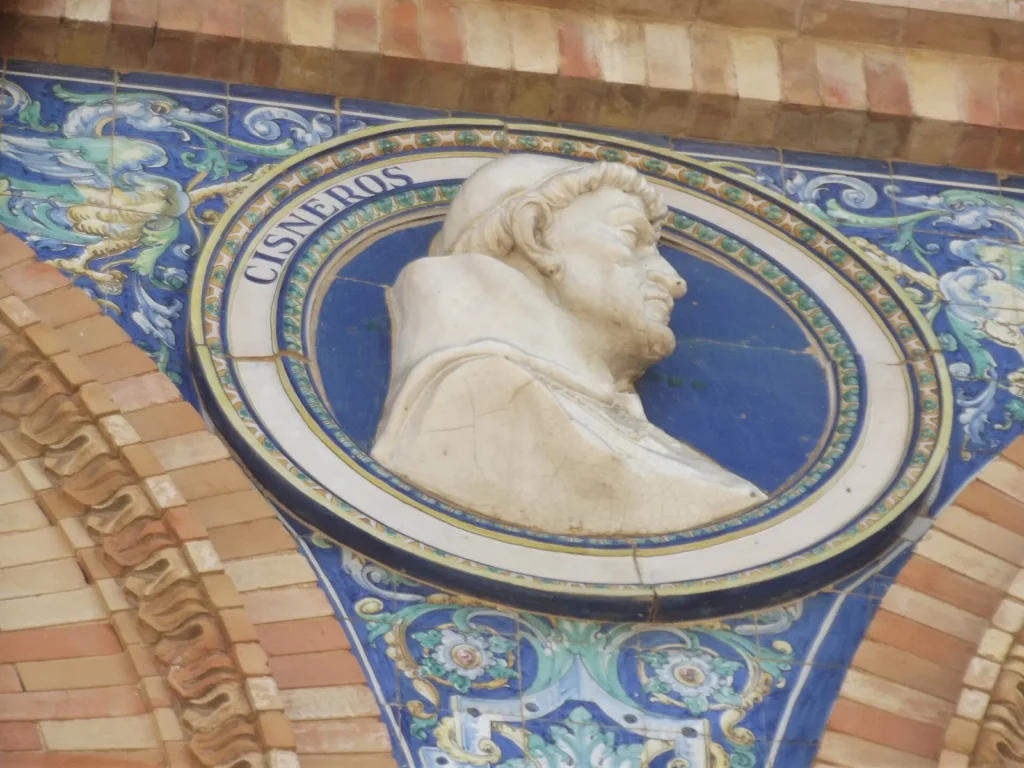
Look up at the arches of the gallery. Between them are the ceramic medallions with the busts of illustrious Spaniards, white on a blue background, from Christopher Columbus and Cardinal Cisneros to Miguel de Cervantes and Diego Velázquez. They are the work of the sculptor Pedro Navia, who also made the 24 imperial eagles with the shield of Charles I and the 4 heralds, 3 metres tall, that stand for the old kingdoms.
The gallery itself is part of the visit. Marble columns hold it up and its ceilings are coffered in wood, and it lets you walk the whole curve under cover. At its centre, the main building rises over 3 floors of stacked arcades, between the 2 towers at the ends that are visible from all over Seville.
Free audio guideReal Alcázar Gardens, Seville
A short history in 6 dates
- 1911 — Aníbal González wins the competition for the design of the Exposition.
- 1914 — the first project for the square, a great open space with water, facing the Parque de María Luisa; the works begin in August. The semicircle stands for Spain’s embrace of its former territories in America, and it looks towards the Guadalquivir, the river that led to America.
- 9 May 1929 — the opening ceremony of the Ibero-American Exposition is held in the square, with King Alfonso XIII.
- 1962 — the square appears in Lawrence of Arabia; in 2002 it becomes the capital of the planet Naboo in Star Wars: Episode II – Attack of the Clones.
- 17 October 2010 — a ceremony marks the end of a restoration that began in 2002. About 25% of the tiles of the province benches were replaced with replicas, and the canal was waterproofed and given a water treatment plant.
- July 2023 — the buildings of the square are declared a Bien de Interés Cultural, in the category of Monument; the file had been opened on 3 November 1981.
Today the buildings house public services of the Spanish State: the Government Delegation in Andalusia and the Ministry of Defence, while the square in front of them belongs to the city of Seville.
Getting there, and what is nearby
The square is on Avenida de Isabel la Católica, on the edge of the Parque de María Luisa. The closest stop is Prado de San Sebastián, on Metro Line 1 and on the tram; San Bernardo, with Metro Line 1, the tram and Cercanías trains, is also within walking distance. Each of these places in Seville has its own free audio guide:
- Real Alcázar of Seville — the royal palace, with its courtyards and halls.
- Real Alcázar Gardens — the gardens of the palace.
- Seville Cathedral — the Gothic cathedral and its bell tower, the Giralda.
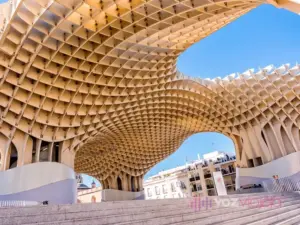
- Setas de Sevilla — the great wooden parasols over Plaza de la Encarnación.
 Free audio guideSeville Cathedral
All of them are on the free audio guides of Seville page. The same guide in Spanish is at Plaza de España en vozviajera.com.
FAQs
How do the free audio guides work?
They play right here on audioguidetravel.com, with no app to download and no sign-up. Press play and listen as you walk round: a phone and a pair of headphones are all you need. The audio streams from this page, so you’ll need mobile data or Wi-Fi.
Can I take the tour at my own pace?
Of course! You set the pace: pause whenever you like, jump back or forward 15 seconds, or tap the bar to jump to any point, and listen as many times as you want so you don’t miss a thing.
If I'm in a group, can we use the same audio guide?
Yes. The same free audio guide opens on as many phones as you like, so you can go round together as a group or with your family, each person at their own pace and with their own headphones. The quickest way is to send the link via WhatsApp, Telegram or however you like: the buttons just below let you share it right now.
Visitor information
As of 3 Nov 2026- Tickets
- Free
- Getting there
- The closest stop is Prado de San Sebastián, on Metro Line 1 and on the tram. The square opens onto the Parque de María Luisa.
- Accessibility
- Ramps at both ends and a step-free way in through the centre; the upper level is by stairs or stair lift
- Tip
- Come early in the morning or at sunset: the light is at its best for photos and the walk is calmer
Nearby
More free audio guides in Seville
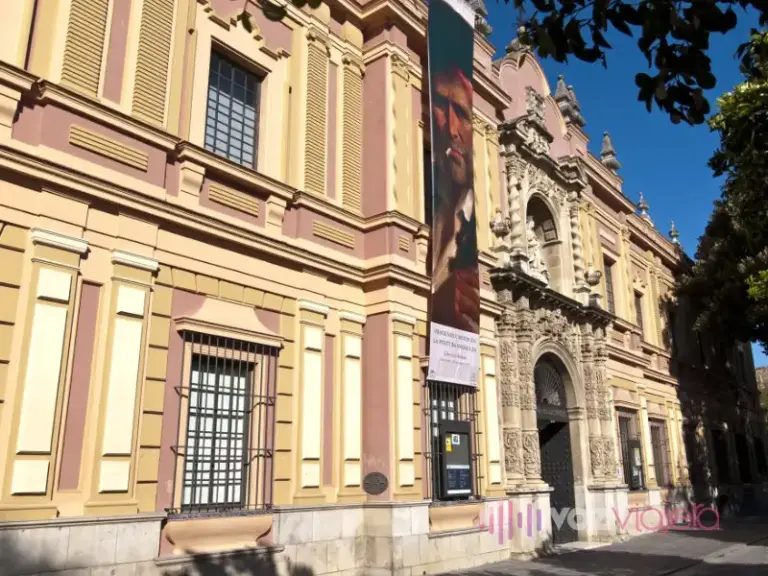 3:40SevilleMuseum of Fine ArtsWelcome to the Museum of Fine Arts of Seville, a temple dedicated to art and history, located in…
 3:53SevilleIsla MagicaIsla Magica, the theme park located in Seville, invites you to embark on an epic adventure that will…
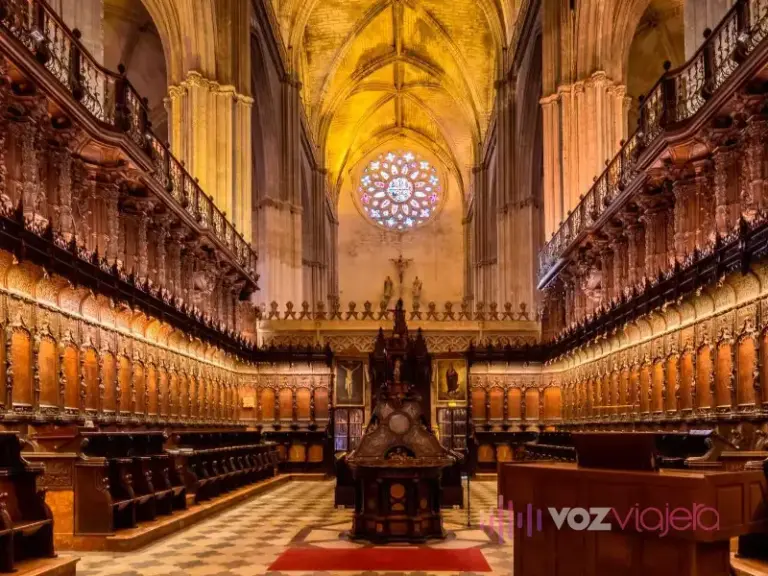 4:12SevilleSeville Cathedral (Interior)The Seville Cathedral is the largest Gothic cathedral in the world and an important architectural landmark. Immerse yourself…