
Naples Archaeological Museum: free audio guide and hours
Free audio guide in English · no app, no sign-up
Free audio guide to the National Archaeological Museum of Naples (MANN), in English: about 6 minutes on the Farnese collection, the Sundial Hall, the Alexander Mosaic, the Secret Cabinet and the treasures of Pompeii and Herculaneum, playing on this page.
 Audio guide
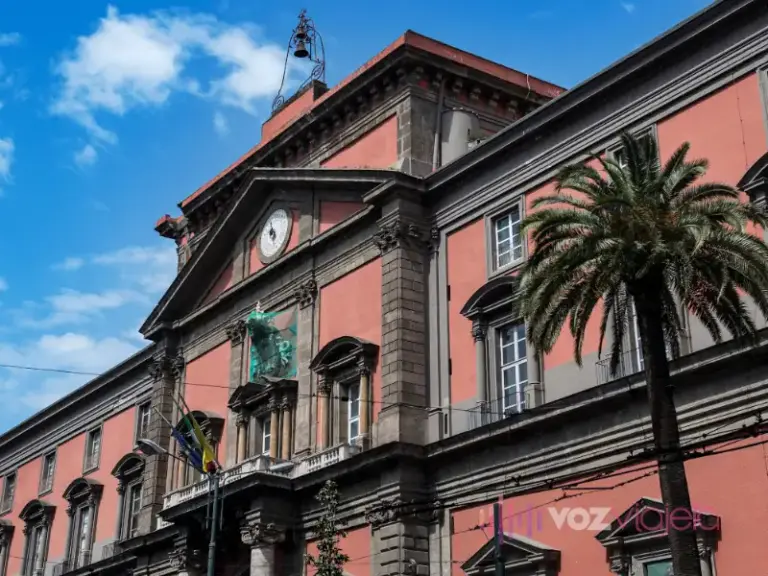
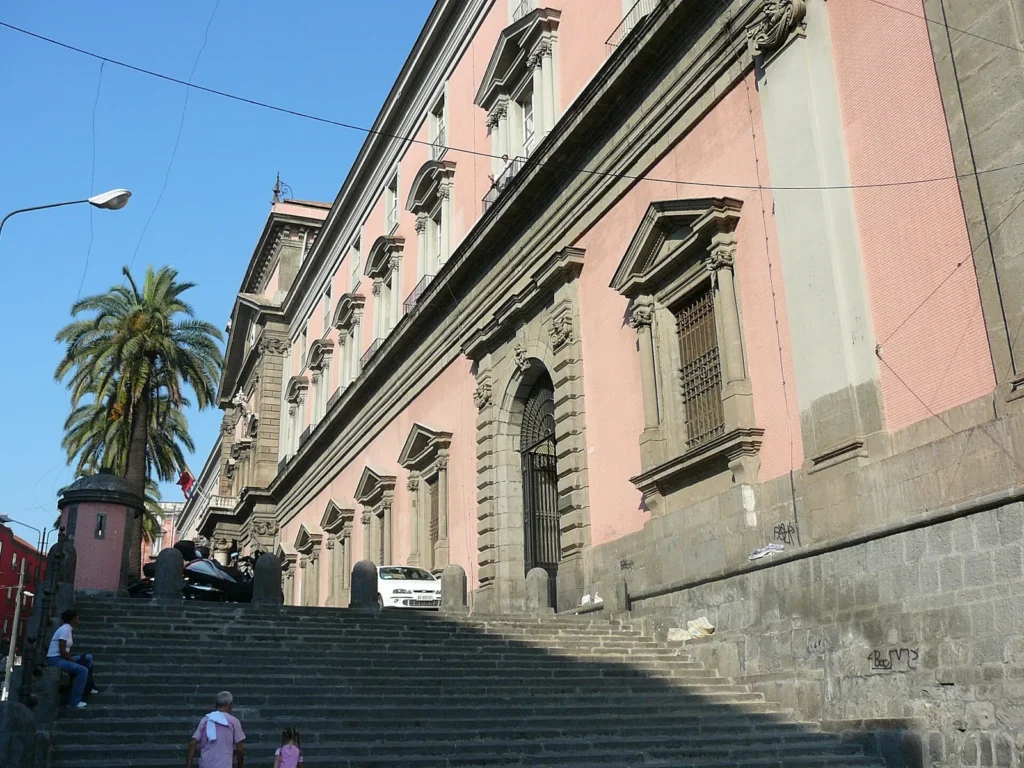
The National Archaeological Museum of Naples, the MANN, holds the Farnese collection of ancient sculpture and many of the most famous finds from Pompeii and Herculaneum: mosaics, frescoes, bronzes and the Secret Cabinet. It stands on Piazza Museo, opens from 09:00 to 19:30 and closes on Tuesdays. This is its free audio guide, in English.
What the audio guide covers
It is free, it plays on this page in your phone’s browser, with no app and no sign-up, and it lasts about 6 minutes. It starts with the story of the building, put up as a cavalry barracks, and of the Bourbon kings who filled it with the Farnese collection and the finds from the towns buried by Vesuvius, and it explains why so many erotic pieces ended up in a room closed to most visitors. Then it walks you through the collections: the Farnese Atlas in the Sundial Hall, the Farnese Bull and the Farnese Hercules, the Pompeian sculptures, the mosaics with the battle between Alexander the Great and Darius, the Secret Cabinet, the frescoes, the Temple of Isis and the Villa of the Papyri, and it ends with the Egyptian, epigraphic and coin collections and the section on ancient Naples.
Some points of interest described in the Naples Archaeological Museum audio guide:
| Point of Interest | Brief Description |
|---|---|
| Sundial Hall | The great hall of the old royal library, with the Farnese Atlas and the sundial drawn on the floor. |
| Farnese Collection | Ancient sculpture collected by the Farnese family, with the Farnese Bull and the Farnese Hercules. |
| Mosaics | Mosaics from Pompeii, Herculaneum and Stabiae, among them the Battle of Alexander and Darius. |
| Secret Cabinet | The erotic art found in the excavations, kept apart for most of its history. |
| Frescoes and Temple of Isis | Wall paintings from Pompeii, and the paintings of its Temple of Isis. |
| Villa of the Papyri | The bronzes and marbles of a great Roman villa at Herculaneum. |
| Egyptian, epigraphic and coin collections | Egyptian objects, ancient inscriptions in Greek, Oscan, Etruscan and Latin, and coins and medals. |
Opening hours, tickets and the rooms open this autumn
The museum opens from 09:00 to 19:30, with last entry at 18:30, and it is closed on Tuesdays. Staff start clearing the galleries at 19:00. It opens on public holidays except 1 January and 25 December, and when a holiday falls on a Tuesday it opens that day and closes on the Wednesday: in 2026, that means open on Tuesday 8 December and closed on Wednesday 9 December.
A full ticket costs €20 and covers the permanent galleries and the temporary exhibitions. Citizens of the EU and the EEA, Switzerland and Uruguay aged 18 to 25 pay €2, up to the day of their 25th birthday. Under-18s of any nationality and visitors with disabilities go free. If you plan to come back, the OPEN MANN card costs €25 and gives unlimited entry for 365 days from your first visit, with priority access.
Entry is free for everyone on the first Sunday of every month. On those days tickets cannot be booked ahead: you pick them up at the ticket office on the day.
Two sections take turns this autumn. Magna Graecia opens on Monday and Friday afternoons, from 14:30 to 19:30, and on Wednesday and Saturday mornings, from 09:00 to 14:00; the upper levels of Prehistory and Protohistory open in the other half of those days. On Thursdays and Sundays both stay closed. And on the free-entry days the Egyptian collection, the Secret Cabinet and Magna Graecia close for safety reasons, so if those are the rooms you came for, pay and come on another day.
The Farnese collection and the Sundial Hall
The Farnese collection was started by Alessandro Farnese, who became Pope Paul III in 1534, and grew with the excavations his family ran in Rome. It reached Naples through Charles of Bourbon, king of Naples from 1734 to 1759, who inherited it from his mother, Elisabeth Farnese; his son, Ferdinand IV, moved it to this building.
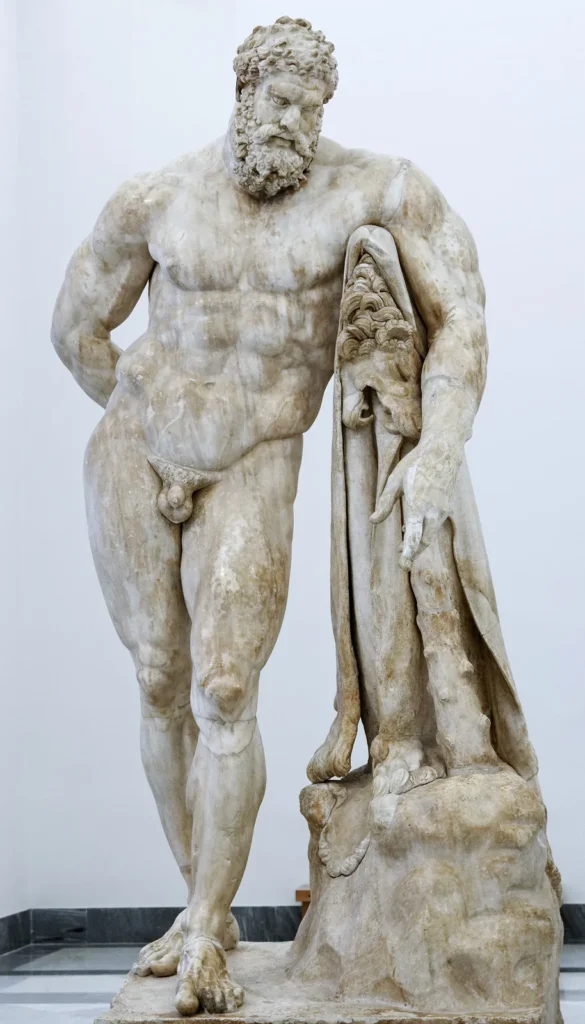
Its most famous pieces stand on the ground floor. The Farnese Hercules and the Farnese Bull both came to light in the excavations of the Baths of Caracalla in Rome, which began in 1545: the Hercules shows the hero at rest, leaning on his club draped in the lion skin, and the Bull is the largest single sculpture recovered from antiquity.
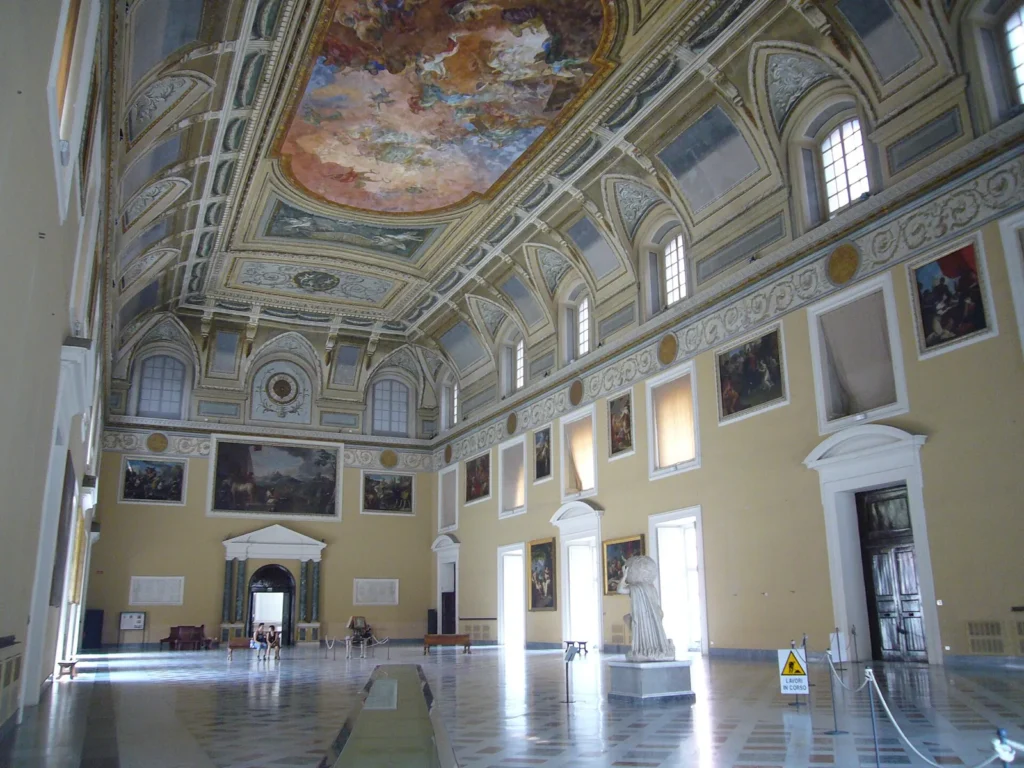
Upstairs, the Sundial Hall was the grand room of the Royal Bourbon Library, later the National Library, from 1783 to 1926. Its ceiling, frescoed by Pietro Bardellino in 1781, celebrates the Bourbon kings as patrons of the arts. In 1791 a sundial was set into the floor, designed by the architect Pompeo Schiantarelli with the calculations of the astronomer Giuseppe Casella, and it still works today: look for the line across the marble in the south-western corner. The hall is also home to the Farnese Atlas, holding up a celestial globe on his shoulders.
Pompeii and Herculaneum: mosaics, frescoes and the Secret Cabinet
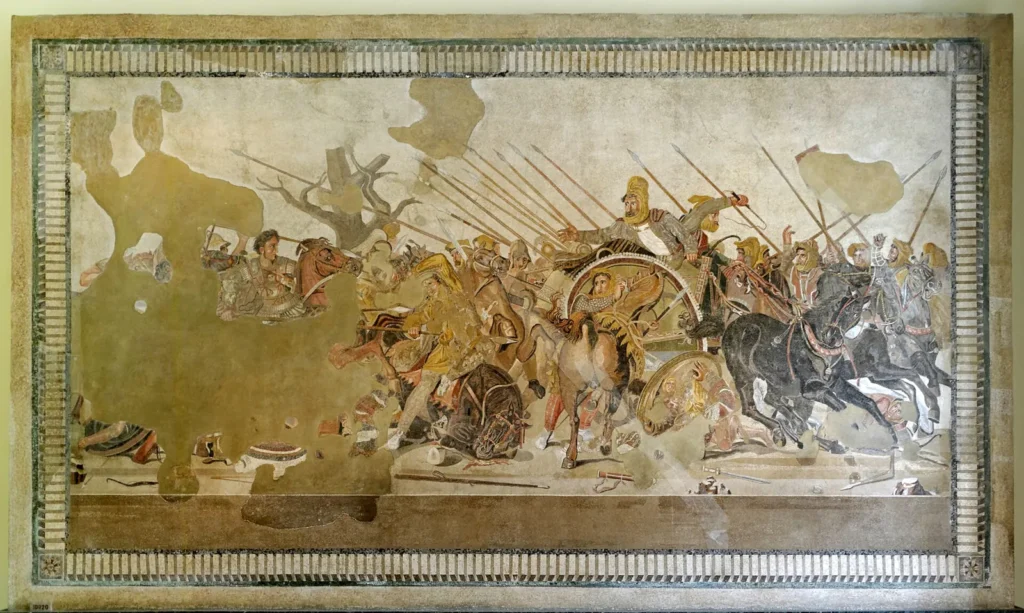
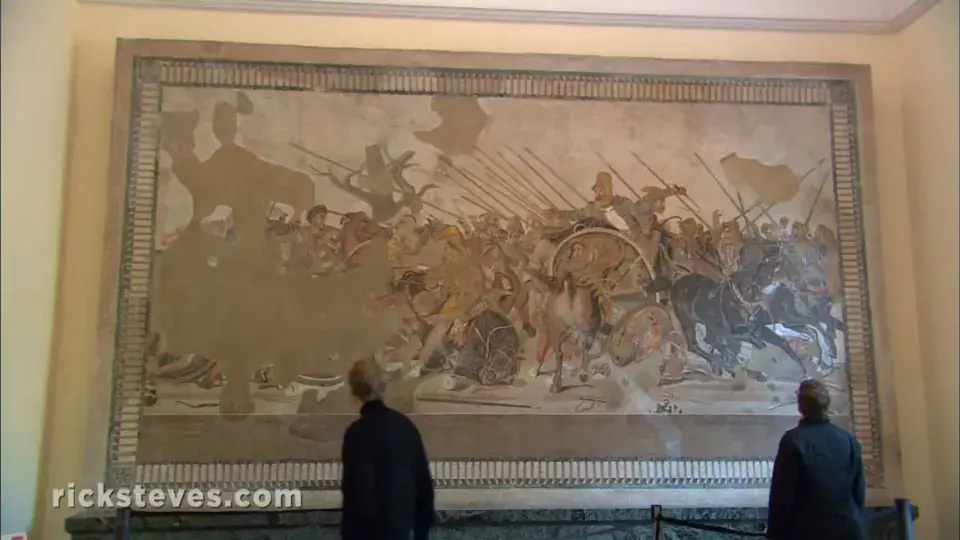
The mosaics come from the houses of Pompeii, Herculaneum and other towns of Campania, and they date from the 2nd century BC to the 1st century AD. The route ends with the Alexander Mosaic, the triumph of Alexander the Great over Darius III of Persia. It was made at the end of the 2nd century BC with more than 1 million tiny tesserae, measures 5.83 by 3.13 metres and weighs about 7 tonnes. It was found in 1831 in the floor of a reception room of the House of the Faun in Pompeii, and in 1916 it was moved onto the wall. It is now being restored and is not on display.
The Secret Cabinet gathers about 250 objects with sexual themes, most of them from Pompeii and Herculaneum. For centuries they were censored and kept apart from the other collections; the room reopened to the public in 2000, with frescoes of myths, pieces from the gardens, the paintings from the brothels, lamps, wind chimes and good-luck symbols.
The Temple of Isis, found in 1764, was the first religious building excavated at Pompeii, and its rooms here show its paintings at the same height they had on the original walls. The marble inscription from its entrance records that Numerius Popidius Celsinus paid for its rebuilding after the earthquake of 62 AD. The Villa of the Papyri, a seaside villa with a front 250 metres long outside Herculaneum, was explored through tunnels under 27 metres of volcanic rock; it is named after the more than 1,800 charred papyrus scrolls found there. Its bronzes, among them the runners, the resting Hermes and the drunken satyr, form the most important group of Roman bronze sculptures to survive.
A short history in 5 dates
- End of the 16th century — The palace is built as the royal cavalry barracks.
- 1616 to 1777 — It is the seat of the University of Naples.
- 1777 — Ferdinand IV chooses it for the Farnese collection and the finds from the Vesuvian towns; the architects Fuga and Schiantarelli enlarge it.
- 1816 — It opens officially as the Real Museo Borbonico, and after the unification of Italy in 1860 it becomes the National Museum.
- 1957 — All the paintings move to the Museum of Capodimonte, and it becomes a purely archaeological museum.
Getting there, and what is nearby
The museum is at Piazza Museo 19. From the Central Station, take Metro Line 1 to Museo or Line 2 to Cavour. From the port, Line 1 runs from Municipio to Museo, and bus R1 goes from Via Medina to Piazza Museo. From the airport, the Alibus takes you to the Central Station, and then Line 1 or Line 2.
For wheelchairs and pushchairs, use the western entrance: follow the pavement from the Museo metro exit to the end, then turn right to the car gate. The lifts serve only their own wing, so on the first floor you go back down to the ground floor to change wing; on the second floor you cross through the Sundial Hall. Visitors with disabilities, pregnant women and older people with reduced mobility skip the queue.
Much of what you see upstairs comes from the excavations of Pompeii, and the House of the Faun and the Lupanar each have their own free audio guide on this site. In Naples itself there is one for Castel Nuovo, by the port, and another for Mount Vesuvius, the volcano that buried those towns in 79 AD.
 Free audio guideHouse of the Faun
 Free audio guideLupanar of Pompeii
 Free audio guideCastel Nuovo
 Free audio guideMount Vesuvius
All of them are on the free audio guides of Naples and free audio guides of Pompeii pages. The same guide in Spanish is at Museo Arqueológico de Nápoles on vozviajera.com.
Where to find it
FAQs
How do the free audio guides work?
They play right here on audioguidetravel.com, with no app to download and no sign-up. Press play and listen as you walk round: a phone and a pair of headphones are all you need. The audio streams from this page, so you’ll need mobile data or Wi-Fi.
Can I take the tour at my own pace?
Of course! You set the pace: pause whenever you like, jump back or forward 15 seconds, or tap the bar to jump to any point, and listen as many times as you want so you don’t miss a thing.
If I'm in a group, can we use the same audio guide?
Yes. The same free audio guide opens on as many phones as you like, so you can go round together as a group or with your family, each person at their own pace and with their own headphones. The quickest way is to send the link via WhatsApp, Telegram or however you like: the buttons just below let you share it right now.
Visitor information
As of 5 Nov 2026- Opening hours
- Wednesday to Monday 09:00–19:30, last entry 18:30. Closed on Tuesdays.
- Tickets
- €20 · €2 for EU/EEA citizens aged 18 to 25 · free under 18 and on the first Sunday of each month
- Getting there
- Metro Line 1 to Museo, or Line 2 to Cavour, both from the Central Station.
- Accessibility
- Step-free western entrance by the car gate; lifts serve one wing each
- Tip
- On free-entry days the Egyptian rooms, Secret Cabinet and Magna Graecia close: pay and come another day
- Official website
- www.museoarcheologiconapoli.it
Nearby
More free audio guides in Naples
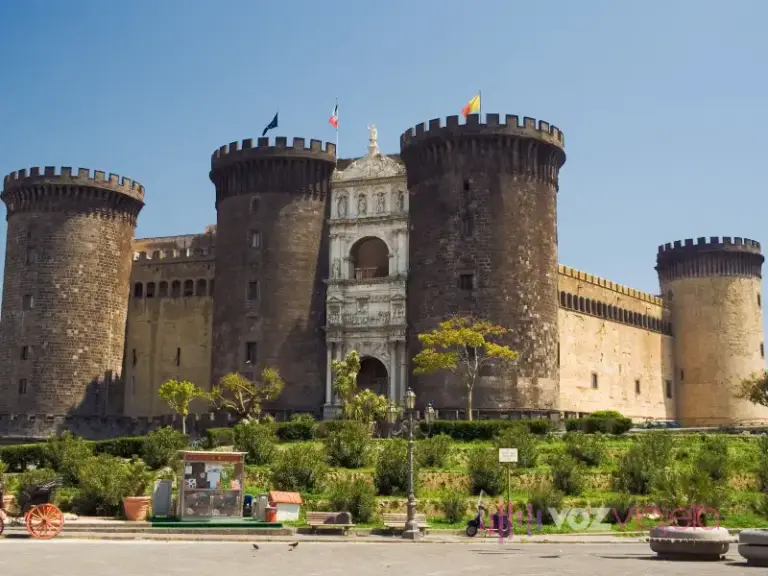 5:33NaplesCastel Nuovo: free audio guide, hours and ticketsFree audio guide to Castel Nuovo, the Maschio Angioino, in English: just under 6 minutes on the castle…
 3:54NaplesMount Vesuvius: free audio guide, hours and ticketsFree audio guide to Mount Vesuvius, in English: about 4 minutes on the volcano that buried Pompeii and…