
Plaza de Oriente: free audio guide, hours and tickets
Free audio guide in English · no app, no sign-up
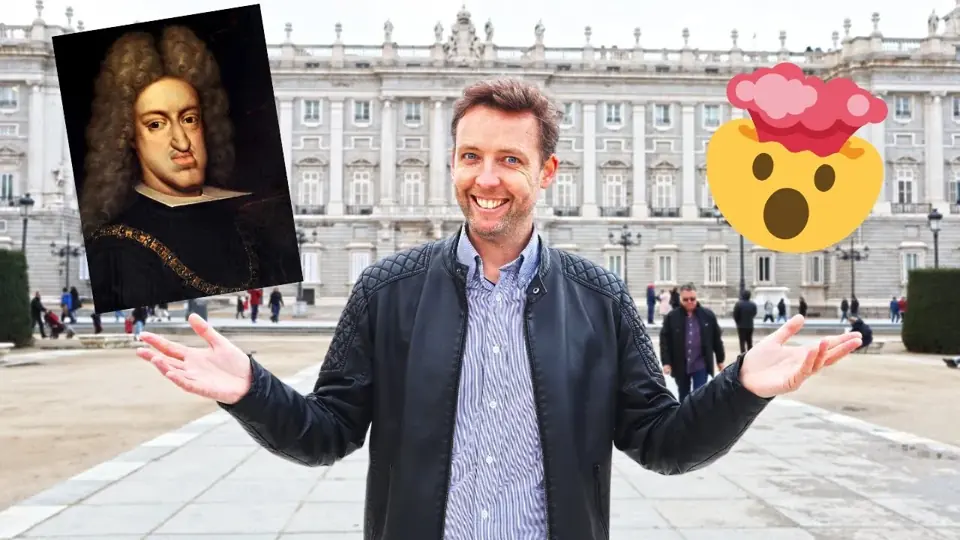
Plaza de Oriente is the grand square between the Royal Palace and the Teatro Real, in the old Habsburg heart of Madrid, with the equestrian statue of Philip IV at its centre. This free audio guide lasts about 4 minutes and is made to be heard beside the statue.
 Audio guide
Before you go in
The few things that change your visit.
Plaza de Oriente is the grand square between the Royal Palace and the Teatro Real, in the old Habsburg heart of Madrid. At its centre stands the equestrian statue of Philip IV, the first in the world with the horse balanced on its hind legs. It is a free public space. This free audio guide lasts about 4 minutes and is made to be heard beside the statue.
What the Plaza de Oriente audio guide covers
Start it in front of the statue of Philip IV, with the Teatro Real behind you; the last stop is the edge of the square, facing the palace. It has 5 parts:
| A square to the east | Where the name comes from, and why there were houses here until the 19th century. |
| Philip IV’s horse | How a bronze horse stands on two legs. |
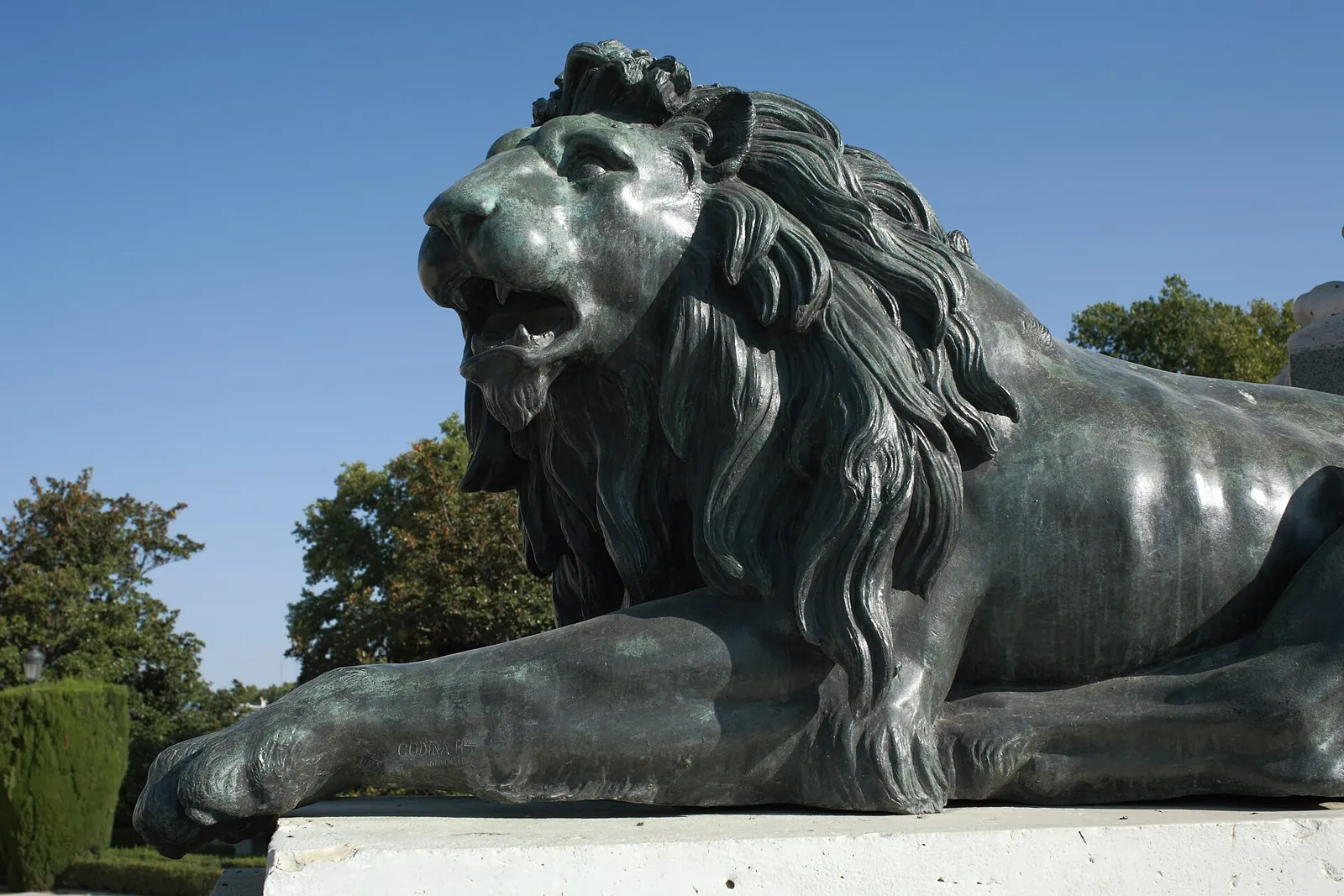
| The hidden signatures | The names and the year carved on the lions of the pedestal. |
| The stone kings | The 20 statues that were meant to crown the palace. |
| The palace in front of you | The east façade, and what happens on Wednesdays and Saturdays. |
Plaza de Oriente hours, tickets and how to get there
Plaza de Oriente is a public square: there is no ticket office, no entry fee and no visiting hours. You can walk around it for free, and the statue, the stone kings and the gardens are all seen from the paths. The gardens are laid out in 3 parts: the central parterre around Philip IV, the Cabo Noval gardens to the north and the Lepanto gardens to the south, both shaded by plane trees.
The easiest way in is the metro: Ópera station, on lines 2 and 5 and the branch line; walk round the Teatro Real and you are in the square within a few minutes. Buses 3, 148 and M3 stop nearby, plus the N16 night bus. The nearest Cercanías commuter-rail station is Sol. If you ride BiciMAD, the city’s bike-share, there are docks on Calle de Pavía and Calle de Carlos III.
The square is linked on foot with the Sabatini Gardens, Plaza de España, Parque del Oeste and the Temple of Debod, so you can stroll from one to the next. Most of the park’s paths are accessible for visitors with reduced mobility.
Why is it called Plaza de Oriente?
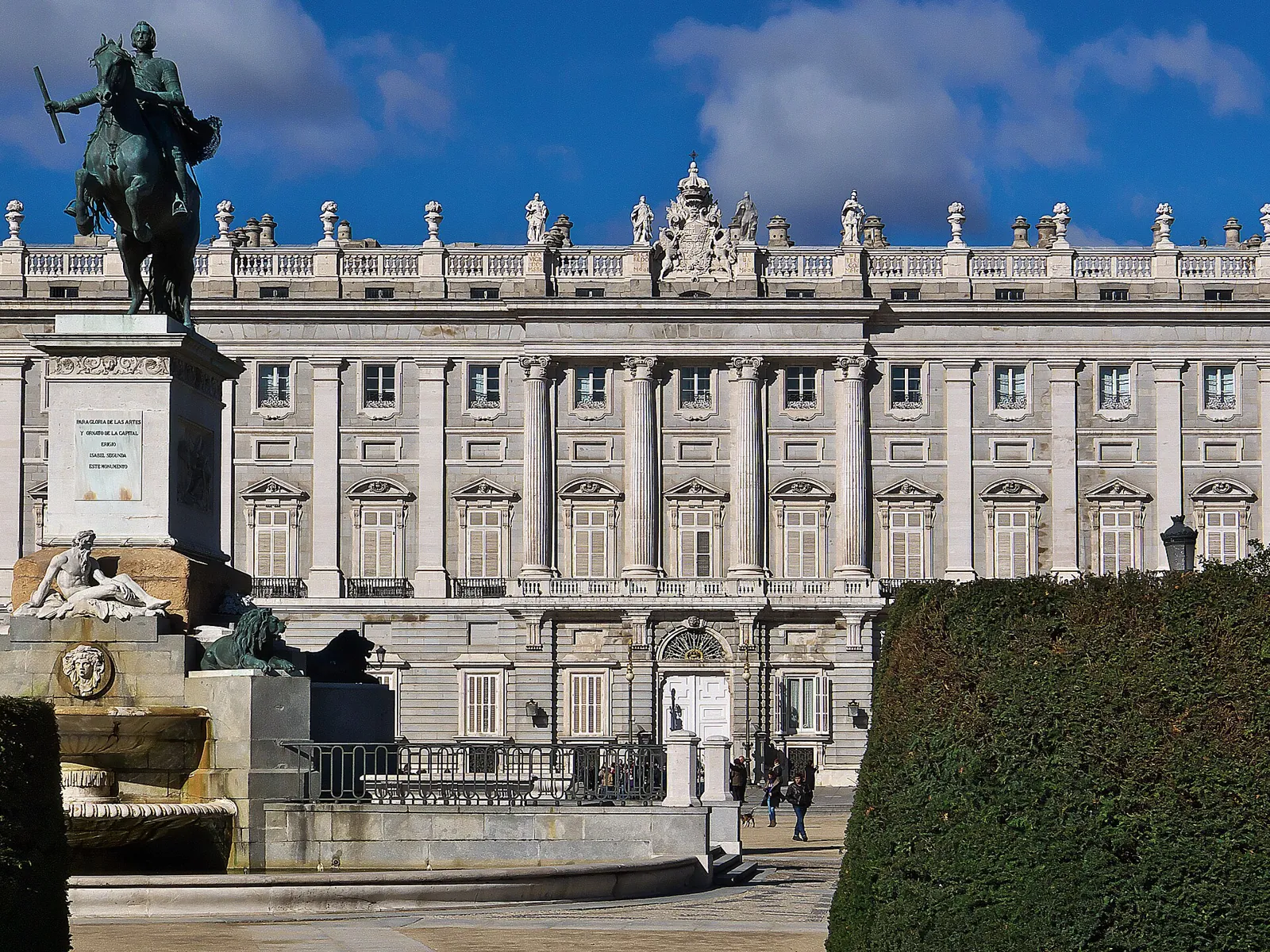
The square lies in the west of Madrid, but to the east of the Royal Palace — “oriente” means east — and that is where the name comes from; by extension, the palace itself is also called the Palacio de Oriente. It is a rectangle that closes in a curve on the Teatro Real side, and its north side is formed by the Royal Monastery of La Encarnación.
Until the early 19th century, blocks of houses stood right up against the palace. Joseph Bonaparte, king of Spain from 1808 to 1813, had them pulled down to open up space and set off the building, and the demolitions earned him the nickname Pepe Plazuelas, “Joe Little-Squares”. Several half-finished projects followed, until in 1844 the architect Narciso Pascual y Colomer signed the layout you see today. The Teatro Real, which closes the square to the east, was not finished until 1850.
In the 1990s Calle de Bailén, the street between the square and the palace, was moved underground and the whole space became pedestrian: since then the square reaches the palace façade on foot.
The equestrian statue of Philip IV
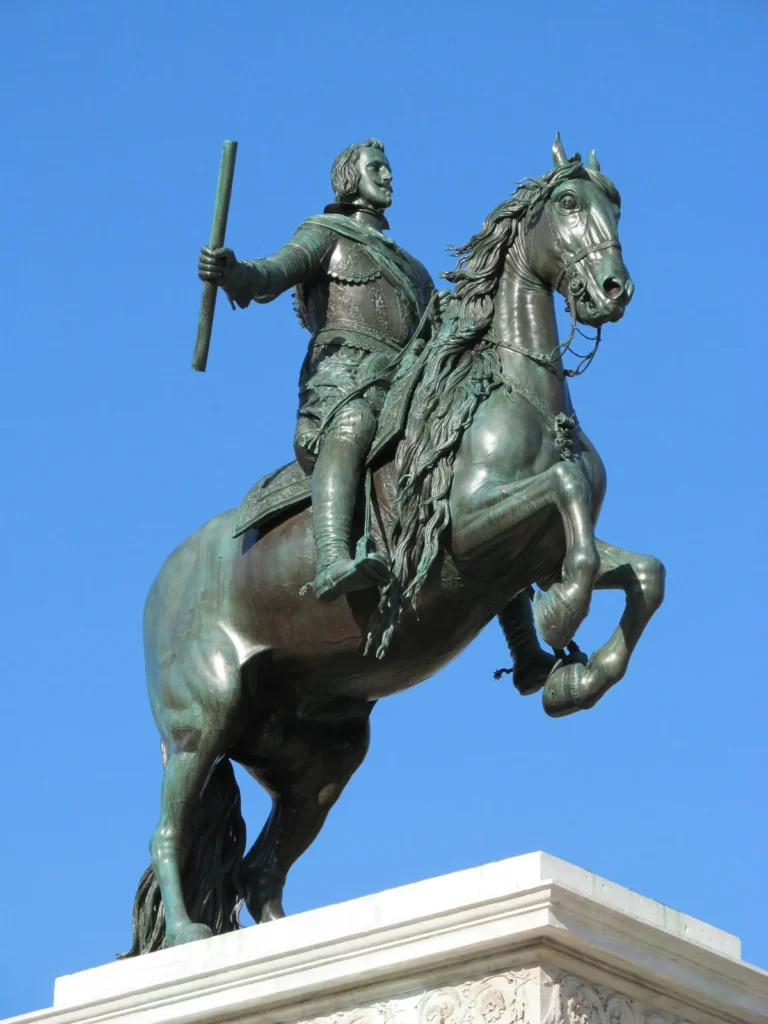
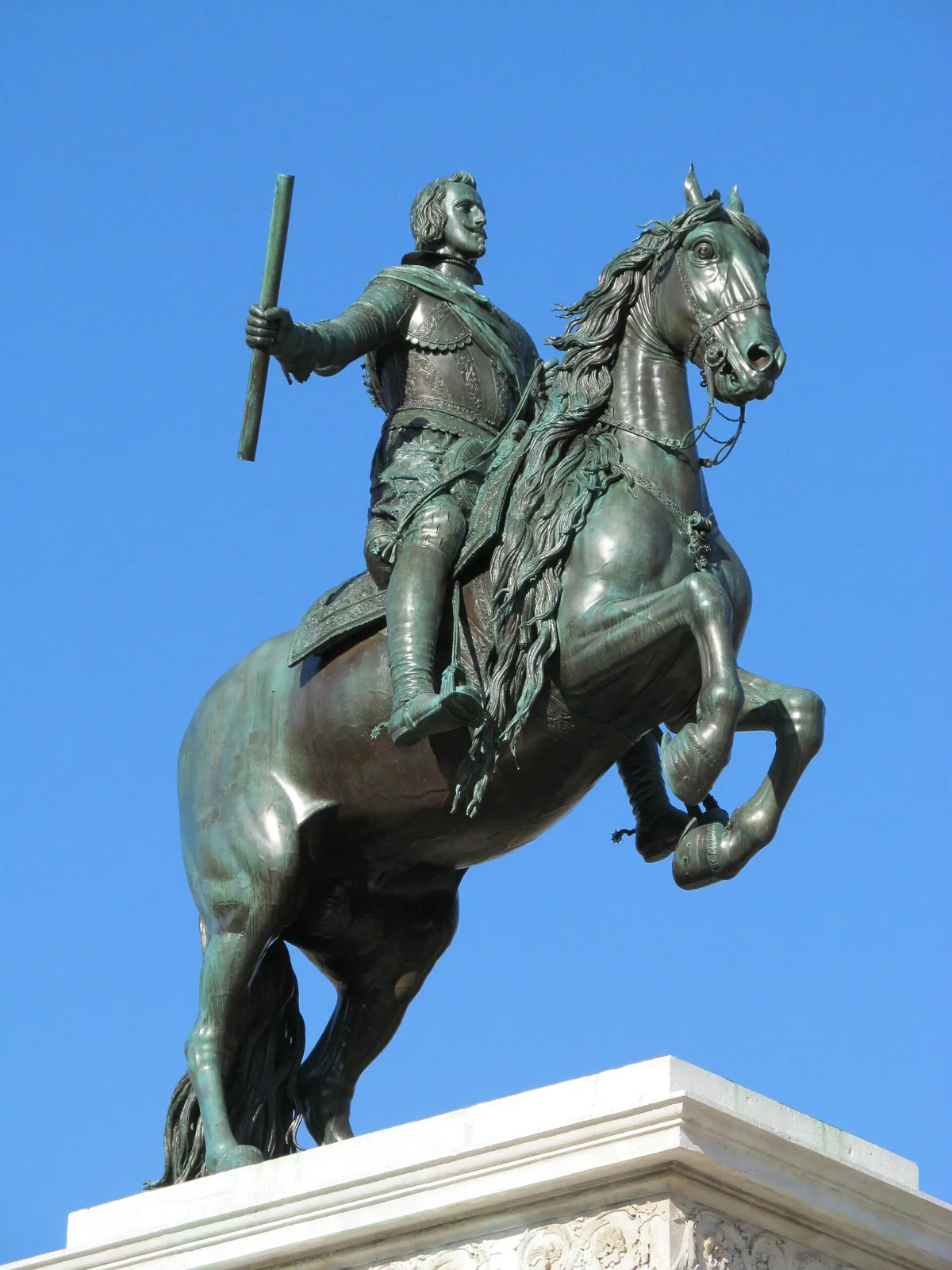
The centrepiece of the square is the equestrian statue of Philip IV, cast in bronze in Florence by the sculptor Pietro Tacca. Philip IV wanted a portrait on horseback that would outdo the one of his father, Philip III, which stands today in Plaza Mayor. In 1634 the Count-Duke of Olivares commissioned it and asked for something nobody had done before: the horse rearing, with its forelegs in the air.
To keep it from toppling, Tacca had the advice of Galileo Galilei. The answer was to spread the metal: the casting is very thin at the head and solid in the hindquarters and the tail, which works as a discreet third support, and inside there are hidden beams anchored to the base. For the face, Velázquez painted a portrait of the king that was sent to Florence. Even so, when the statue reached Madrid in 1642 the likeness did not convince, and the head had to be reworked in Madrid by Ferdinando Tacca, the sculptor’s son; his father had died in 1640, a month after the statue left for Spain.
The statue spent almost 2 centuries in the gardens of the Buen Retiro, with a spell on top of the façade of the old Alcázar. In November 1843, under Isabella II, it was moved to this square: the move took just 3 hours, and it was installed over 2 days, the horse on the 16th and the rider on the 17th. The monument is dated 1844. The king faces the Teatro Real, with his back to the palace, bareheaded, in half armour, with a general’s baton in his right hand.
The pedestal was made at that time: 2 reliefs, one of Philip IV giving Velázquez the cross of the Order of Santiago and one an allegory of the king as patron of the arts; 2 fountains, 2 river figures and 4 bronze lions at the corners, modelled by Francisco Elías Vallejo.
The stone kings of Plaza de Oriente
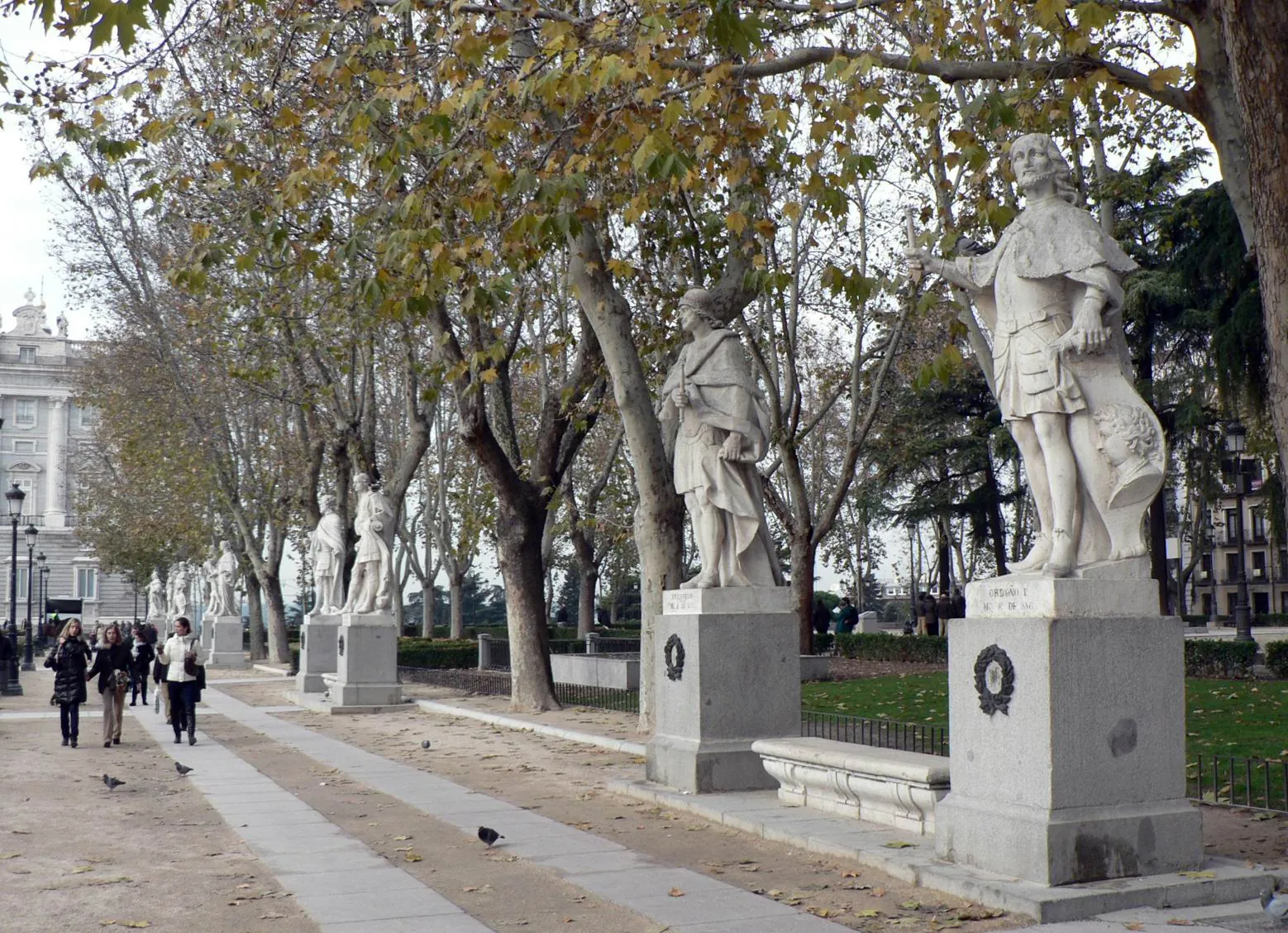
On either side of the central parterre stand 2 rows of 10 statues of kings, carved in limestone, known in Madrid as “the Gothic kings”. In fact only 5 are Visigoths; the other 15 are monarchs of the early Christian kingdoms of the peninsula.
They belong to a series carved between 1750 and 1753, under Ferdinand VI, to crown the cornice of the Royal Palace. Some were actually hoisted up there, but in the end they were scattered around Madrid and other cities. Tradition says it was because of a nightmare of Queen Elisabeth Farnese, who dreamt that the figures fell on the royal family. Until 1927, 44 kings surrounded the statue; since then there have been 20, and the 2 straight rows date from the 1941 redesign.
Each pedestal carries the king’s name, so you can play at spotting the ones you have heard of.
What to see around Plaza de Oriente
The square sits at the centre of a monumental ensemble. To the west is the east façade of the Royal Palace, which you can visit inside with its own ticket and its own free audio guide; to the east, the Teatro Real, Madrid’s opera house; and to the north, the Royal Monastery of La Encarnación.
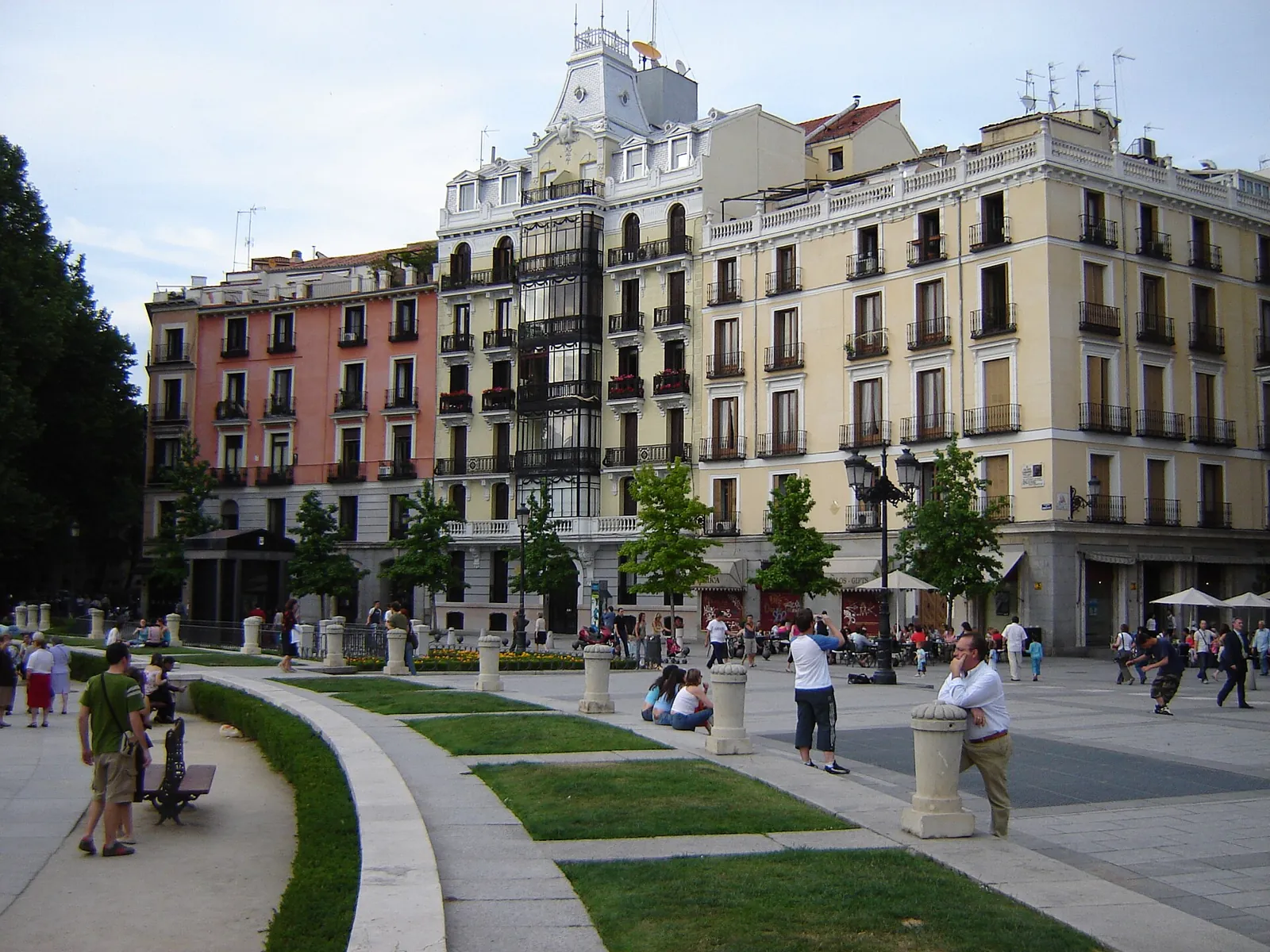
The side gardens hold 2 more monuments: in Cabo Noval, the one to Corporal Luis Noval, by Mariano Benlliure, from 1912; and in Lepanto, the one to Captain Ángel Melgar, from 1911. From the north end you walk down in a few minutes to the Sabatini Gardens and Plaza de España, and heading west you reach the Temple of Debod, a good place to end a walk in the late afternoon.
If you are spending a day in central Madrid, a comfortable order is: Plaza de Cibeles in the morning, the Royal Palace at midday, Plaza de Oriente with this audio guide afterwards and the Temple of Debod to finish at sunset. If you have an extra day, El Escorial is an easy trip from the city.
 Free audio guideRoyal Palace of Madrid
 Free audio guideEl Escorial Monastery
 Free audio guidePlaza de Cibeles, Madrid
Where to find it
FAQs
How do the free audio guides work?
They play right here on audioguidetravel.com, with no app to download and no sign-up. Press play and listen as you walk round: a phone and a pair of headphones are all you need. The audio streams from this page, so you’ll need mobile data or Wi-Fi.
Can I take the tour at my own pace?
Of course! You set the pace: pause whenever you like, jump back or forward 15 seconds, or tap the bar to jump to any point, and listen as many times as you want so you don’t miss a thing.
If I'm in a group, can we use the same audio guide?
Yes. The same free audio guide opens on as many phones as you like, so you can go round together as a group or with your family, each person at their own pace and with their own headphones. The quickest way is to send the link via WhatsApp, Telegram or however you like: the buttons just below let you share it right now.
Visitor information
As of 17 Nov 2026- Opening hours
- Public square: no ticket office and no visiting hours.
- Tickets
- Free.
- Time needed
- Audio guide of about 4 min; a walk round the square, about 20 min.
- Getting there
- Metro Ópera (lines 2 and 5 and the branch line); buses 3, 148 and M3.
- Accessibility
- Most paths are accessible for visitors with reduced mobility.
- Tip
- Check the pedestal's lions for the signatures "ELIAS" and the mark "CODINA HNOS / MADRID".
- Official website
- www.esmadrid.com
Nearby
More free audio guides in Madrid
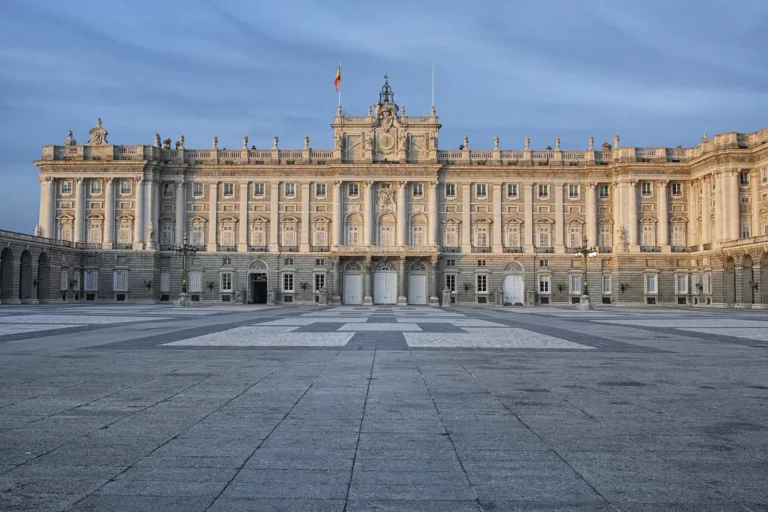 3:58MadridRoyal Palace of Madrid: free audio guide, hours and ticketsThe free Royal Palace of Madrid audio guide lasts about 4 minutes and is made for listening on…
 2:33MadridPalacio de Cristal, Madrid: free audio guide to the Crystal PalaceThe Palacio de Cristal, Madrid’s Crystal Palace, is the iron and glass pavilion that Ricardo Velázquez Bosco built…
 6:11MadridRetiro Park, Madrid: free audio guide, boats and opening hoursRetiro Park (Parque del Retiro, or El Retiro) is Madrid’s great historic garden: 125 hectares and more than…