
Temple of Athena Nike: free audio guide, hours and tickets
Free audio guide in English · no app, no sign-up
This free audio guide to the Temple of Athena Nike plays straight from your phone, with no app and no sign-up, as you climb the ramp to the Propylaia with the bastion on your right. It tells you what Pausanias wrote about this spot and why the sea matters to the story, why the Victory worshipped here had no wings, which architect the city’s own decree names, why the frieze you look up at is a 2010 copy and where the 14 original blocks are, and how the temple came to be taken apart and rebuilt 3 times. Press play on the ramp.
 Audio guide
Before you go in
The few things that change your visit.
- It has no ticket of its own: you pay the Acropolis ticket, €30.00
- The frieze you see is a copy from 2010: the original is in the Acropolis Museum
- Nobody goes up onto the bastion: you see it from the ramp and from the 2015 viewing area
- Last entry is 30 minutes before closing, and closing moves forward on 1 October, 16 October and 1 November
- Wheelchair lift: call +30 213 1317762 one hour before arriving
On this page
- What the audio guide tells you
- The frieze you see is a copy, and the original is 10 minutes away
- How you see it: nobody goes up onto the bastion
- What it was for, and why it is called the Wingless Victory
- The sea is visible from here: Pausanias and the death of Aegeus
- Taken down and rebuilt 3 times
- Tickets, opening hours and access
- Where to find it
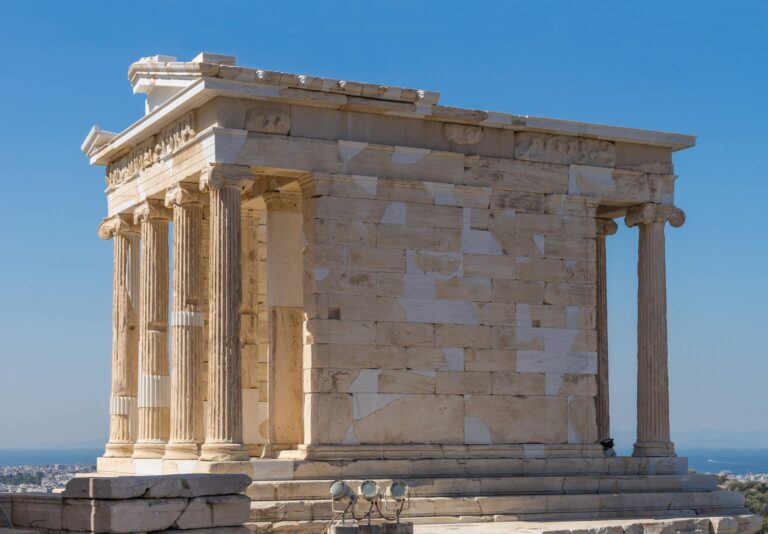
The Temple of Athena Nike is the small Ionic temple on the bastion to the right of the ramp up to the Acropolis of Athens, on the south-west corner of the rock, over the way in. It has no ticket of its own: you see it on the €30.00 Acropolis ticket. This is its free audio guide, to play as you climb.
What the audio guide tells you
It plays in your phone’s browser, with no app and no sign-up. Press play on the ramp, where the bastion rises on your right, and let it walk you up to the Propylaia. These are the stops:
| The sea from the bastion | The 2 sentences Pausanias wrote about this spot, and why the second still checks out. |
| Black sails | Why the myth put the death of King Aegeus here, and what made Theseus forget the sails. |
| A victory without wings | The chained war god of Sparta and the wingless Victory of Athens. |
| The decree in stone | A priestess chosen from all the women of Athens, and the architect named 3 times. |
| The frieze you are looking at | What it is made of, and where each of the 14 original blocks is now. |
| 319 pieces | The iron that split the marble from inside, and the scars that served as a map. |
| What is underneath | A Mycenaean tower and an older temple, found in 1936 under the floor. |
| The Victory taking off her sandal | The parapet carved for people climbing this ramp. |
The frieze you see is a copy, and the original is 10 minutes away
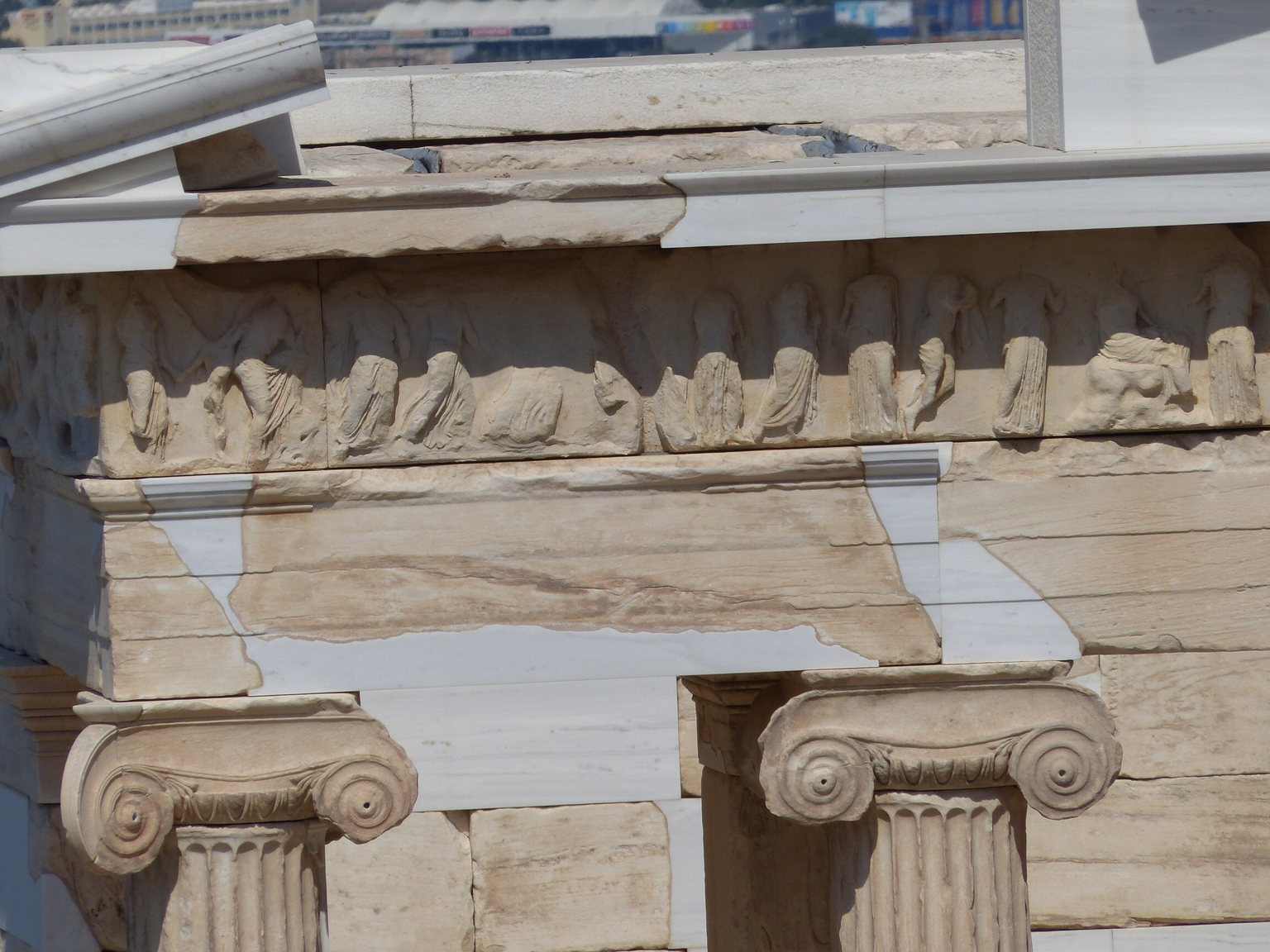
The band of carving round the top of the temple is made of casts in artificial stone, fixed in place in the summer of 2010. The original frieze was removed in 1998 to protect it, and it is in the Acropolis Museum, about 740 metres away on foot.
It is still worth reading from below. It runs round the cella on all 4 sides, and each side tells a different story. On the east, an assembly of the gods around Zeus, enthroned near the centre. On the south, Greeks against Persians, most probably the Battle of Marathon in 490 BC. On the north and west, Greeks against Greeks, carved in the years of the Peloponnesian War.
The original is 14 blocks: 9 in the Acropolis Museum, 4 in the British Museum in London and 1 lost. In the museum they are on the first floor, west wing, with the Nike adjusting her sandal in the same area. The museum is a separate ticket: €20.00 full and €10.00 reduced.
How you see it: nobody goes up onto the bastion
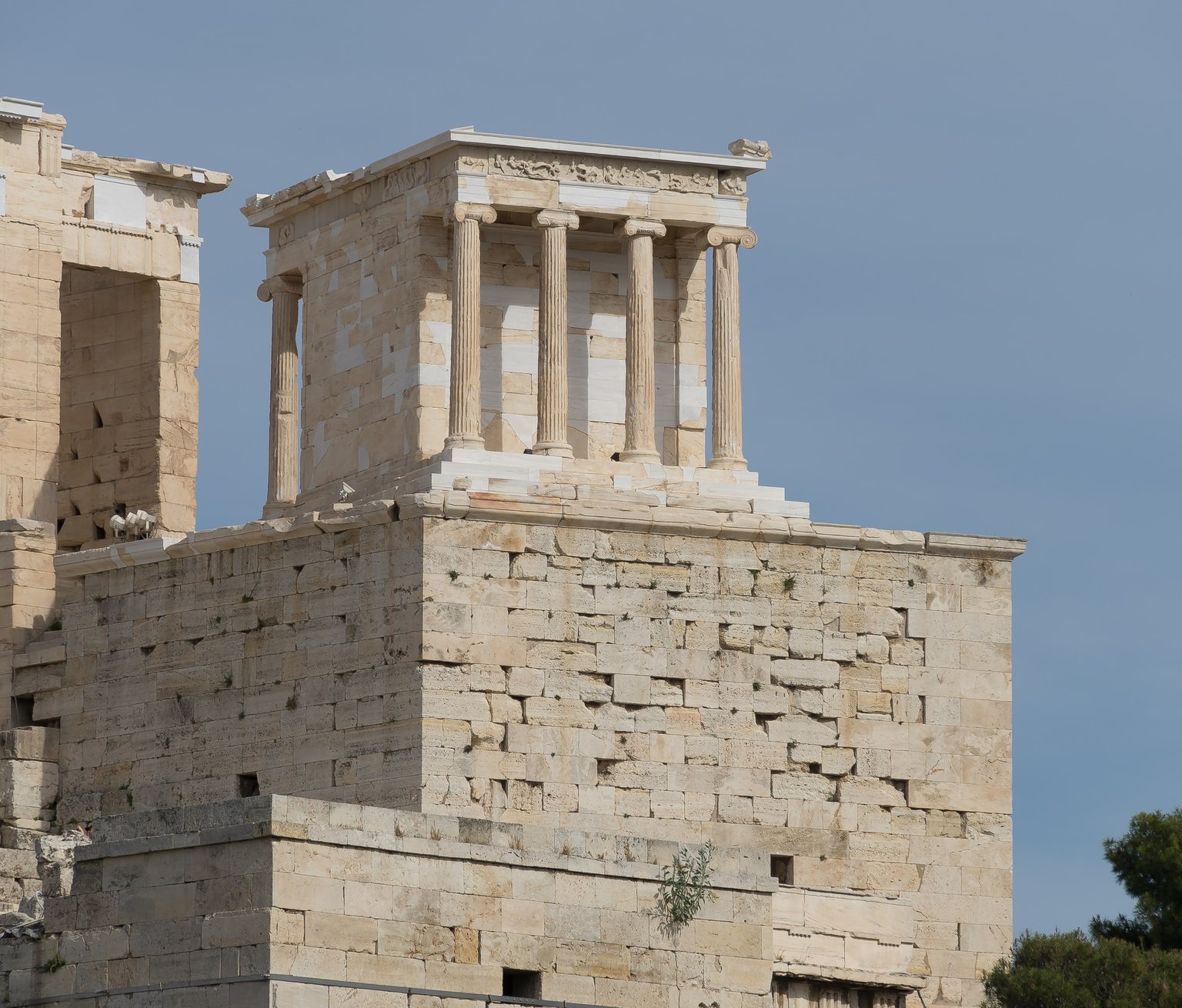
No visitor route climbs onto the bastion. That leaves 2 ways of seeing the temple, and both are good.
The first is close up and from below, on the way up: the building passes a few metres above your head. The second is face on, from the top: in 2015 the state built a viewing area near the Brauronion, just south of the Propylaia, precisely to look at the temple from the east.
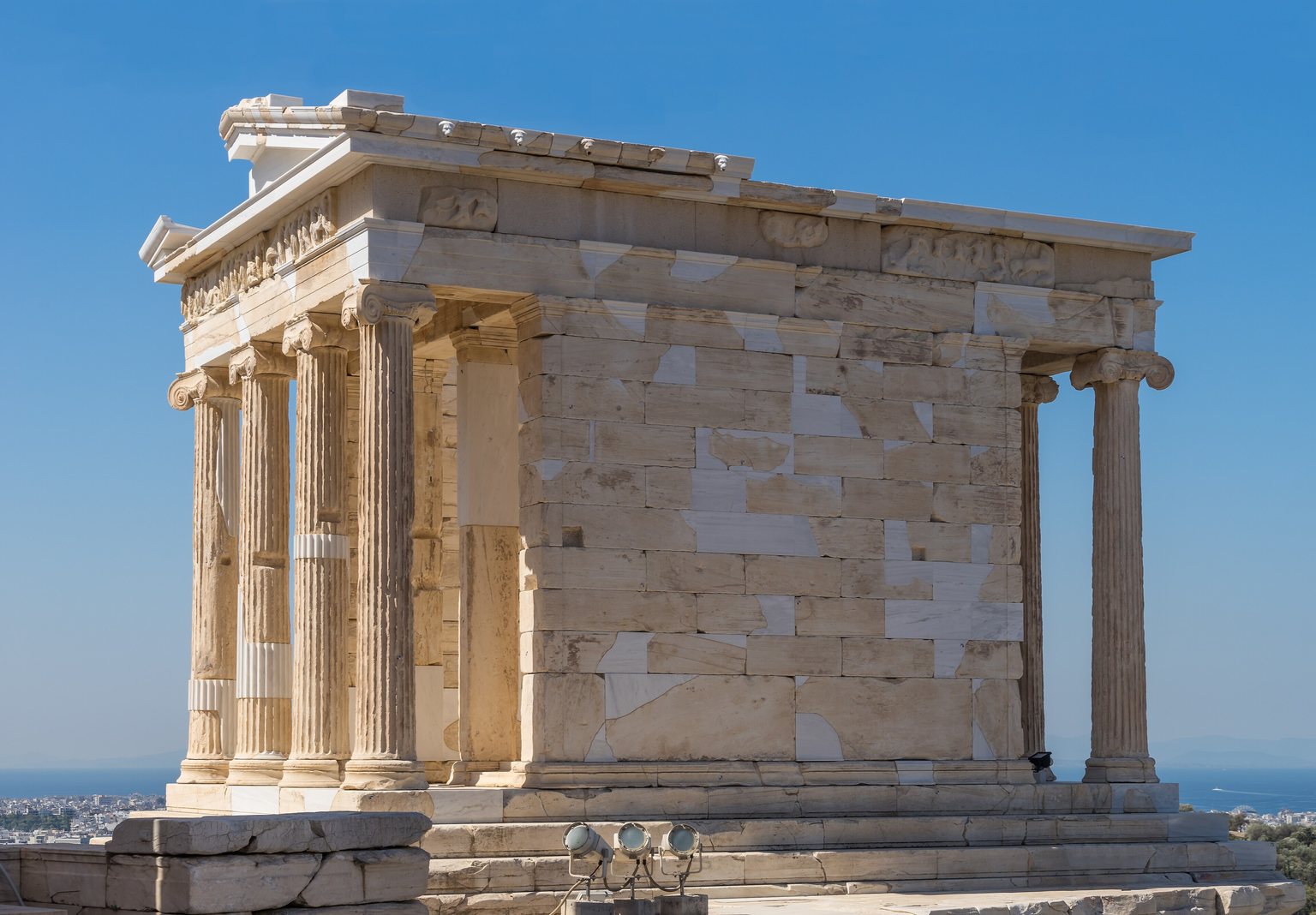
From there you can count its 8 monolithic columns: 4 at the front, 4 at the back and none down the sides.
Opposite, across the ramp, stands the pedestal of Agrippa, and according to the Ministry of Culture it is exactly the same height as the Temple of Athena Nike.
What it was for, and why it is called the Wingless Victory
This is a temple of Athena under the epithet Nike, victory: from the Persian Wars onwards she was worshipped here as the goddess who granted victory in war. The cult figure was a xoanon, an old wooden statue, and it had no wings. Hence the name Nike Apteros, the Wingless Victory.
The explanation is in Pausanias, though not where he describes this temple but in his book on Sparta. The Spartans kept a statue of Enyalios, the war god, bound in fetters so that he would never run away; the Athenians believed that their Victory, having no wings, would always stay where she was. Sparta kept its god with chains; Athens kept hers by taking away the wings.
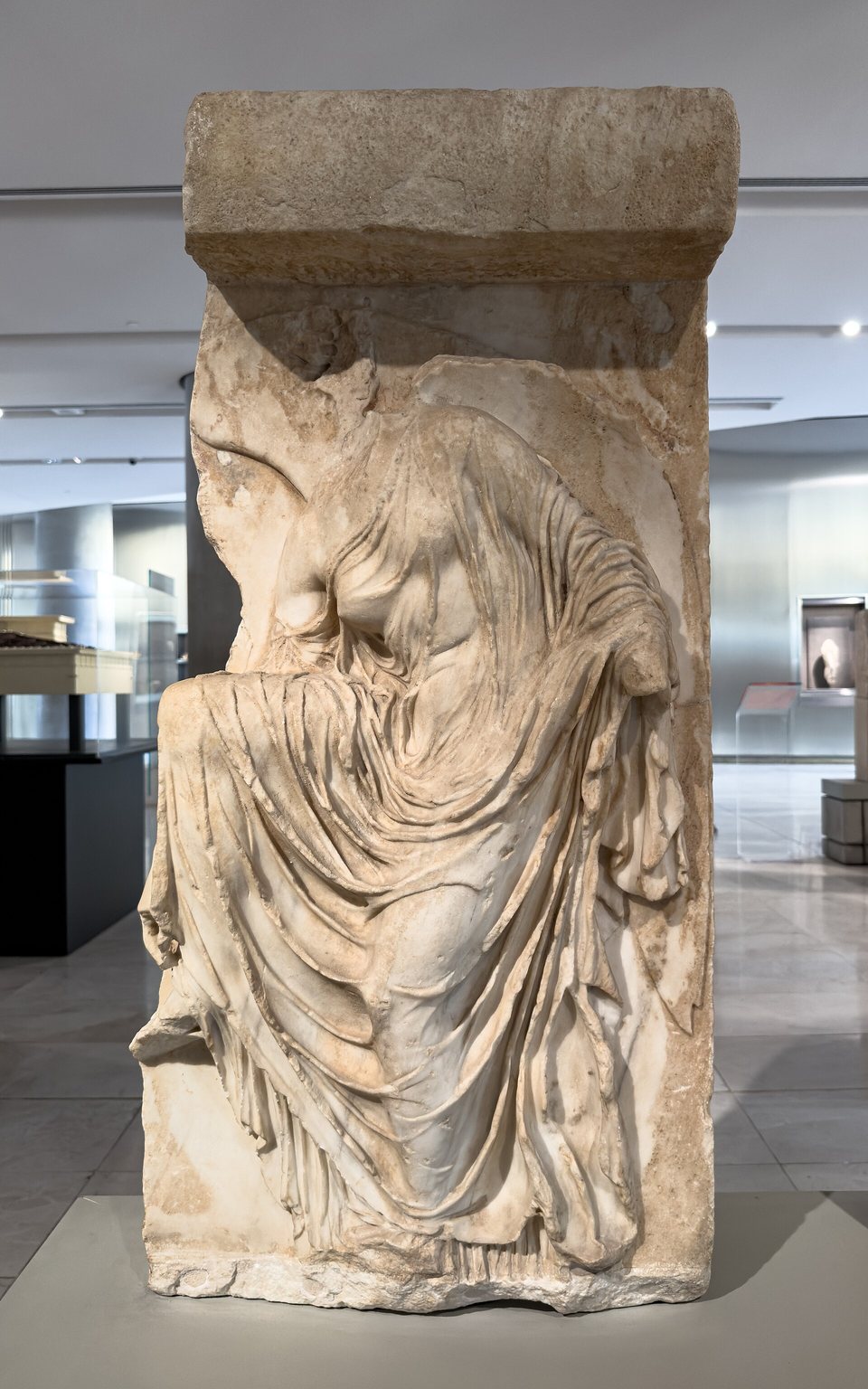
Yet every Nike carved on the parapet round this bastion is winged. The parapet went up in 409 BC, a marble barrier about 1 metre high along the sheer edge, and its slabs were carved on the outside, to be seen by people climbing the ramp: from below and in passing, by someone arriving out of breath. The best known is the Nike adjusting her sandal, and according to the museum she is unbinding it to walk barefoot in the sacred area.
A decree of the city survives that orders a temple and a stone altar to be built here “in whatever way Kallikrates may specify”: the same architect who worked on the Parthenon, 187 metres away. The decree also orders a priestess for Athena Nike to be appointed from all the women of Athens: the earliest known city priesthood at Athens filled not from a single family but from all citizens of the relevant sex. During the Peloponnesian War she needed a second decree to get paid.
The sea is visible from here: Pausanias and the death of Aegeus
When Pausanias describes the climb, in the 2nd century AD, he gives this spot 2 sentences. In the first he names it: on the right of the Propylaia is a temple of the Wingless Victory. In the second he writes something you can check on the way up: from this point the sea is visible. It still is, which is why the myth put its saddest scene here.
It was here, they say, that Aegeus threw himself down to his death. Theseus had told his father he would come back from Crete under white sails if he beat the bull of Minos, and he never changed the black ones. Pausanias gives the reason, and it turns the story round: he forgot because he had just lost Ariadne. From this height Aegeus saw the black sails, took his son for dead, and threw himself down.
Taken down and rebuilt 3 times
In the 5th century AD the temple became a church, and in the Ottoman period a powder magazine. In 1686, with the Venetian fleet of Morosini threatening, it was demolished down to its steps and its marble went into a wall in front of the Propylaia, where it stayed for 149 years.
When that wall came down in 1835, the temple was put back up: according to the Acropolis Restoration Service, the first restoration on any monument of the Acropolis. The second rebuilding, in 1935 to 1940, was forced by the bastion, which was in danger of collapsing, and it left heavy iron set into the marble. Iron swells as it rusts, and swelling iron splits stone from the inside.
Hence the third, from 2000 to 2010: the temple was dismantled completely and put back, 319 members, this time on a stainless-steel grid. To put each block back in its place, the restorers followed the traces left by the medieval and Ottoman building work: the marks of the people who wrecked it became the map for rebuilding it.
The dismantling of 1936 also showed what lay underneath. The bastion is a Mycenaean fortification that the Athenians encased in neatly built walls to set the temple on top, and under the floor were the remains of an earlier stone temple, with the base of the archaic cult figure. They are preserved, together with the Mycenaean tower, in a basement space inside the classical bastion. Under the floor of the temple there is a temple.
Tickets, opening hours and access
There is no ticket for the Temple of Athena Nike on its own. You buy the Acropolis and Slopes ticket, €30.00 full and €15.00 reduced, at the ticket offices on site or online at the official state ticket office. Under-25s from the EU, under-18s from outside it and visitors with a disability go free. Over-65s from Greece or the EU pay €15.00, but only from 1 October to 31 May.
The ticket is used once and carries a compulsory time slot. If you leave the Acropolis or the South Slope you cannot re-enter any site with it, so decide the order before you go through the gate.
The site opens at 08:00. From 16 to 30 September it closes at 19:00, with last entry at 18:30, and closing moves forward on 1 October, 16 October and 1 November, when last entry becomes 16:30. It is a rock of 160 metres climbed in the open: the first hours after 08:00 are the ones to aim for.
The metro is Akropoli, on line 2, and the official visitor portal gives 12 minutes on foot from there to the main entrance, at the end of Dionysiou Areopagitou. A slope lift takes wheelchair users up the rock, from its own entrance north of the main one. Its status can change overnight and it does not run in strong wind, so call +30 213 1317762 one hour before arriving. Ticket validation and access for visitors with a disability happen only at the main entrance. The toilets inside the site are closed for renovation: use the ones outside before going in.
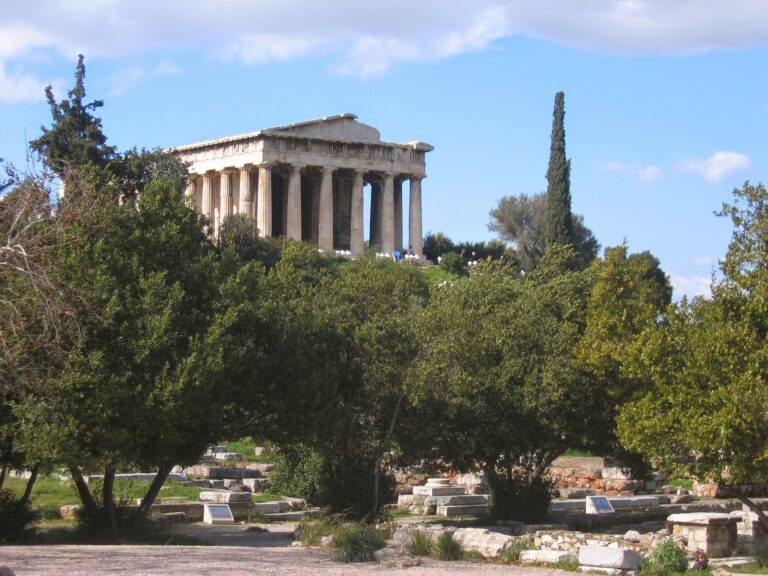
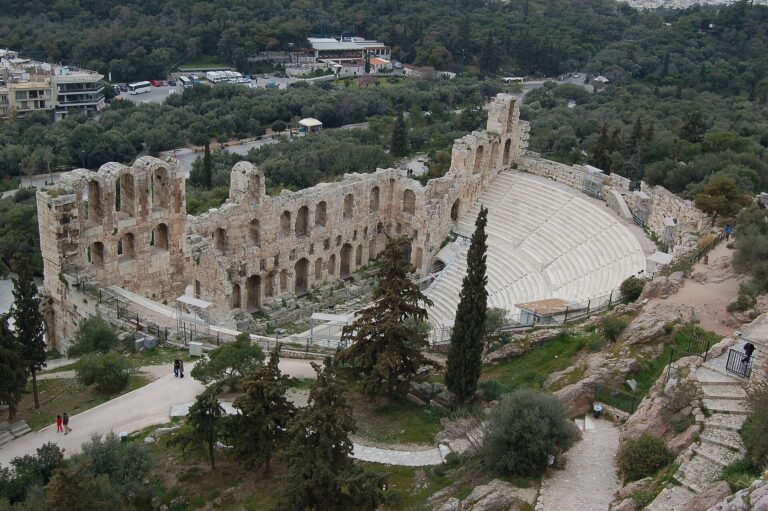
The same ticket covers the whole of the Acropolis. At the foot of the rock, about 322 metres away, is the Odeon of Herodes Atticus, and about 17 minutes’ walk away, the Temple of Hephaestus. The rest of the city is on the free audio guides of Athens page.
Reading this in Spanish? The same guide, written for a Spanish-speaking visitor and narrated in Spanish, is at Templo de Atenea Niké en vozviajera.com.
Where to find it
FAQs
How do the free audio guides work?
They play right here on audioguidetravel.com, with no app to download and no sign-up. Press play and listen as you walk round: a phone and a pair of headphones are all you need. The audio streams from this page, so you’ll need mobile data or Wi-Fi.
Can I take the tour at my own pace?
Of course! You set the pace: pause whenever you like, jump back or forward 15 seconds, or tap the bar to jump to any point, and listen as many times as you want so you don’t miss a thing.
If I'm in a group, can we use the same audio guide?
Yes. The same free audio guide opens on as many phones as you like, so you can go round together as a group or with your family, each person at their own pace and with their own headphones. The quickest way is to send the link via WhatsApp, Telegram or however you like: the buttons just below let you share it right now.
Visitor information
As of 25 Sep 2026- Opening hours
- 08:00 to 19:00 until 30 September; from 1 October it closes at 18:30. Last entry 30 min before closing
- Tickets
- €30.00 full · €15.00 reduced (Acropolis and Slopes ticket)
- Getting there
- Metro Akropoli (line 2) and 12 minutes on foot; the temple is right of the ramp
- Accessibility
- Slope lift for wheelchair users: call +30 213 1317762 one hour before arriving
- Tip
- The ticket is used once: leave the rock and you cannot re-enter, so decide your order first
- Official website
- odysseus.culture.gr
Nearby
More free audio guides in Athens
 9:36AthensAncient Agora of Athens: free audio guide, hours and ticketsThis free audio guide to the Ancient Agora of Athens plays straight from your phone — no app,…
 5:59AthensOdeon of Herodes Atticus: free audio guide, closed for worksThis free audio guide to the Odeon of Herodes Atticus plays straight from your phone — no app,…
 7:00AthensLycabettus Hill: free audio guide, funicular and hoursThis free audio guide to Lycabettus Hill plays straight from your phone — no app, no sign-up —…