
Sanctuary of Apollo, Pompeii: free audio guide and tickets
Free audio guide in English · no app, no sign-up
Free audio guide to the Sanctuary of Apollo in Pompeii, in English: 4 minutes on one of the oldest places of worship in the city, its portico of 48 columns, the altar and the sundial column. It plays on this page.
 Audio guide
What the audio guide covers
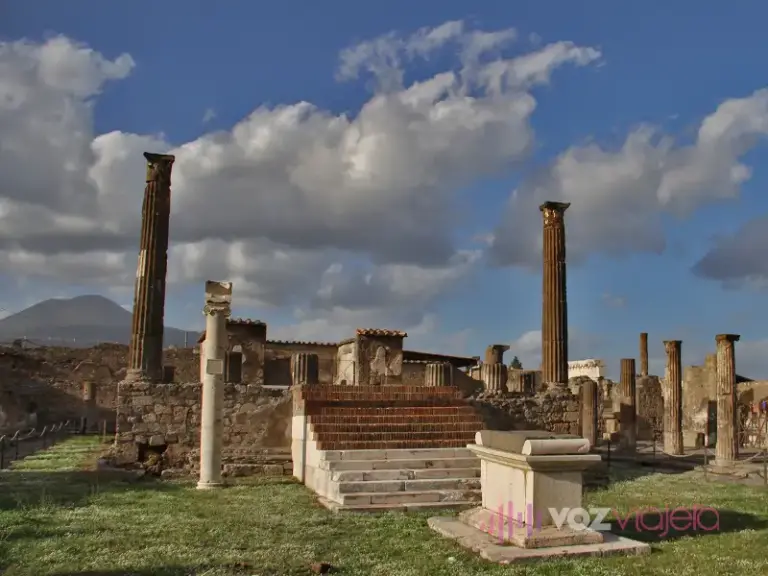
The Sanctuary of Apollo is one of the oldest places of worship in Pompeii: a temple on a podium inside a courtyard ringed by a portico, just off the Forum. This audio guide is free, plays on this page from your phone’s browser with no app and no sign-up, and lasts 4 minutes. Play it standing in the courtyard, behind the altar with the temple steps in front of you: from there you can see everything it describes.
It opens with the history of the sanctuary, from the first open-air altars to the earthquake of 62 AD, and then walks you round the precinct: the wall, the portico, the temple on its podium, the altar and the sundial. The stops in the table follow the order of the audio.
| Stop | What it tells you |
|---|---|
| Welcome | A temple buried by Vesuvius in 79 AD and brought back to light in the 19th century. |
| The origins | An open area with altars, then a first building with a terracotta roof in the 6th century BC. |
| The Samnite rebuilding | The quaestor Oppius Campanus and the Oscan inscription on the floor of the cella. |
| The age of Augustus | The sundial, the wall that closed the sanctuary off and the games in honour of Apollo. |
| The precinct | The perimeter wall, the way in from the Via Marina and the old doorways turned into niches. |
| The portico | 48 fluted tuff columns and the capitals redone after the earthquake of 62 AD. |
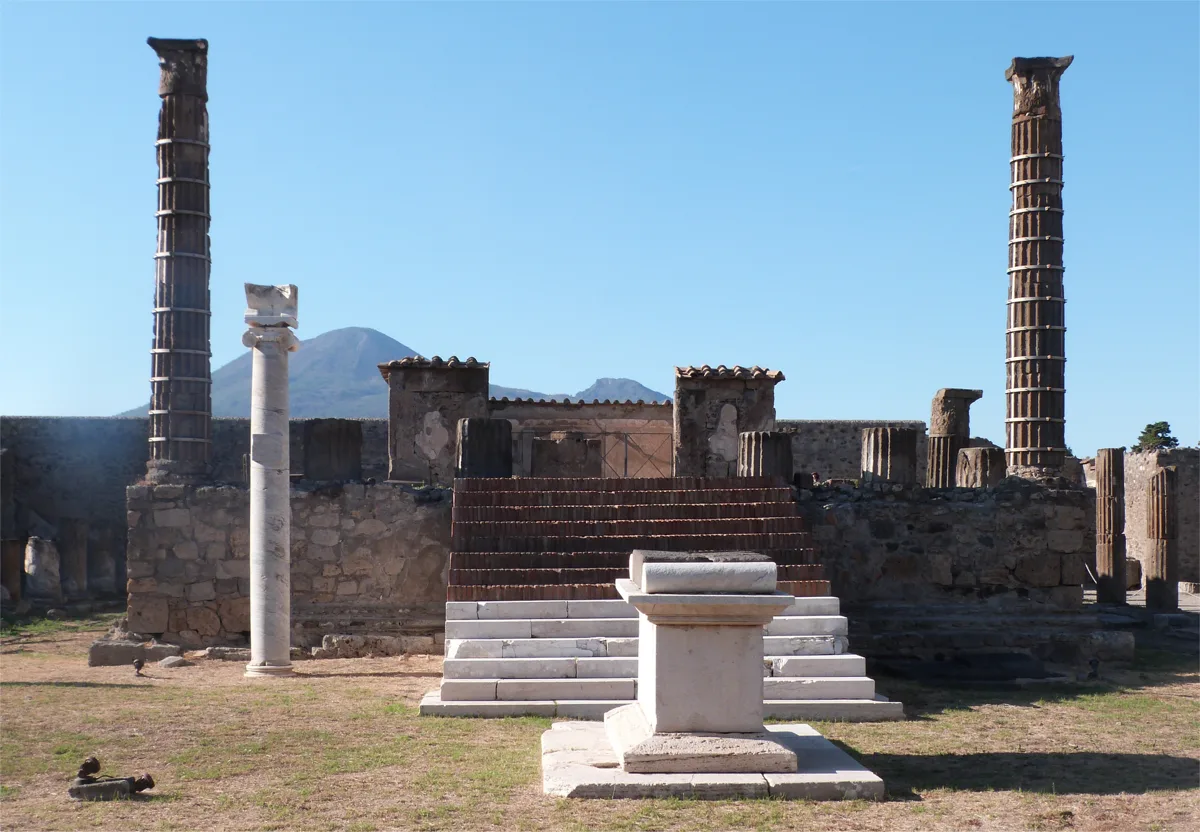
| The temple, the altar and the sundial | The podium with its staircase, the white marble altar in front of it and the Ionic column with the sundial. |
One of the oldest places of worship in Pompeii
The sanctuary stands beside the street that climbed from the Porta Marina gate up to the Forum, the public heart of the city. That spot was chosen early: deep excavations here have turned up vases, votive offerings and terracotta decorations from an archaic temple of the 6th century BC, when Greeks and Etruscans were already present in Campania and Apollo was worshipped as one of the founding cults of the settlement.
What you see today took shape between the 3rd and the 2nd centuries BC, when the old building was completely renovated: a temple raised on a base, a portico running round a courtyard and an altar in the middle. After that came only a minor renovation under Nero, and that is the sanctuary that reached the days of the eruption of 79 AD.
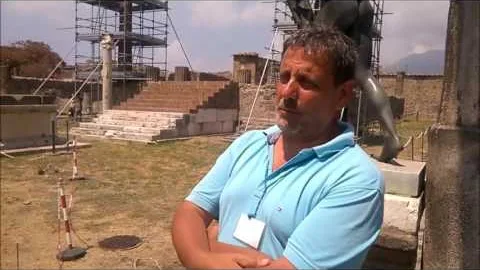
The digging itself has a long history: 1816-1817 first, then campaigns in 1931-1932, 1942-1943, 1997 and 2015. The video below, from the park’s own channel, shows one of the university excavations in the sanctuary.
Inside the courtyard: the portico, the altar and the temple
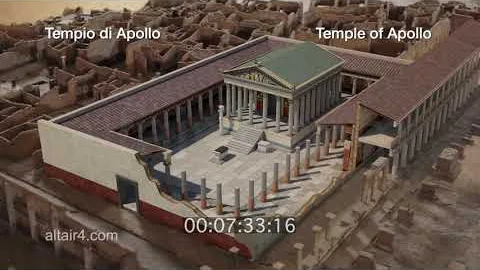
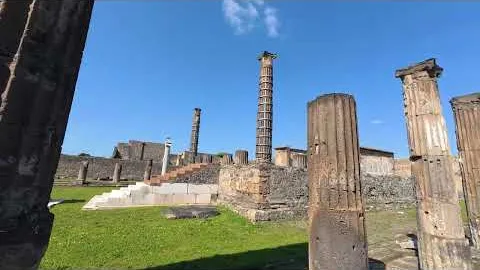
The precinct is a walled rectangle. Round the courtyard runs a portico. The audio guide counts 48 fluted columns of volcanic tuff and tells how their Ionic capitals were replaced, after the earthquake of 62 AD, by Corinthian capitals painted yellow, red and dark blue.
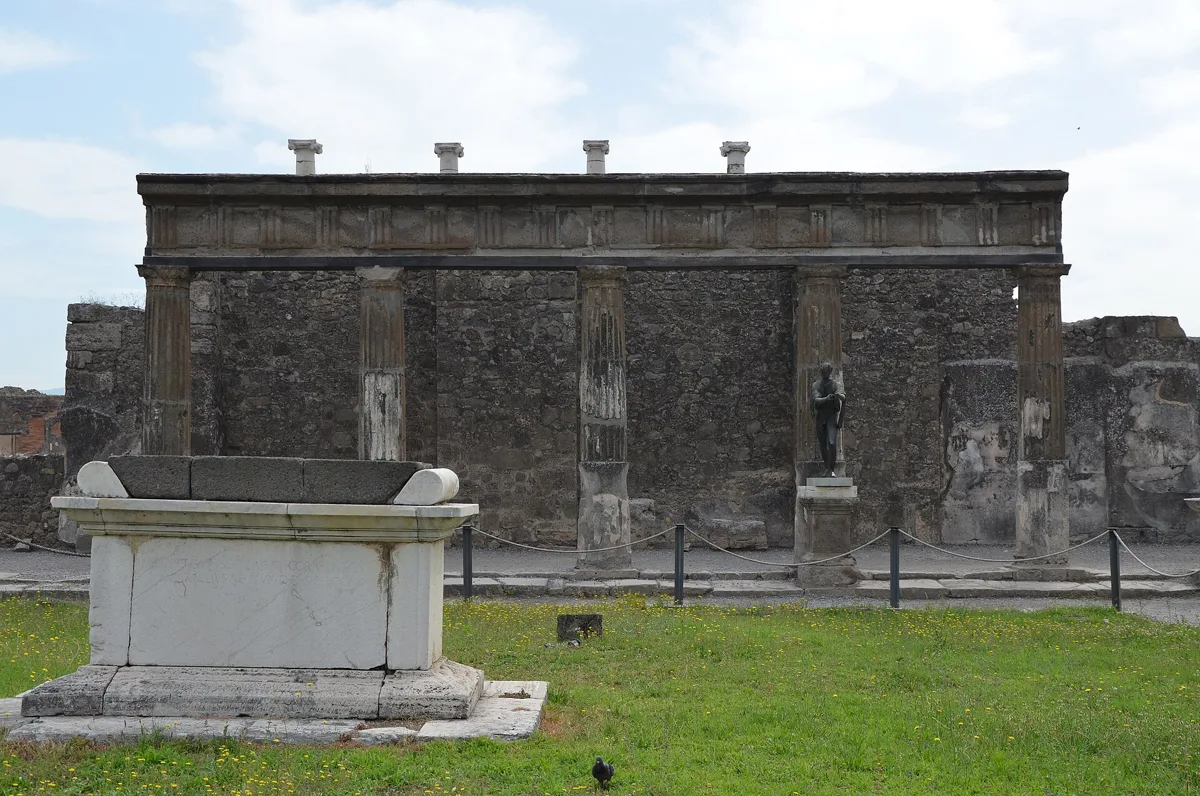
On the east side, the one that backs onto the Forum, a row of open doorways once linked the sanctuary to the square, under a monumental colonnade that may have carried a terrace. Today the way in is from the Via Marina, round the side; the audio guide tells how the old doorways were turned into niches painted with scenes from the Trojan War.
At the head of the courtyard the temple rises on a podium, reached by a staircase. In front of the steps stands the altar in white marble, and beside the steps an Ionic column with a sundial on top; the audio guide dates it to the age of Augustus. From the altar you get the classic view: the podium, the columns on either side and, on a clear day, the cone of Vesuvius behind.
Apollo and Diana: the 2 bronzes
The sanctuary was the setting for the ludi Apollinares, the festival in honour of the god, with gladiatorial games and theatre. At its core were the coming-of-age rites of boys and girls, who took Apollo and his twin sister Diana as their protectors.
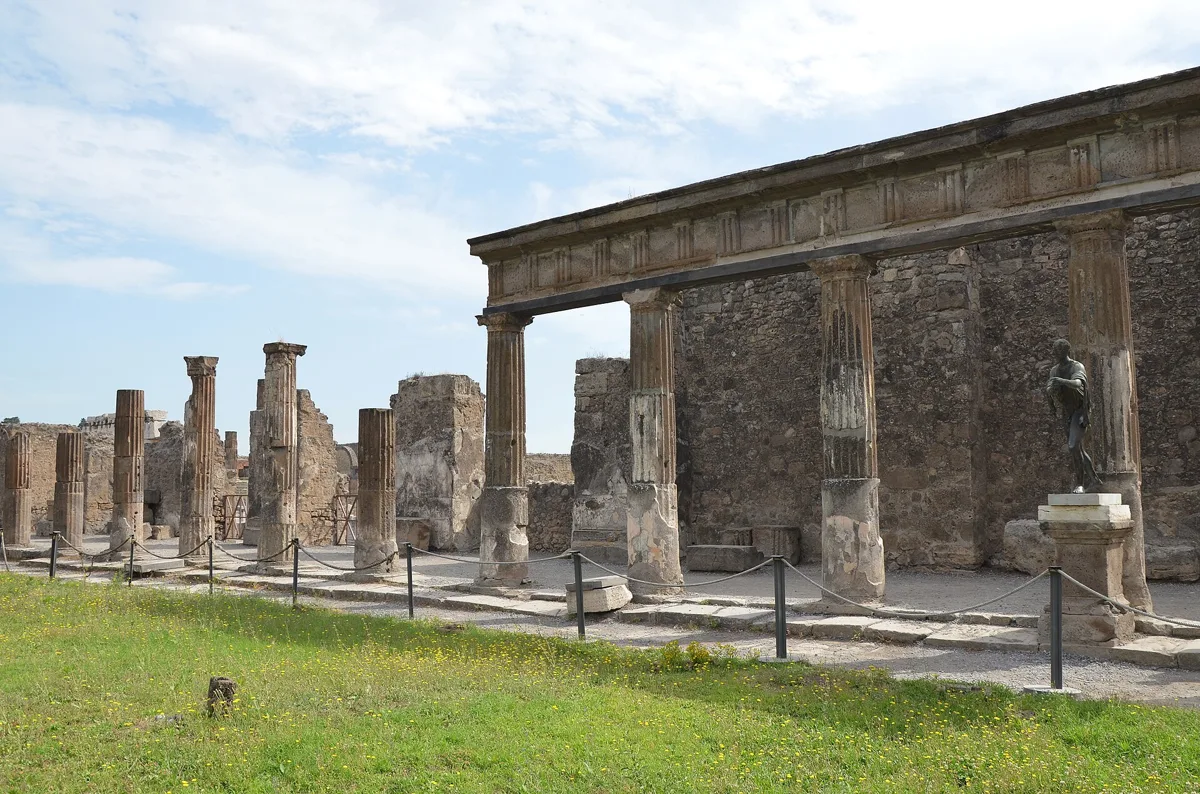
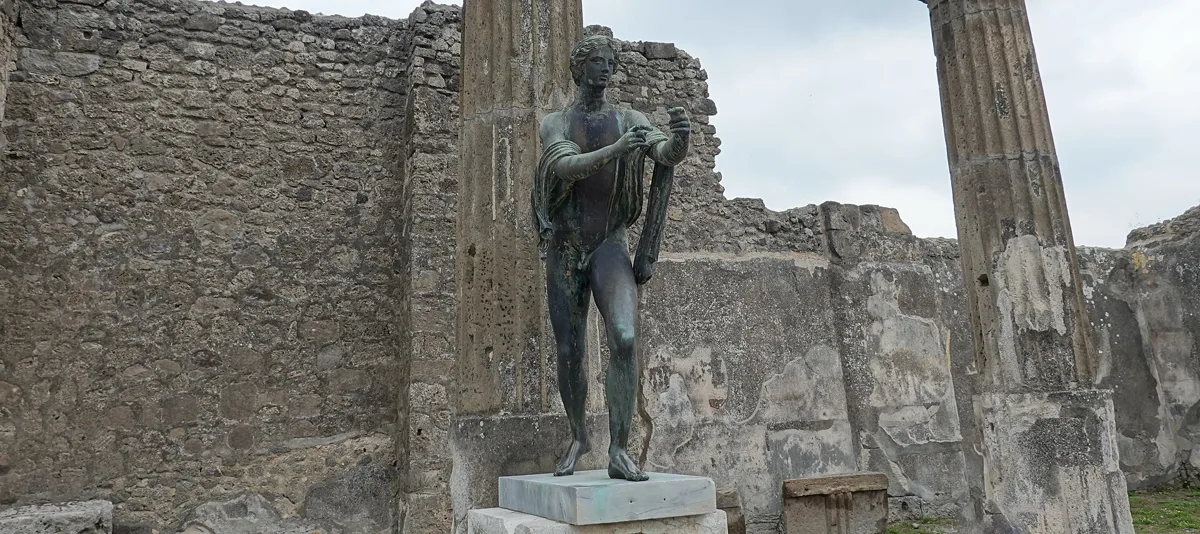
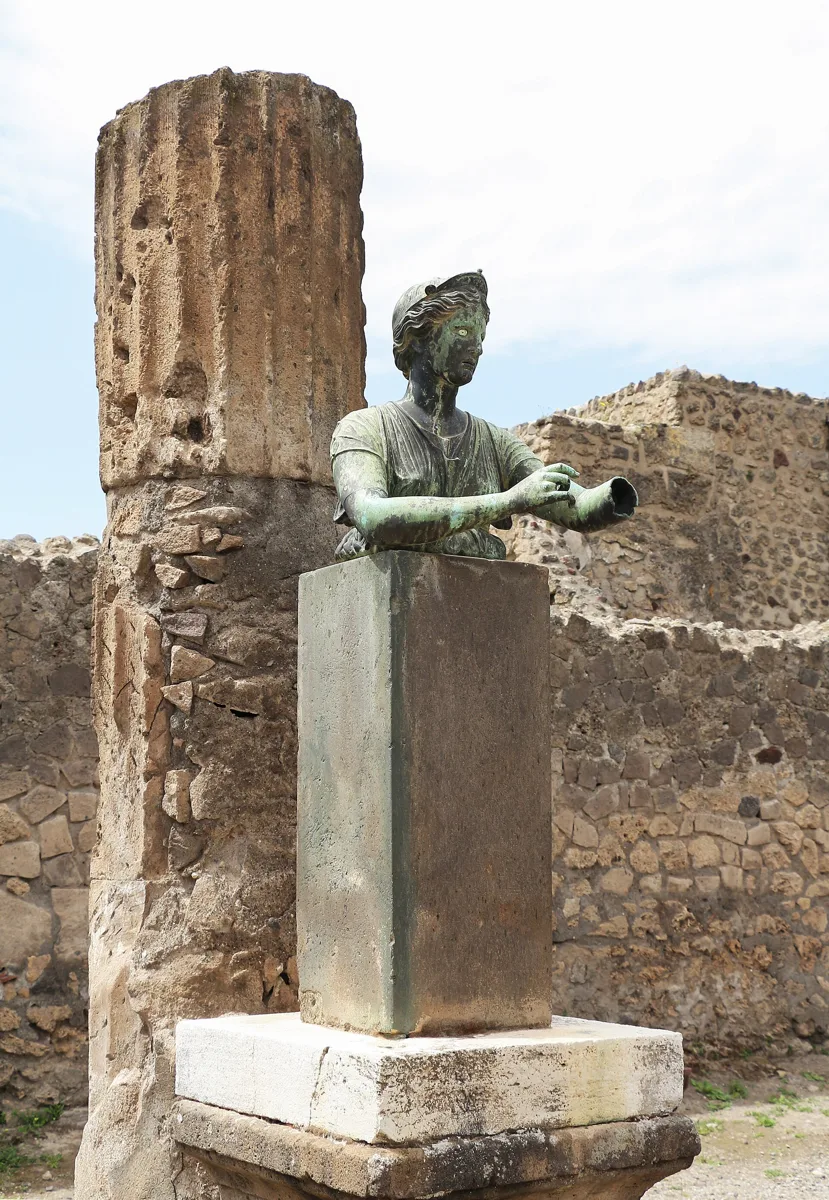
Both gods are here in bronze: Apollo as an archer in front of the east portico, Diana as a bust on a pillar. They are copies of Hellenistic originals kept in the National Archaeological Museum of Naples.
Opening hours and tickets this winter
The Sanctuary of Apollo is inside the archaeological site of Pompeii and has no ticket of its own. From 15 October to 15 March the site opens every day from 9:00 to 17:00, with last entry at 15:30; from 16 March to 14 October it is 9:00 to 19:00, with last entry at 17:30. It closes on 25 December and 1 January.
The ticket for the ancient city alone costs €20; with the suburban villas (the Villa of the Mysteries and the Villa of Diomedes), Villa Regina in Boscoreale and the shuttle bus, €25. EU citizens aged 18 to 24, and holders of an Italian residence permit of the same age, pay €2. Each ticket is valid for 1 entry: you cannot go out and come back in.
The nearest way in is the Porta Marina entrance, on the Via Villa dei Misteri. By train, take the Circumvesuviana Naples-Sorrento line to the Pompei Villa dei Misteri stop. From the gate, walk up the Via Marina towards the Forum: the sanctuary lies along that street, on your left just before the square.
Nearby, with their own free audio guides
A detail worth knowing before you arrive: you do not walk into the sanctuary from the Forum. Its eastern wall runs along the square, and the way in is from the Via Marina, round the side. From the Forum, 5 minutes north brings you to the House of the Faun, which takes up a whole block of some 3,000 square metres; the battle mosaic that made it famous is in Naples now, and what lies on its floor is a copy. And if you walk the Via dell’Abbondanza, the main street, from end to end — just over 1 km, 15 or 20 minutes — you arrive at the amphitheatre, which the park itself calls the oldest known amphitheatre of the Roman world, built in 70 BC. Both have their own free audio guide here. (Walking times are our estimate from the park’s own published coordinates.)
 Free audio guidePompeii Forum
 Free audio guideNaples Archaeological Museum
 Free audio guideHouse of the Faun
Where to find it
FAQs
How do the free audio guides work?
They play right here on audioguidetravel.com, with no app to download and no sign-up. Press play and listen as you walk round: a phone and a pair of headphones are all you need. The audio streams from this page, so you’ll need mobile data or Wi-Fi.
Can I take the tour at my own pace?
Of course! You set the pace: pause whenever you like, jump back or forward 15 seconds, or tap the bar to jump to any point, and listen as many times as you want so you don’t miss a thing.
If I'm in a group, can we use the same audio guide?
Yes. The same free audio guide opens on as many phones as you like, so you can go round together as a group or with your family, each person at their own pace and with their own headphones. The quickest way is to send the link via WhatsApp, Telegram or however you like: the buttons just below let you share it right now.
Visitor information
As of 29 Oct 2026- Opening hours
- Every day 9:00-17:00 (15 Oct-15 Mar) · last entry 15:30
- Tickets
- Pompeii only €20 · with the suburban villas €25 · EU citizens 18-24 €2
- Time needed
- About 20 min in the sanctuary (our estimate)
- Getting there
- Circumvesuviana Naples-Sorrento line to Pompei Villa dei Misteri, for the Porta Marina entrance.
- Accessibility
- Ancient, uneven paving; the accessible «Pompeii for All» route starts at Piazza Anfiteatro
- Tip
- Come in through Porta Marina: the sanctuary is on the way up to the Forum
- Official website
- pompeiisites.org
Nearby
More free audio guides in Pompeii
 3:14PompeiiPompeii ForumDelve into the heart of ancient Pompeii, where the Forum awaits to reveal the secrets of a lost…
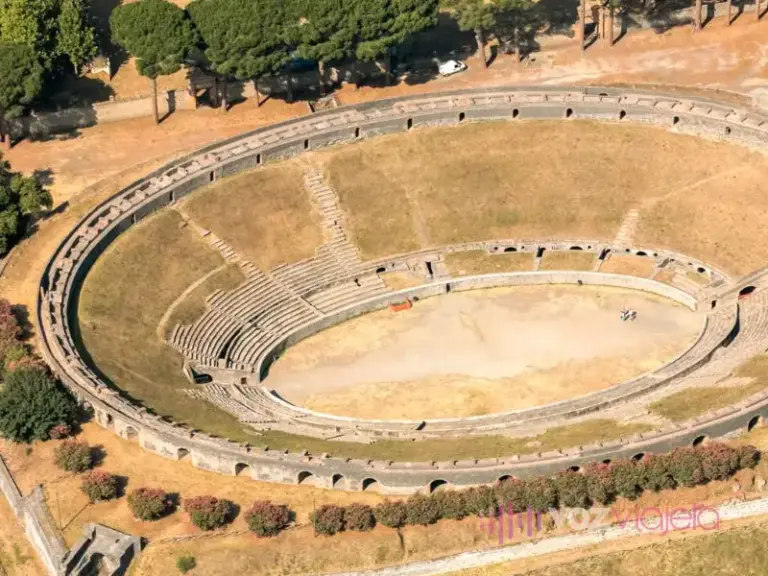 2:52PompeiiRoman amphitheater of PompeiiStepping into Pompeii’s Roman Amphitheater is like opening a history book and jumping straight into its most exciting…
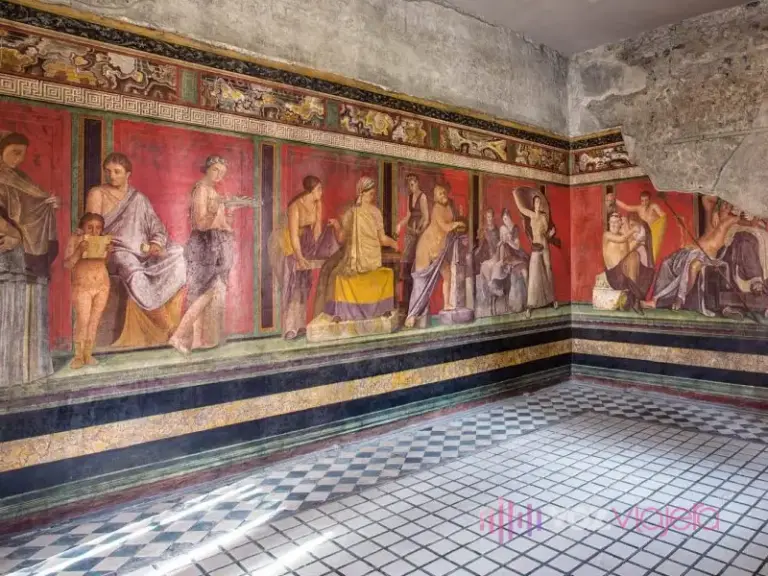 3:32PompeiiVilla of the MysteriesEmbark on an unparalleled journey to the heart of ancient Rome with a visit to the Villa of…