
Almudena Cathedral, Madrid: free audio guide, hours and tickets
Free audio guide in English · no app, no sign-up
Almudena Cathedral is Madrid’s cathedral, opposite the Royal Palace: classical outside, Gothic Revival inside. This free audio guide lasts about 4 and a half minutes and takes you from the bronze doors on Calle Bailén to the patron saint’s altar, Saint Isidore’s chest and the apse.
 Audio guide
Before you go in
The few things that change your visit.
- The cathedral is open every day, 10 a.m. to 8:30 p.m., and entry is free, with a €1 donation
- The museum and dome cost €8 (€5 reduced), Monday to Saturday, 10 a.m. to 2:30 p.m.
- No sightseeing during Mass (11 a.m. Mon-Fri, noon and 7 p.m.): 1 to 7 p.m. has no regular Mass
- Inside: the Virgin of Almudena, Queen María de las Mercedes's tomb, Saint Isidore's chest and the apse
On this page
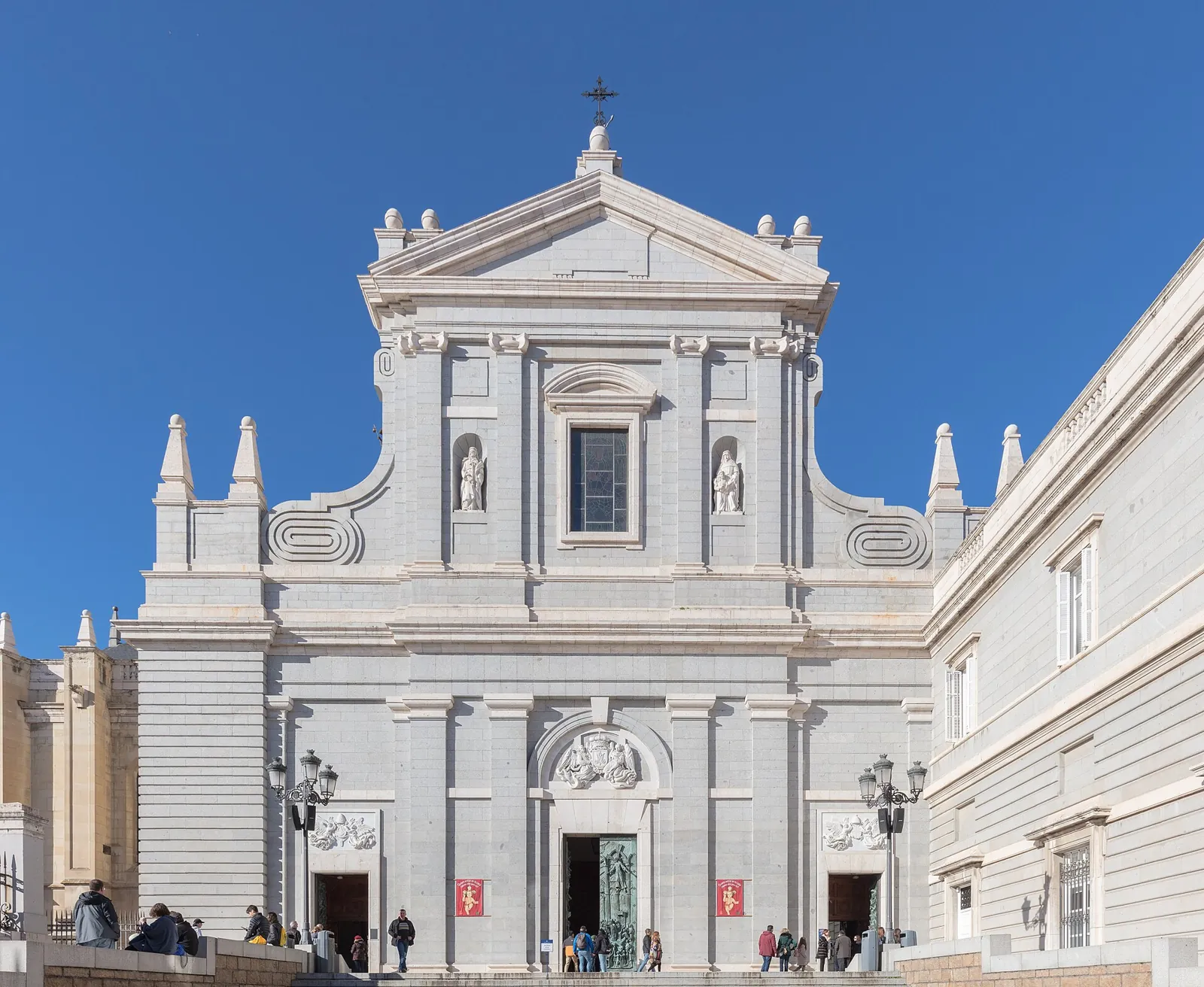
Almudena Cathedral is Madrid’s cathedral, built right opposite the Royal Palace between 1883 and 1993. The outside is classical, designed to match the palace; the inside is Gothic Revival, under a ceiling painted in bright geometric colors. Entry is free, with a suggested €1 donation, and it opens daily from 10 a.m. This free audio guide lasts about 4 and a half minutes and takes you from the bronze doors to the apse.
What the Almudena Cathedral audio guide covers
Press play at the foot of the steps of the main front, the one facing the Royal Palace, then keep listening as you walk round to the Calle Bailén entrance and go in. Each part tells you where to look. There are 6 parts:
| Where Madrid began | Why the cathedral stands on this exact spot, next to the site of the old Moorish fortress where Madrid began. |
| The bronze doors | The finding of the Virgin in the city wall and the day the cathedral was consecrated, cast in relief. |
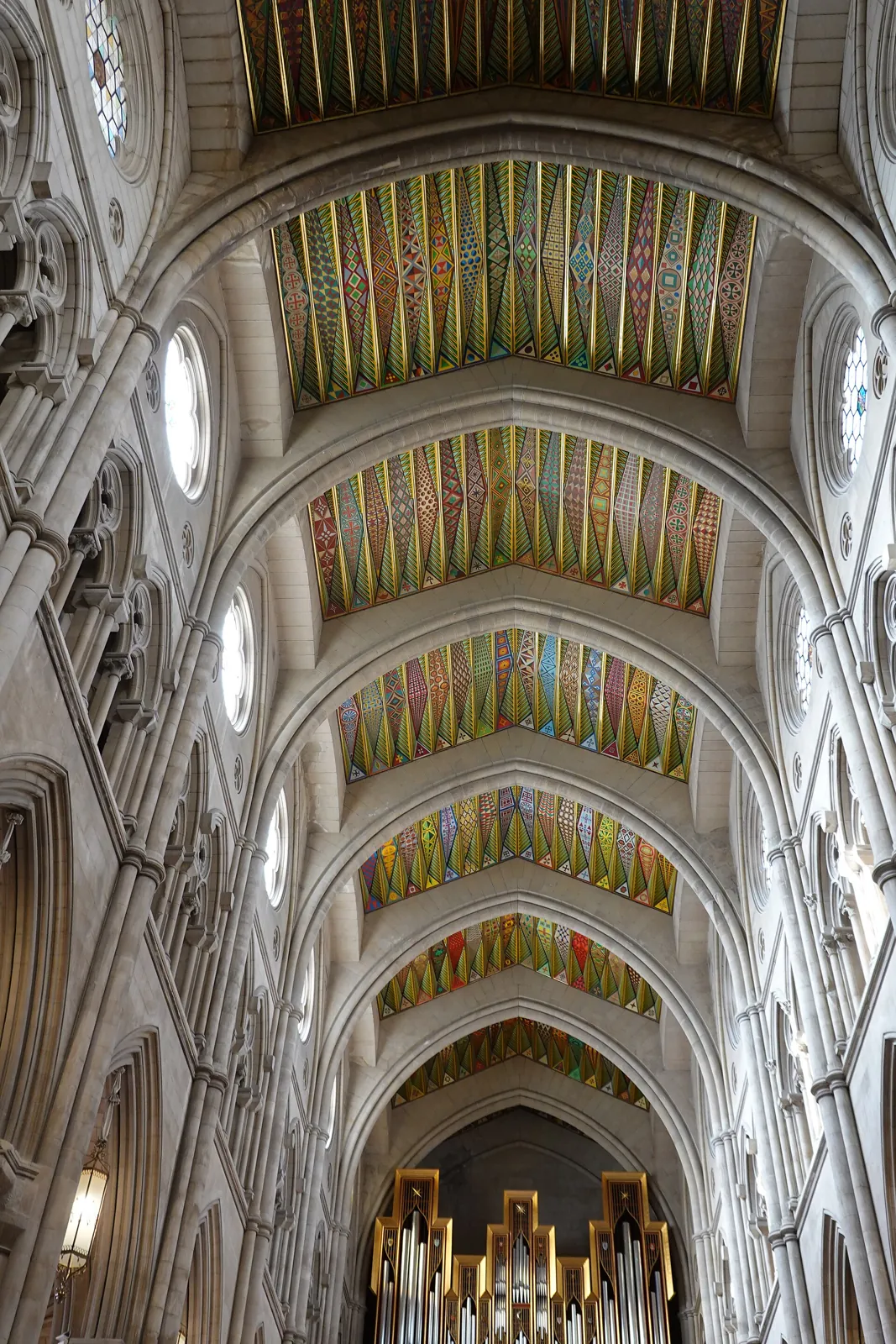
| The colored ceiling | A Gothic church inside a classical shell, and a building site that lasted 110 years. |
| The patron saint and the queen | The Virgin of Almudena and Queen María de las Mercedes, buried at her feet. |
| Saint Isidore | The 13th-century chest of Madrid’s patron saint, in the ambulatory. |
| The apse | The murals and the stained glass with the word for “Word” in 6 languages. |
Almudena Cathedral opening hours and tickets
There are 3 separate ways in, each with its own hours, and they are on different sides of the building. Worth sorting out before you go:
- The cathedral: enter at Calle Bailén 10. Open every day, 10 a.m. to 8:30 p.m. from September to June, and 10 a.m. to 9 p.m. in July and August. It’s free; at the door they ask for a €1 donation towards the upkeep of the building.
- The museum and the dome: the ticket office is on the steps of the main facade, the one facing the Royal Palace. Open Monday to Saturday, 10 a.m. to 2:30 p.m.; closed on Sundays, Catholic holy days of obligation and days with special services. Tickets cost €8, or €5 reduced, and children under 9 go free. No booking is needed for a self-guided visit: you buy the ticket on the spot.
- The crypt: its own entrance is at Calle Mayor 90. Open daily, 10 a.m. to 2 p.m. and 5 to 8 p.m.
The €5 museum rate covers ages 10 to 16, EU students up to 25, EU visitors over 65, visitors with a disability card, and residents of the ecclesiastical province of Madrid, among others.
What to see inside Almudena Cathedral
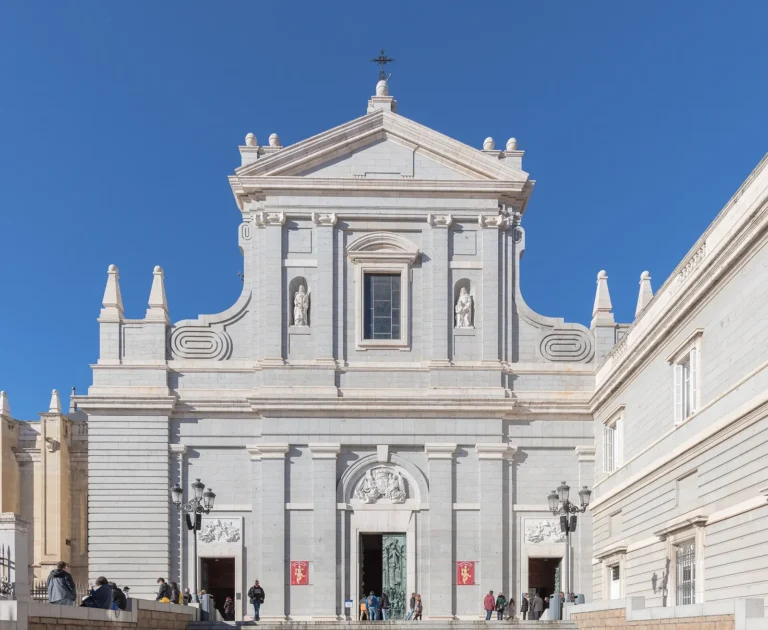
You go in through one of the 3 bronze doors on Calle Bailén, all by the sculptor Sanguino. The left-hand one shows King Alfonso VI finding the statue of the Virgin in 1085; the central one shows Pope John Paul II consecrating the cathedral on June 15, 1993. Out in the square stands a statue of that pope, more than 3 meters tall, by Juan de Ávalos.
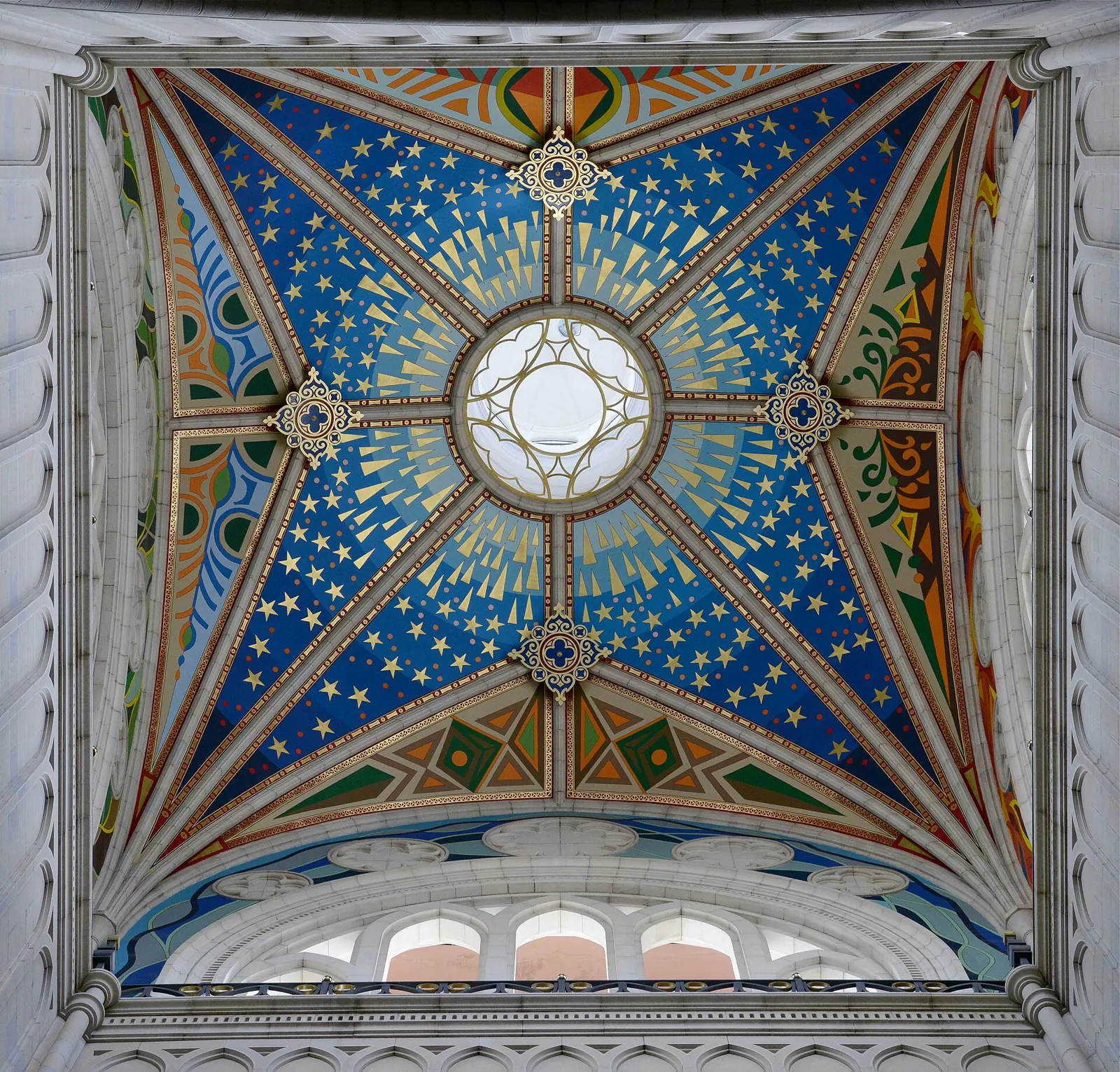
Inside, everything flips. After the sober classical exterior comes a Gothic Revival church on a Latin-cross plan, with stained glass and a nave ceiling covered in colorful geometric patterns by the painter José Luis Galicia. The stops not to miss:
- The altar of the Virgin of Almudena, in the transept, straight ahead as you come in from Calle Bailén. She is Madrid’s patron saint: a late 15th-century carving attributed to Diego Copín of Toledo. Her feast day is November 9.
- The tomb of Queen María de las Mercedes, under the stairs of that same altar. The first wife of Alfonso XII, she died in 1878; in 2000 her remains were finally laid here at the Virgin’s feet, as Alfonso XII had wished.
- Saint Isidore’s chest, in the central chapel of the ambulatory: a 13th-century Gothic chest that once held the body of Madrid’s patron saint.
- The Christ of the Good Death by Juan de Mesa, presiding over the sanctuary behind the high altar.
- The apse, with murals by Kiko Argüello blessed in 2004, and 7 stained-glass windows with the word for “Word” in Latin, Greek, Hebrew, Syriac, Russian and Spanish, with Mary’s name in the middle.
- The organ, up in the choir loft at the back of the nave, above the main entrance, built by the organ maker Gerhard Grenzing.
You can take photos and video in the cathedral, as long as you don’t disturb anyone praying. No food or drink, and tour guides are not allowed to explain anything inside, which is exactly why you listen to this guide on your own phone, with headphones.
The dome and the cathedral museum
The museum is the only way up to the dome, so it’s worth it even if museums aren’t your thing. The route starts in the Chapter House and the Main Sacristy, both covered in modern mosaics, then moves through rooms on the history of the Madrid diocese, the Virgin of Almudena and Saint Isidore. Highlights include the codex of John the Deacon, the oldest account of Saint Isidore’s life and miracles, and the models of the 2 cathedral designs: the original Gothic one and the classical one that was actually built.
Halfway round, you climb the stairs to the dome and step out onto its balconies, with Madrid all around you and the Royal Palace straight ahead. A second gallery then covers the 7 sacraments and ends with footage of the 1993 consecration Mass.
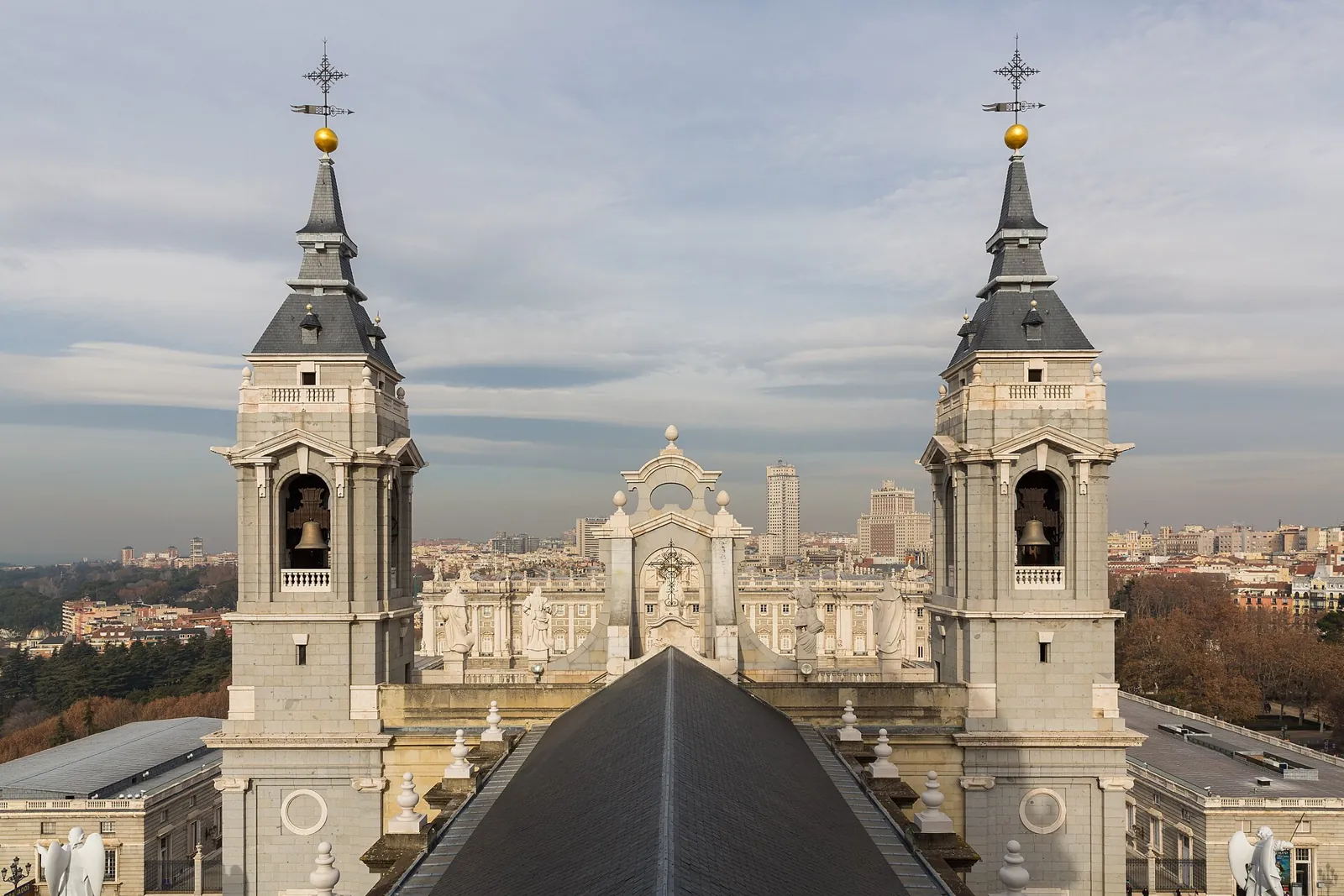
The museum has elevators, ramps and platforms for visitors who need them. Pay by card if you can, as the ticket office suggests, and keep your ticket on you for the whole visit, since staff may ask to see it.
How to get to Almudena Cathedral
The nearest metro station is Ópera, on lines 2 and 5 and the Ópera-Príncipe Pío branch line. From there it’s about a 7-minute walk down Calle Bailén, past the Royal Palace. Buses 3 and 148 stop where Calle Bailén meets Calle Mayor, a few steps from the door.
The Calle Bailén entrance is wheelchair accessible via a ramp over 10 meters long with a 7% slope: wide, but with no handrail.
Almudena Cathedral history: 110 years in the making
The cathedral sits where Madrid was born. In the 9th century the emir Muhammad I built a fortress here to watch the passes of the Guadarrama mountains, and a town grew up around it. The Virgin takes her name from those walls: almudaina is Arabic for “walled enclosure”, and tradition says her statue was found hidden among the stones.
Madrid became the capital in 1561, yet it had no bishop until 1885, when Pope Leo XIII created the diocese of Madrid-Alcalá. By then work had already begun: King Alfonso XII laid the first stone on April 4, 1883, at the wish of his first wife, María de las Mercedes, who was devoted to the Virgin. The Marquis of Cubas designed a huge Gothic Revival cathedral, and its Romanesque Revival crypt opened in 1911.
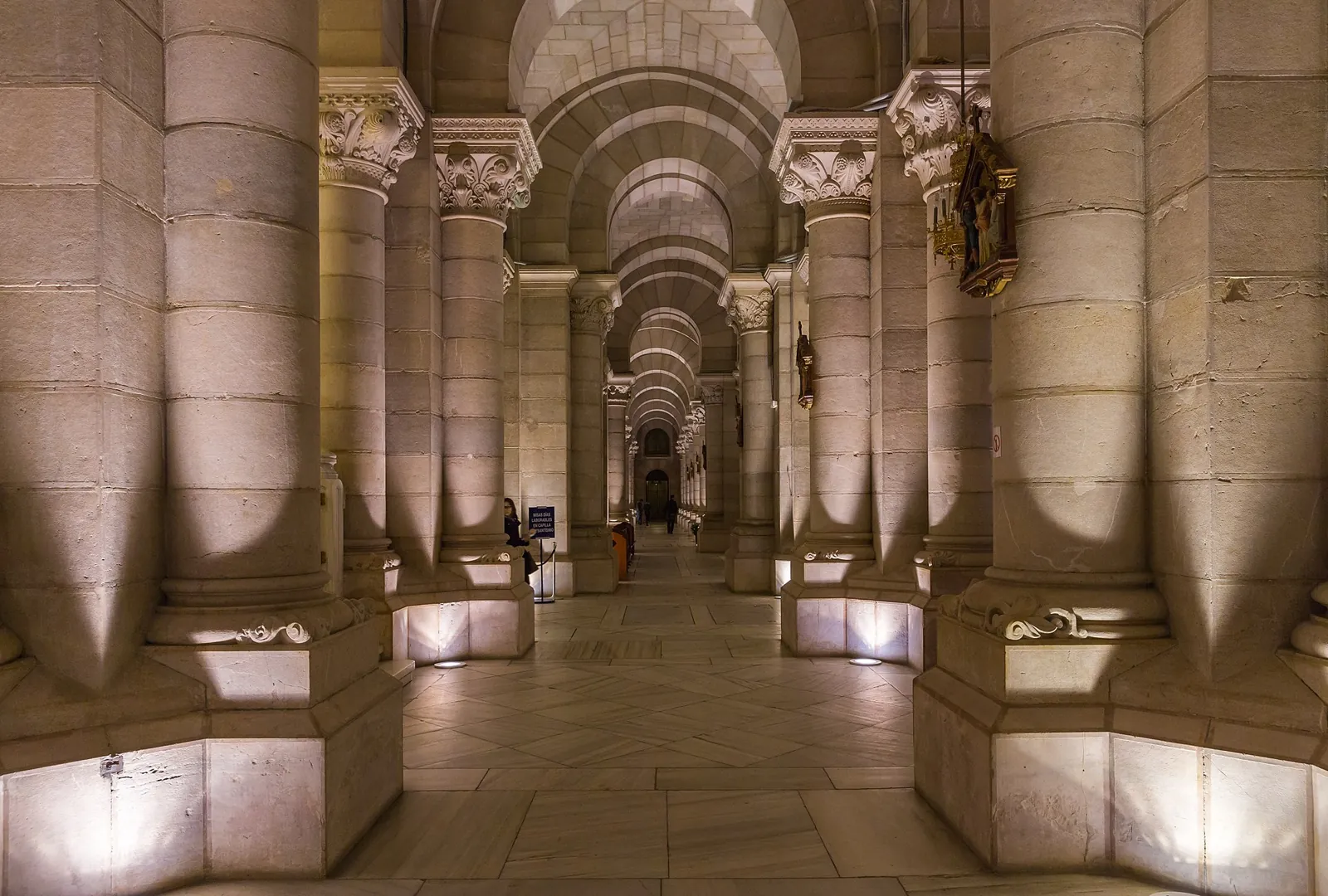
The Spanish Civil War brought everything to a halt. In 1944 a competition was called to finish it; Fernando Chueca and Carlos Sidro won it, kept what had been built and finished the outside in a classical style to match the Royal Palace. Hence a cathedral that’s Gothic inside and classical outside. John Paul II consecrated it on June 15, 1993, more than 100 years after the first stone. In 2004 the current king and queen, Felipe VI and Letizia, were married here.
Tips for visiting Almudena Cathedral
- Do the museum and dome first. They close at 2:30 p.m.; save the cathedral for the afternoon, when there are no regular Masses between 1 and 7 p.m.
- For the crypt, go between 5 and 6:30 p.m., before its evening Mass. The entrance is at Calle Mayor 90.
- Bring a coin for the €1 donation at the cathedral door.
- Respect and quiet. It’s a sacred place: dress modestly, take your hat off when you go in and switch your phone to silent.
- Around November 9, the feast of the patron saint, check the agenda on the official website: the museum closes on days with special services.
When you come out, the Royal Palace is on your right, and Calle Bailén leads on to the Plaza de Oriente. If you head up Calle Mayor towards the center, you’ll reach the Mercado de San Miguel in about 7 minutes.
 Free audio guideMercado de San Miguel, Madrid
 Free audio guidePlaza de Cibeles, Madrid
Where to find it
FAQs
How do the free audio guides work?
They play right here on audioguidetravel.com, with no app to download and no sign-up. Press play and listen as you walk round: a phone and a pair of headphones are all you need. The audio streams from this page, so you’ll need mobile data or Wi-Fi.
Can I take the tour at my own pace?
Of course! You set the pace: pause whenever you like, jump back or forward 15 seconds, or tap the bar to jump to any point, and listen as many times as you want so you don’t miss a thing.
If I'm in a group, can we use the same audio guide?
Yes. The same free audio guide opens on as many phones as you like, so you can go round together as a group or with your family, each person at their own pace and with their own headphones. The quickest way is to send the link via WhatsApp, Telegram or however you like: the buttons just below let you share it right now.
Visitor information
As of 20 Oct 2026- Opening hours
- Cathedral: daily, 10 a.m.-8:30 p.m. (July-Aug to 9 p.m.). Museum and dome: Mon-Sat, 10 a.m.-2:30 p.m.
- Tickets
- Cathedral free (€1 donation). Museum and dome: €8, reduced €5, free under 9.
- Time needed
- Audio guide of about 4.5 min; the cathedral, about 45 min; museum and dome, about 1 hour.
- Getting there
- Metro Ópera (lines 2 and 5, plus the Príncipe Pío branch). Buses 3 and 148. Enter at Calle Bailén 10.
- Accessibility
- Ramp over 10 m long, 7% slope, no handrail, on Calle Bailén; the museum has elevators and ramps.
- Tip
- Do the museum and dome in the morning; see the cathedral between 1 and 7 p.m., with no regular Mass.
- Official website
- catedraldelaalmudena.es
Nearby
More free audio guides in Madrid
 3:02MadridEl Escorial Monastery: free audio guide, tickets and opening timesThe Royal Monastery of San Lorenzo de El Escorial is Philip II’s statement in granite: a monastery, a…
 5:41MadridPrado Museum, Madrid: free audio guide, hours and ticketsThe Prado Museum (Museo del Prado) is Madrid’s great picture gallery on the Paseo del Prado: Velázquez, Goya,…
 2:33MadridPalacio de Cristal, Madrid: free audio guide to the Crystal PalaceThe Palacio de Cristal, Madrid’s Crystal Palace, is the iron and glass pavilion that Ricardo Velázquez Bosco built…