
Sainte-Chapelle: free audio guide, tickets and opening hours
Free audio guide in English · no app, no sign-up
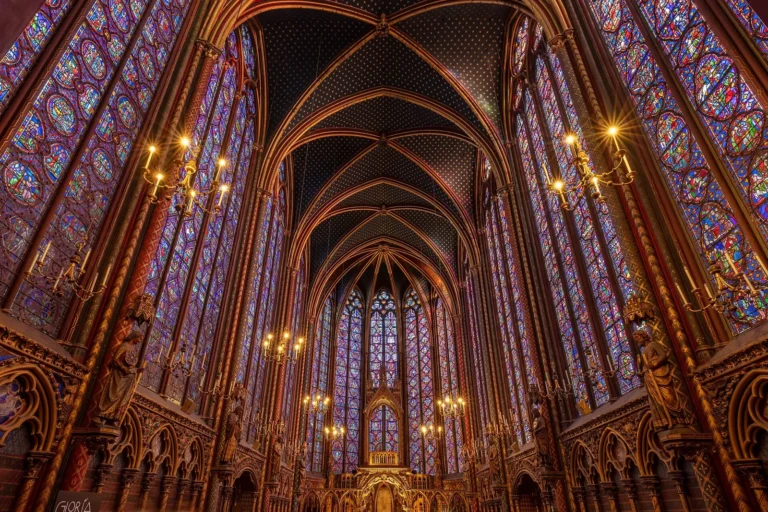
The Sainte-Chapelle is Louis IX’s Gothic chapel on the Île de la Cité, consecrated in 1248 to hold the Crown of Thorns: a lower chapel and, upstairs, 15 stained-glass windows with 1,113 scenes. This free audio guide lasts about 4 minutes and takes you from one chapel to the other.
 Audio guide
Before you go in
The few things that change your visit.
- Open every day: 9:00 to 17:00 from October to March, until 19:00 from April to September
- Tickets are €22 for visitors from outside the European Economic Area and €16 for EEA nationals and residents
- The first Sunday of November to March is free, and booking isn't possible
- It sits inside the Law Courts: no cloakroom, and sharp or glass items aren't returned
- 15 windows up to 15 metres tall with 1,113 scenes; two-thirds of the glass is original 13th-century work
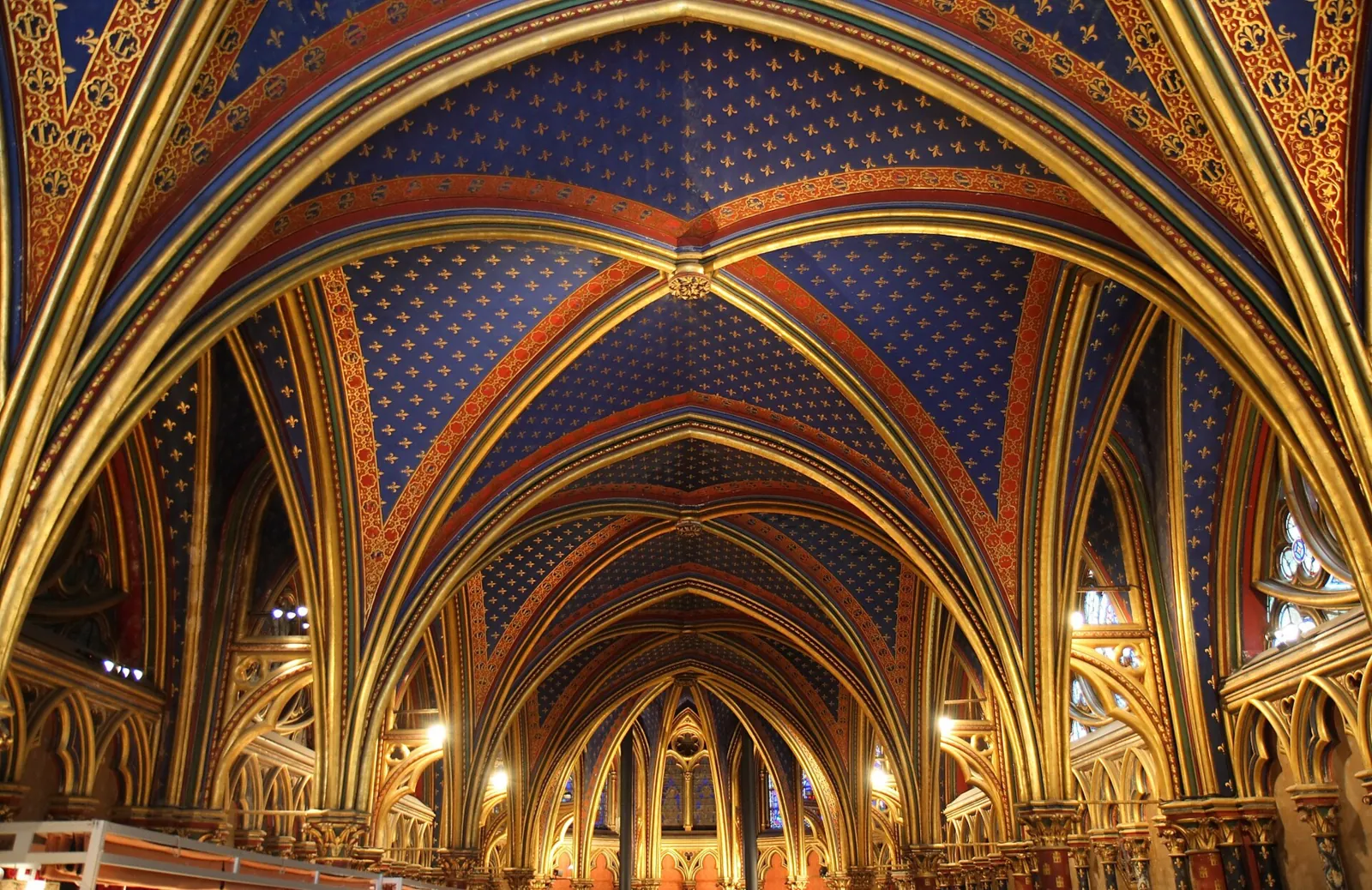
The Sainte-Chapelle is the Gothic chapel Louis IX built on the Île de la Cité to hold the Crown of Thorns, consecrated in 1248. Downstairs is a low chapel with a blue vault scattered with gold fleurs-de-lis; upstairs, a single room walled with 15 stained-glass windows up to 15 metres tall. It opens every day at 9:00. This free audio guide lasts about 4 minutes and takes you from one chapel to the other.
What the audio guide covers
Start it in the courtyard, facing the front of the chapel, and keep it on inside: each part tells you where to look next. It follows the visit route, lower chapel first, then the upper chapel. There are 5 parts:
| A reliquary the size of a building | Why a king paid half a year’s royal income for a crown of thorns. |
| The lower chapel | The palace staff’s chapel: blue vaults, gold fleurs-de-lis and 140 carved capitals. |
| The upper chapel | 33 steps up, and the walls turn into 670 m² of glass. |
| How to read the windows | From Genesis on the north side to Louis IX himself on the south, and the relic tribune. |
| The Apocalypse rose | Remade around 1485, with Charles VIII’s crowned “K” hidden in a panel. |
Sainte-Chapelle tickets and prices
The price depends on your nationality or residence. If you are a national of a country in the European Economic Area, that is the EU plus Iceland, Liechtenstein and Norway, or have lived in one for more than 4 months, a ticket costs €16, and the joint ticket with the Conciergerie €23. Everyone else, including most visitors from the US, the UK, Canada and Australia, pays €22, or €30 for the joint ticket.
Under-18s go free, as do 18 to 25-year-olds who are EU nationals or non-EU residents of France, and disabled visitors with one companion, on showing official proof of disability. Bring ID for children and young adults: it’s checked at the entrance. Free or not, you still book a time slot on the official ticket site, children and Paris Museum Pass holders included; disabled visitors get priority access, but booking is still advised. If you’re running late, your entry is guaranteed up to 30 minutes after your slot, but don’t turn up before it. Tickets can’t be exchanged or refunded.
With the joint ticket, your slot is for the Sainte-Chapelle; you can see the Conciergerie before or after, but its last entry is at 17:15, and it takes 1 to 1.5 hours. The monument also runs a guided tour at no extra charge on top of your ticket, in French only, at 11:00 and 15:00 when a guide is available: book the 10:30 or 14:30 slot to catch it.
Sainte-Chapelle opening hours
The Sainte-Chapelle opens every day. From 1 October to 31 March it’s open 9:00 to 17:00; from 1 April to 30 September, 9:00 to 19:00. Last entry is 30 minutes before closing. It closes only on 1 January, 1 May and 25 December.
School holidays and the Easter weekend are the busiest times, and without a booking you may wait a long time or not get in at all.
Getting there and the security check
The entrance is at 10 boulevard du Palais, on the Île de la Cité. The closest stop is Cité on metro line 4; RER B and C stop at Saint-Michel, and metro lines 1, 7, 11 and 14 at Châtelet. Buses 21, 24, 27, 38, 58, 81, 85 and 96 run nearby.
The chapel stands inside the grounds of the Paris Law Courts (Palais de Justice), and the security reflects that: X-ray screening, possible ID checks by police around the building, and strict screening that takes time. That’s why the queue crawls even with a timed ticket.
You enter the lower chapel by a ramp. The upper chapel is reached by a narrow spiral staircase of 33 steps with handrails; if you can’t manage stairs, ask a member of staff to take you up in the lift. Strollers must be small and foldable to pass the X-ray, and they aren’t allowed in the upper chapel: bring a baby carrier.
The lower chapel and the upper chapel
In 1239, after 2 years of negotiation, Louis IX bought the Crown of Thorns from Baldwin II, the Latin emperor of Constantinople, for 135,000 livres tournois, half the kingdom’s yearly income. More relics followed in 1241, 22 in all, including a fragment of the True Cross, and the king decided to build them a home inside his own palace.
It went up in less than 7 years and was consecrated on 26 April 1248; nobody knows for sure who designed it. It has 2 floors. The upper chapel was for the king and his guests, linked to the king’s apartments by a gallery; the lower chapel served the palace staff.
The sturdy lower chapel carries the upper one. Look at its 140 capitals, carved with Gothic leaves and flowers, and at the small internal flying buttresses, the “étrésillons”, that hold back the push of the vaults.
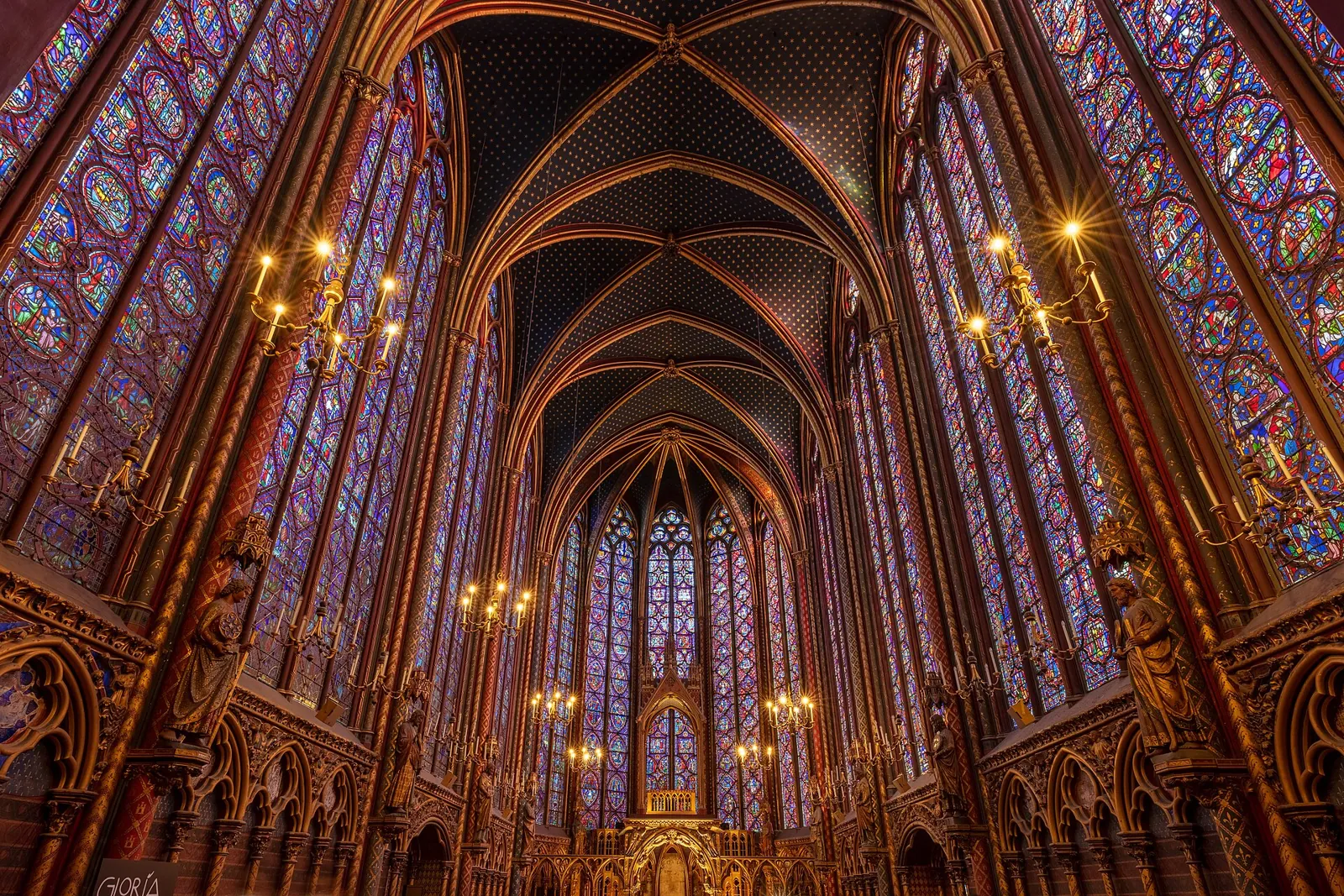
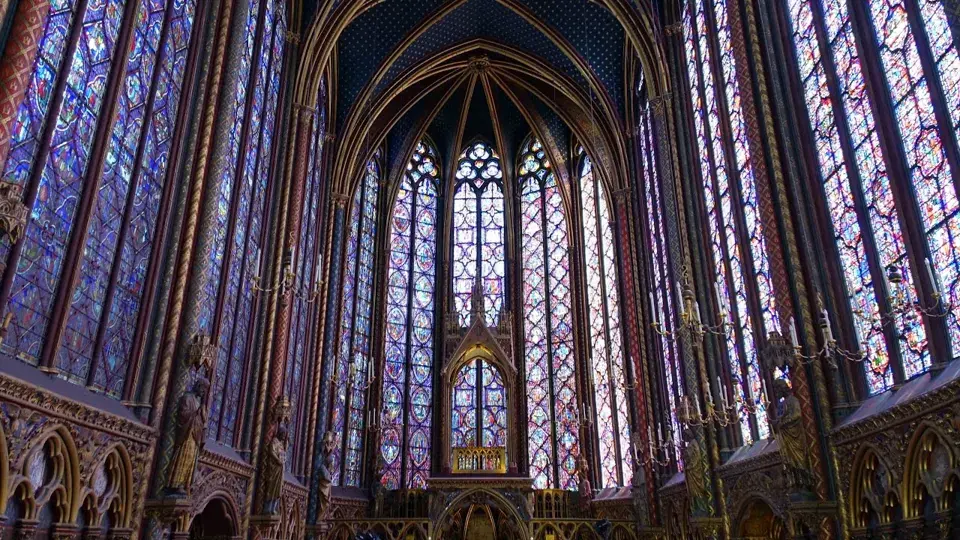
Then the stairs, and the stone all but disappears. The upper chapel is a single nave of 4 bays ending in a 7-sided apse, and its 15 windows are 15 metres tall in the nave and 13 in the apse: 670 m² of glass telling 1,113 scenes from the Bible. Two-thirds of the glass is original 13th-century work.
Reading the windows and the Apocalypse rose
Don’t try to read every panel: the windows were made to be seen more than read. The story starts on the north side with Genesis, then Moses, Joshua and the kings of Israel; the south side has Judith, Job and Esther, and in its last window the king himself appears. The Passion window is in the centre of the apse. The glaziers kept to a short palette, red, blue, 2 greens, 2 violets and one yellow, which is why the whole room looks so unified.
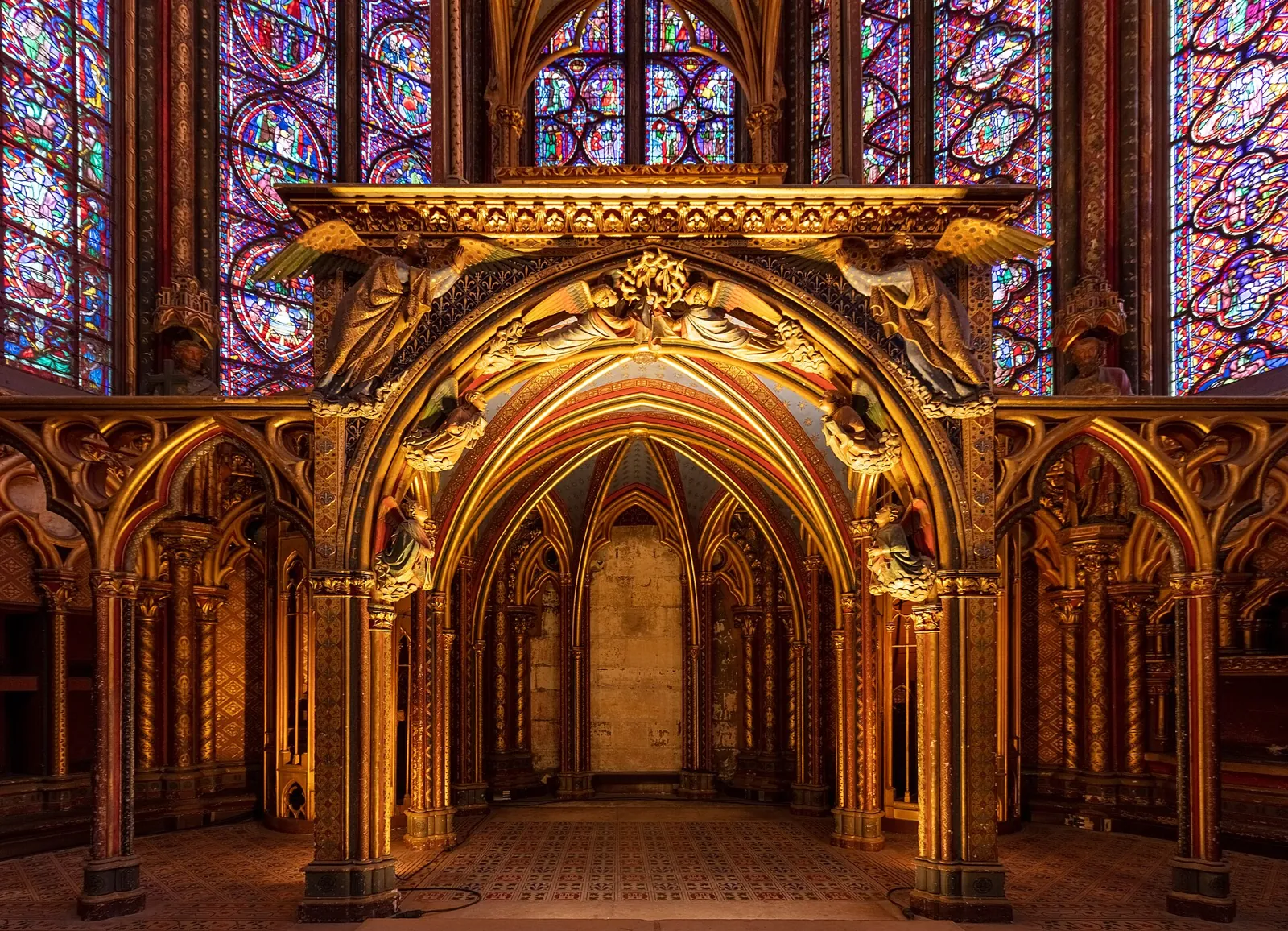
In front of the Passion window stands the relic tribune, from the 1260s and rebuilt in the 19th century. It held the great silver reliquary, melted down in the Revolution. The Crown of Thorns survived and went to the treasury of Notre-Dame in 1806. Statues of the 12 apostles line the piers.
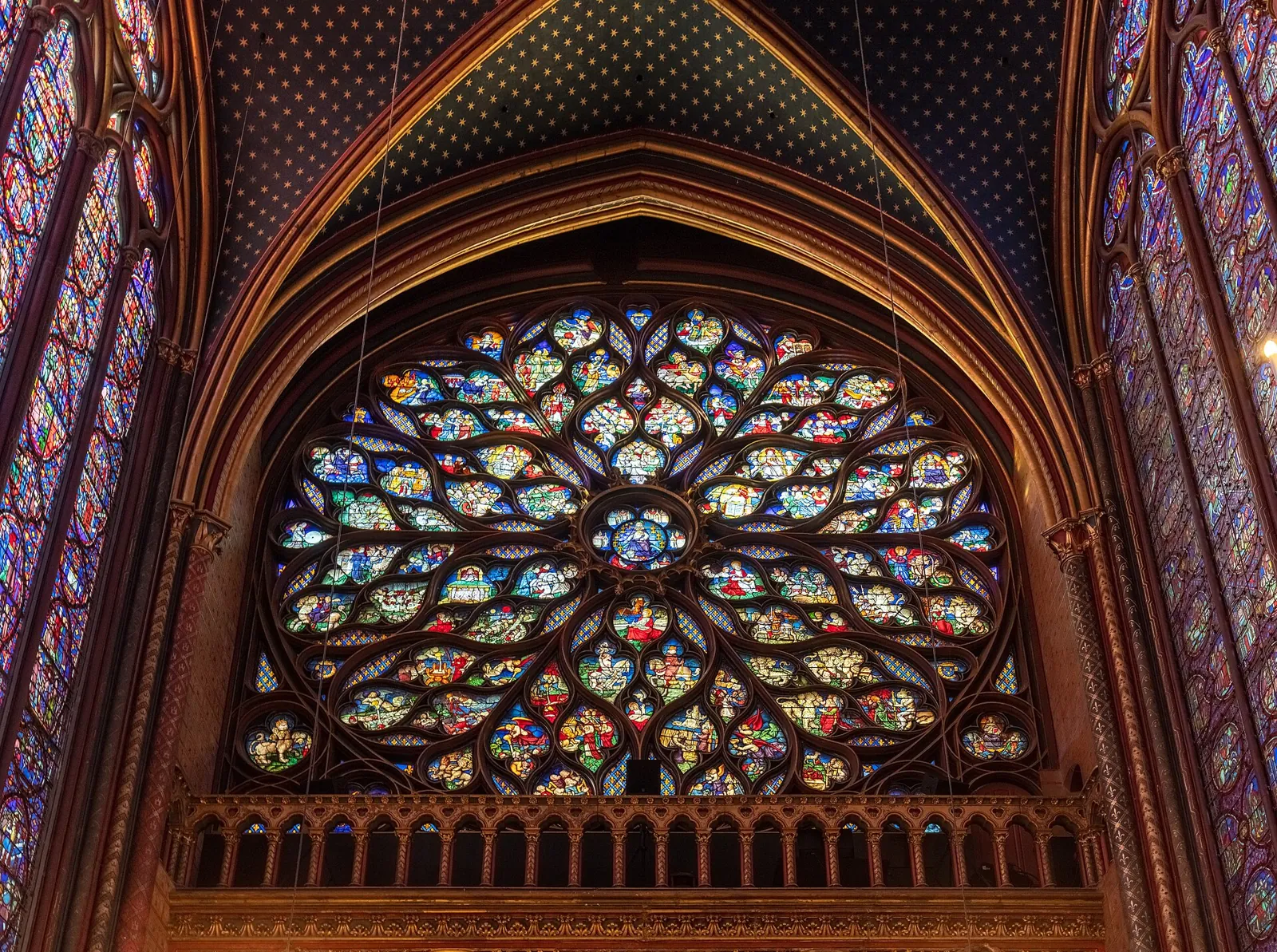
Now turn to the west. The Apocalypse rose, 9 metres across, was remade around 1485 under Charles VIII in the Flamboyant style of the day, and here yellow and green take over from red and blue. Look in a lower-left panel for the crowned “K” of Karolus, Charles, and at the centre for Christ with a sword coming from his mouth. Only 9 of its 87 panels were restored in the 19th century.
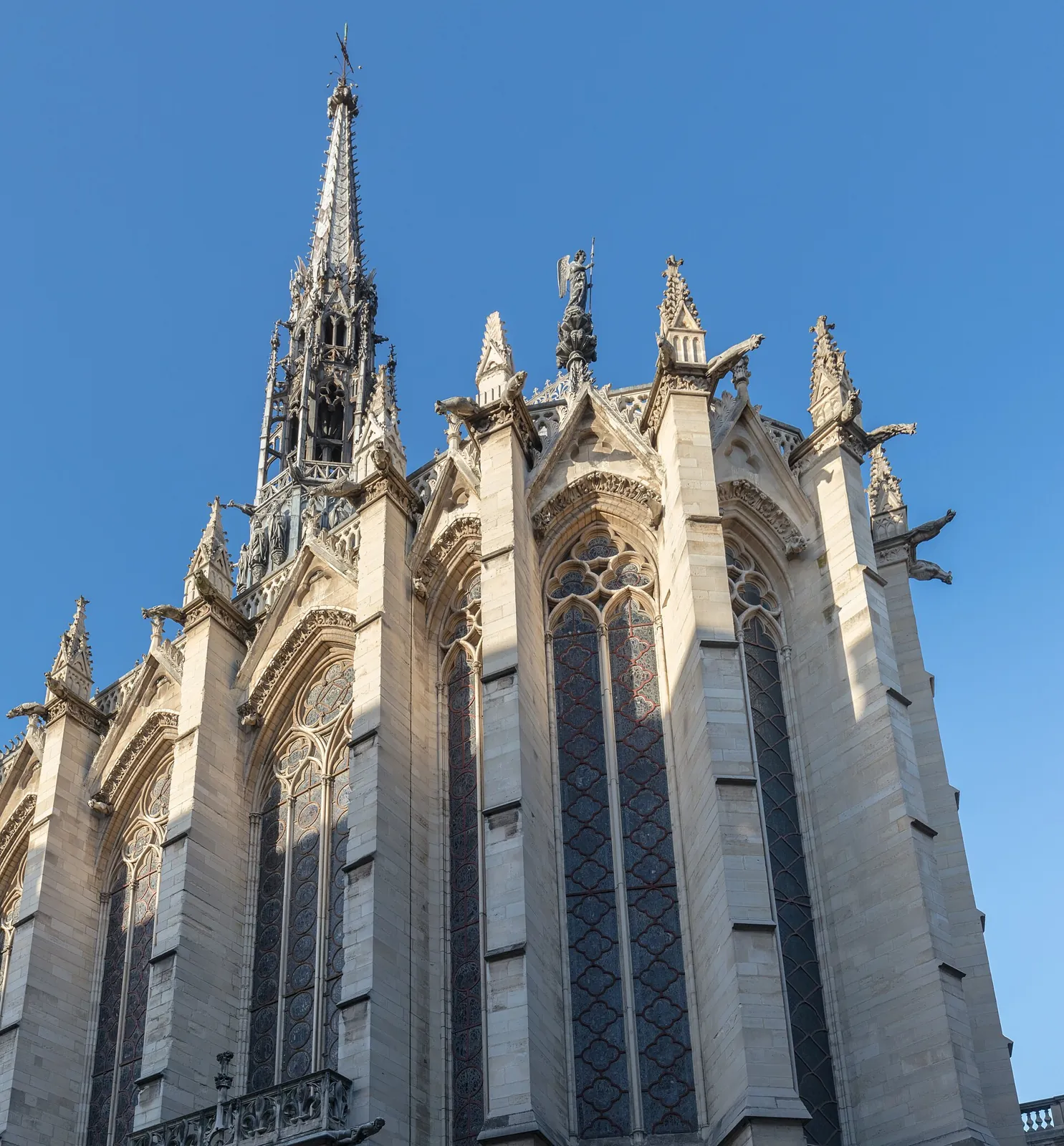
The chapel survived fires in 1630 and 1776, then served as a flour store and, from 1803 to 1838, as an archive for the law courts; windows were blocked and panels sold off, notably to England. Between 1840 and 1863 the architects Duban, Lassus and Boeswillwald brought back its 13th-century look, and the spire, the fifth the chapel has had, rising 75 metres above the ground, dates from that work. Restoration goes on: in early 2025 work began on the Ezekiel window, and the chapel stayed open.
Near the Sainte-Chapelle
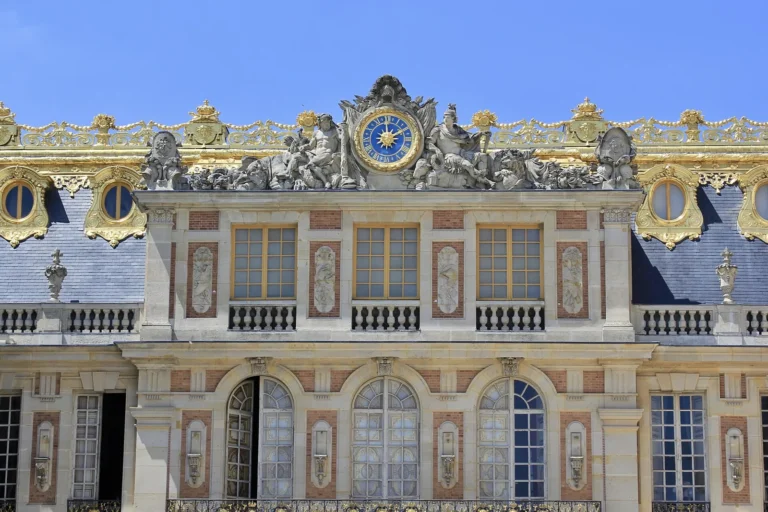
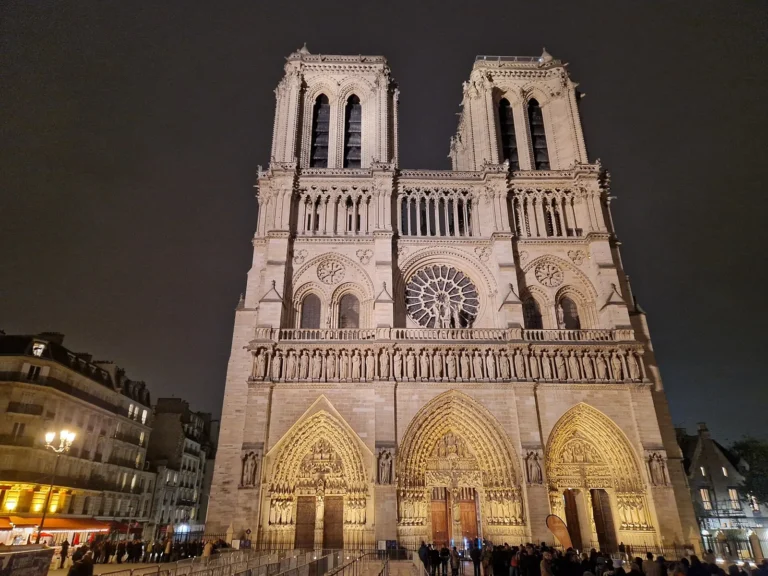
Notre-Dame de Paris is on the same island, and the Crown of Thorns went to its treasury in 1806. With a spare day, the Palace of Versailles is a train ride away. Both have a free audio guide, like the rest of our Paris audio guides.
 Free audio guideNotre-Dame de Paris
 Free audio guidePalace of Versailles
Where to find it
FAQs
How do the free audio guides work?
They play right here on audioguidetravel.com, with no app to download and no sign-up. Press play and listen as you walk round: a phone and a pair of headphones are all you need. The audio streams from this page, so you’ll need mobile data or Wi-Fi.
Can I take the tour at my own pace?
Of course! You set the pace: pause whenever you like, jump back or forward 15 seconds, or tap the bar to jump to any point, and listen as many times as you want so you don’t miss a thing.
If I'm in a group, can we use the same audio guide?
Yes. The same free audio guide opens on as many phones as you like, so you can go round together as a group or with your family, each person at their own pace and with their own headphones. The quickest way is to send the link via WhatsApp, Telegram or however you like: the buttons just below let you share it right now.
Visitor information
As of 30 Oct 2026- Opening hours
- Daily: 9:00-17:00 October to March and 9:00-19:00 April to September; last entry 30 min before closing.
- Tickets
- €22 for non-EEA visitors, €16 for EEA nationals and residents; with the Conciergerie €30 or €23.
- Time needed
- Audio guide about 4 min; book a time slot and allow for the security line.
- Getting there
- 10 boulevard du Palais, Île de la Cité. Metro 4 to Cité; RER B or C to Saint-Michel.
- Accessibility
- Ramp into the lower chapel; 33 steps up, or a lift with a staff member. Free with proof, plus one companion.
- Tip
- No cloakroom: sharp items, glass and large bags are confiscated at the door and not returned.
- Official website
- www.sainte-chapelle.fr
Nearby
More free audio guides in Paris
 5:02ParisPalace of Versailles: free audio guide, hours and ticketsThe Palace of Versailles was home to the French court from 1682 to 1789: the Royal Chapel, the…
 3:40ParisNotre-Dame de Paris: free audio guide, opening hours and towersNotre-Dame de Paris is the city’s great Gothic cathedral, on the Île de la Cité, begun in 1163…