Puerta de Alcalá, Madrid: free audio guide, history and how to get there
Free audio guide in English · no app, no sign-up
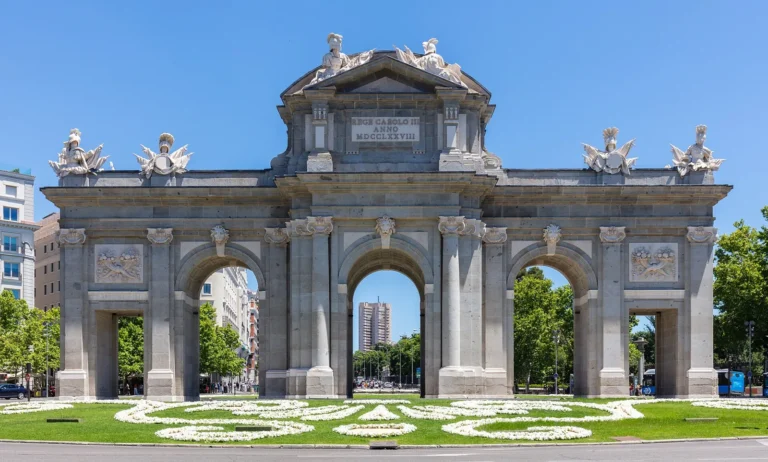
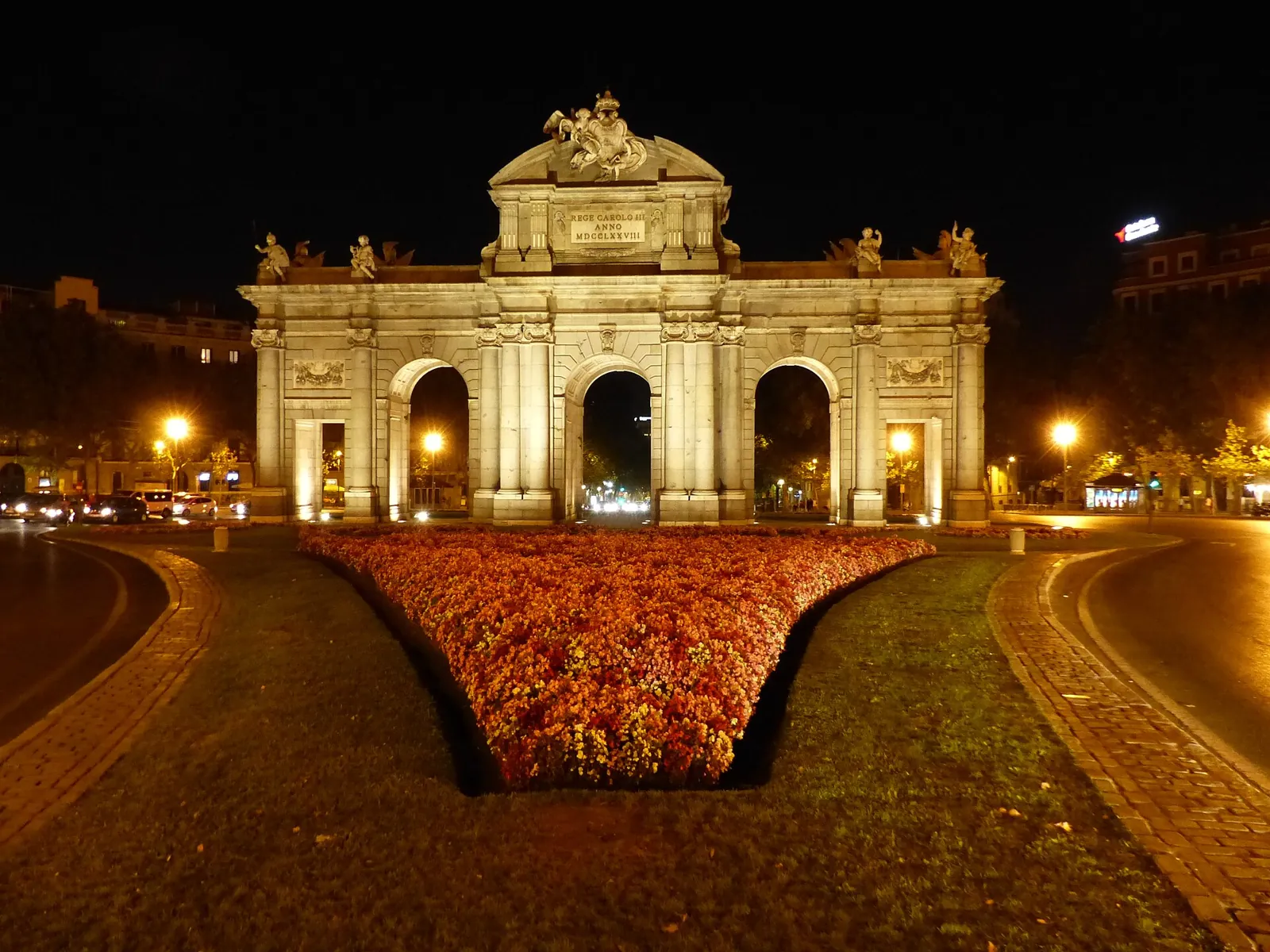
The Puerta de Alcalá, Madrid’s Alcalá Gate, is the granite triumphal arch that King Charles III built where the road from Alcalá de Henares entered the city: 5 openings, a design by Francesco Sabatini and the year 1778 spelt out in bronze at the top. It stands in the middle of Plaza de la Independencia, next to Retiro Park, and you can see it for free at any time. This free audio guide tells its story in about 3 minutes.
 Audio guide
Before you go in
The few things that change your visit.
- Open-air monument: free and visible at any time
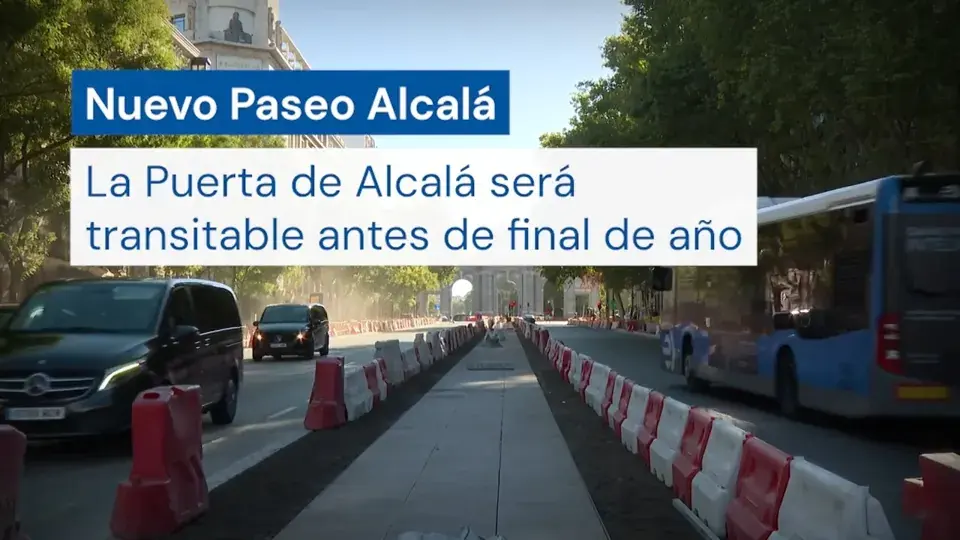
- Roadworks on Calle de Alcalá until the first quarter of 2027
- You will be able to walk through the gate before the end of 2026, says the City Council
- Finished in 1778 to a design by Francesco Sabatini
- 4 virtues on the outer side; military trophies on the inner side
- Metro Retiro or Banco de España (line 2)
On this page
- What the Puerta de Alcalá audio guide covers
- Puerta de Alcalá opening times, tickets and the 2026 works
- History: from the 1599 gate to Charles III's arch
- The 2 sides of the gate: what to look for
- Iron gates, a new square and an award-winning restoration
- How to get to the Puerta de Alcalá, and what is nearby
- Where to find it
The Puerta de Alcalá, Madrid’s Alcalá Gate, is the granite triumphal arch that King Charles III built where the road from Alcalá de Henares entered the city: 5 openings, a design by Francesco Sabatini and the year 1778 spelt out in bronze at the top. It stands in the middle of Plaza de la Independencia, next to Retiro Park, and you can see it for free at any time. This free audio guide tells its story in about 3 minutes.
What the Puerta de Alcalá audio guide covers
Press play on the pavement facing the side that looks towards Cibeles, then walk round the square with it on. The 2 sides of the gate are not the same, and the guide tells you what to look for on each. These are its stops:
| In front of the gate | Where the name comes from, and who ordered it built. |
| The gates before this one | Brick gates from 1599 and 1693, both closer to the centre. |
| The 1769 competition | Sabatini against Ventura Rodríguez and José de Hermosilla, and who won. |
| The side facing the city | Military trophies and lion heads. |
| The travellers’ side | The 4 virtues, the royal arms and a figure of Fame who has lost her trumpet. |
| The scars | Shrapnel from 1808, and the iron gates that shut it at night. |
| Last stop | A gate that will partly work as a gate again. |
Puerta de Alcalá opening times, tickets and the 2026 works
The Puerta de Alcalá is an open-air monument owned by the city, so there are no opening hours and no ticket: it is free to see at any time. It sits in the middle of Plaza de la Independencia, a busy roundabout, so you look at it from the pavements around the square. By day you can make out the carving; at night it is floodlit and looks completely different.
| Opening times | Outdoors, visible at any time. |
| Price | Free. |
| Address | Plaza de la Independencia, s/n, 28001 Madrid. |
| Time needed | The 3-minute audio guide plus a walk round the square. |
The best part of the project is in the middle. On 1 September 2026 the City Council announced that people will be able to walk through the Puerta de Alcalá before the end of the year: with the central promenade and the new crossings, the monument will partly get back its role as a gateway into the city. Here is the City Council’s own 1-minute video:
History: from the 1599 gate to Charles III’s arch
It takes its name from the road to Alcalá de Henares, and it was one of the 5 old royal gates into Madrid. The arch you see is not the first one. In 1599 an earlier gate, designed by the Italian painter Patricio Cajés, was put up for the arrival of Queen Margaret of Austria, wife of Philip III. It was made of brick, with 3 arches, and it stood further west, where Calle de Alcalá meets today’s Calle de Ruiz de Alarcón. In 1691 it was pulled down to widen the street, and in 1693 another brick gate with 3 arches went up a little further east, where Calle de Alfonso XI now meets Calle de Alcalá. That second gate was rebuilt in 1702 to welcome Maria Luisa of Savoy, wife of Philip V.
In 1764 Charles III had that second gate demolished to widen the street, and wanted a new gate to crown the Salón del Prado. In 1769 he held a competition between the 3 leading architects at court: Ventura Rodríguez sent in 5 proposals, José de Hermosilla 1, and Francesco Sabatini, a military engineer from Palermo, 2. Sabatini won. Money was short, so work only began in 1774, with 2,000,000 reales advanced by the city against its tax on taverns, and it was finished in 1778, the year in its inscription.
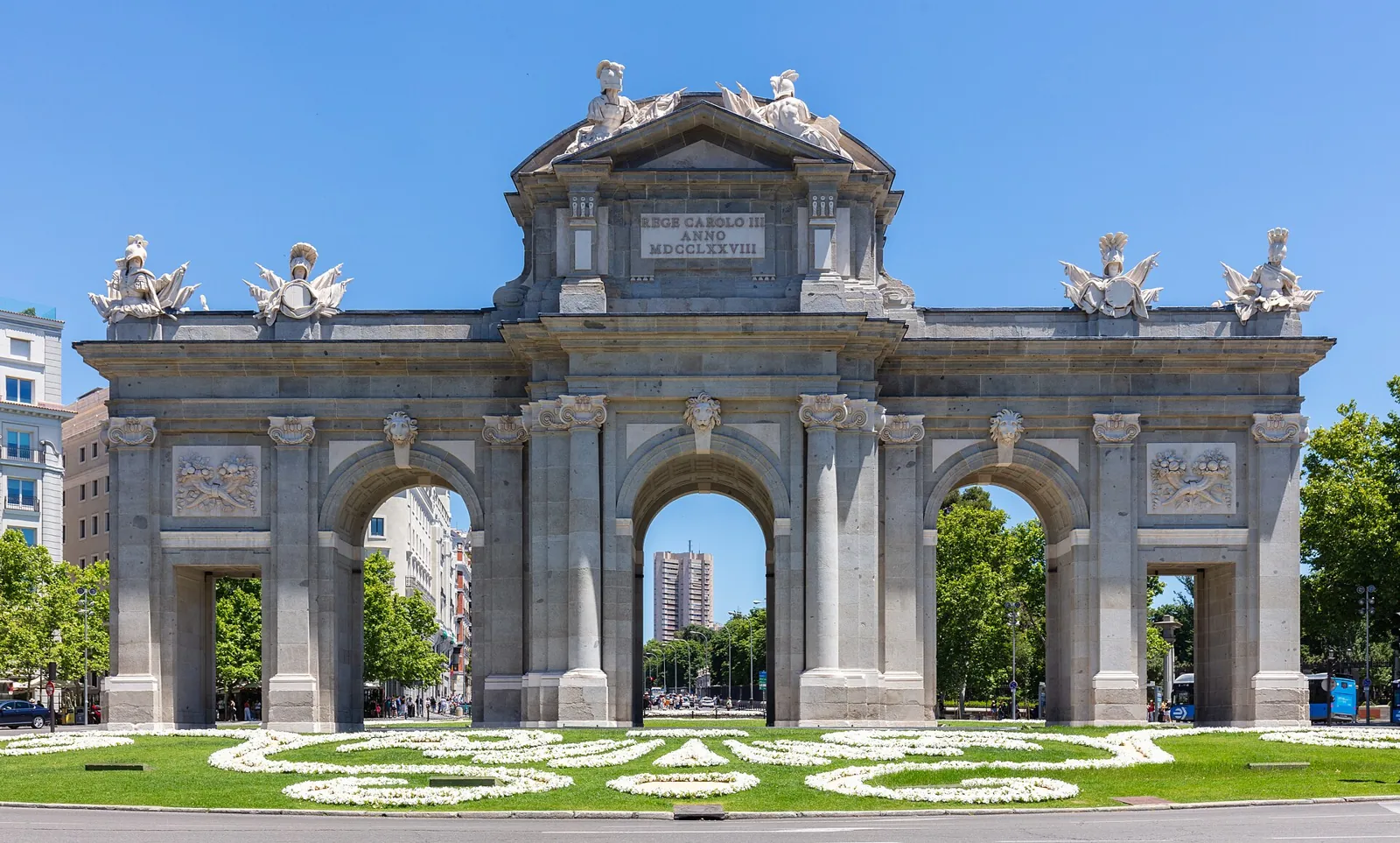
The result is a neoclassical triumphal arch with 5 openings, where the Toledo and San Vicente gates have 3: 3 round arches in the centre and 2 flat-topped openings at the ends. Madrid’s official tourist board presents it as the first triumphal arch built in Europe after the fall of the Roman Empire, a forerunner of the Arc de Triomphe in Paris and the Brandenburg Gate in Berlin.
The 2 sides of the gate: what to look for
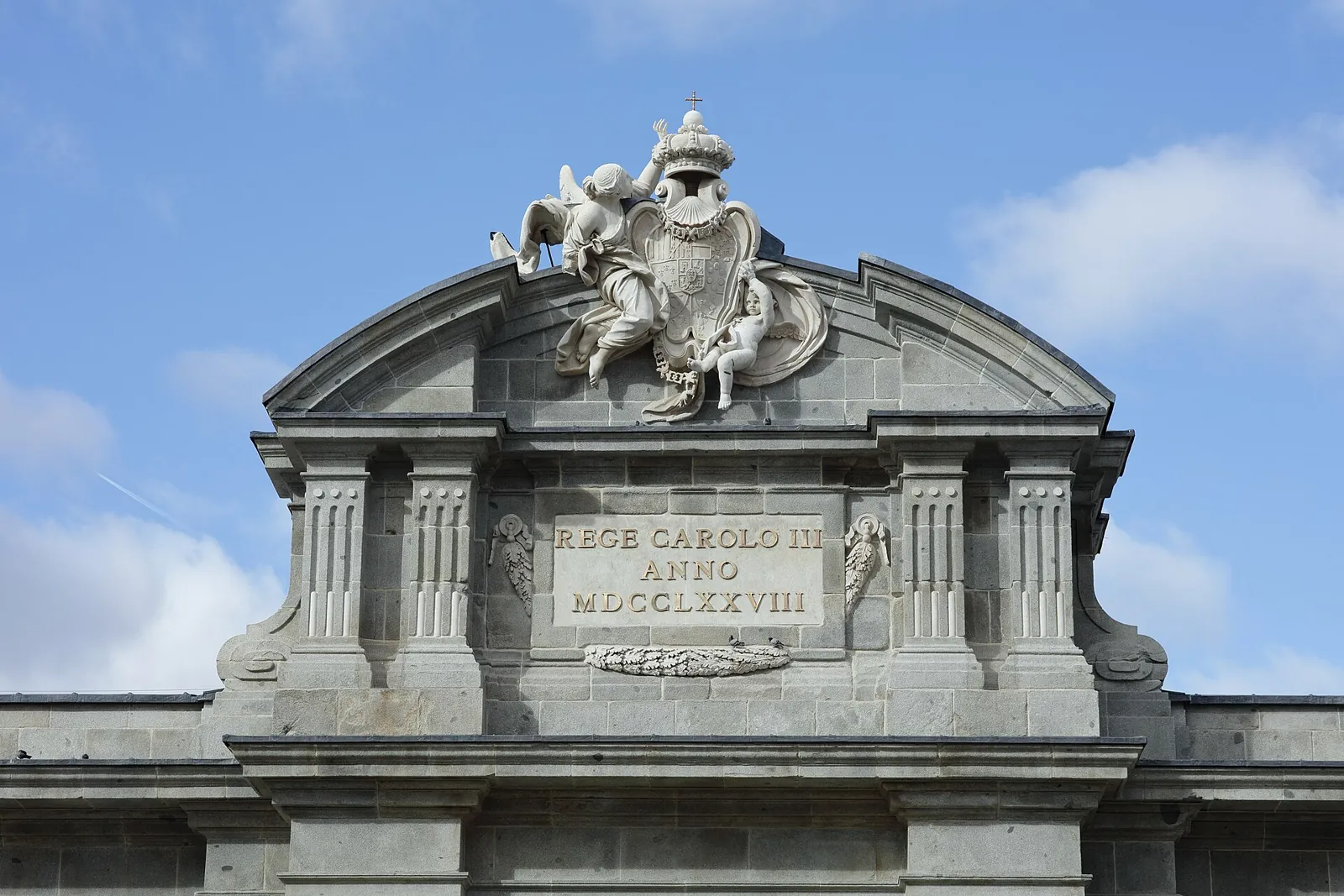
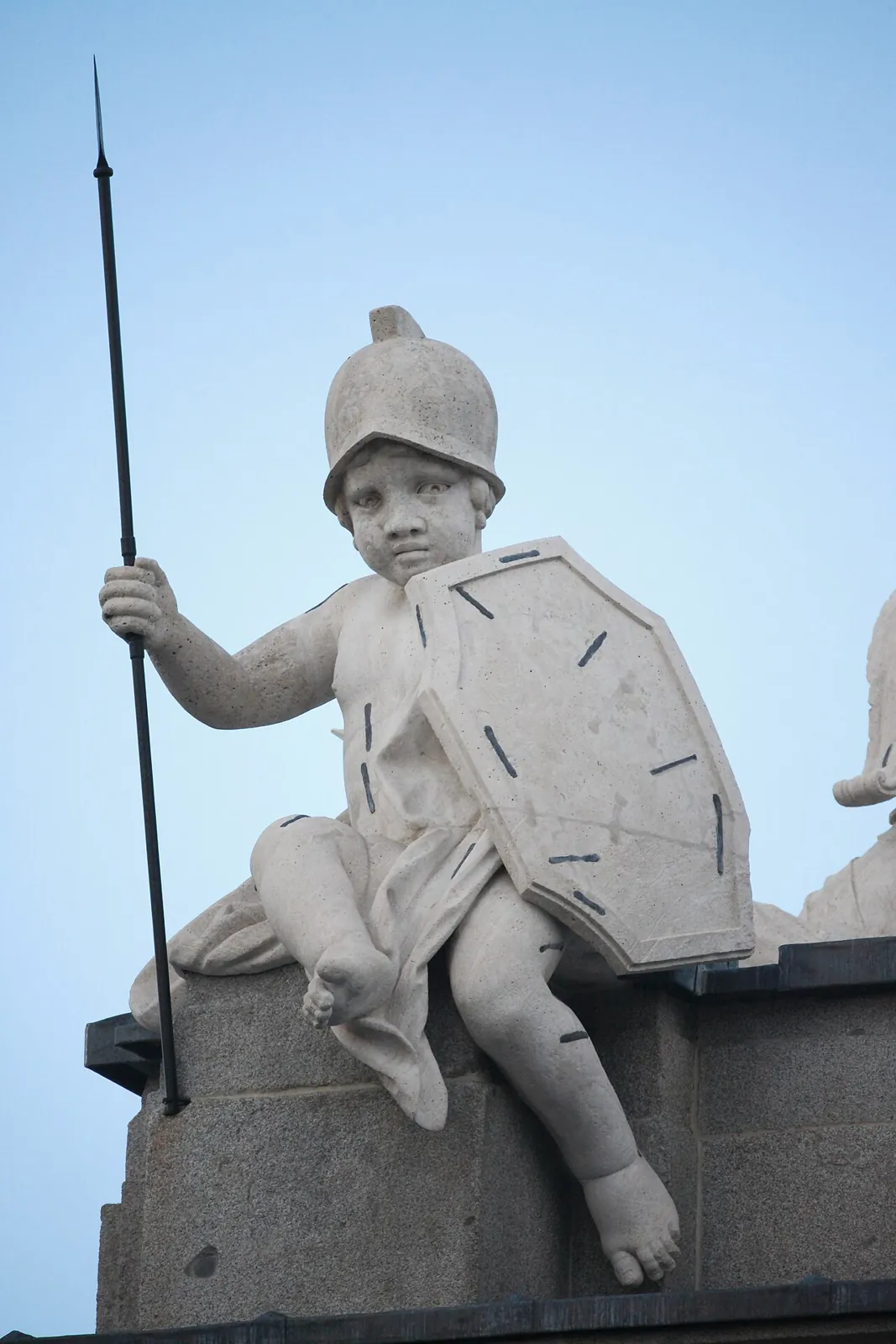
The outer side, facing the old road to Alcalá, is the richer one, because it was what travellers saw as they arrived in Madrid. Above the columns sit 4 children standing for the cardinal virtues. Fortitude has a shield, a helmet and an iron spear. Temperance holds a horse’s bit; the metal whip it once carried is gone. Justice, with the fasces, raises an arm that used to hold a sword, now lost too. And Prudence looks into a mirror while holding a snake. At the very top are the royal arms with a cherub and the winged figure of Fame, who has lost the right hand that held a metal trumpet.
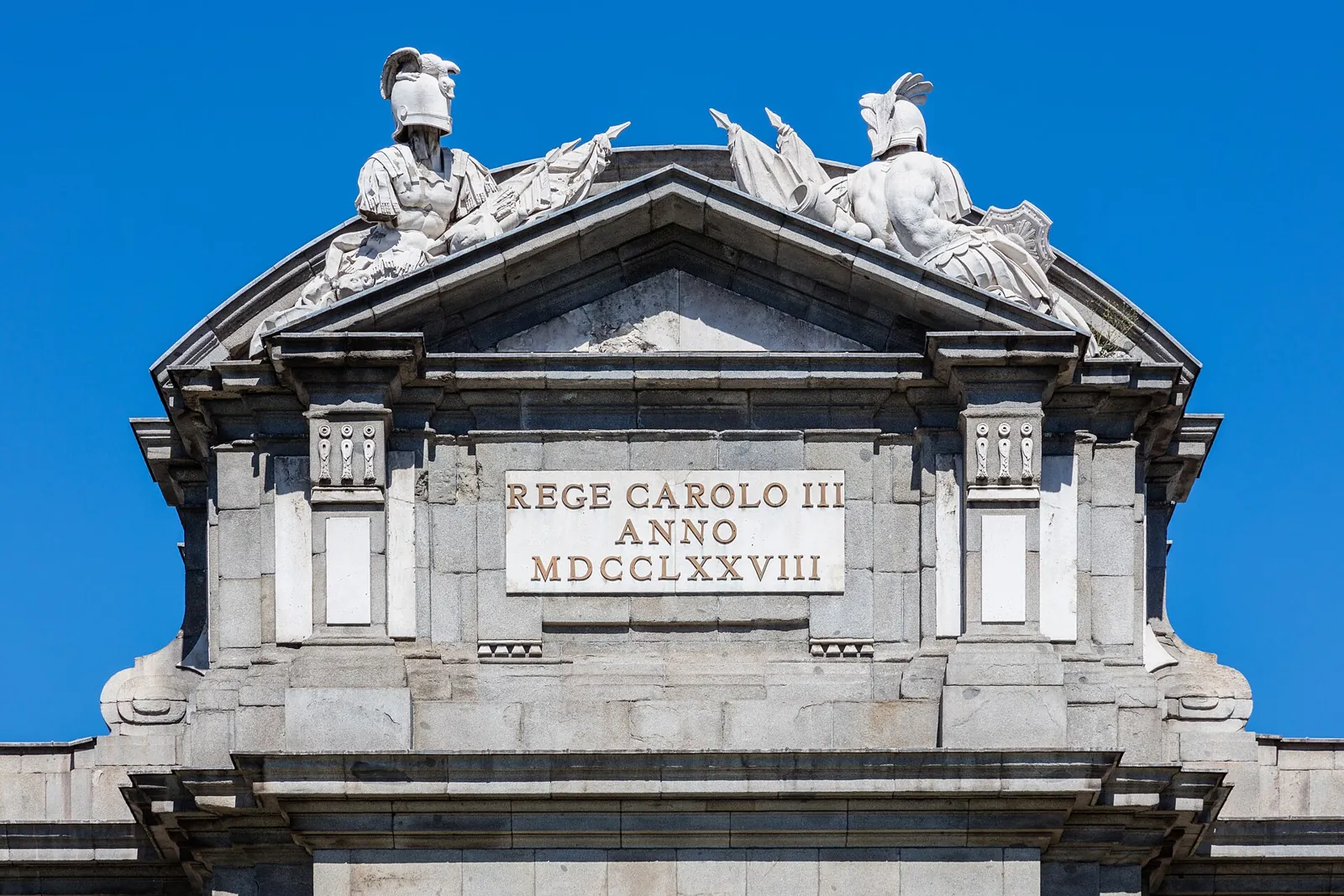
The inner side, which faced the city, is plainer. Instead of children it has Roman-style military trophies: breastplates, helmets, flags, drums, cannons, cannonballs and even an obelisk. That is Sabatini’s signature: he was a lieutenant colonel in the Corps of Engineers. The keystones of the arches carry lion heads, and the panels have horns of plenty. Both sides repeat the same inscription in bronze letters: REGE CAROLO III ANNO MDCCLXXVIII, “in the reign of Charles III, in the year 1778”.
The sculpture is by 2 of the king’s court sculptors. Francisco Gutiérrez carved the royal arms, Fame, the children and the trophies; Roberto Michel did the lion heads, the horns of plenty and the garlands. You can find the pair together again just down the street: Gutiérrez carved the goddess of the Cibeles Fountain, and Michel the lions pulling her chariot. The gate is built of granite from Segovia, with the finest details in limestone from Colmenar de Oreja. Its capitals follow the design Michelangelo drew in 1538 for the Capitoline palaces in Rome.
Iron gates, a new square and an award-winning restoration
Until the second half of the 19th century it was a working gate. It was part of the wall that had ringed Madrid since Philip IV, and it had wrought-iron gates that closed at 10pm in winter and 11pm in summer. They went with the wall when the city expansion approved in 1860 was carried out, and in 1869, at the suggestion of councillor Ángel Fernández de los Ríos, the round Plaza de la Independencia was laid out around it. Since then it has been what Sabatini drew: a free-standing triumphal arch.
In 1894 the architect Arturo Mélida proposed an equestrian statue of Charles III on its axis. It was never built, but his model was used for the statue of the king that has stood in the Puerta del Sol since 1995. The Puerta de Alcalá was declared a National Monument in 1976.
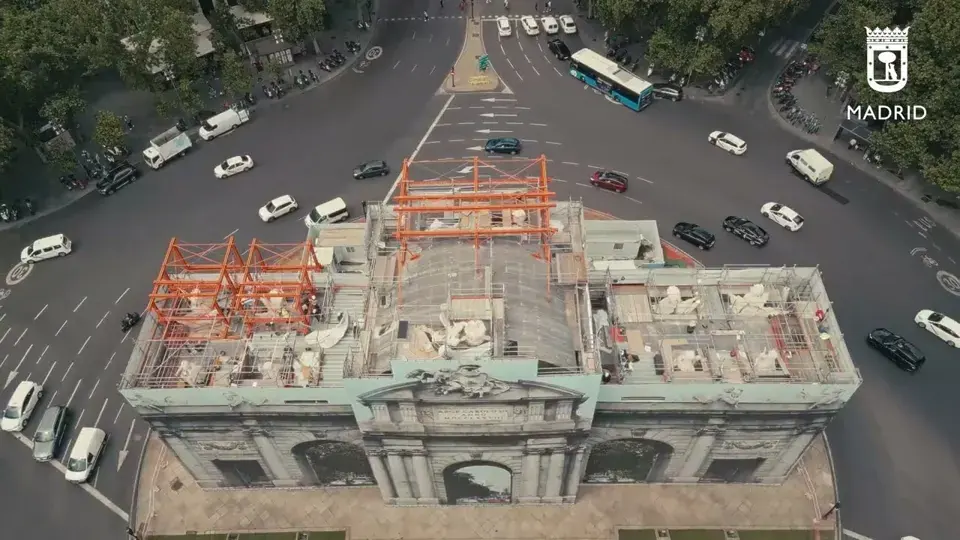
The latest major restoration was started by the City Council in 2022, with more than 100 specialists: conservators, architects, engineers, historians, stonemasons, blacksmiths and sculptors, combining traditional techniques with the latest technology. Through the Abierto por Restauración (“open for restoration”) programme, more than 12,000 people climbed the scaffolding to see it up close. In 2025 the work won a European Heritage Award / Europa Nostra Award and the Public Choice Award, after receiving the most votes in the Europe-wide poll. The gate is part of the Landscape of Light, a UNESCO World Heritage Site since 2021. Here is how the restoration was done:
How to get to the Puerta de Alcalá, and what is nearby
By metro, the nearest stations are Retiro and Banco de España, both on line 2. City buses 1, 2, 9, 15, 19, 20, 28, 51, 52, 74 and 146 stop nearby, among others, and the closest Cercanías commuter-train station is Recoletos. If you use the BiciMAD bike-share, there are docks on Calle Valenzuela 3, Calle Serrano 8 and Calle Alcalá 95. Calle de Alcalá, Calle Alfonso XII and Calle Serrano all meet at the square, and the entrance to Retiro Park is right next to it. Plaza de Cibeles is a short walk down Calle de Alcalá.
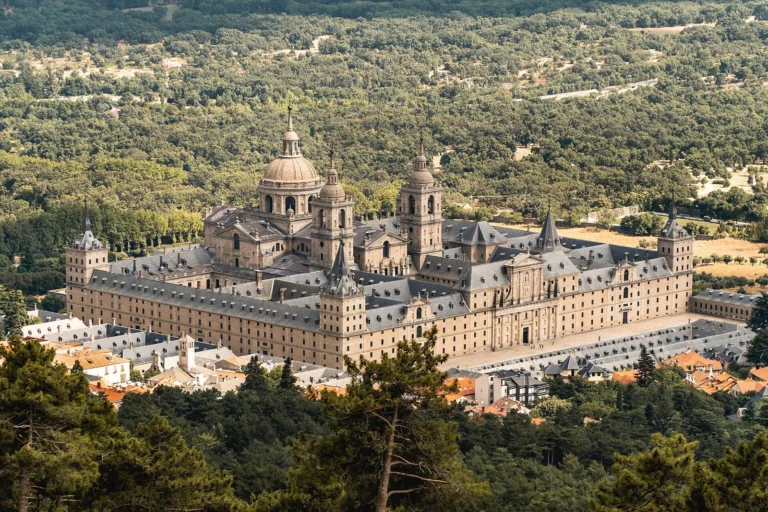
If you have a day to spare, the El Escorial Monastery, Philip II’s palace and royal burial vault, is about 43 km north-west: buses 661 and 664 leave from the Moncloa interchange, and Cercanías commuter line C-8a stops in the town below. It opens Tuesday to Sunday, and a standard ticket costs €14 (October 2026):
 Free audio guideEl Escorial Monastery
For another great Spanish monument with its own free audio guide, head north-west to Galicia:
 Free audio guideSantiago de Compostela Cathedral
Find all our audio guides for the country under Spain.
Where to find it
FAQs
How do the free audio guides work?
Our audio guides work through the website audioguidetravel.com; you don’t need to download any app. Just follow the instructions on the website to guide you through Puerta de Alcalá, Madrid: free audio guide, history and how to get there while listening to our experts’ explanations.
Can I take the tour at my own pace?
Of course! Our free audio guides are designed so that you set the pace. You can pause, rewind, or listen as many times as you want without missing a detail. By visiting Puerta de Alcalá, Madrid: free audio guide, history and how to get there your way, you’ll enjoy it even more.
If I'm in a group, can we use the same audio guide?
Yes, our website allows sharing the same free audio guide among multiple devices. This way, you can visit Puerta de Alcalá, Madrid: free audio guide, history and how to get there as a group or family, listening to the explanations simultaneously. The quickest way to do this is to share the link via WhatsApp, email, or any method you like. I’ve included some buttons below for you to do that now.
Visitor information
As of 2 Oct 2026- Opening hours
- Outdoors, visible at any time, every day.
- Tickets
- Free: it is an open-air monument with no ticket.
- Time needed
- About a 3-minute audio guide in front of the gate, plus a walk round the square to see both sides.
- Getting there
- Metro Retiro or Banco de España (line 2); buses 1, 2, 9, 15, 19, 20, 28, 51, 52, 74 and 146.
- Accessibility
- Seen from the pavements around the square; the 2026 works move the pedestrian crossings.
- Tip
- Walk round it: the virtues and royal arms are on the outer side, the trophies on the side facing Cibeles.
- Official website
- www.esmadrid.com