
This free audio guide to the Ancient Agora of Athens plays straight from your phone — no app, no sign-up — while you walk the site. It tells you which gate is open while the main entrance is rebuilt, where the 50 men who ran Athens by rota ate and 17 of them slept every night, and why the Temple of Hephaestus is still roofed when everything around it is foundations. Press play at the gate.
 Audio guide
Before you go in
The few things that change your visit.
- Entry and exit are through the Thiseio Square gate, not Adrianou 24, since 1 July 2025
- Between 16 and 30 September it closes at 18:30, last entry 18:00, and the closing time steps back again on 1 and 16 October
- €20.00 covers the site and its museum — and from outside the EU you pay it in full from age 18
- The upper floor of the Stoa of Attalos and the Church of the Holy Apostles have been closed since 1 November 2025
- Free entry on Saturday 26 and Sunday 27 September 2026, with tickets at the counters only
On this page
- What the audio guide tells you
- The gate that is open: Thiseio Square, not Adrianou 24
- Ancient Agora or Roman Agora? Two sites, two tickets
- Opening hours, fortnight by fortnight
- Tickets: what you pay, and who pays less
- The Temple of Hephaestus, whole on the hill
- The Stoa of Attalos and the museum inside the site
- Where the democracy actually worked: the Tholos and the Bouleuterion
- The giants, the church and 25 centuries on the same ground
- How long to allow, and when to go
- Nearby, with their own free audio guides
- Tickets and prices
- Where to find it
- FAQs
The Ancient Agora of Athens was the city’s public square: its market, its council chambers, its law courts and its meeting ground, on the flat land below the Acropolis. Inside the fence stand the Temple of Hephaestus, still whole, and the Stoa of Attalos, which houses the site museum. Entry is €20.00, and while the main gate is being rebuilt you go in from Thiseio Square.
This page is the free audio guide, plus the practical detail checked on 17 September 2026 against the Ministry of Culture’s own listing for the site and the Greek state ticket office: the gate that is open, the time it closes this fortnight, and who pays less than €20.00.

What the audio guide tells you
It is free, it plays in your phone’s browser, and there is no app to install and no sign-up. Press play at the gate: the route runs along the Panathenaic Way from north to south, and it leaves the climb to the temple for the end, when you already know what you are looking down on.
| The Thiseio Square gate | Which door is in use, and why it pays to do the flat ground first and climb last. |
| The Panathenaic Way | The road that cuts diagonally across the square, the one the procession for Athena climbed to the Acropolis. |
| The Stoa of Attalos | The 2-storey arcade a king of Pergamon paid for, rebuilt from the foundations up in the 1950s as the site museum. |
| The Tholos and the Bouleuterion | The round building where the 50 men on duty ate and 17 of them slept, next to the council’s hall. |
| The Monument of the Eponymous Heroes | The base of 10 bronze statues that worked as the city’s noticeboard: call-up lists, draft laws, summonses. |
| The giants of the Odeon of Agrippa | The 3 carved pillars in the middle of the site, and the building they are the last piece of. |
| The Church of the Holy Apostles | The only medieval building left inside the Agora, and what stood here between antiquity and the digs. |
| The Temple of Hephaestus | The climb, why this temple is still roofed when the rest is foundations, and what its carved panels say. |
The gate that is open: Thiseio Square, not Adrianou 24
The site’s address is Adrianou 24, and that is where the main entrance stands. It is being rebuilt: the Ministry of Culture’s listing for the site states that from 1 July 2025, and until the redevelopment works are finished, visitors enter and leave through the archaeological site gate on Thiseio Square — Jacqueline de Romilly Square, beside Thiseio station. Checked again on 17 September 2026.
That changes where your visit starts: the Thiseio gate puts you on the west side, at the foot of the temple hill. Go down into the flat ground first, walk it, and save the climb for last.
Getting there: metro Thiseio (line 1) is about 5 minutes’ walk from that gate, and Monastiraki (lines 1 and 3) about 11. Buses 025 and 026 stop at Monastiraki.
Accessibility, from the official listings: both floors of the Stoa of Attalos are wheelchair accessible and there is a lift, which the wardens operate on request, and the information desk has tactile plans and braille leaflets in English and Greek. To reach the Temple of Hephaestus area by wheelchair you use the Thiseio Square gate, off Apostolou Pavlou street, ringing ahead on +30 210 3214824.
Ancient Agora or Roman Agora? Two sites, two tickets
Athens has 2 agoras, and they are 2 separate enclosures about 5 minutes’ walk apart, each with its own gate and its own ticket. This one — officially Ancient Agora of Athens – Areios Pagos — is the classical one, and it costs €20.00. The Roman Agora, off Dioskouron street in Plaka, is the later market square around the Tower of the Winds, and it costs €10.00.
The Temple of Hephaestus is inside this site: it has no gate, no ticket and no hours of its own, and you climb to it with the same €20.00 ticket that gets you through the fence. The Acropolis is a third site again, up the slope, with its own €30.00 ticket.
Opening hours, fortnight by fortnight
Between 16 and 30 September the site is open 08:00 to 18:30, and the last entry is at 18:00. Autumn here is not one long season: the closing time steps back every fortnight, so the hour to check is the hour for the date you are going.
| Dates | Open | Last entry |
| 1 April – 31 August | 08:00 – 19:30 | 19:00 |
| 1 – 15 September | 08:00 – 19:00 | 18:30 |
| 16 – 30 September | 08:00 – 18:30 | 18:00 |
| 1 – 15 October | 08:00 – 18:00 | 17:30 |
| 16 – 31 October | 08:00 – 17:30 | 17:00 |
| 1 November – 31 March | 08:00 – 17:00 | 16:40 |
It is closed on 1 January, 25 March, 1 May, Easter Sunday and 25 and 26 December; on Good Friday it opens 12:00 to 17:00 and on Holy Saturday 08:30 to 15:30. And if you are coming for the museum rather than the ruins: the museum in the Stoa of Attalos opens at 10:00 on Tuesdays, 2 hours after the gate. Hours checked on 17 September 2026 against the official visitor site and the Ministry’s listing.
Tickets: what you pay, and who pays less
The full ticket is €20.00 and the reduced one €10.00, the price charged today by the state ticket office. That one ticket covers the archaeological site and its museum, which stands inside the fence: the museum’s own listing puts it plainly — the museum ticket is one and the same as the site ticket. Nothing inside is charged separately.
Buy online and the ticket carries a time slot. It can be changed up to 2 hours before the visit and up to 2 times, and the money is not refunded.
Who pays less is worth reading closely if you are travelling from outside the EU, because age alone does not do it. Entry is free for under-18s from any country, on an ID card or passport, and free for 18 to 25-year-olds from Greece and the EU. People with a disability of 67 % or more, and one companion, enter free. The €10.00 reduced ticket goes to over-65s from Greece and the EU, and only between 1 October and 31 May; it also goes to teachers accompanying school visits and to parents accompanying EU primary-school groups. Read the other way round: a visitor from the United States, the United Kingdom, Canada or Australia pays the full €20.00 at any age from 18 upwards, and a 22-year-old from outside the EU pays it too.
There are days when everybody walks in free, and one of them is about to land: 6 March, 18 April, 18 May, the last weekend of September — which in 2026 means Saturday 26 and Sunday 27 September, for the European Heritage Days — and 28 October. From 1 November to 31 March the first and third Sunday of each month are free as well. On free days the ticket office states that tickets are issued only at the counters: there is nothing to book online, so come for the 08:00 opening rather than at midday.

The Temple of Hephaestus, whole on the hill
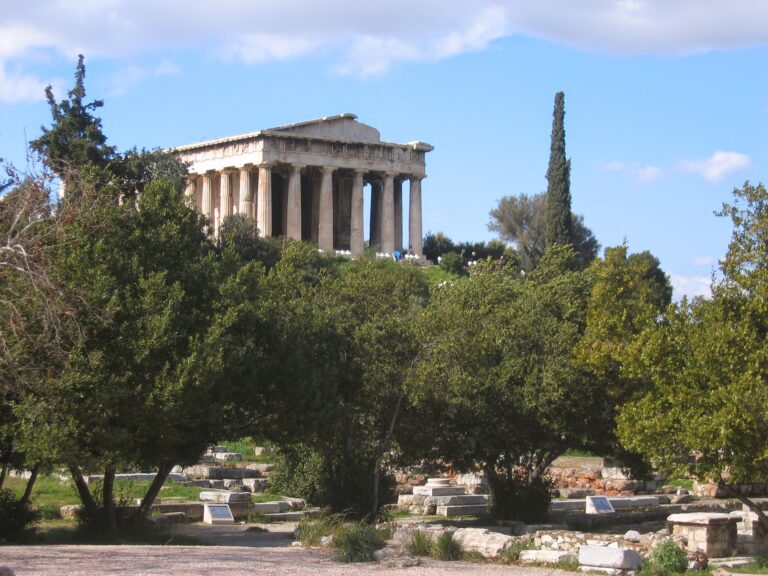
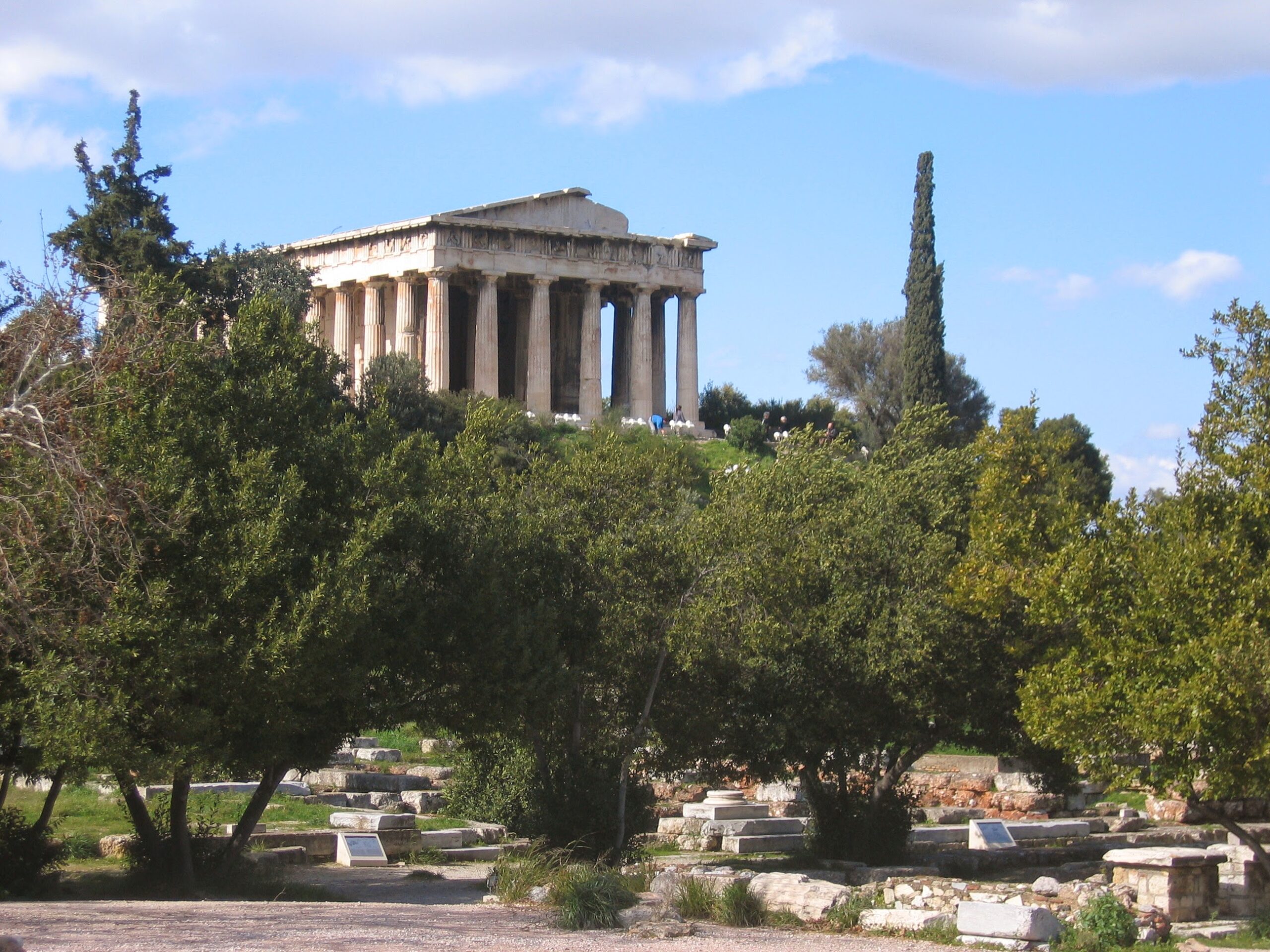
It stands on top of Agoraios Kolonos, the hill that closes the Agora on its western side, and you have to climb to it. The Ministry’s listing for the monument dates it between 460 and 420 BC and says it was raised by an architect still unknown, to whom other temples of similar structure in Attica are attributed.
It was a temple to 2 deities at once: Hephaestus, god of fire and patron of metalworkers, and Athena Ergane, patron of potters and craft. Pausanias described them worshipped together here (1, 14, 5-6), and the excavation settled it in the best way available — metalworking workshops came out of the ground all round the hill.
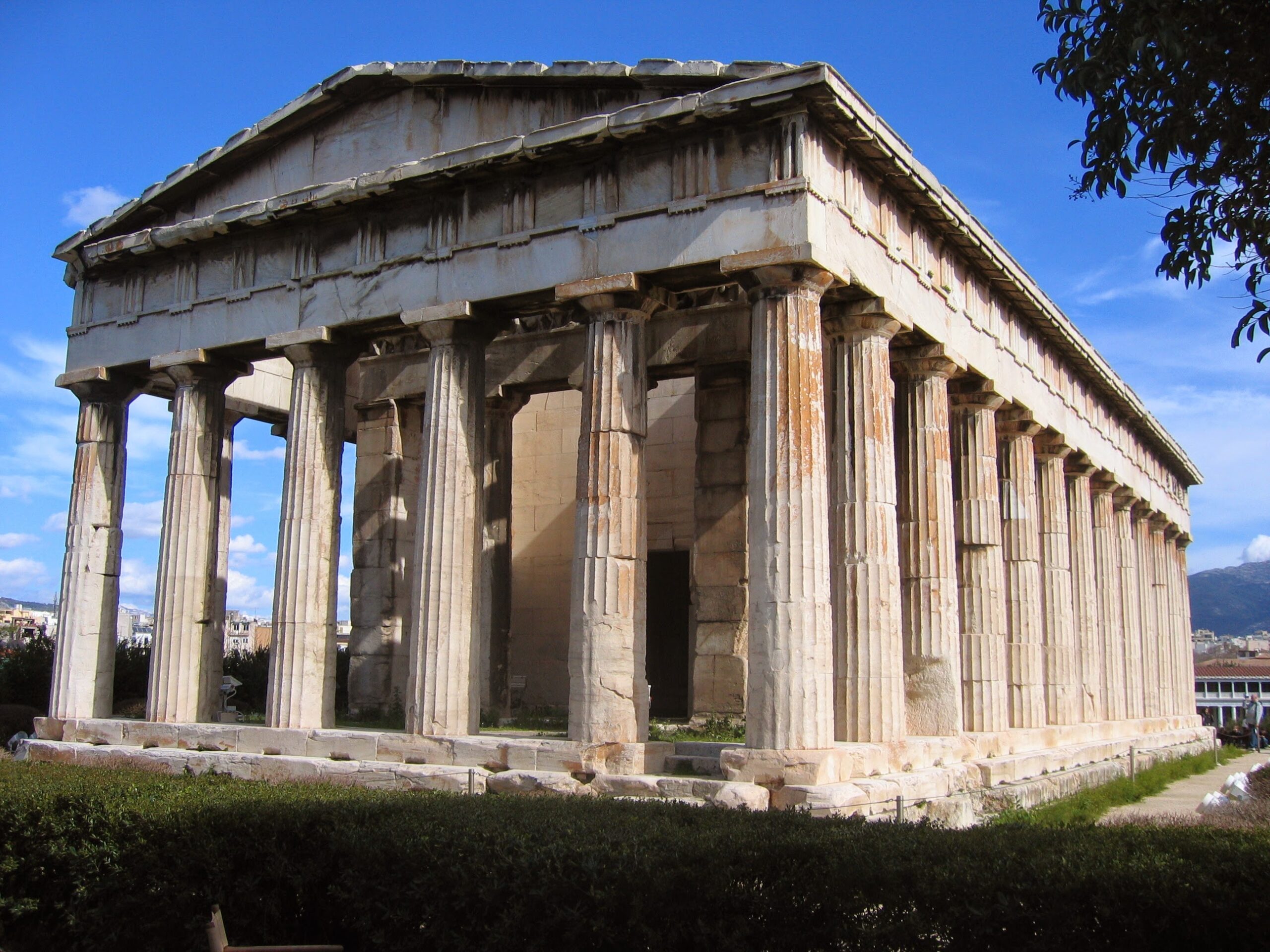
The building is Doric, with 6 columns on the short sides and 13 on the long ones: 34 around the perimeter, all of it Pentelic marble from the steps to the roof, with the sculpture in Parian. Inside, at the far end, is the pedestal that carried the bronze statues of the 2 gods by Alkamenes, made between 421 and 415 BC.
The carved panels explain the temple’s other name: the 10 metopes facing the Agora tell 9 labours of Herakles, and on the north and south sides there are 4 deeds of Theseus — which is where Theseion comes from. It is still standing for one very practical reason: in the 7th century it became the church of St George Akamates and stayed in use as a church until Greek independence. A building with a use is a building nobody quarries for lime. It was restored between 1972 and 1975, and the roof repaired in 1978.

The Stoa of Attalos and the museum inside the site
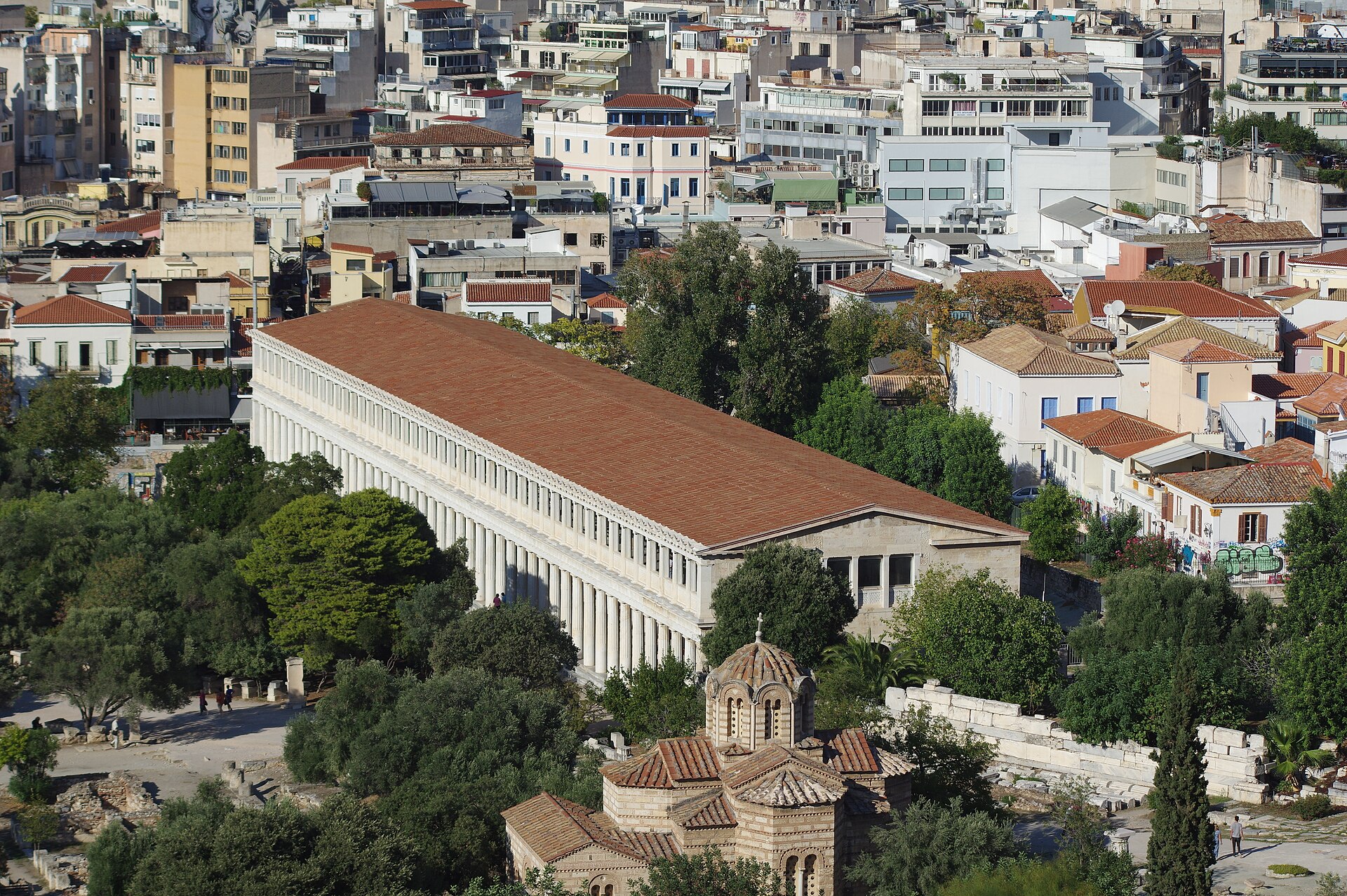
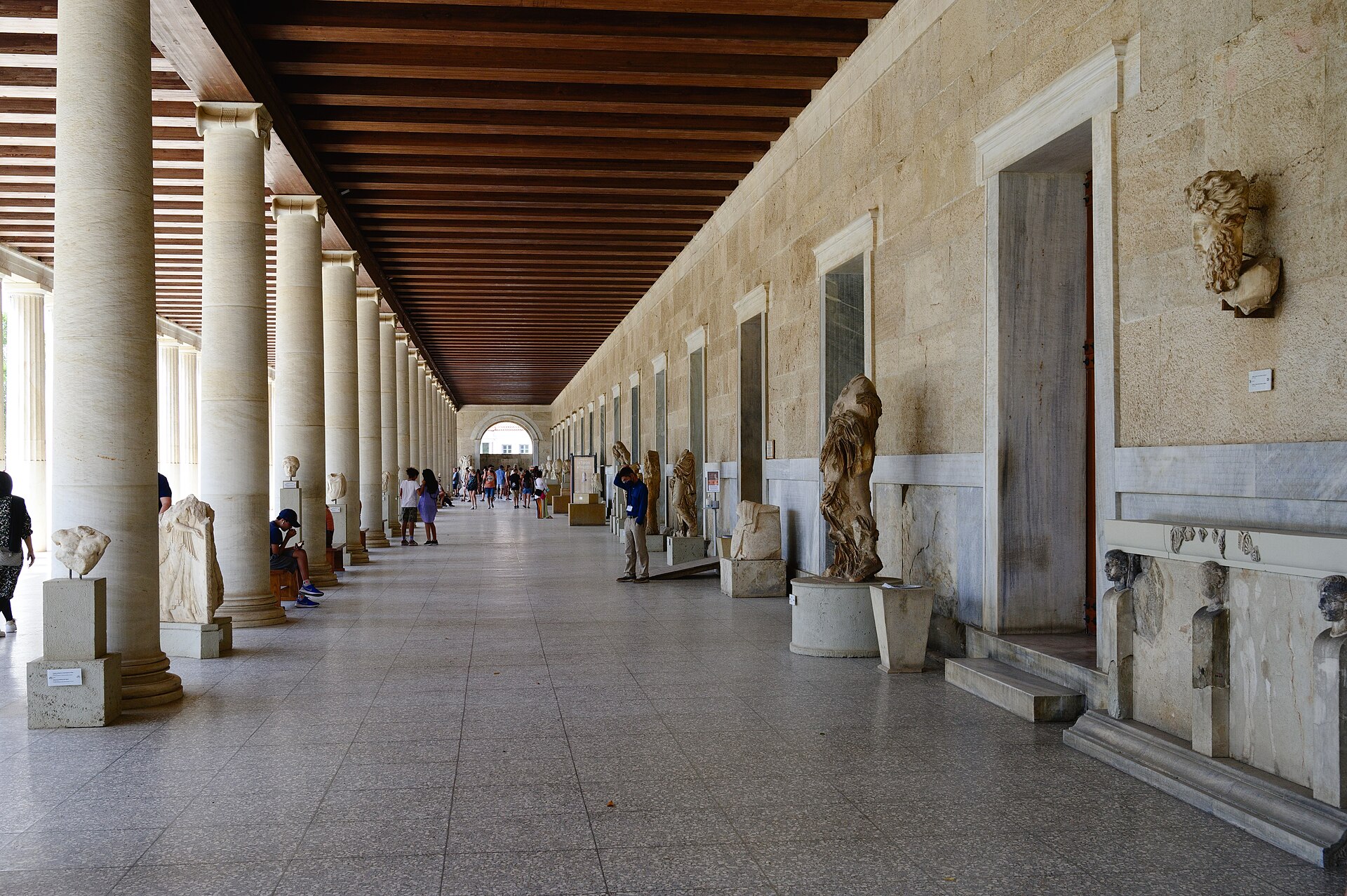
The Stoa of Attalos went up between 159 and 138 BC, a gift from Attalos II, king of Pergamon — the Ministry describes it as a king’s donation “to the cradle of philosophy”. It was 120 m wide and 20 m deep, with 2 floors and 21 shops at the back of each, and part of the dedication survives on the lower architrave: “King Attalos, son of Attalos and Queen Apollonis”. The Herulians brought it down in 267 AD and its blocks ended up built into the Late Roman wall.
What you see today is not a ruin, and it is not the ancient building either. It is a reconstruction: designed from the studies of the architect Yannis Travlos, built between 1953 and 1956 by the American School of Classical Studies with John D. Rockefeller, Jr.‘s money, so that the site would have a museum on its own ground. The Greek State took it over in 1957.
Inside is the reason to go in even on a hot day: the hardware of the democracy, dug out of the square outside. Official clay measures and bronze weights. A marble fragment of a kleroterion, the machine that drew jurors by lot. The bronze identity tickets jurors carried, the clay water clock that timed the speeches, the bronze ballots they voted with, and potsherds with the names of 5th-century politicians scratched on them — the ballots of ostracism. And a marble stele carrying the law against tyranny that the Athenians passed in 336 BC, with a relief of the People of Athens being crowned by Democracy.
Two things are shut at the moment, and it is better to know before you plan the visit round them: since 1 November 2025 the display on the upper floor of the Stoa and the Church of the Holy Apostles are closed to the public. What is open is the ground-floor gallery, the portico between the columns, where the sculpture and most of the cases are; the church you see from outside, which is where its interest is anyway.
,_gallery,_225206.jpg)
Where the democracy actually worked: the Tholos and the Bouleuterion
The most interesting part of the Agora is the part that shows worst, because only the foundations are left. Along the west side stood the buildings where Athens was actually run.
The Bouleuterion was the hall of the Boule, the council of 500 citizens: 50 from each of the 10 tribes, drawn by lot and replaced every year. It prepared the business — the motions that the assembly of all citizens then voted on. That assembly met on the Pnyx, the hill a few minutes west of this fence; what happened on this ground was the council work, the courts, the archives and the trade.
Next to it, the Tholos of 470 BC is the round building with 6 columns inside, and it holds the hardest idea in Athenian democracy to believe. The 50 prytaneis, the council’s executive committee, had their seat here for their turn of 35 or 36 days. They ate here, and 17 of them — a third — slept inside every night, so that the city was never, at any hour, without someone answerable on duty. When the turn ended another tribe took over, and by the end of the year all 10 had governed. The state’s official weights and measures were kept in the same building.
Opposite stood the Monument of the Eponymous Heroes, from about 350 BC: a long base carrying the 10 bronze statues of the heroes the tribes were named after, and the city’s noticeboard. Under your own tribe’s statue went the call-up lists, the draft laws and the summonses — if you wanted to know whether you were going to war, you came here and read. Next along is the Metroon, from the 2nd century BC, sanctuary of the Mother of the Gods and city archive at once.
The giants, the church and 25 centuries on the same ground
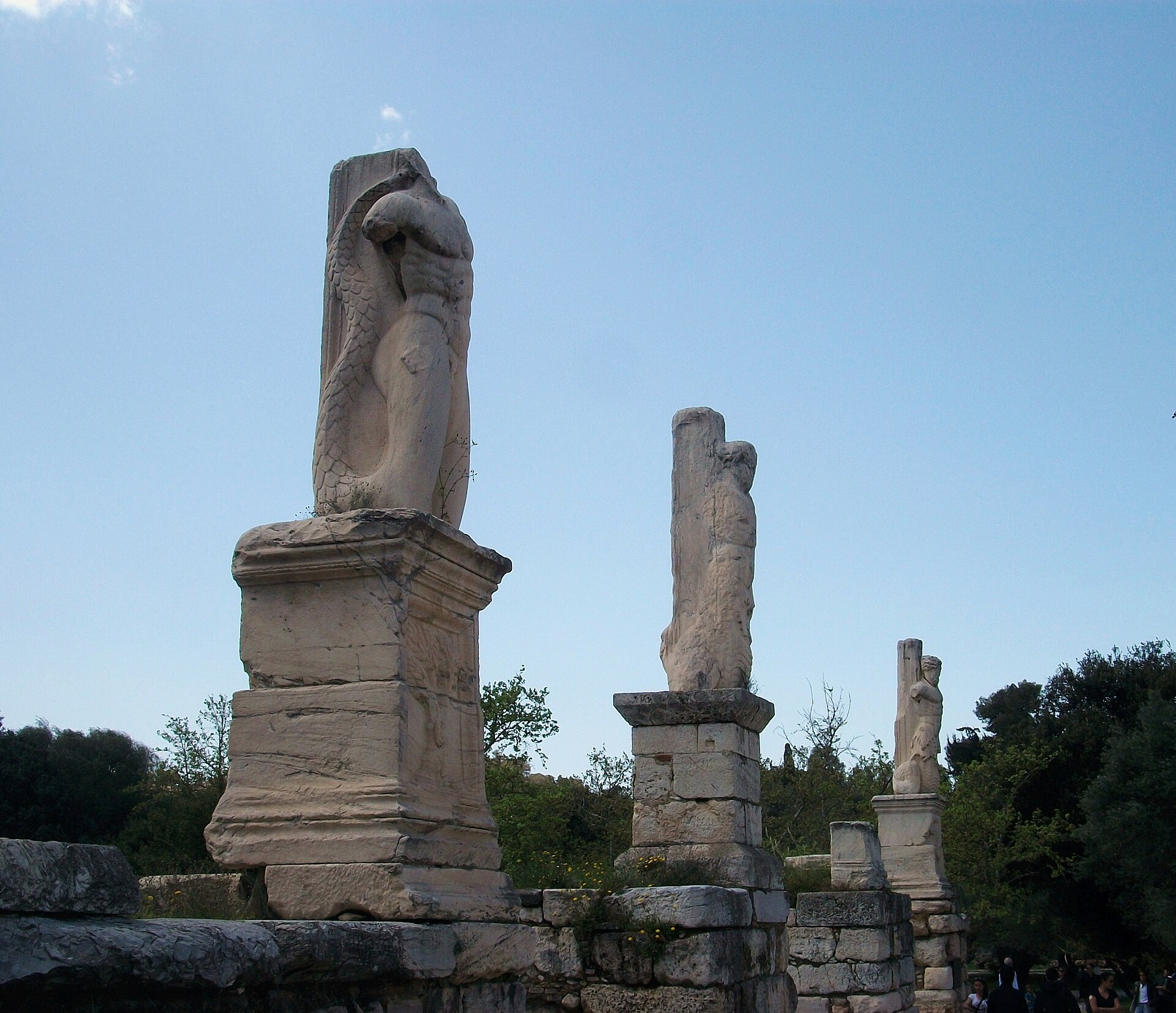
In the middle of the site stand 3 colossal carved pillars: giants with serpent tails and tritons with fish tails. They are what is left of a monumental façade raised over the ruins of the Odeon of Agrippa, the concert hall that Marcus Vipsanius Agrippa gave the Athenians around 15 BC and which filled the northern half of the old square.
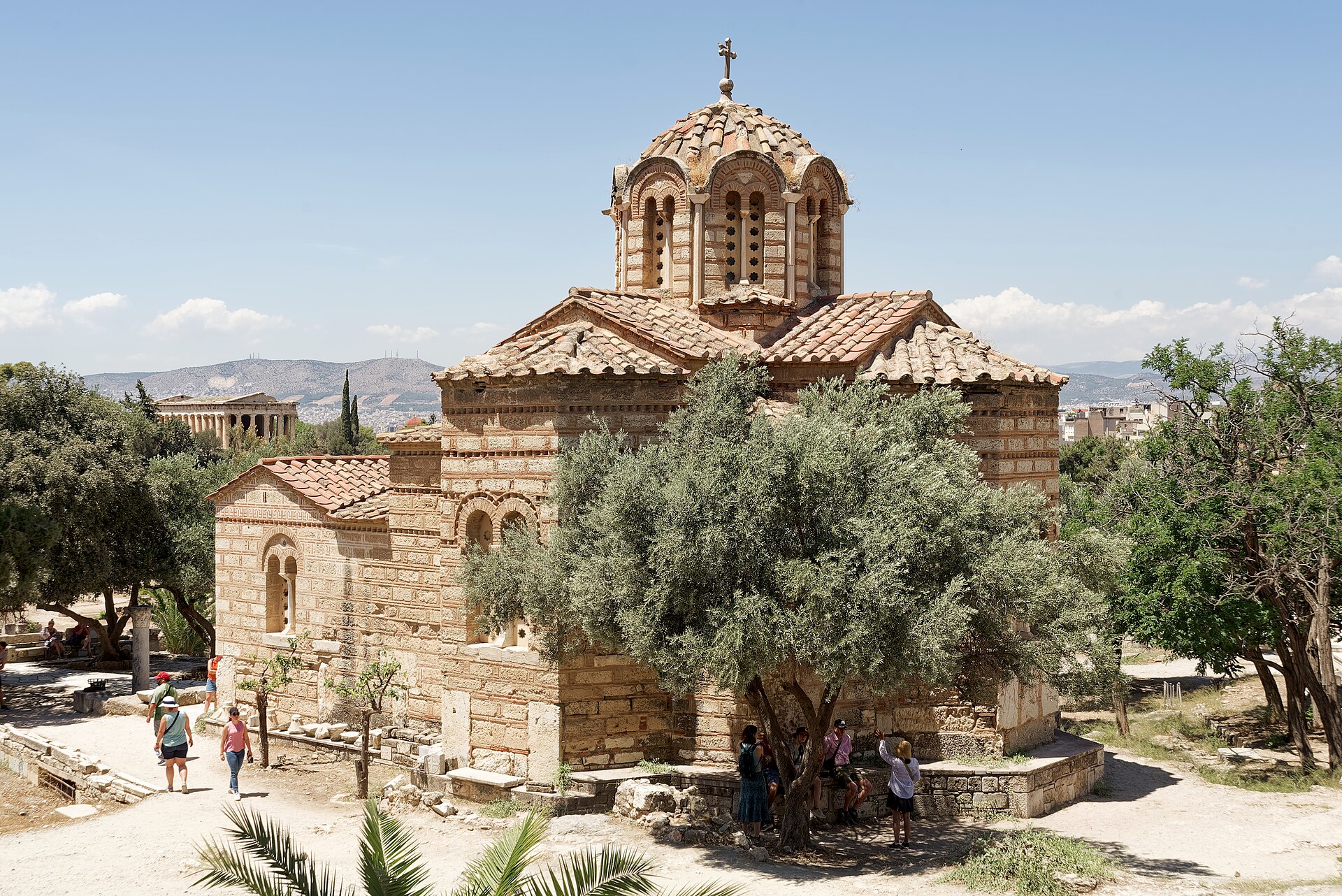
The Church of the Holy Apostles was built shortly before the year 1000, resting in part on a Roman nymphaeum of the 2nd century AD, and it is the only medieval monument surviving inside the Agora: an inscribed-cross plan with apses on all 4 sides, a dome on 4 columns, and an outside skin of worked ceramic with the “Kufic” motifs named after the Arabic script of the city of Kufa. It was restored to its original form between 1954 and 1957.
Why is it the only one? Because for centuries there was a neighbourhood here, and to uncover the Agora about 400 modern buildings across some 12 hectares had to come down. What is underneath goes back further than the square: Mycenaean and Iron Age graves, and traces of occupation from around 3000 BC. The Agora was founded in the middle of the 6th century BC, and among its first public buildings, from about 520 BC, was the Altar of the Twelve Gods — a place of asylum, and the point from which distances to anywhere outside Athens were measured: the city’s zero milestone.
After that it never got a quiet century: democracy in 508 BC and building in earnest, the Persians in 480 BC, its final rectangular shape in the 2nd century BC, Sulla‘s troops in 86 BC, and in 267 AD the Herulian invasion, which flattened the buildings to their foundations and left the area outside the new city wall. The American School began the systematic excavation in 1931, with Rockefeller money, and it is still going.
One object sums up the whole place: a marble post inscribed “I am the boundary stone of the Agora”, from about 500 BC, which marked where public space began. It came out of the ground beside a house full of cobbler’s nails and a cup with the name Simon on it — the house of Simon the cobbler, where Socrates met his pupils.

How long to allow, and when to go
Allow 1 hour 30 to 2 hours for the site and the ground-floor museum at walking pace with stops — our own reckoning, not a published figure. What you plan around comes from the ground rather than the clock. This site is not flat: the temple is on top of the hill and the climb is part of the visit. And it is open air, with shade only under the trees, the portico of the Stoa and the temple itself. It opens at 08:00 all year, and that first hour is the one with the low sun on the Hephaisteion and the only one that makes the climb easy.
The Agora is part of “The Heart of Ancient Athens”, which has held the European Heritage Label since 2014, along with the Acropolis and its slopes, the Roman Agora, the Library of Hadrian, the Pnyx, the Areopagus and the Kerameikos. Most of that list is within 20 minutes on foot of this gate, and each piece of it has its own ticket.

Nearby, with their own free audio guides
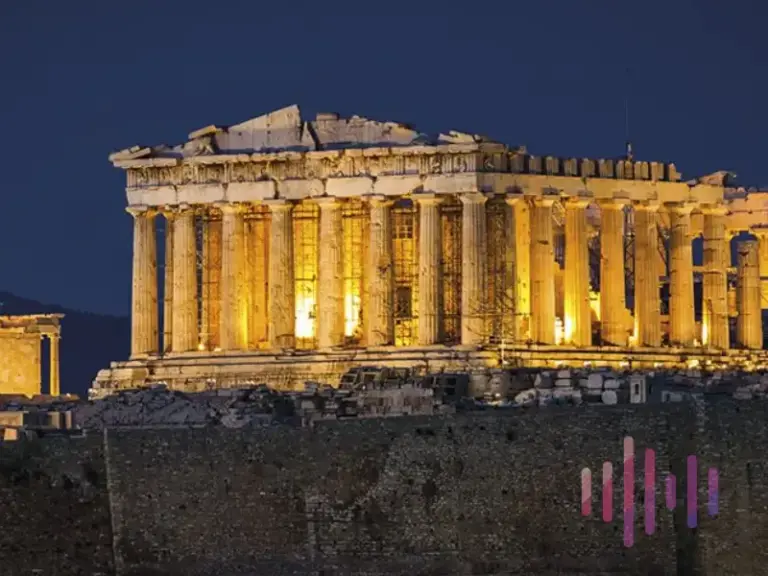
The Acropolis is the obvious next stop and the one you can see from here: the Panathenaic Way joins the two, and its ticket is separate, at €30.00. Its main event has a guide of its own on this site, the Parthenon, and on the far side of the rock is the Temple of Olympian Zeus, the largest temple ever begun in Greece. All of them, and the rest of the city, are on the free audio guides of Athens page.
Reading this in Spanish? The same guide, written for a Spanish-speaking visitor and narrated in Spanish, is at Ágora de Atenas en vozviajera.com.
Tickets
| Ticket | Price | Who and what |
|---|---|---|
| Full | €20.00 | The archaeological site and the museum in the Stoa of Attalos. Price checked 17-09-2026 |
| Reduced | €10.00 | Over-65s from Greece and the EU, between 1 October and 31 May; teachers accompanying school visits; parents accompanying EU primary-school groups |
| Under 18 | Free | Any country, with an ID card or passport |
| 18 to 25 from Greece or the EU | Free | With an ID card or passport showing age and country |
| Disability of 67 % or more | Free | And one companion, with the disability certificate |
| Free-entry days | Free | 6 March, 18 April, 18 May, the last weekend of September, 28 October; and the first and third Sunday of each month from 1 November to 31 March. Tickets at the counters only |
Swipe to see the other columns
FAQs · Ancient Agora of Athens
Do you need a ticket for the Ancient Agora of Athens?
Yes. The full ticket is €20.00 and the reduced one €10.00, checked on 17 September 2026 at the Greek state ticket office and on the Ministry of Culture's listing for the site.
You can buy it at the counters by the gate or online from the state ticket office. The online ticket carries a time slot, can be changed up to 2 hours before the visit and up to 2 times, and is not refundable.
How long do you need at the Ancient Agora?
Allow 1 hour 30 to 2 hours for the site and the ground-floor museum at walking pace with stops. That is our own estimate, not a published figure.
Two things stretch it: the site is not flat — the Temple of Hephaestus is on top of the hill and the climb is part of the visit — and the museum in the Stoa of Attalos is included, so it is easy to spend 30 minutes indoors.
What is included in the Ancient Agora ticket?
The whole archaeological site and its museum, which stands inside the fence in the Stoa of Attalos: nothing in there is charged separately.
That covers the Temple of Hephaestus, the foundations of the Bouleuterion and the Tholos, the giants of the Odeon of Agrippa and the Panathenaic Way. Since 1 November 2025 the display on the upper floor of the Stoa and the Church of the Holy Apostles are closed to the public; the ground-floor gallery is open.
Is the Temple of Hephaestus included in the Ancient Agora ticket?
Yes, and it has no ticket of its own. The temple — the Hephaisteion, also called the Theseion — stands on top of the hill of Agoraios Kolonos inside this site, and you climb to it with the same €20.00 ticket.
It is not part of the Acropolis, which is a separate site up the slope with its own €30.00 ticket.
Where is the entrance to the Ancient Agora?
Through the gate on Thiseio Square (Jacqueline de Romilly Square), about 5 minutes' walk from Thiseio station on metro line 1.
The site's address is Adrianou 24 and the main entrance is there, but it is being rebuilt: the Ministry of Culture moved visitor entry and exit to the Thiseio Square gate on 1 July 2025, for as long as the works last.
When is the Ancient Agora of Athens free?
On 6 March, 18 April, 18 May, the last weekend of September — in 2026, Saturday 26 and Sunday 27 September — and 28 October; plus the first and third Sunday of each month from 1 November to 31 March.
On those days tickets are issued only at the counters, so there is nothing to book online: come for the 08:00 opening rather than at midday.
Is the Ancient Agora of Athens worth visiting?
It is, for one thing you will not get on the Acropolis: this is where the machinery of the democracy survives, and you can see it. The museum holds the marble fragment of the kleroterion that drew jurors by lot, the bronze ballots, the water clock that timed the speeches, the potsherds used as votes in ostracism and the stele of the law against tyranny passed in 336 BC.
And above it stands the Temple of Hephaestus, still with its 34 Doric columns, its entablature and part of its roof, because in the 7th century it became a church and stayed in use as one until Greek independence.
FAQs
How do the free audio guides work?
Our audio guides work through the website audioguidetravel.com; you don’t need to download any app. Just follow the instructions on the website to guide you through Ancient Agora of Athens while listening to our experts’ explanations.
Can I take the tour at my own pace?
Of course! Our free audio guides are designed so that you set the pace. You can pause, rewind, or listen as many times as you want without missing a detail. By visiting Ancient Agora of Athens your way, you’ll enjoy it even more.
If I'm in a group, can we use the same audio guide?
Yes, our website allows sharing the same free audio guide among multiple devices. This way, you can visit Ancient Agora of Athens as a group or family, listening to the explanations simultaneously. The quickest way to do this is to share the link via WhatsApp, email, or any method you like. I’ve included some buttons below for you to do that now.
Visitor information
As of 17 Sep 2026- Opening hours
- 16–30 September: 08:00–18:30, last entry 18:00. 1 April – 31 August: 08:00–19:30, last entry 19:00.The closing time steps back every fortnight in autumn: 1–15 September 19:00 (last entry 18:30) · 16–30 September 18:30 (18:00) · 1–15 October 18:00 (17:30) · 16–31 October 17:30 (17:00) · 1 November – 31 March 08:00–17:00. Closed on 1 January, 25 March, 1 May, Easter Sunday and 25 and 26 December. Good Friday 12:00–17:00, Holy Saturday 08:30–15:30. The museum in the Stoa of Attalos opens at 10:00 on Tuesdays, according to the Ministry's listing for the museum.
- Tickets
- €20.00 full · €10.00 reducedThe €20.00 ticket covers the archaeological site and its museum, which stands inside the fence: nothing in there is charged separately. Checked on 17 September 2026 at the Greek state ticket office and on the Ministry of Culture's listing. Entry is free for under-18s from any country and for 18 to 25-year-olds from Greece and the EU, on an ID card or passport; over-65s from Greece and the EU pay €10.00, and only between 1 October and 31 May. So a visitor from outside the EU pays the full €20.00 at any age from 18 upwards. Tickets bought online carry a time slot, can be changed up to 2 hours before the visit and up to 2 times, and are not refundable. On free-entry days tickets are issued only at the counters.
- Time needed
- 1 hour 30 – 2 hoursOur own estimate for the site and the ground-floor museum at walking pace with stops. The site is not flat: the Temple of Hephaestus is on top of the hill of Agoraios Kolonos and you have to climb to it. The museum is inside the fence and included in the same ticket.
- Best time to go
- The first hour after 08:00
- Getting there
- Since 1 July 2025 visitors enter and leave through the Thiseio Square gate (Jacqueline de Romilly Square) while the main entrance at Adrianou 24 is rebuilt. Metro Thiseio (line 1) is about 5 minutes' walk from that gate, and Monastiraki (lines 1 and 3) about 11.The site's address is still Adrianou 24, and that is where the main entrance stands, but the Ministry of Culture states on its listings for the site and for the museum that from 1 July 2025, and until the redevelopment works there are finished, visitor entry and exit are through the archaeological site gate on Thiseio Square. Checked on 17 September 2026. Buses 025 and 026 stop at Monastiraki. Both floors of the Stoa of Attalos are wheelchair accessible and there is a lift, which the wardens operate on request; the information desk has tactile plans and braille leaflets in English and Greek. To reach the Temple of Hephaestus area by wheelchair you use the Thiseio Square gate, off Apostolou Pavlou street, ringing ahead on +30 210 3214824 or +30 210 3210180. Since 1 November 2025 the display on the upper floor of the Stoa of Attalos and the Church of the Holy Apostles are closed to the public.
- Address
- Adrianou 24, 10555 Athens, Greece
- Official website
- www.hh.gr
Nearby
More free audio guides in Athens
 6:59AthensAcropolisUnquestionably, the crown jewel of Athens: the Acropolis. This ancient citadel rises majestically above the city, offering not…
 8:00AthensParthenonWelcome to the heart of Athens, where every stone tells a story! Imagine a place where ancient Greece…
 7:00AthensLycabettus HillThis free audio guide to Lycabettus Hill plays straight from your phone — no app, no sign-up —…