
Roman Forum: free audio guide, hours and tickets
Free audio guide in English · no app, no sign-up
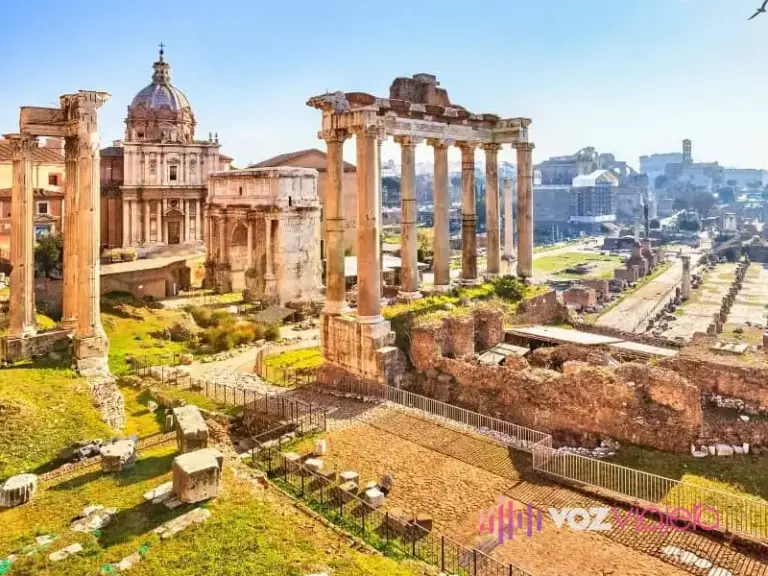
Free audio guide to the Roman Forum, in English: 7 minutes along the Via Sacra, from the Curia and the Arch of Septimius Severus to the Basilica of Maxentius and the Arch of Titus, playing on this page.
 Audio guide
On this page
- What the audio guide tells you
- Opening hours: 09:00 to 16:30 until 28 February
- Tickets: €18, and what it does not open
- Getting in: 3 entrances and the metro
- What is left: from a drained swamp to the Column of Phocas
- The Vestals, and the Roman Forum Museum
- Nearby, with their own free audio guides
- Where to find it
The Roman Forum is the valley between the Palatine and the Capitoline hills where ancient Rome held its markets, trials, elections and processions, and what is left of it: temples, basilicas, the Senate house and triumphal arches. It shares a single €18 ticket with the Colosseum and the Palatine. From 25 October 2026 to 28 February 2027 it opens at 09:00 and closes at 16:30. This is its free audio guide, in English.
What the audio guide tells you
It is free, it plays on this page in your phone’s browser, with no app and no sign-up, and it lasts 7 minutes. It walks you along the Via Sacra: from the Curia, the Rostra and the Arch of Septimius Severus at the Capitoline end, past the Temple of Saturn, the Basilica Julia, the Temple of Caesar and the House of the Vestals, to the Basilica of Maxentius and the Arch of Titus.
Some points of interest described in the Roman Forum Audioguide:
| Point of Interest | Brief Description |
|---|---|
| Curia | The Senate house: Diocletian’s rebuilding, saved because it became the church of Sant’Adriano; its bronze doors are copies. |
| Rostra | The speakers’ platform, named after the rams of the warships taken at Antium in 338 BC. |
| Arch of Septimius Severus | Built in 203 AD for his victories over the Parthians; the name of his son Geta was removed from the inscription. |
| Temple of Saturn | 8 columns at the foot of the Capitoline; it housed the treasury of the Roman Republic. |
| Basilica Julia and Column of Phocas | Caesar’s hall for business and the courts, and the last monument of the Forum, put up in 608 AD. |
| Temple of Caesar | Dedicated by the future Augustus in 29 BC, where Caesar’s body was cremated. |
| Temple of Vesta and House of the Vestals | The round temple of the sacred fire, and the house of the 6 priestesses who kept it. |
| Temple of Antoninus and Faustina | Its church door hangs high above the Via Sacra: the level of the ground before the excavations. |
| Basilica of Maxentius | Begun by Maxentius in 308 AD and finished by Constantine after 312. |
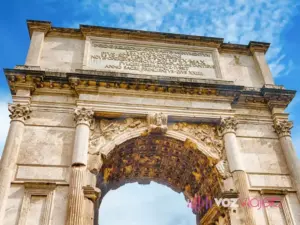
| Arch of Titus | Built by Domitian for his brother Titus; it has a free audio guide of its own. |
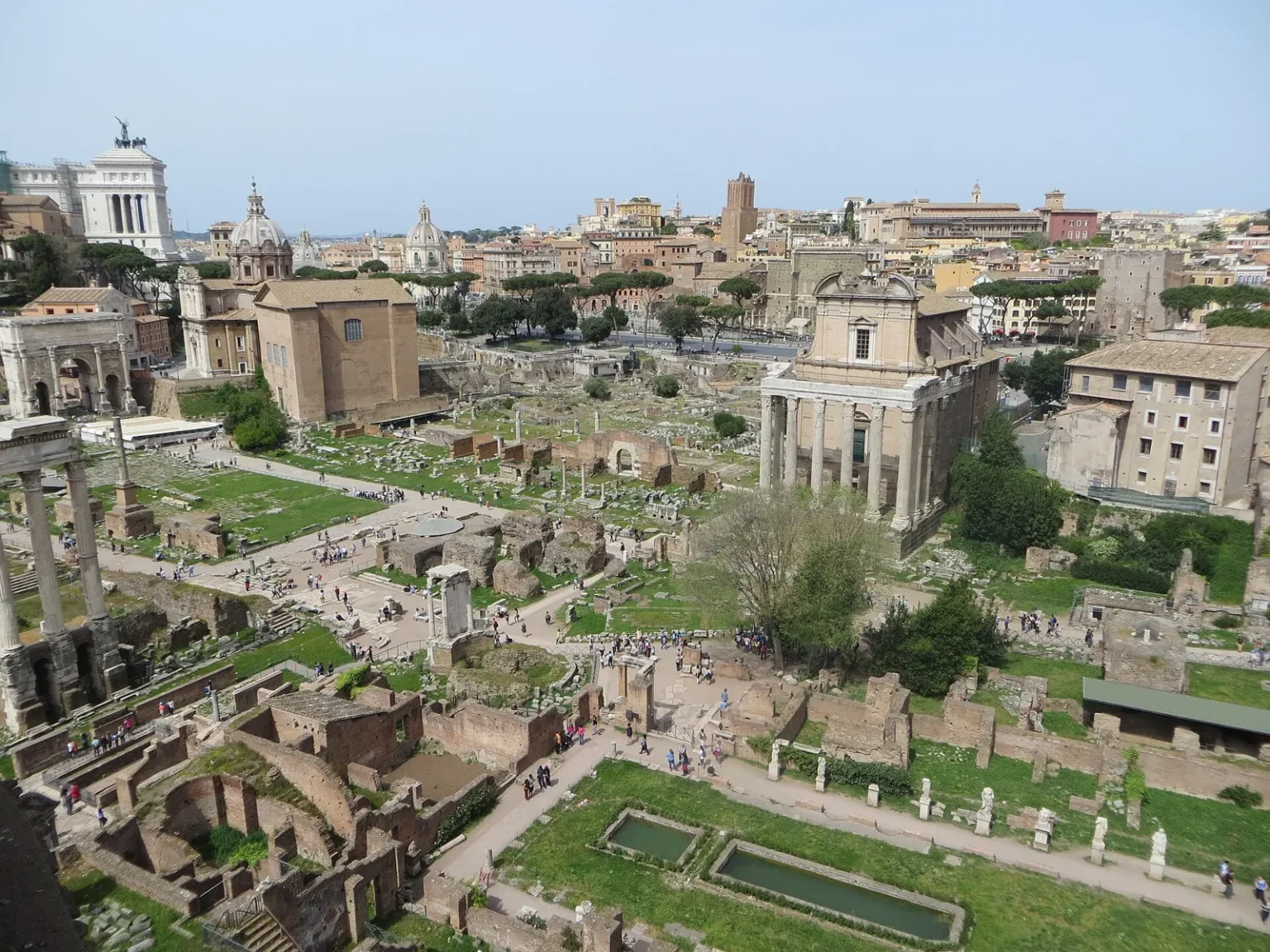
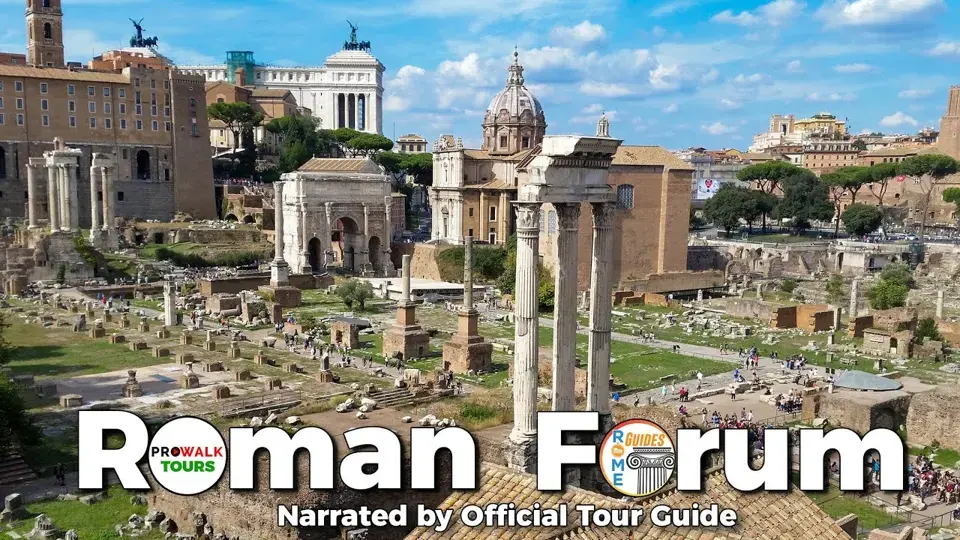
If you want to see the ground before you go, here is a guided tour of the Roman Forum, narrated in English.
Opening hours: 09:00 to 16:30 until 28 February
From 25 October 2026 to 28 February 2027 the Roman Forum and the Palatine open at 09:00, the last admission is at 15:30 and the park closes at 16:30. The Colosseum, on the same ticket, opens earlier, at 08:30.
It is closed on 25 December 2026 and 1 January 2027. Entry is free for everyone on the first Sunday of the month, on 25 April, 2 June and 4 November: the next ones are Sunday 1 November and Wednesday 4 November. The Forum Pass SUPER cannot be used on the free first Sunday. Checked on 25 October 2026 against the opening times of the Parco archeologico del Colosseo.
Tickets: €18, and what it does not open
The standard ticket is €18, “Colosseum, Roman Forum and Palatine”. It is valid for 24 hours, with 1 entry to the Colosseum, without the arena, and 1 entry to the Roman Forum and Palatine area, which includes the Roman Forum Museum and the exhibitions on at the time. EU citizens from 18 up to the day of their 25th birthday pay €2. Tickets carry the holder’s name, you keep an ID visible at the entrances, and online sales open 30 days before the visit on the official booking site.
On the Palatine there are 2 more SUPER sites: the House of Augustus, closed on Mondays, and the House of Livia, closed for restoration since 24 August 2026.
Getting in: 3 entrances and the metro
You can go in at 3 entrances: Largo della Salara Vecchia 5/6, Via del Tulliano, and the Via Sacra from Piazza del Colosseo. Take metro line B to Colosseo, or line C to Colosseo-Fori Imperiali; buses 51, 75, 81, 85, 87 and 118 stop nearby.
Coming in by the Via Sacra from the Colosseum, you pass the Arch of Titus, at the south-east edge of the Forum, which has a free audio guide of its own.
What is left: from a drained swamp to the Column of Phocas
The valley was a swamp. It was drained in the late 7th century BC, and for over a millennium it stayed the centre of public life in Rome. The Basilica Aemilia, a covered hall for business and the courts, was founded in 179 BC by the censors Marcus Aemilius Lepidus and Marcus Fulvius Nobilior.
The plain brick building at the north-west end is the Curia, the Senate house. Julius Caesar began it in 44 BC and Augustus finished it in 29 BC, but what stands is the rebuilding by Diocletian after a fire in 283. It survived because it became the church of Sant’Adriano in the 7th century; its bronze doors are modern copies, as the originals were moved to the Basilica of St John Lateran in 1660.
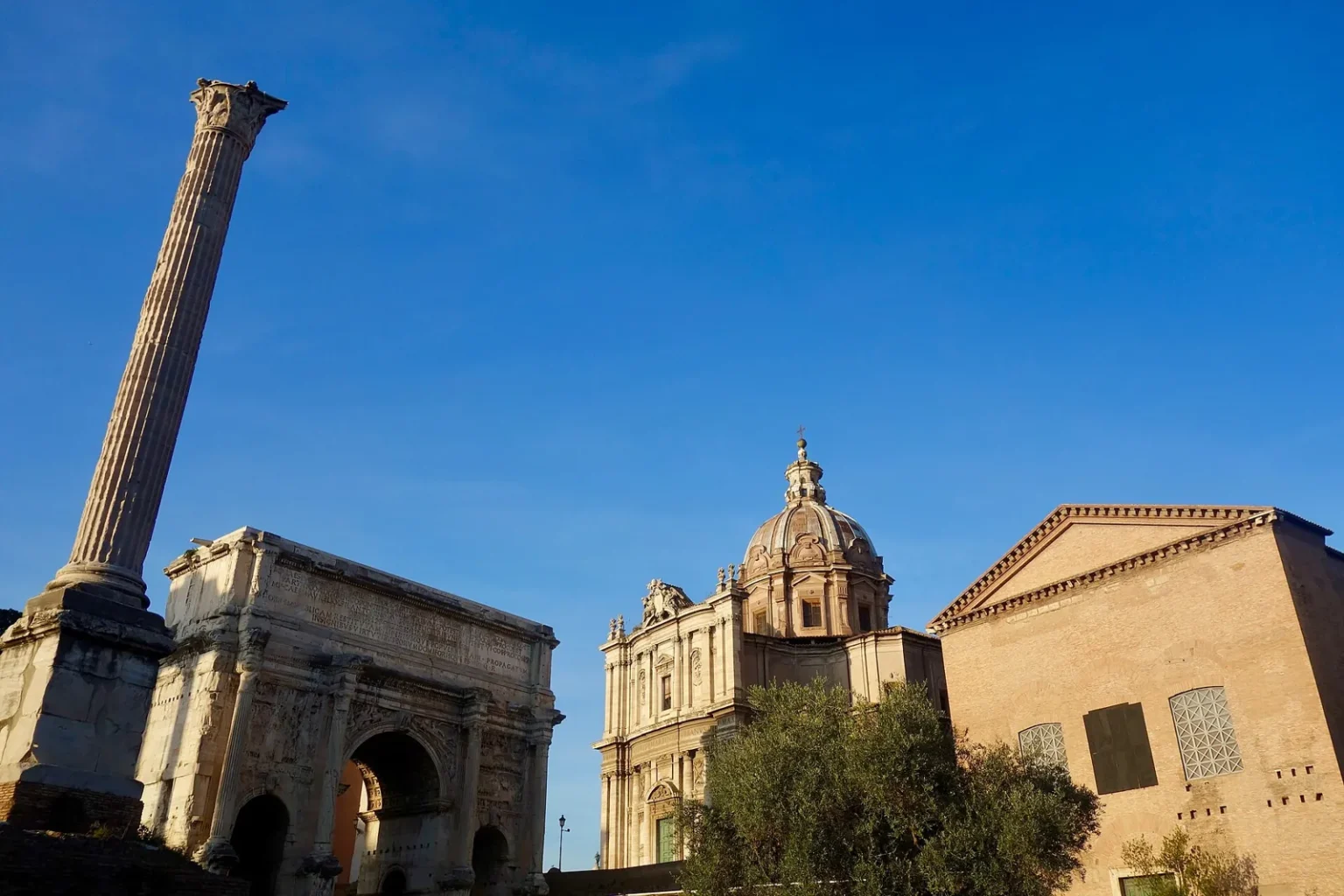
The emperors added only prestige monuments: the Temple of Vespasian and Titus and the Temple of Antoninus Pius and Faustina, dedicated to the deified emperors, and the Arch of Septimius Severus, raised at the western end in 203 AD for his victories over the Parthians.
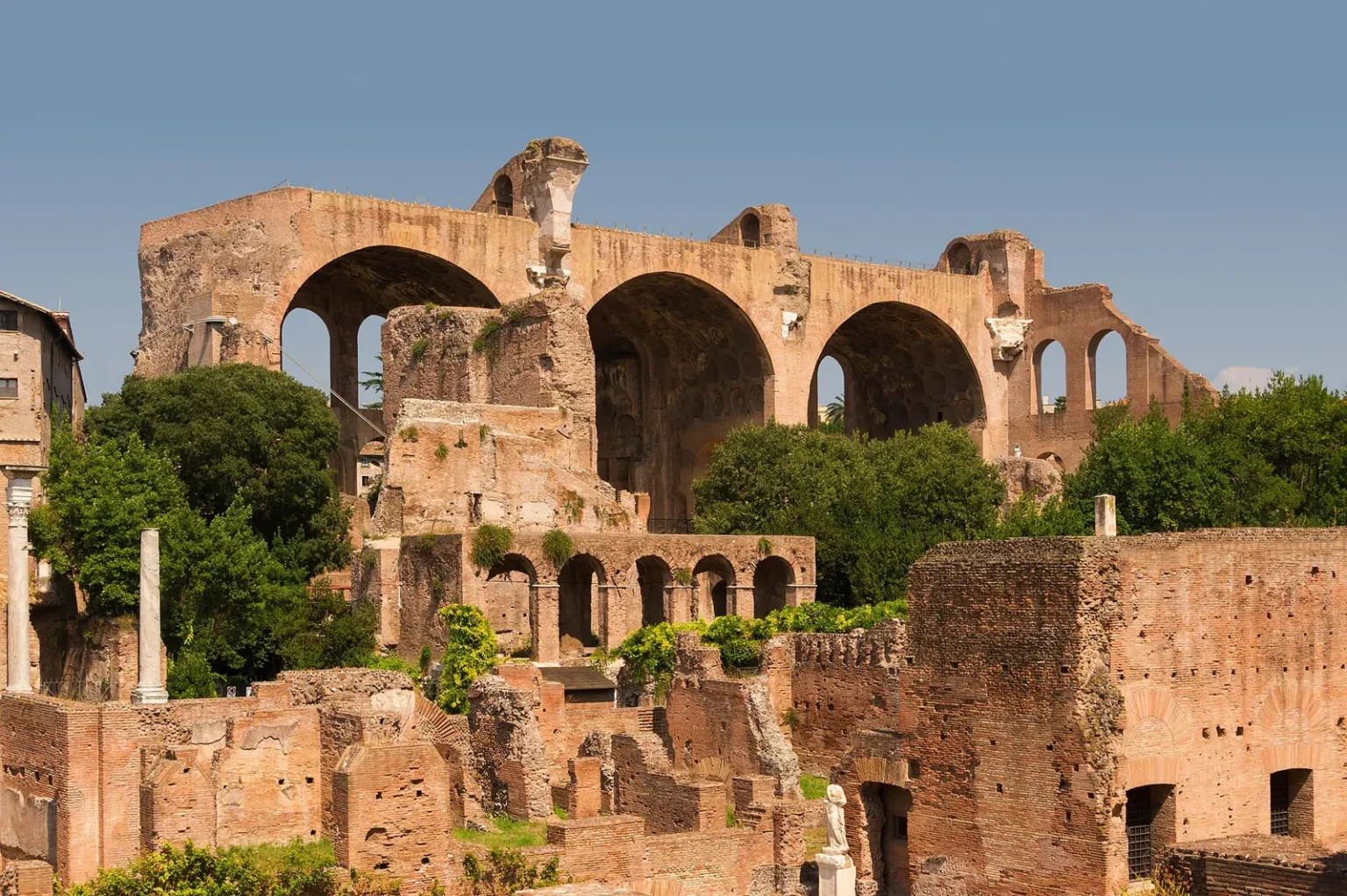
The last great project was Maxentius’s, in the early 4th century: a temple to the memory of his son Romulus and the basilica on the Velian Hill. The Basilica of Maxentius was begun in 308 AD and finished by Constantine, after he defeated Maxentius at the Milvian Bridge in 312. The last monument of the Forum is the Column of Phocas, put up in 608 AD in honour of the Byzantine emperor.
After that, silt buried part of the valley and it turned to meadow, the Campo Vaccino. Some buildings lasted because they became churches: the Temple of Antoninus and Faustina is San Lorenzo in Miranda, and the Temple of Romulus is Santi Cosma e Damiano. The first systematic excavations came only after the unification of Italy.
The Vestals, and the Roman Forum Museum
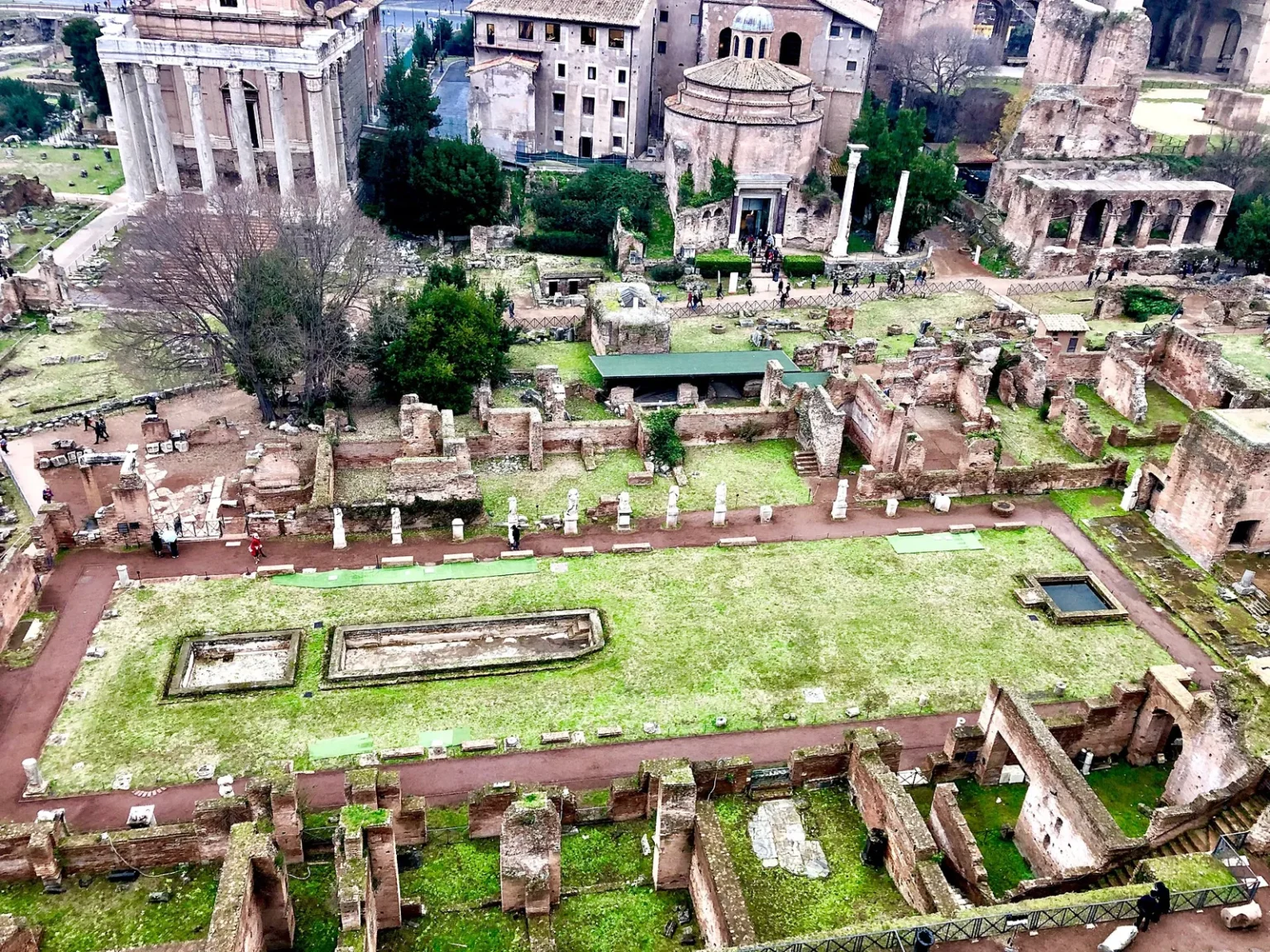
The round Temple of Vesta is where the Vestal Virgins kept the sacred fire of Rome. Behind it is the House of the Vestals, brought to light by Rodolfo Lanciani in the excavations of 1882-1884; the rooms of its south-east sector were restored from 2013 to 2020 and now display stone finds from the excavations.
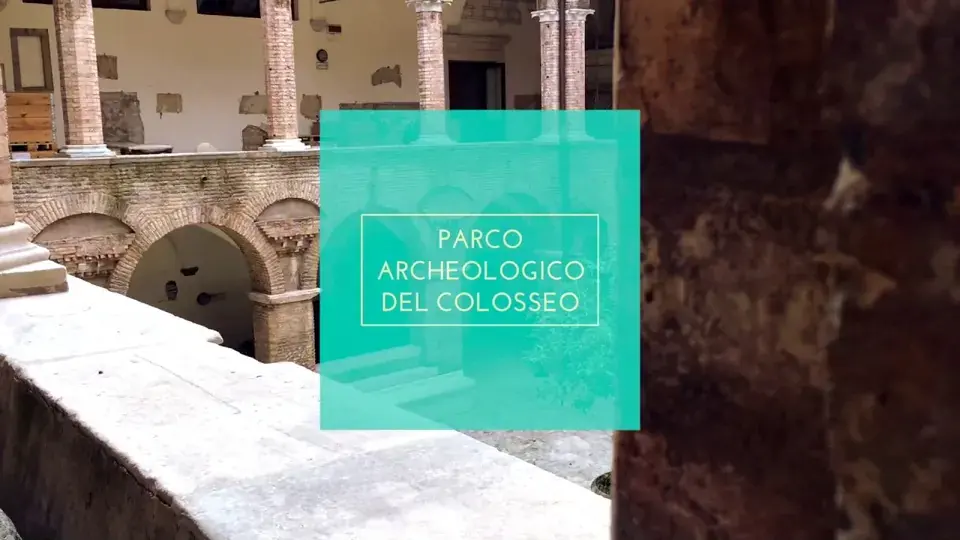
The Roman Forum Museum is on the same ticket, in the cloister of Santa Maria Nova, the convent of Santa Francesca Romana, built for Pope Alexander VI between 1492 and 1503. Giacomo Boni set up the Forum’s Antiquarium there in 1908. The rooms show tombs from the cemetery he dug in 1902-1905 beside the Temple of Antoninus and Faustina, a cemetery of 41 graves, the oldest from about the 10th century BC; the statues of Castor and Pollux from the Fountain of Juturna; and the reliefs of the Basilica Aemilia, with Romulus and Remus, the Rape of the Sabine Women and the punishment of Tarpeia.
Nearby, with their own free audio guides
- Arch of Titus — at the south-east edge of the Forum, on the Via Sacra.
- Arch of Constantine — between the Colosseum and the Palatine.
- Colosseum — on the same €18 ticket, open from 08:30.
- Circus Maximus — on the far side of the Palatine.
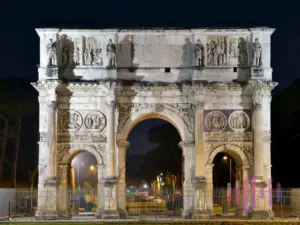 Free audio guideArch of Constantine
All of them, and the rest of the city, are on the free audio guides of Rome page. The same guide in Spanish is at Foro Romano en vozviajera.com.
Where to find it
FAQs
How do the free audio guides work?
They play right here on audioguidetravel.com, with no app to download and no sign-up. Press play and listen as you walk round: a phone and a pair of headphones are all you need. The audio streams from this page, so you’ll need mobile data or Wi-Fi.
Can I take the tour at my own pace?
Of course! You set the pace: pause whenever you like, jump back or forward 15 seconds, or tap the bar to jump to any point, and listen as many times as you want so you don’t miss a thing.
If I'm in a group, can we use the same audio guide?
Yes. The same free audio guide opens on as many phones as you like, so you can go round together as a group or with your family, each person at their own pace and with their own headphones. The quickest way is to send the link via WhatsApp, Telegram or however you like: the buttons just below let you share it right now.
Visitor information
As of 25 Oct 2026- Opening hours
- Daily from 09:00. Until 28 February 2027: last admission 15:30, the park closes at 16:30.
- Tickets
- €18 · €2 reduced
- Getting there
- Metro line B to Colosseo, or line C to Colosseo-Fori Imperiali.
- Tip
- The 24-hour €18 ticket shows the Curia only from outside; the Forum Pass SUPER opens it
- Official website
- colosseo.it
Nearby
More free audio guides in Rome
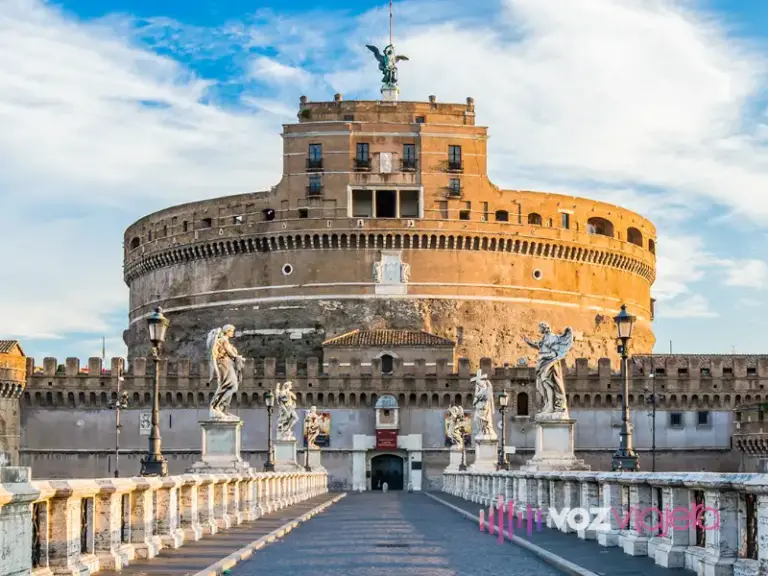 6:11RomeCastel Sant’Angelo: free audio guide, hours and ticketsFree audio guide to Castel Sant’Angelo, in English: 6 minutes from Hadrian’s tomb and its helical ramp to…
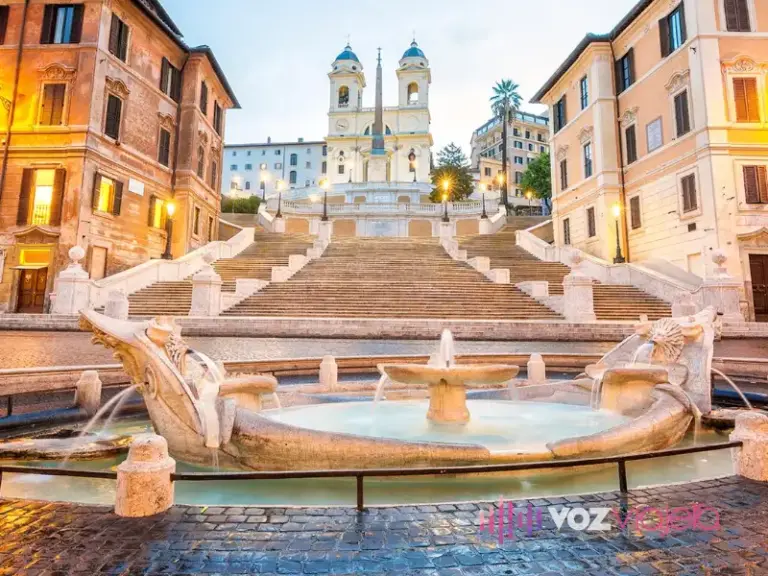 4:01RomeSpanish SquareWith its iconic steps, the Spanish Square is a perfect place to relax and people-watch. It is a…
 6:00RomeVatican Museums: free audio guide, hours and ticketsThis free audio guide to the Vatican Museums plays straight from your phone — no app, no sign-up…