
Fort Saint-Jean, Marseille: free audio guide and hours
Free audio guide in English · no app, no sign-up
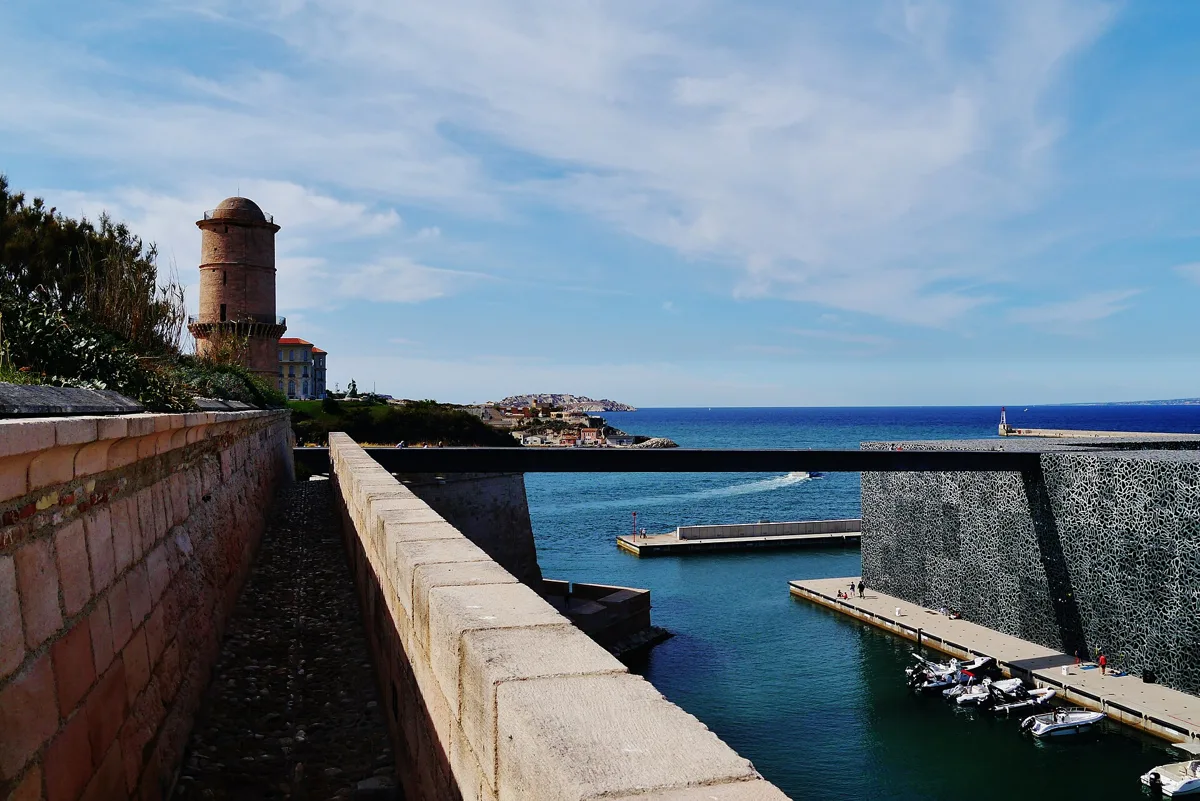
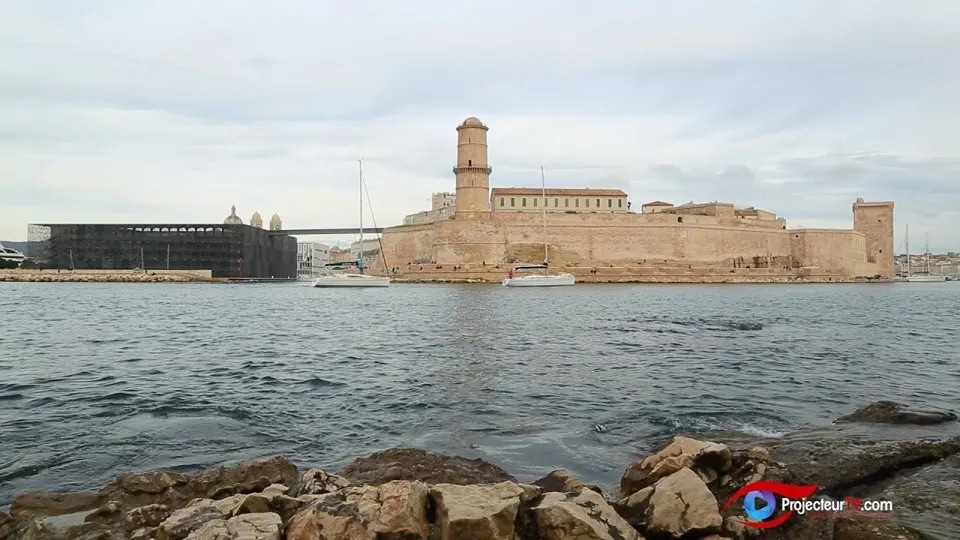
Fort Saint-Jean guards the entrance to the Old Port of Marseille: a fort that Louis XIV ordered in 1660 around King René’s 15th-century tower and the Tour du Fanal, on the site of a 12th-century commandery of the Knights of Saint John. Part of the Mucem, its ramparts and gardens are free to walk. This is its free audio guide, about 8 minutes long.
 Audio guide
What the audio guide covers
It is free, it plays on this page in your phone’s browser, with no app and no sign-up, and it lasts about 8 minutes. The first half tells the story of the site, from the Greeks and the Knights of Saint John to Louis XIV and the Revolution; the second half walks you through the fort, from the square tower to the courtyards, and ends with a few tips for the visit. The stops in the table follow the order of the audio.
| Minute | Stop | What you hear |
|---|---|---|
| 0:00 | Welcome | You picture yourself facing the sea at the walls of the fort, at the entrance to the Old Port. |
| 0:42 | Where the name comes from | The commandery of the Knights Hospitaller of Saint John, set up on this spur of the Saint-Laurent hill at the end of the 12th century, and the Greek finds from the 6th century BC. |
| 1:07 | The 2 towers and the fort | King René’s square tower, the round lighthouse tower of 1644, Louis XIV’s fort and the moat of 1679. |
| 1:47 | The Knights of Saint John | Who the Hospitallers were: a military and religious order of the Crusades that cared for pilgrims. |
| 2:16 | King René’s tower | Why the king of Provence built a square tower to guard the harbour mouth in the 15th century. |
| 2:40 | Louis XIV’s fort | The lighthouse tower, the fort ordered by Louis XIV, the houses and Hospitaller land taken to make room for it, and Vauban’s moat. |
| 3:30 | A prison in the Revolution | Philippe Égalité, Duke of Orléans, and 2 of his sons locked up in the fort. |
| 4:04 | The secret passage | An old story about a tunnel from the fort into the town, which has never been confirmed. |
| 4:37 | Walking in | The square tower up close and the openings its defenders shot from. |
| 5:06 | The Tour du Fanal | The round tower that marked the harbour entrance, and the view out to sea. |
| 5:26 | Greek Marseille | The first Greek settlement on this ground, 6th century BC. |
| 5:42 | The heart of the fort | Soldiers’ life, the old cells of the Revolution and the inner courtyards. |
| 6:24 | The moat | The ditch dug in 1679 that cut the fort off from the town. |
| 6:49 | Tips | Sunset for the light, the first hour after opening for quiet, the café in the fort and a jacket for the sea breeze. |
| 7:42 | Farewell | Marseille, founded by Greeks around 600 BC. |
From the Greeks to the Knights of Saint John
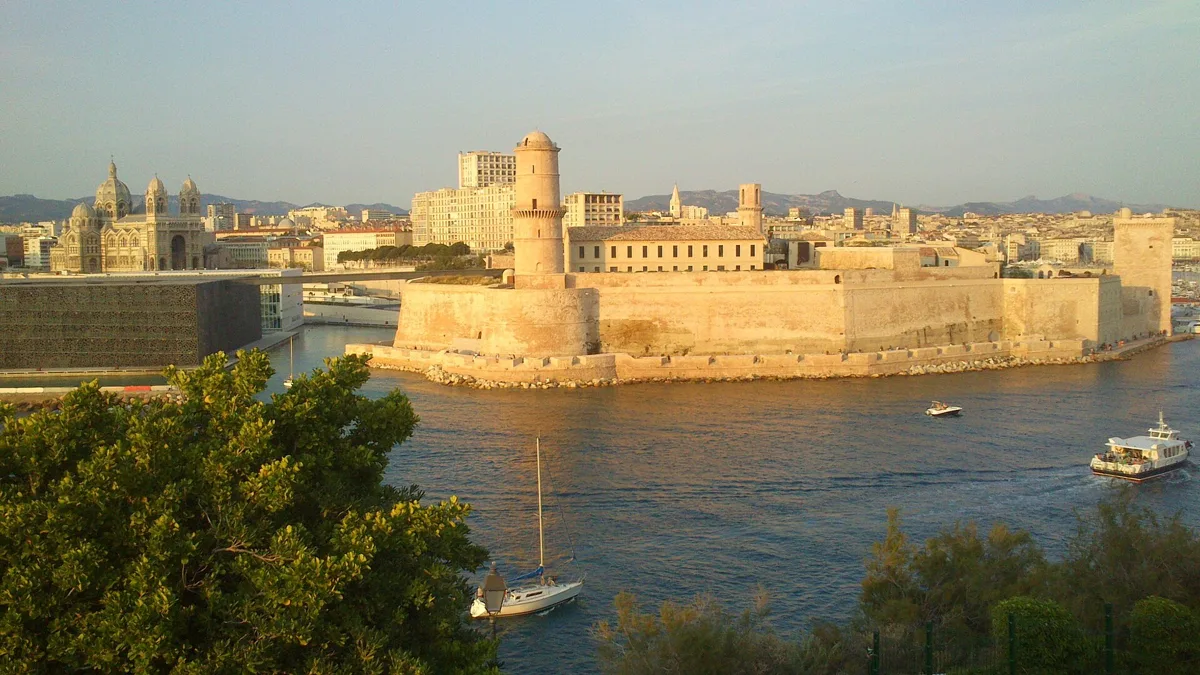
Fort Saint-Jean stands on the northern side of the entrance to the Old Port, on the first of the low hills where the Greek town of Marseille grew up. Digs on this spot have turned up pottery from the first Greek settlement, in the 6th century BC.
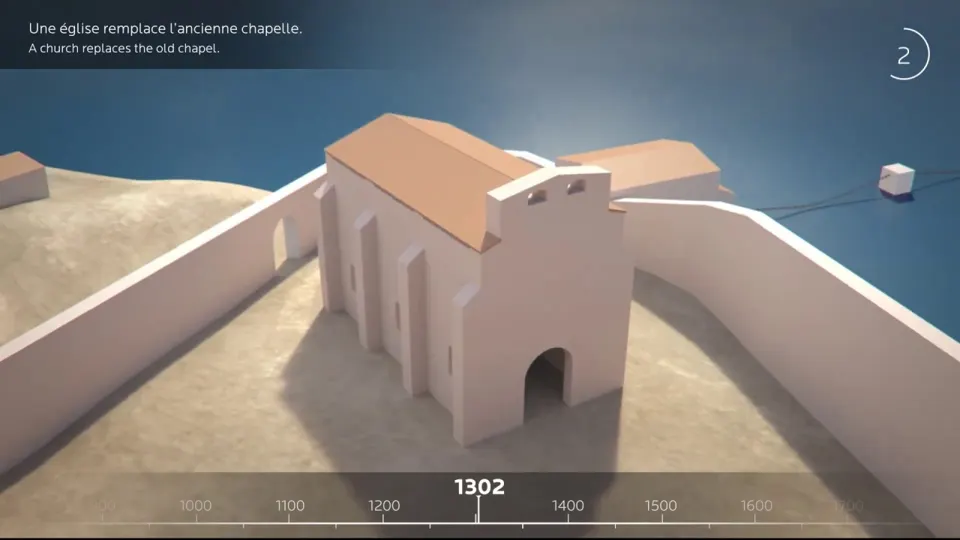
The name comes from the Knights Hospitaller of Saint John of Jerusalem. Their commandery here is on record from 1178, built in the pink limestone of La Couronne, and it became a complex with a church, a chapel, a hospital and the commander’s palace. When Pope Urban V came to Marseille in 1365, the cardinals travelling with him stayed in that palace.
King René’s tower and the Tour du Fanal
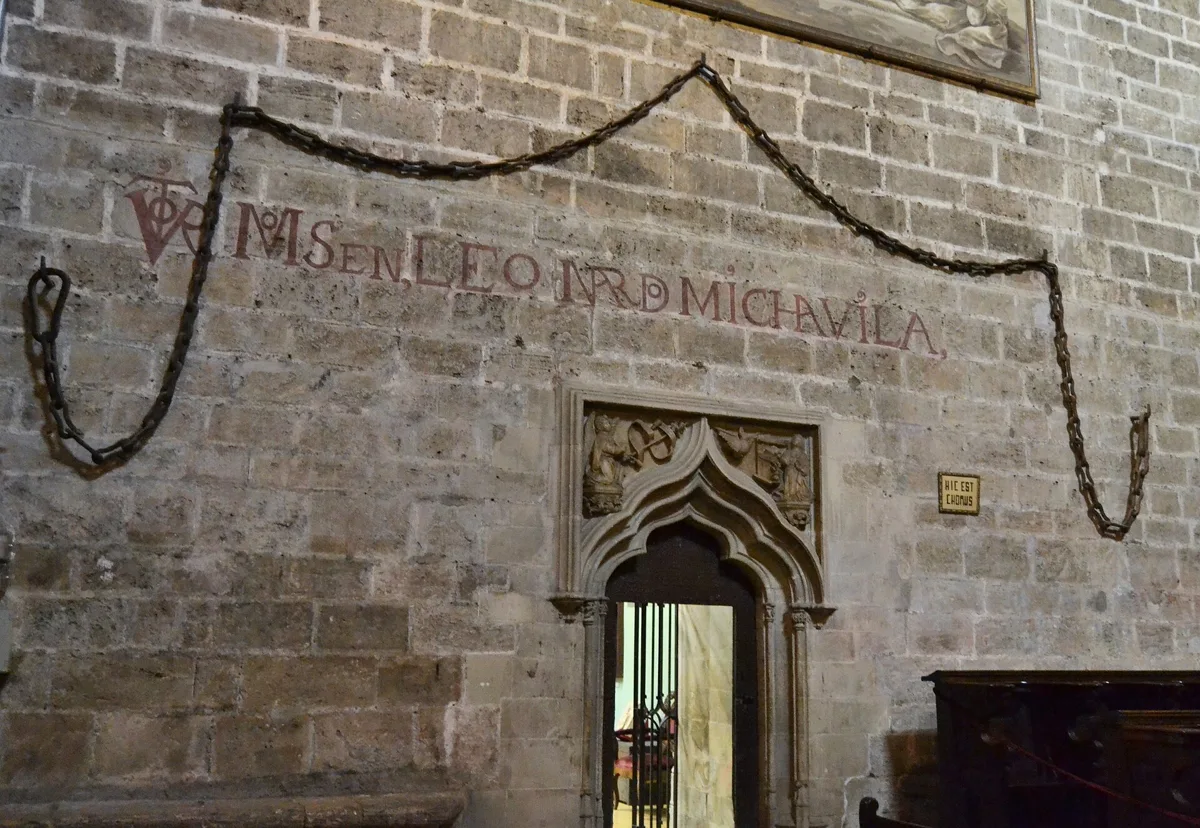
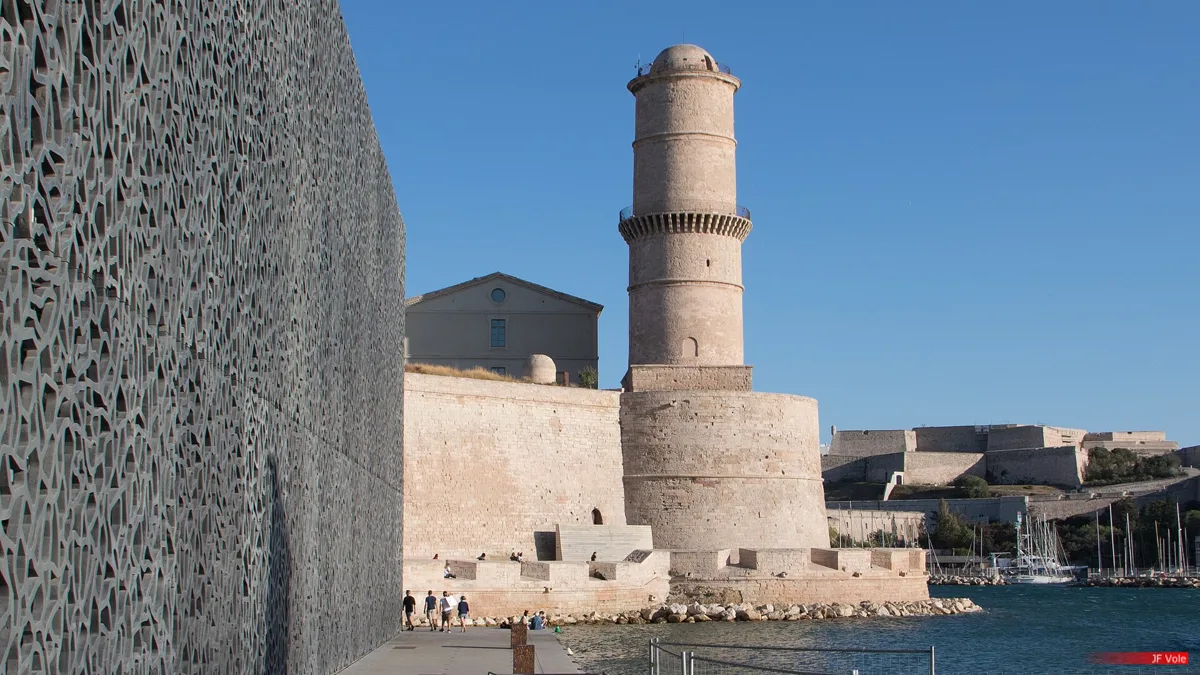
After the sack of 1423, the old harbour tower was falling down. King René, Count of Provence, had a stronger square tower built in its place between 1447 and 1452, and that is the tower you see today on the side of the channel. The town paid most of the bill, the fishermen of the Saint-Jean quarter raised their share through a tax on fish, and the king covered the rest; in return, the king granted them the calanque of Morgiou for ever, with the sole right to set a tuna net there.
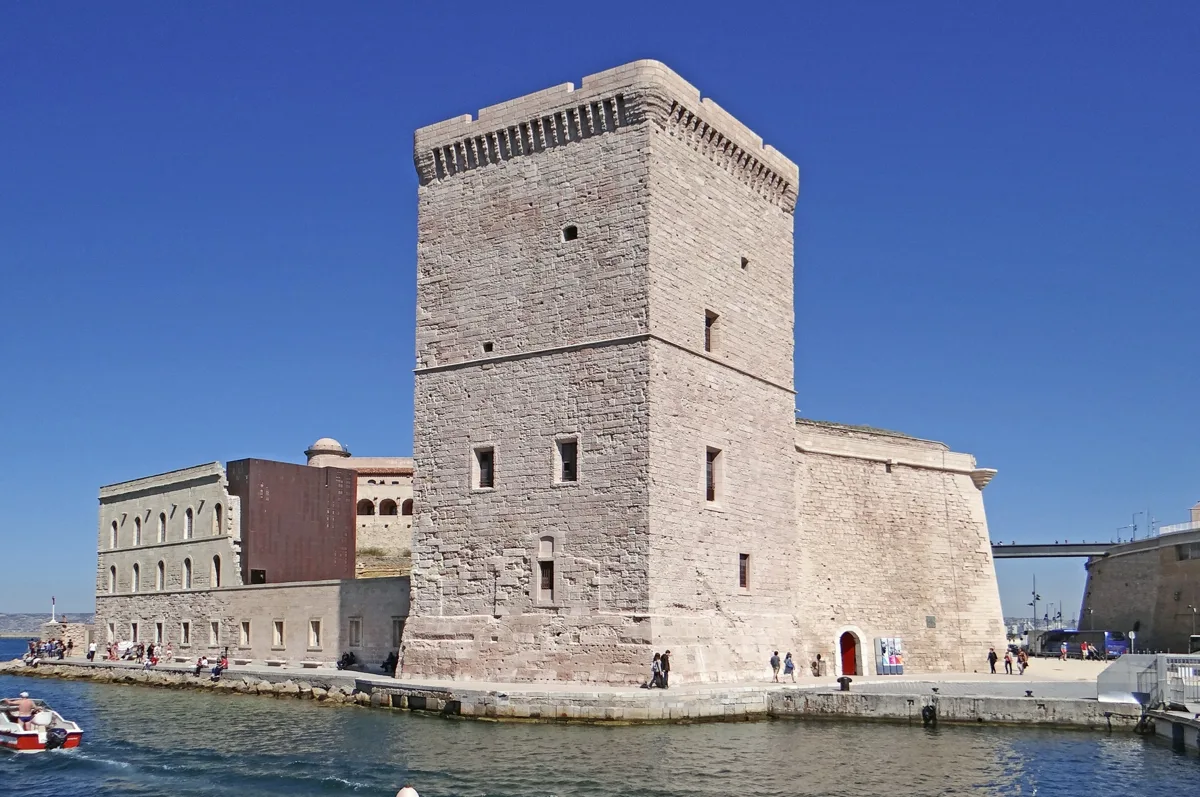
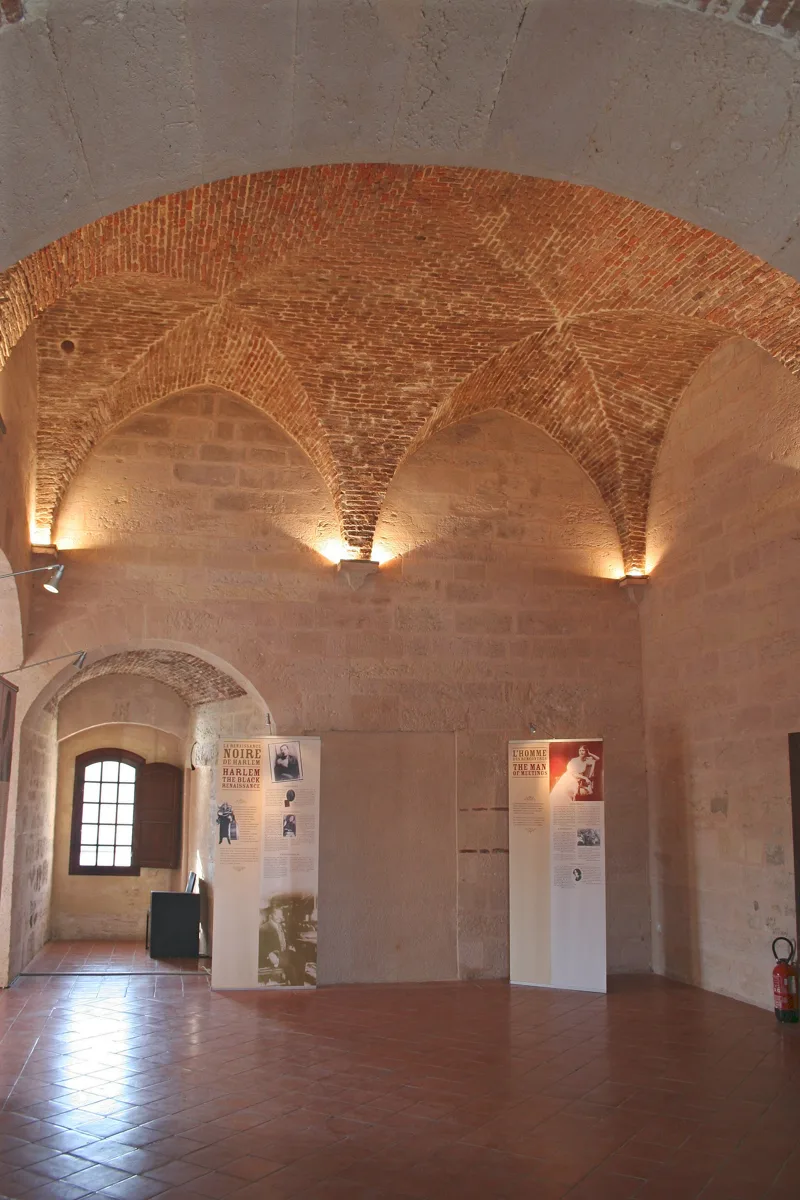
The tower is one of the oldest buildings on the site and it can be visited; inside, its floors are vaulted rooms.
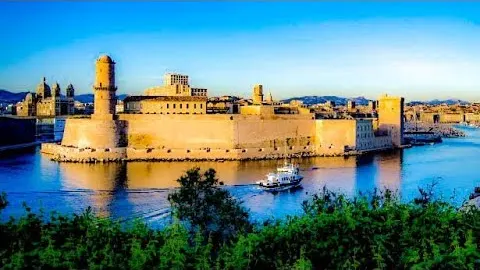
At the other end of the promontory, Marseille’s shipowners asked for a watchtower to mark the harbour entrance, and the Tour du Fanal went up between 1644 and 1646 on the ruins of an older lookout. Fires of bundled wood were lit on top as a signal, and the iron brackets that held them are still there. With its dome, it has become the emblem of the fort.
Louis XIV’s fort: guns that faced the town
Marseille spent the late 1650s in open revolt against the Crown. On 2 March 1660 Louis XIV entered the town in person to reassert his authority, and he ordered 2 forts at the harbour mouth: Fort Saint-Nicolas on the south side and Fort Saint-Jean on the north, its walls wrapped round King René’s tower and the Tour du Fanal. The Hospitallers had to leave, and part of the neighbourhood was pulled down to make room.
A line attributed to the king sums up the mood: “We noticed that the people of Marseille were very fond of pretty bastides, their country houses, so we wanted one of our own at the entrance to this great port.” The design was by the military engineer Louis Nicolas de Clerville, and the work was almost finished when he died in 1671. In 1679 Vauban judged the defences too weak and had a wide moat dug between the fort and the town, with a triangular outwork in front of the gate and a low gun battery on the seafront. From the start, the fort’s guns watched the town as much as the sea.
The Revolution, the Foreign Legion and 1944
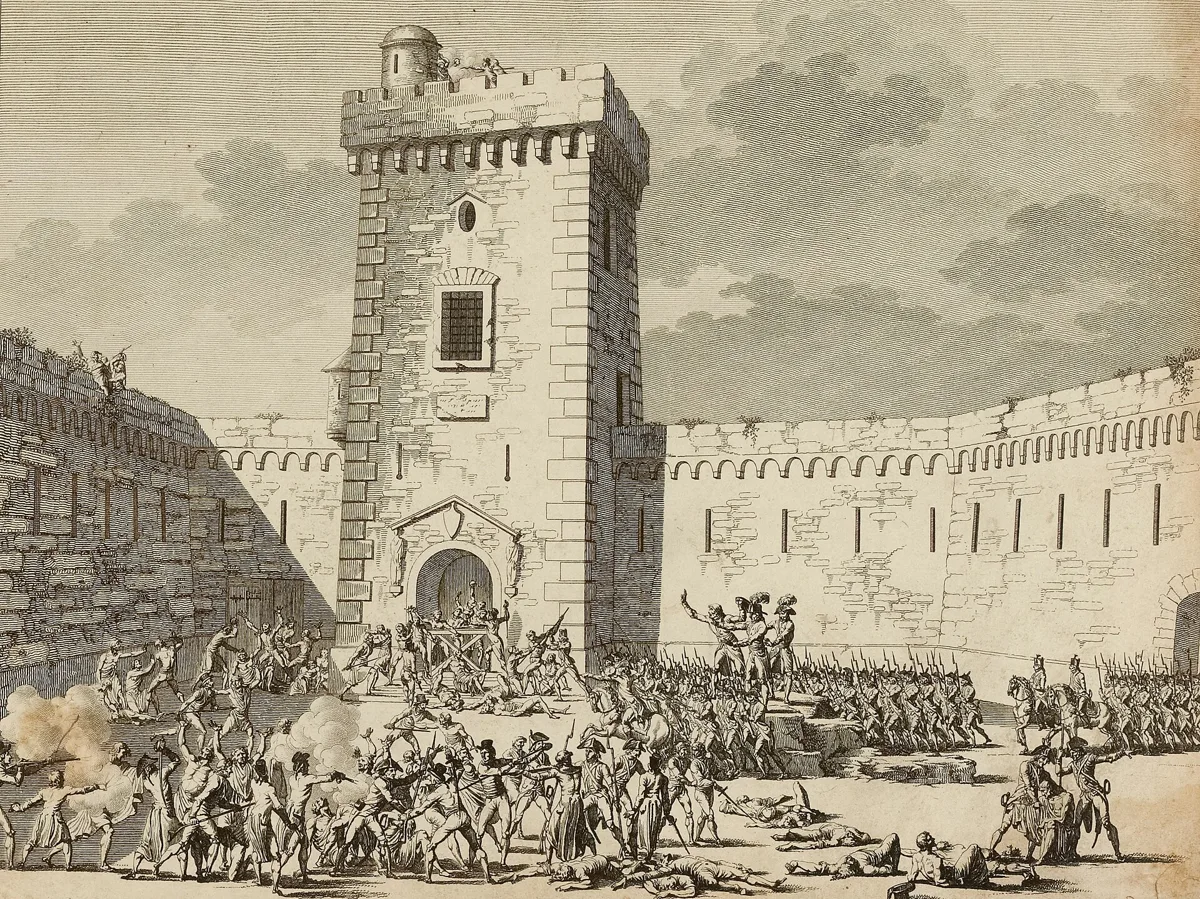
On 30 April 1790 a revolutionary crowd set out to take the forts of Marseille. At Fort Saint-Jean the Chevalier de Beausset refused to surrender; on 2 May, as he tried to slip away, he was recognised and killed. In 1793 the fort became a state prison for Philippe Égalité, Duke of Orléans, and 2 of his sons, the Duke of Montpensier and the Count of Beaujolais. On 5 June 1795 royalists killed about 100 of the Jacobin prisoners held in the fort.
In the 19th and 20th centuries the fort was an army barracks. While the French Foreign Legion was based in North Africa, until 1962, it was the last stop for recruits before they sailed for training in Algeria. German troops occupied Marseille on 12 November 1942 and stored explosives in the lower part of the fort; in August 1944 that depot blew up and destroyed many of the old buildings.
The army handed the ruins over to the Ministry of Culture in 1960, and the fort was listed as a historic monument on 16 June 1964. Since 2013 it has been part of the Mucem, the Museum of European and Mediterranean Civilisations, joined to its modern J4 building by a 115 m footbridge and to the Panier district by another of 70 m.
Hours, tickets and getting there
The fort covers 15,000 m², with 1,100 m² of exhibition rooms and 12,000 m² of gardens, the Garden of Migrations, planted with species from all round the Mediterranean. In the upper part you can walk the Officers’ Gallery and the ramparts all the way to the Tour du Fanal; in the lower part are King René’s tower and the old chapel of Saint John.
It opens every day except Tuesdays, 1 May and 25 December. From November to April the hours are 10:00 to 18:00; from May to October it closes at 19:00, and at 20:00 from early July to the end of August. Ticket desks close 45 minutes before closing time and the exhibition rooms 15 minutes before.
The exhibition ticket costs €11 (€7.50 reduced; €18 for a family ticket of 2 adults with up to 5 children under 18) and covers every exhibition in the fort and in the J4 building on the same day. The Café du Fort opens every day except Tuesdays from 10:00 to 18:00.
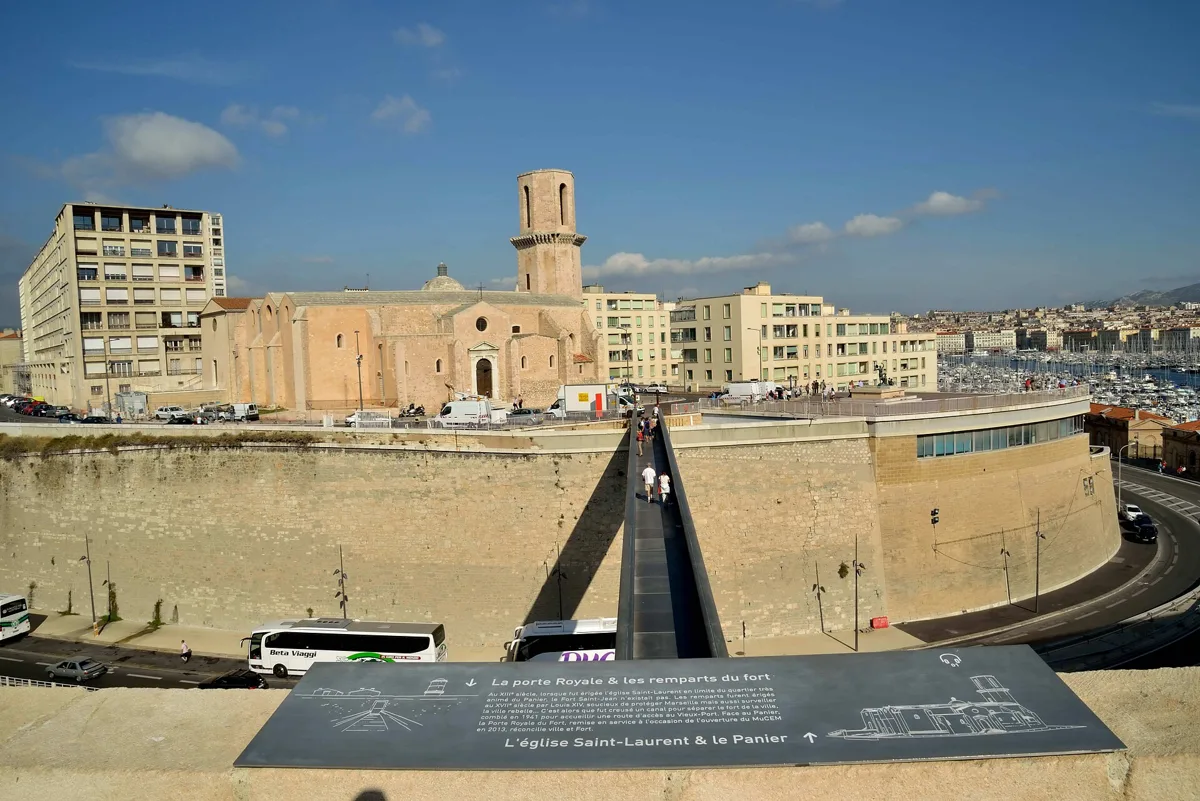
The fort has 2 entrances of its own: from the Old Port, through the Cour de la Commande at 201 Quai du Port, about 10 minutes on foot from Vieux-Port metro station (line 1); and from the Panier, over the footbridge from the Saint-Laurent church to the Place d’Armes. You can also cross from the J4 building, about 10 minutes from Joliette metro station (line 2). Buses 49, 60 and 82s stop at Fort Saint-Jean, and bus 83 at Mucem Fort Saint-Jean.
Our other Marseille stops are close by: the Old Port right below the walls, the basilica of Notre-Dame de la Garde on its hill across the water, and the Castle of If on its island out in the bay.
 Free audio guideOld Port of Marseille
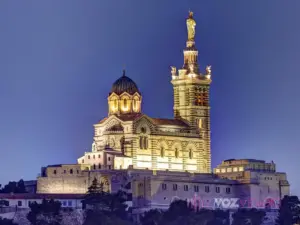 Free audio guideNotre-Dame de la Garde
 Free audio guideCastle of If
You will find them all in our free Marseille audio guides. In Spanish, this audio guide is on vozviajera.com.
Where to find it
FAQs
How do the free audio guides work?
They play right here on audioguidetravel.com, with no app to download and no sign-up. Press play and listen as you walk round: a phone and a pair of headphones are all you need. The audio streams from this page, so you’ll need mobile data or Wi-Fi.
Can I take the tour at my own pace?
Of course! You set the pace: pause whenever you like, jump back or forward 15 seconds, or tap the bar to jump to any point, and listen as many times as you want so you don’t miss a thing.
If I'm in a group, can we use the same audio guide?
Yes. The same free audio guide opens on as many phones as you like, so you can go round together as a group or with your family, each person at their own pace and with their own headphones. The quickest way is to send the link via WhatsApp, Telegram or however you like: the buttons just below let you share it right now.
Visitor information
As of 10 Nov 2026- Opening hours
- Wed-Mon 10:00-18:00 Nov-Apr; 10:00-19:00 May-Oct, 10:00-20:00 6 Jul-30 Aug
- Tickets
- Ramparts and gardens free · exhibitions €11, €7.50 reduced, €18 family
- Time needed
- About 1 hour for the ramparts and towers (our estimate)
- Getting there
- Metro Vieux-Port (line 1), 10 min on foot · buses 49, 60, 82s
- Accessibility
- Lift between the 2 entrances out of service; some areas not or only partly accessible (Nov 2026)
- Tip
- Closed Tuesdays; when it is open, the ramparts and gardens are free, no ticket needed
- Official website
- www.mucem.org
Nearby
More free audio guides in Marseille
 7:56MarseilleNotre-Dame de la GardeClimb the hill to visit the imposing basilica of Notre-Dame de la Garde, which overlooks the city from…
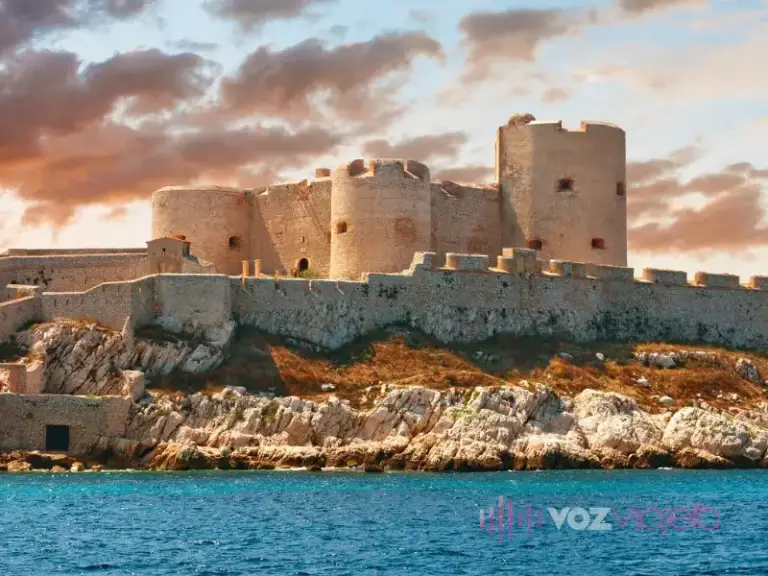 7:33MarseilleCastle of IfVisit the mysterious island of the Castle of If, immortalized in the novel The Count of Monte Cristo.…
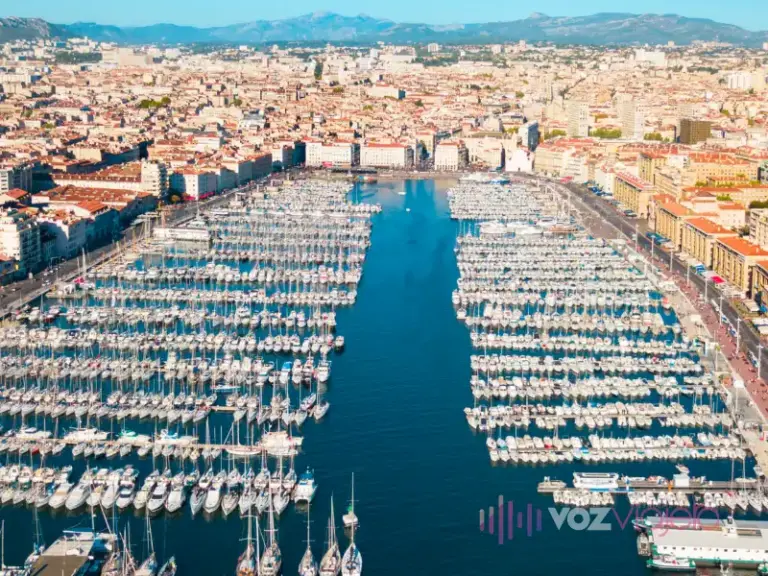 9:37MarseilleOld Port of MarseilleThe Old Port of Marseille is the historic heart of the city, with more than 2,600 years of…