
Trafalgar Square: free audio guide, Nelson’s Column and the lions
Free audio guide in English · no app, no sign-up
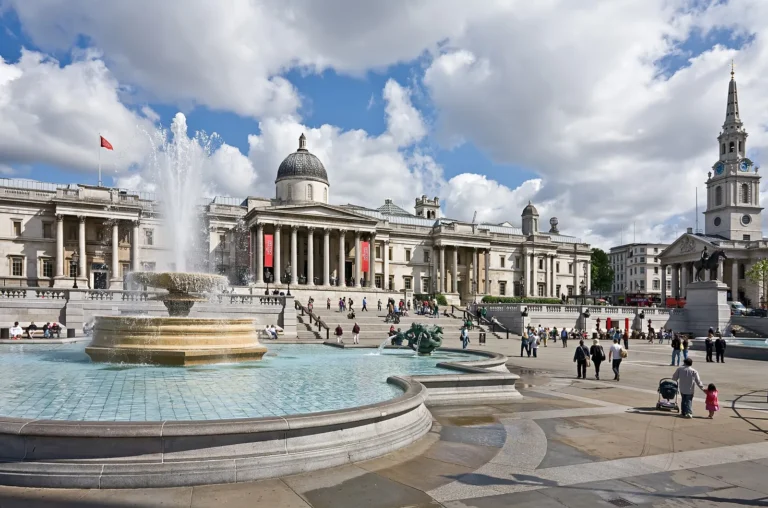
London’s best-known meeting point, Trafalgar Square is where Nelson stands on top of his column, 4 bronze lions guard its base and the National Gallery fills the north side. It is free and open day and night. This free audio guide takes about 4 minutes; play it sitting by one of the lions.
 Audio guide
Before you go in
The few things that change your visit.
- A public square, free and open at any hour
- Charing Cross Tube (Bakerloo and Northern lines), no lifts
- Nelson's Column is 44 m tall, built 1840-1843
- Landseer's 4 lions arrived in 1867
- Lady in Blue on the Fourth Plinth since 10 September 2026
London’s best-known meeting point, Trafalgar Square is the open square where Nelson stands on top of his column, 4 bronze lions guard its base and the National Gallery fills the whole north side. There is no gate and no ticket: the Mayor of London runs it as a public space, free day and night. This free audio guide takes about 4 minutes; play it sitting by one of the lions.
What the Trafalgar Square audio guide covers
Start it beside one of the lions, facing the National Gallery. It comes in 5 parts:
| A square built on stables | What stood here before, why it is called Trafalgar and who laid it out. |
| Nelson, way up there | The granite column, the admiral’s statue and the bronze platform made from old guns. |
| The lions | Landseer’s 4 lions, which turned up almost 25 years after the column. |
| The empty plinth | The 4 plinths in the square and the one that never got a permanent statue, now home to contemporary art. |
| Corners most people miss | A tiny police box, old units of length set into a wall, and the spot London measures its distances from. |
Getting to Trafalgar Square and when to go
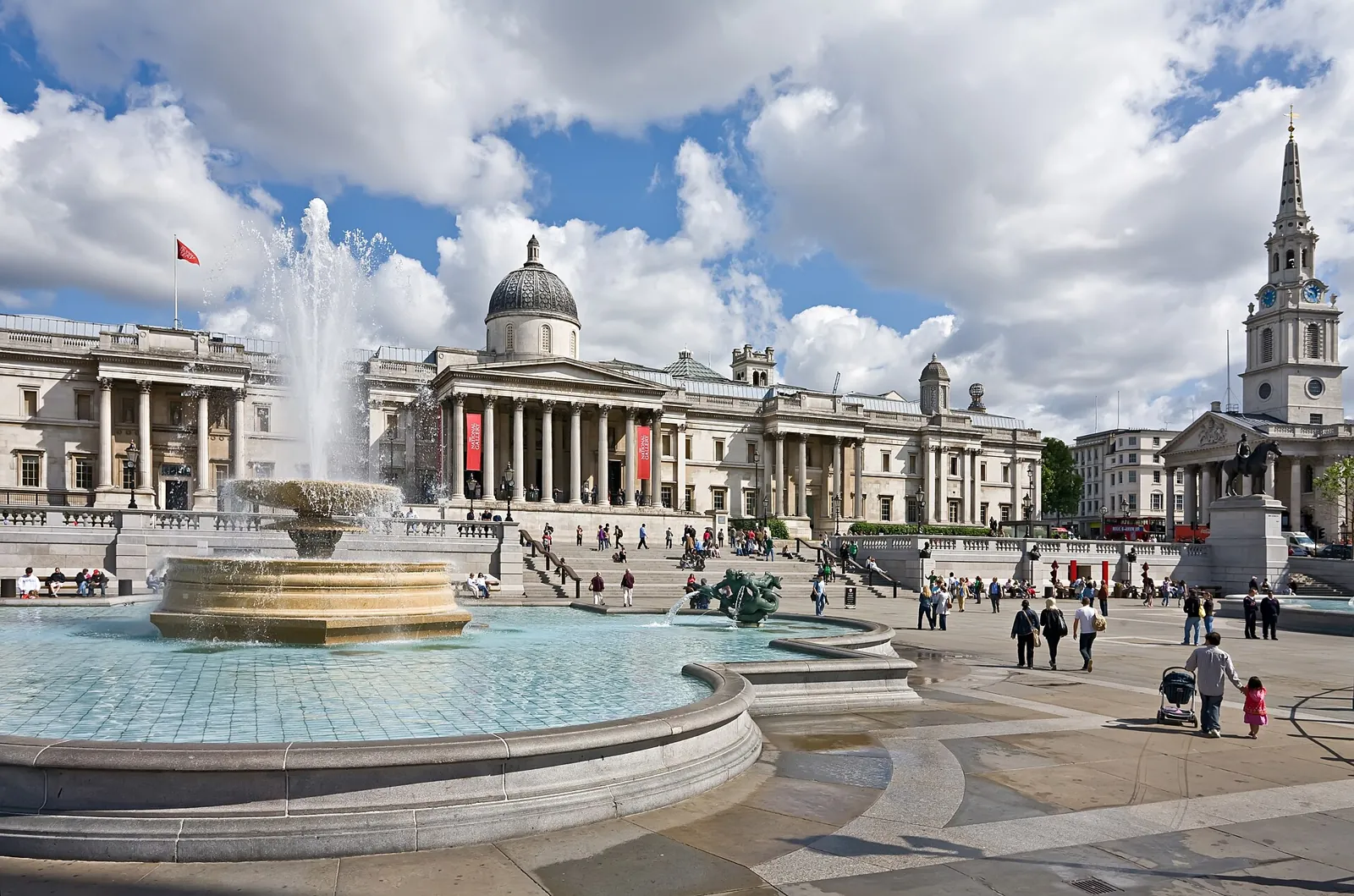
You can wander in at any hour: the square is open 24 hours a day and costs nothing. It is also a working civic space. The Mayor of London hands it over for cultural celebrations, events, filming and, very often at weekends, rallies and demonstrations, so a Saturday visit may come with a stage, a crowd or a march.
By Tube, get off at Charing Cross (zone 1), served by the Bakerloo and Northern lines and right next to the square. Buses are often simpler: routes 87, 91, 139 and 176 are among those stopping around it. On foot, it is a short stroll from Piccadilly Circus or Leicester Square.
Nelson’s Column and Landseer’s lions
From the 14th century this was the Great Mews, the royal stables serving Whitehall Palace. In 1812 the architect John Nash began reshaping the area, with the idea of a space open to the public, and once the stables moved behind Buckingham Palace the site was cleared. It was named Trafalgar Square in 1830, after the naval battle of 21 October 1805 in which Horatio Nelson beat the French and Spanish fleets and was killed in the battle. In 1838 Sir Charles Barry put forward the plan with the Nelson memorial and the 2 fountains.
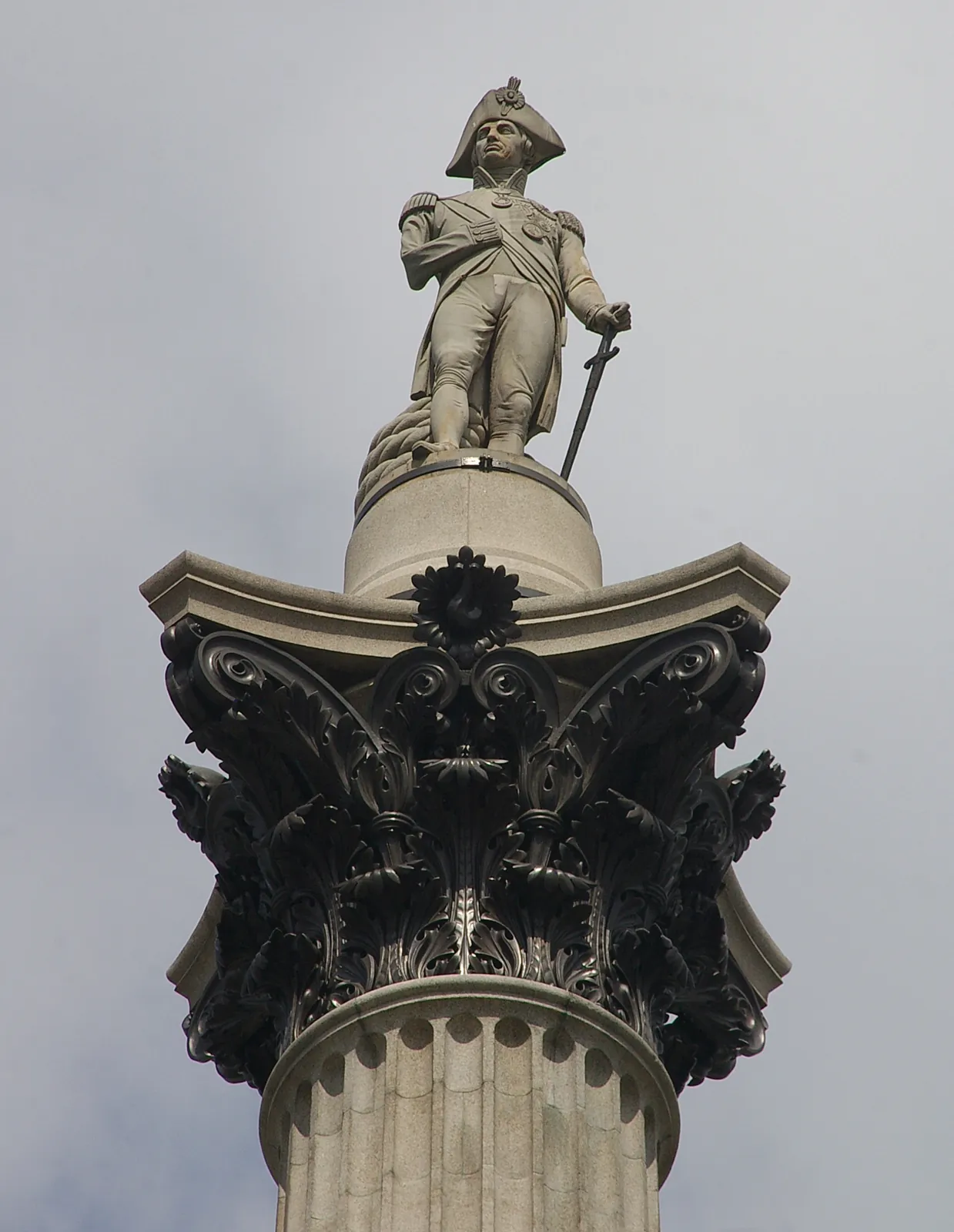
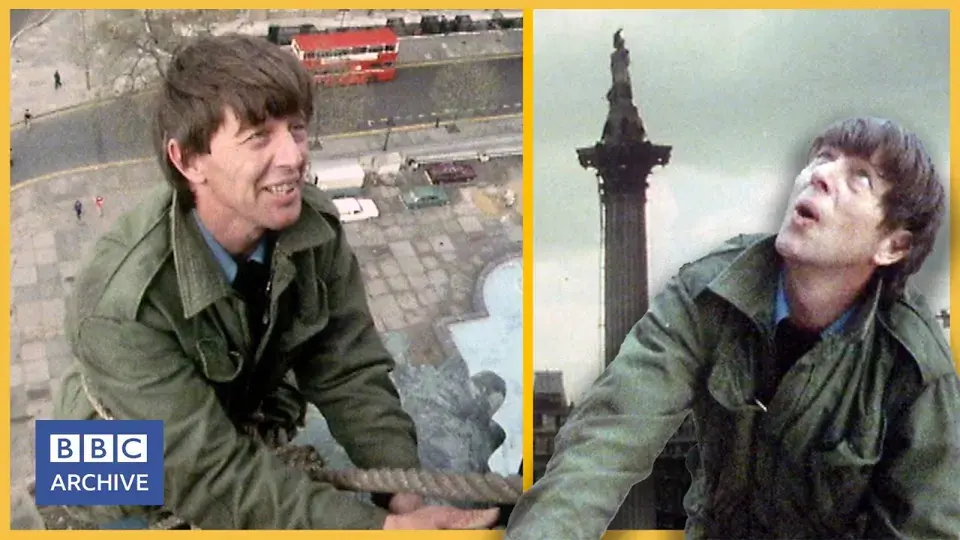
Nelson’s Column went up between 1840 and 1843 to a design by William Railton. It is a 44 m Corinthian column of granite with a bronze capital, topped by E. H. Baily’s statue of the admiral, about 5 m tall, standing on a bronze platform made from old guns from the Woolwich Arsenal foundry. Around the base, 4 bronze reliefs, all in place by 1852, show his great battles: Cape St Vincent, the Nile, Copenhagen and Trafalgar. The monument is Grade I listed, the highest grade in England, and is inspected every 2 years.
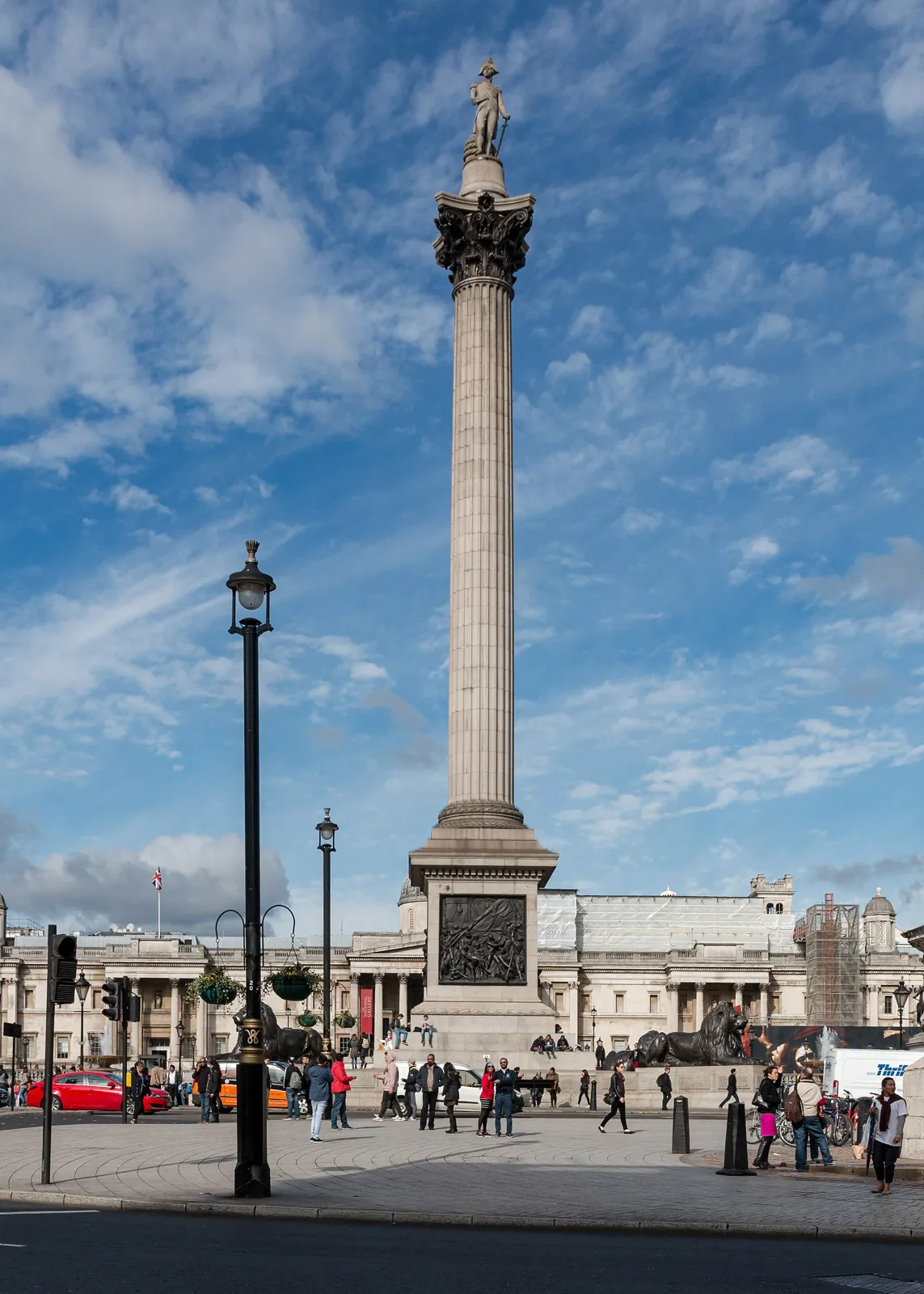
When the statue needed repairs, the restorers wanted the original stone, Craigleith sandstone. The Scottish quarry had closed long before, but some of the stone turned up during the restoration of Donaldson’s School for the Deaf in Edinburgh, and a Scottish company donated it to patch Nelson up.
The 4 bronze lions guarding the base were not part of the first plan. They were designed by the painter Sir Edwin Landseer, cast by Baron Marochetti and put in place in 1867, almost a quarter of a century after the column was finished.
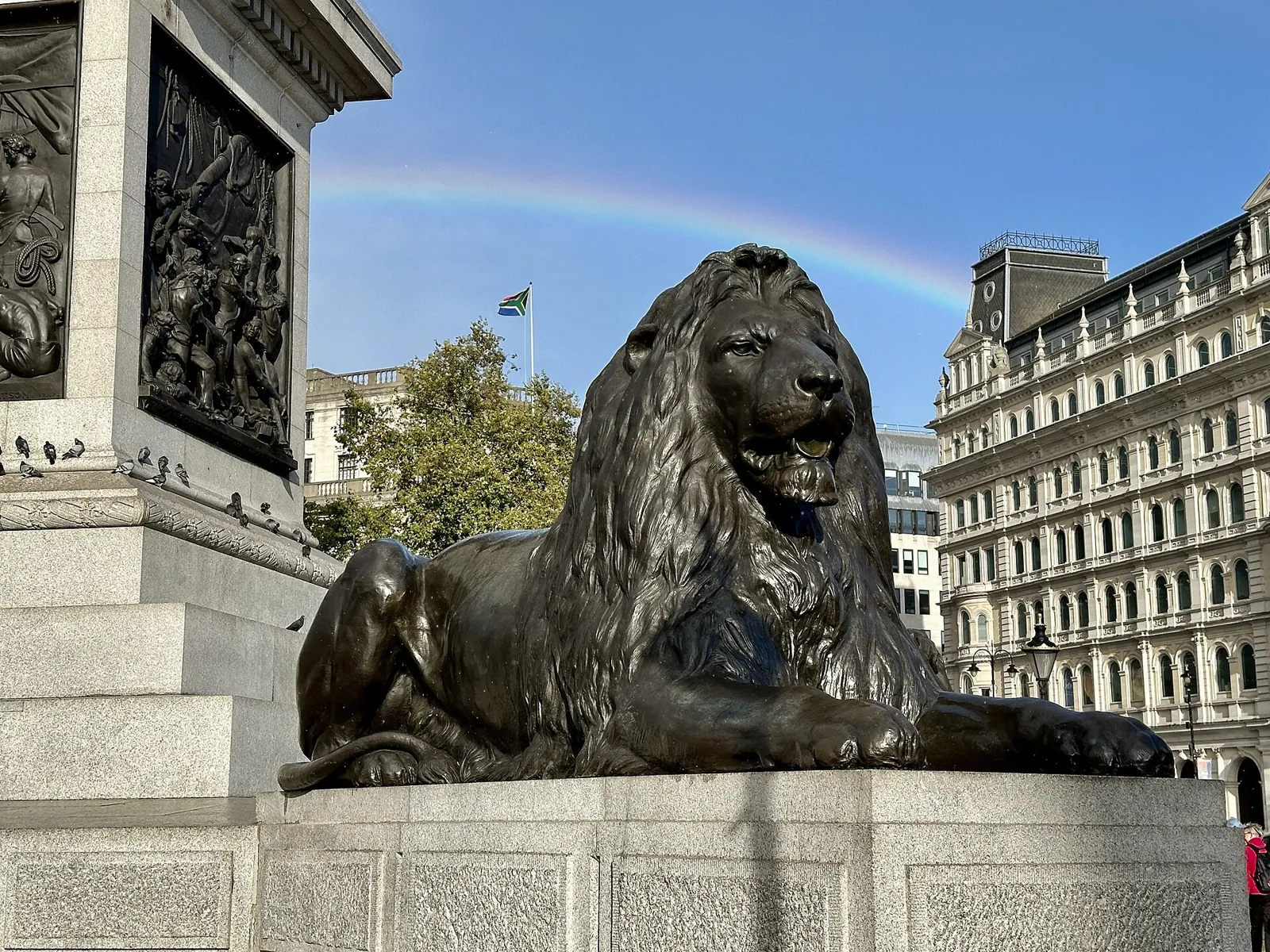
The fountains and the Fourth Plinth
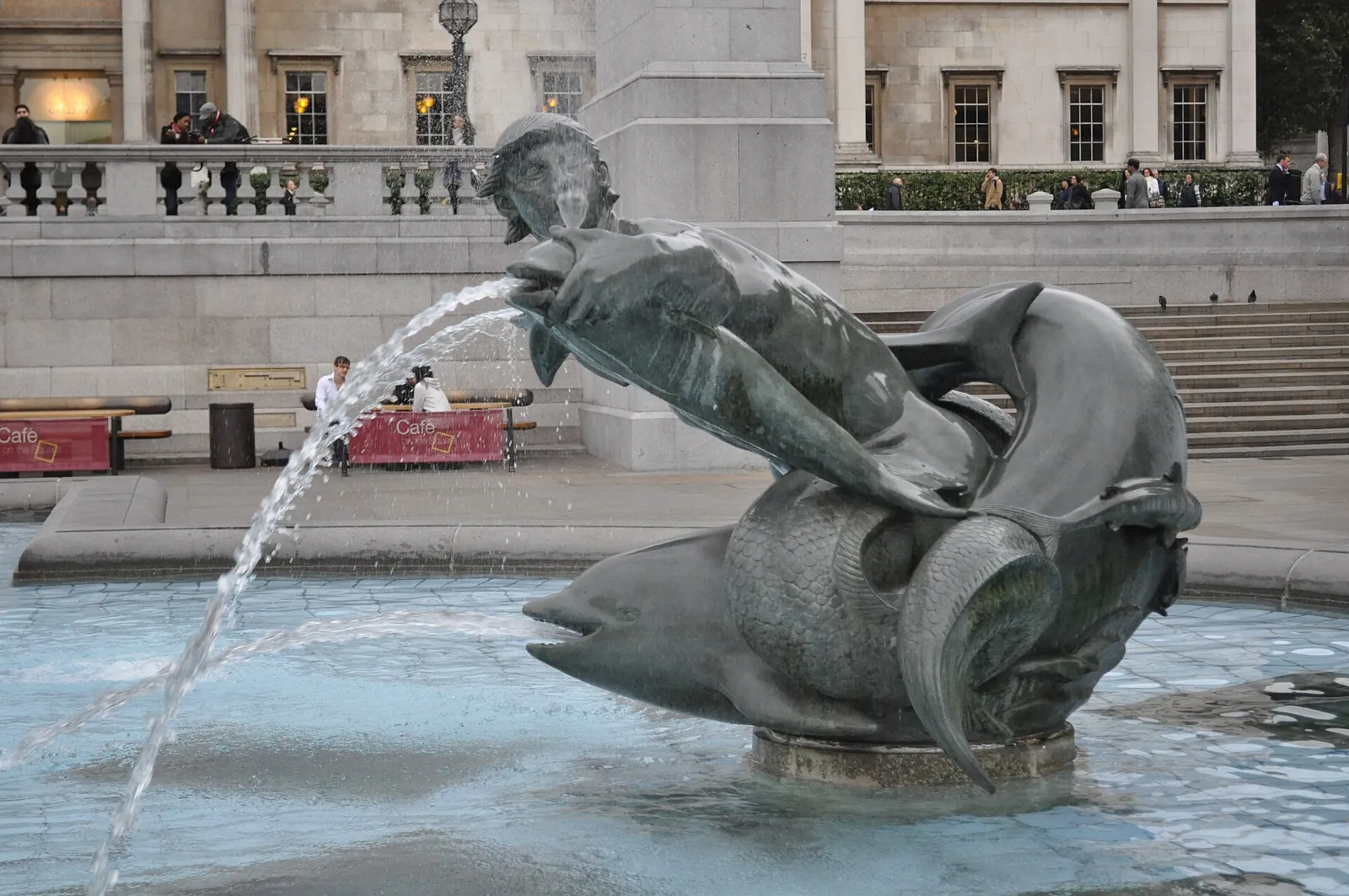
The 2 fountains date from 1845, and the mermaids, dolphins and tritons, the fish-tailed men, were added after the originals. Between 1937 and 1939 the architect Sir Edwin Lutyens replaced the basins with larger fountains, as memorials to Admirals Beatty and Jellicoe, whose bronze busts are on the north wall. The fountains run on most days.
There are 4 plinths at the corners of the square. 3 carry permanent bronze statues: King George IV on horseback in the north-east corner, from 1843; General Sir Charles Napier in the south-west, from 1856; and Major General Sir Henry Havelock in the south-east, from 1861. The fourth, in the north-west corner, never got its statue. Since 1999 it has shown specially commissioned contemporary artworks that change every couple of years: this is the Fourth Plinth.
On the lawn in front of the National Gallery stand statues of James II and George Washington, and on the south side is the equestrian statue of Charles I, cast in 1633. It stands on the site of the original Charing Cross, the point from which distances from London are still measured.
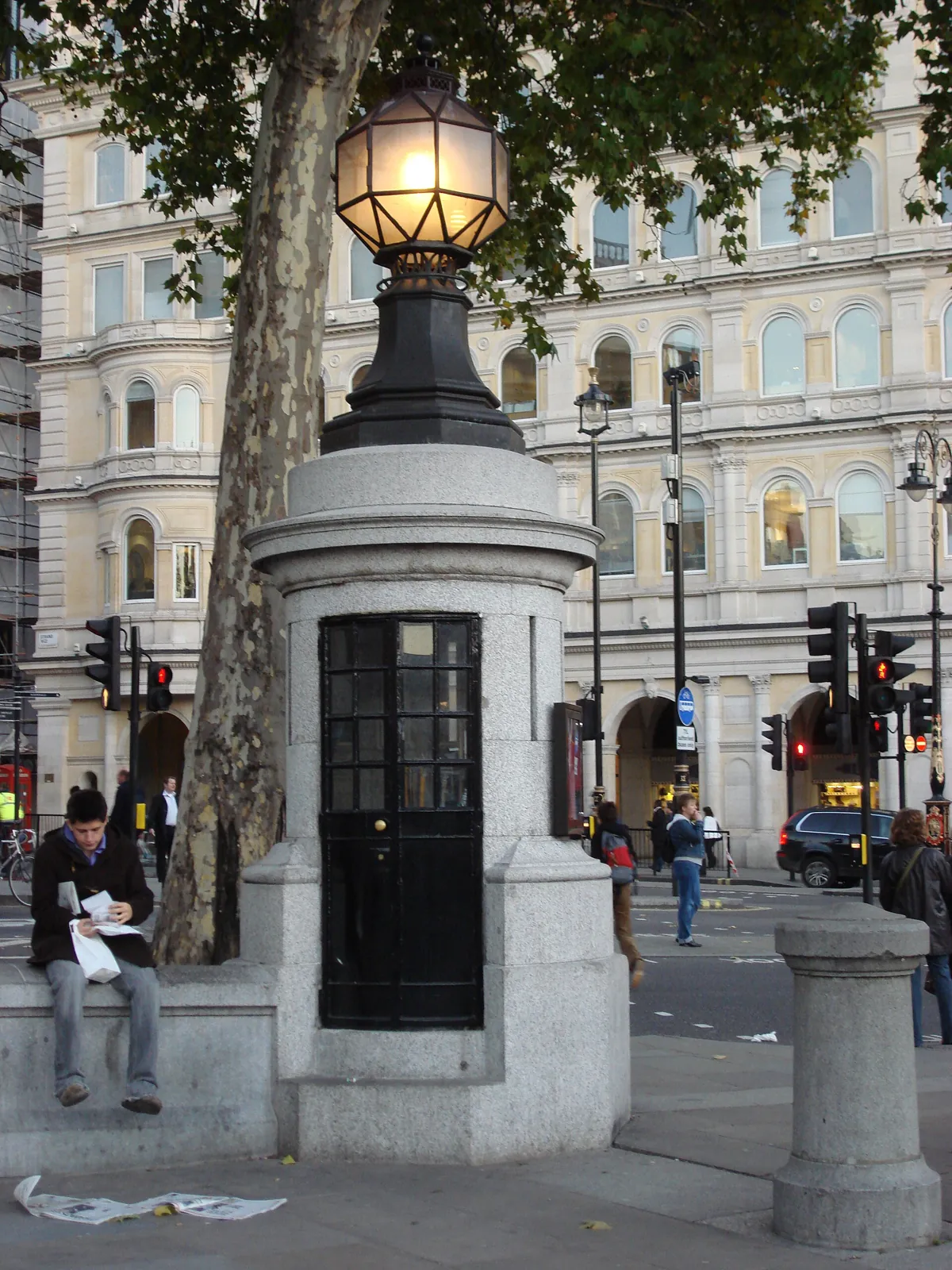
Hidden corners of Trafalgar Square
On the south-east corner stands what is probably the smallest police box ever built. It began as a lamp, put up in 1826; in 1926 Scotland Yard added a telephone line and a light so officers could call for help. Today it is used for storage, but it is still there, with its narrow door and the lamp on top.
In 1876 the Imperial Measures were set into the north terrace wall, so that surveyors could check archaic measures such as perches and chains against feet and yards. They were moved when the central staircase was built, and you can now find information about them outside the café on the square.
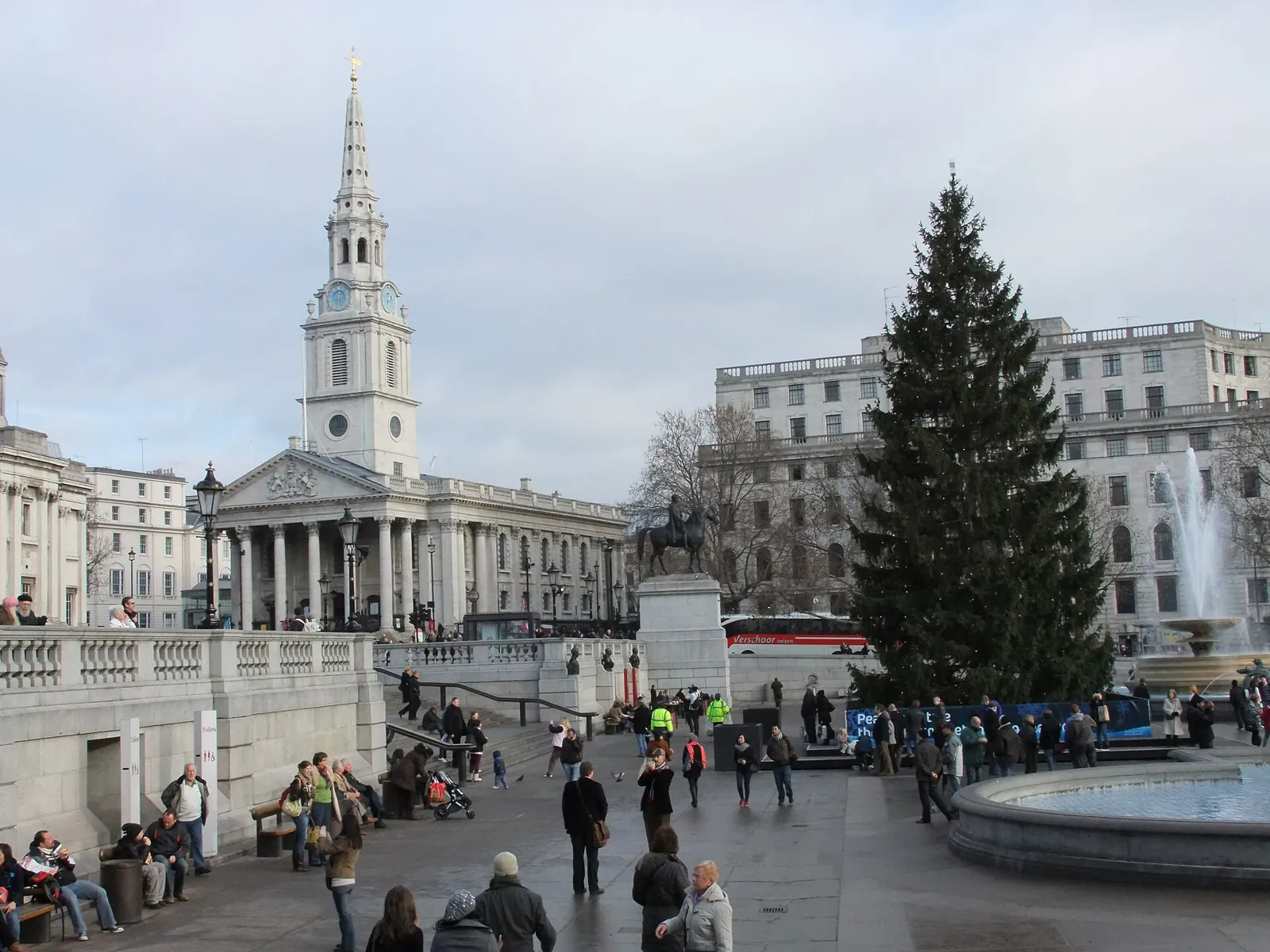
Every December the square puts up its Christmas tree, a Norway spruce sent by the city of Oslo every year since 1947 as thanks for Britain’s support during the Second World War.
What to see near Trafalgar Square
The north side belongs to the National Gallery, one of the world’s great picture collections: general admission is free, it is open daily from 10am to 6pm and until 9pm on Fridays, and it closes from 24 to 26 December and on 1 January. Only some exhibitions charge. On the north-east corner is James Gibbs’ church of St Martin-in-the-Fields, with Canada House on the west side of the square and South Africa House on the east.
Through Admiralty Arch, to the south-west, The Mall runs straight to Buckingham Palace. To the south, Whitehall leads down to Big Ben and Westminster Abbey, and to the north-west, Leicester Square and Piccadilly Circus are a short stroll away. The palace and the abbey each have their own audio guide:
 Free audio guideBuckingham Palace
 Free audio guideWestminster Abbey
Planning a longer walk? Every audio guide for the city is collected under London.
Where to find it
FAQs
How do the free audio guides work?
They play right here on audioguidetravel.com, with no app to download and no sign-up. Press play and listen as you walk round: a phone and a pair of headphones are all you need. The audio streams from this page, so you’ll need mobile data or Wi-Fi.
Can I take the tour at my own pace?
Of course! You set the pace: pause whenever you like, jump back or forward 15 seconds, or tap the bar to jump to any point, and listen as many times as you want so you don’t miss a thing.
If I'm in a group, can we use the same audio guide?
Yes. The same free audio guide opens on as many phones as you like, so you can go round together as a group or with your family, each person at their own pace and with their own headphones. The quickest way is to send the link via WhatsApp, Telegram or however you like: the buttons just below let you share it right now.
Visitor information
As of 10 Oct 2026- Opening hours
- Public square, open 24 hours a day, every day.
- Tickets
- Free: it is a public square with no ticket. The National Gallery is free too.
- Time needed
- A 4-minute audio guide; the square, as long as you like.
- Getting there
- Tube: Charing Cross (Bakerloo and Northern lines), by the square. Buses incl. 87, 91, 139, 176.
- Accessibility
- The square has a step-free lift (since 2003); Charing Cross Tube station has none.
- Tip
- Go up to the National Gallery terrace for the column, the fountains and Whitehall.
- Official website
- www.london.gov.uk
Nearby
More free audio guides in London
 2:44LondonBuckingham Palace: free audio guide, tickets and opening timesBuckingham Palace began as a townhouse built in 1703 for the Duke of Buckingham and became a palace…
 2:44LondonTower Bridge: free audio guide, hours and ticketsTower Bridge is the bascule bridge that Horace Jones and John Wolfe Barry designed and that went up…
 3:51LondonCamden Market, Camden Town: free audio guide, hours and getting thereCamden Market is the sprawling market of vintage clothes, vinyl, crafts and street food beside Regent’s Canal in…