
Monasterio de San Juan de los Reyes, Toledo: free audio guide
Free audio guide in English · no app, no sign-up
The Monasterio de San Juan de los Reyes is the Franciscan monastery Queen Isabella of Castile built in Toledo to give thanks for the victory at Toro in 1476, and the finest example of Isabelline Gothic. This free audio guide runs for about 4 minutes; play it in the cloister.
 Audio guide
Before you go in
The few things that change your visit.
On this page
- What the San Juan de los Reyes audio guide covers
- Opening hours, tickets and getting to San Juan de los Reyes
- Why the Catholic Monarchs built San Juan de los Reyes
- Inside the church of San Juan de los Reyes
- The cloister of San Juan de los Reyes and its gargoyles
- What to see near San Juan de los Reyes
- Where to find it
The Monasterio de San Juan de los Reyes is the Franciscan monastery Queen Isabella of Castile built in Toledo to give thanks for the victory at Toro in 1476, and the finest example of the late Gothic style Spain calls Isabelline. A €4 ticket covers the church, both cloisters and the old sacristy. This free audio guide runs for about 4 minutes; play it in the cloister.
What the San Juan de los Reyes audio guide covers
Press play in the lower cloister, by the garden; the last stop is the church. It comes in 5 parts:
| A queen’s vow | Why Isabella built it, and what she first meant it to be. |
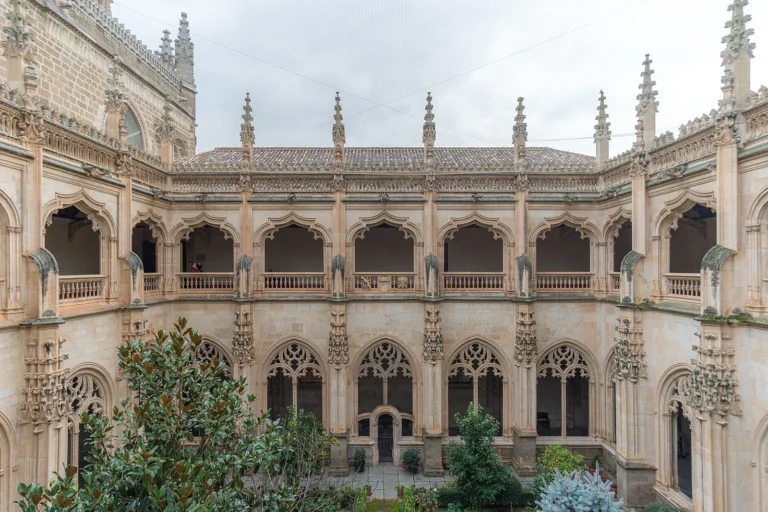
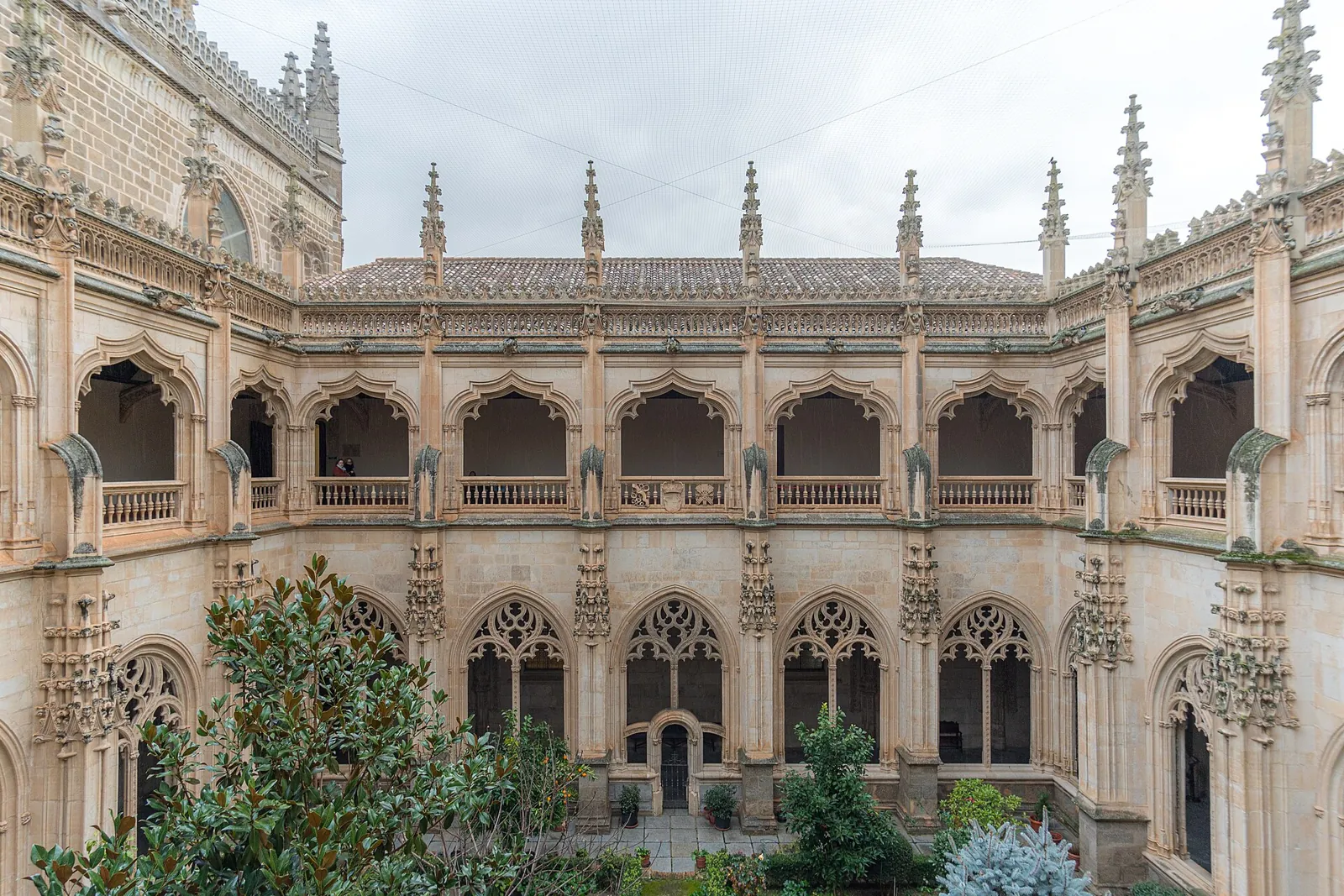
| The lower cloister | Lace-like stone windows, rib vaults and carving that never repeats itself. |
| The gargoyles | The stone beasts on the roof, and the date one of them carries. |
| The upper cloister | A painted wooden ceiling covered in the Catholic Monarchs’ badges. |
| The church | Coats of arms, a royal inscription running round the walls and the chains outside. |
Opening hours, tickets and getting to San Juan de los Reyes
The monastery opens every day, with no lunch break, apart from the closing days below. Winter hours, from 16 October to 28 February, are 10:00 to 17:45; summer hours, from 1 March to 15 October, are 10:00 to 18:45. The ticket desk shuts 20 minutes before closing, so in winter aim to arrive before 17:00 to be safe. It is closed on 25 December and 1 January, and on 24 and 31 December it closes at 13:00. You do not need to book.
A standard ticket is €4 (for anyone over 16). Children aged 11 to 16, students and holders of a youth card pay €3, large families and visitors with a disability of up to 64 % pay €2.50, and children under 11 and visitors with a disability above 64 % go free. You can buy at the desk or online.
Planning to see 4 or more of Toledo’s historic sights? The tourist wristband (pulsera turística) costs €14, lasts 7 days and gets you into 7 sights: this one, Santo Tomé, Santa María la Blanca, El Salvador, the Jesuit church, the Cristo de la Luz mosque and the Real Colegio de Doncellas Nobles. Any of them will sell you one.
The visitor entrance is at Calle de los Reyes Católicos 17, on the west side of the old town, on the same street as the Santa María la Blanca synagogue. The big doorway on the square is the church door used for services, although on days with a religious celebration it may be the way into the church. From Toledo railway station it is about 1.8 km as the crow flies.
Why the Catholic Monarchs built San Juan de los Reyes
On 1 March 1476, on the fields of Toro, in the province of Zamora, Ferdinand of Aragon’s army beat the supporters of Juana la Beltraneja and of King Afonso V of Portugal. That battle opened the way to the throne of Castile for Isabella, and she wanted Toledo to remember it, with a church that would also be the tomb for her and her husband. She dedicated it to Saint John the Evangelist, her favourite saint, and gave it to the Franciscans.
Work began around 1477, with Juan Guas as the main architect. The church and its lantern tower were up by 1486, the carving of the crossing by 1490 and the lower cloister by 1495; the whole monastery was only finished around 1525 or 1526, under Charles V, Isabella’s grandson. By then it was no longer meant to be a royal pantheon: after taking Granada in 1492, the monarchs chose that city as their burial place.
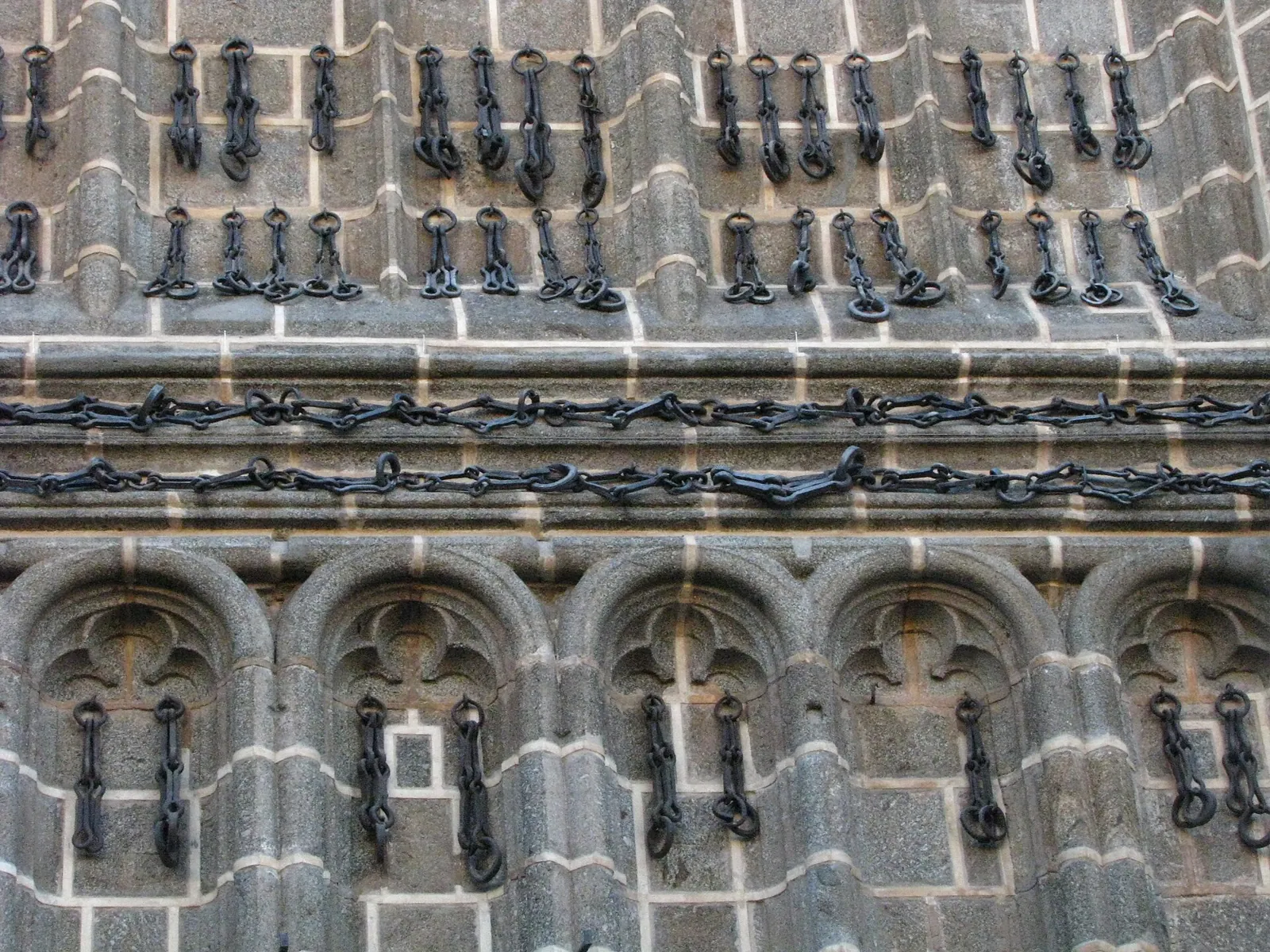
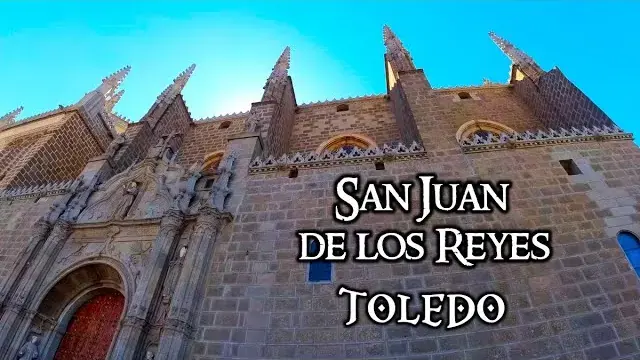
Outside, you will notice the iron chains hanging on the granite walls. They belonged to Christian captives freed during the war for Granada, in the campaigns of Málaga and Almería, and the freed men brought them to Toledo as a thank-offering. There must once have been many more.
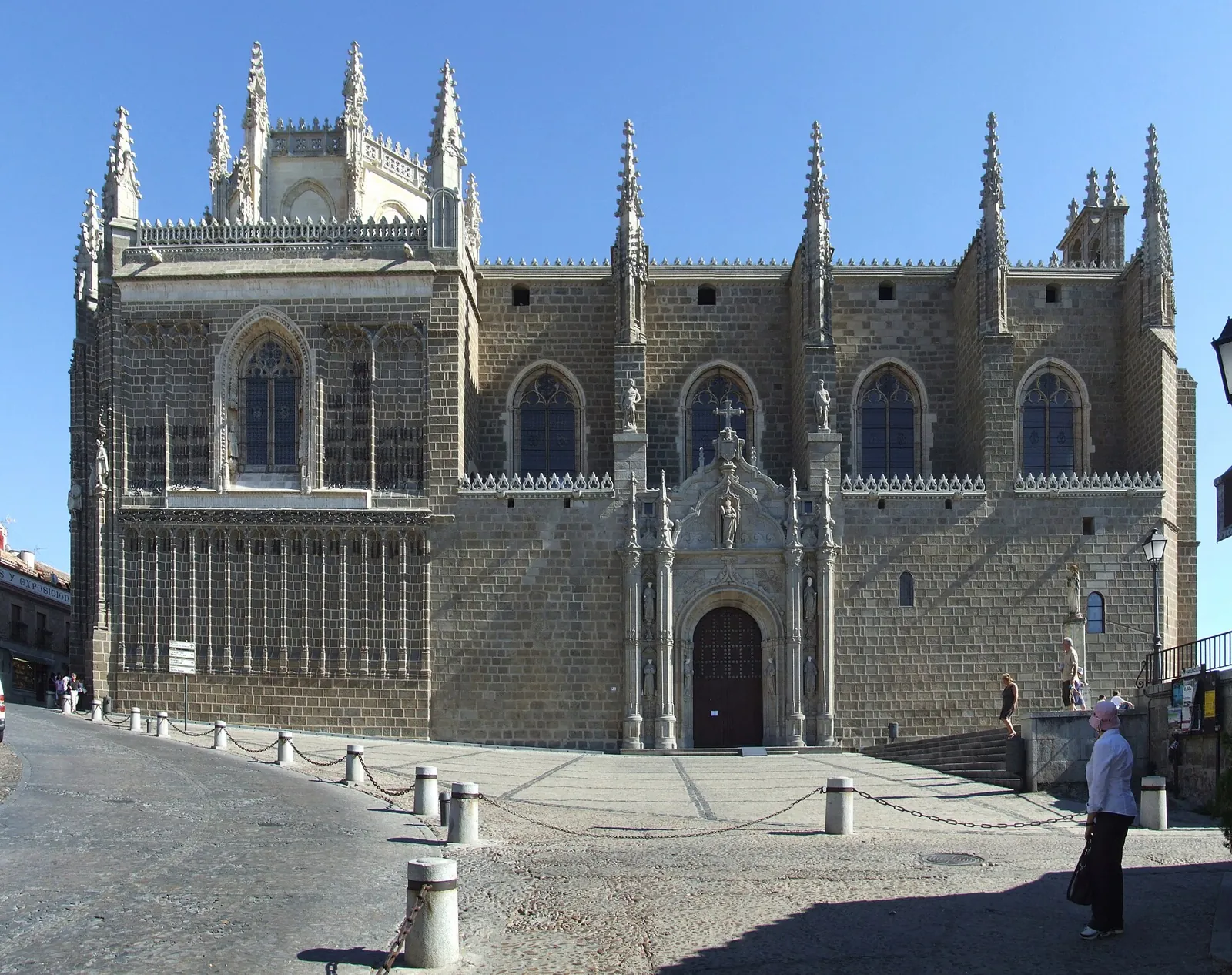
The main doorway of the church, the one facing the square, came much later. It was carved between 1606 and 1610 to a design by Covarrubias, when Gothic was long out of fashion: Franciscan saints gather round Saint John, and 2 soldiers dressed as Romans keep watch from the top of the buttresses.
Inside the church of San Juan de los Reyes
The church has a single nave on a Latin-cross plan, 55 m long, 12 m wide and 30 m high, with shallow chapels between the piers. Look up: the rib vaults are dotted with coats of arms, yokes, bundles of arrows and the crowned initials of the king and queen, like a starry sky, and the motto “tanto monta” turns up again and again.
Halfway up the walls, a carved band runs right round the church with an inscription in Gothic letters recording who built it: Don Hernando and Doña Ysabel, king and queen of Castile, León, Aragon and Sicily. From the middle of the piers spring the royal galleries, the most lavish corner of the whole building, a lace of pierced stone crowded with the monarchs’ initials.
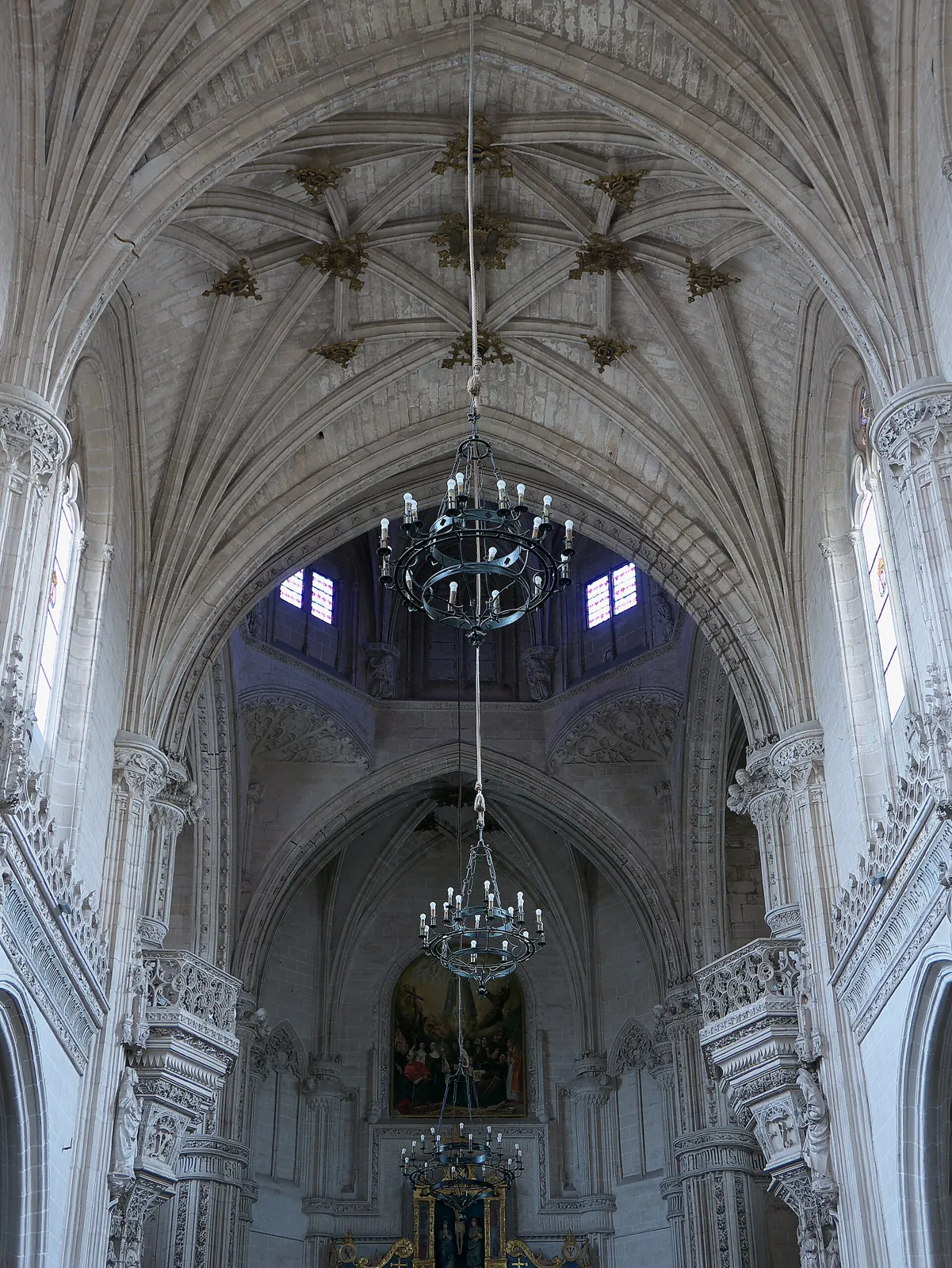
The original altarpiece was lost in the Napoleonic wars. The one over the high altar today came from the Hospital de Santa Cruz in Toledo; it is the work of Francisco de Comontes and tells the story of Saint Helena and the True Cross.
The cloister of San Juan de los Reyes and its gargoyles
The lower cloister was designed as an extension of the church. Each walk is 30 m long, 4.20 m wide and 8 m high, and its 20 windows, 5 on each side, are filled with pierced tracery that looks like latticework. No two arches are carved alike: leaves, animals and little figures, which play with light and shade when the sun is out.
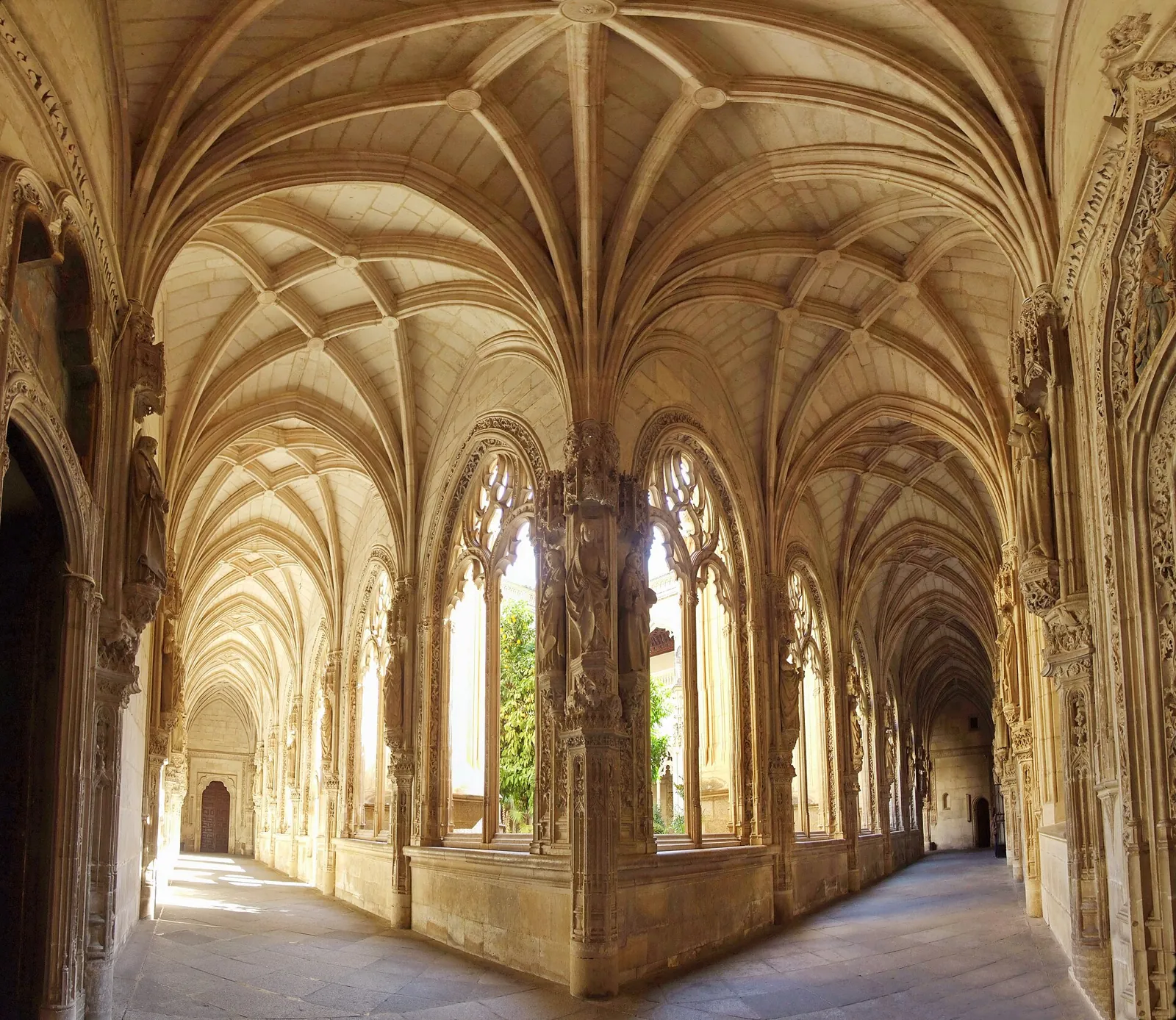
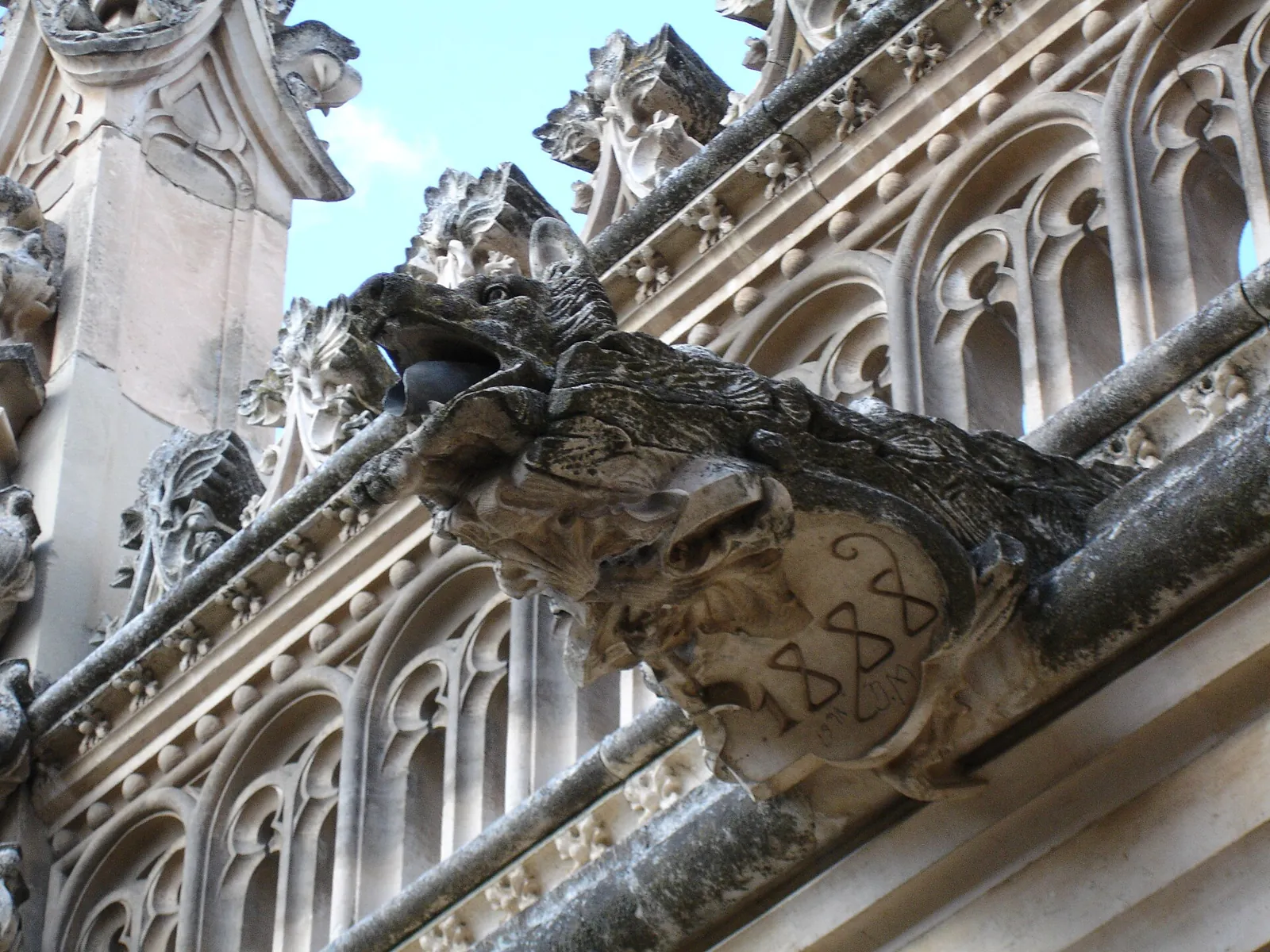
Much of what you see here is a 19th-century rescue. The monastery was badly damaged during the Peninsular War in 1808, and in 1836 the friars were thrown out when Church property was seized and sold off. Restoration under the architect Arturo Mélida began in 1883: he rebuilt vaults and walks, and designed the cresting along the roof and the gargoyles. Those wildly shaped beasts belong to the Romantic taste of the 1800s, not to the age of Isabella and Ferdinand. The Franciscans returned in 1954, and the church reopened for worship in 1967.
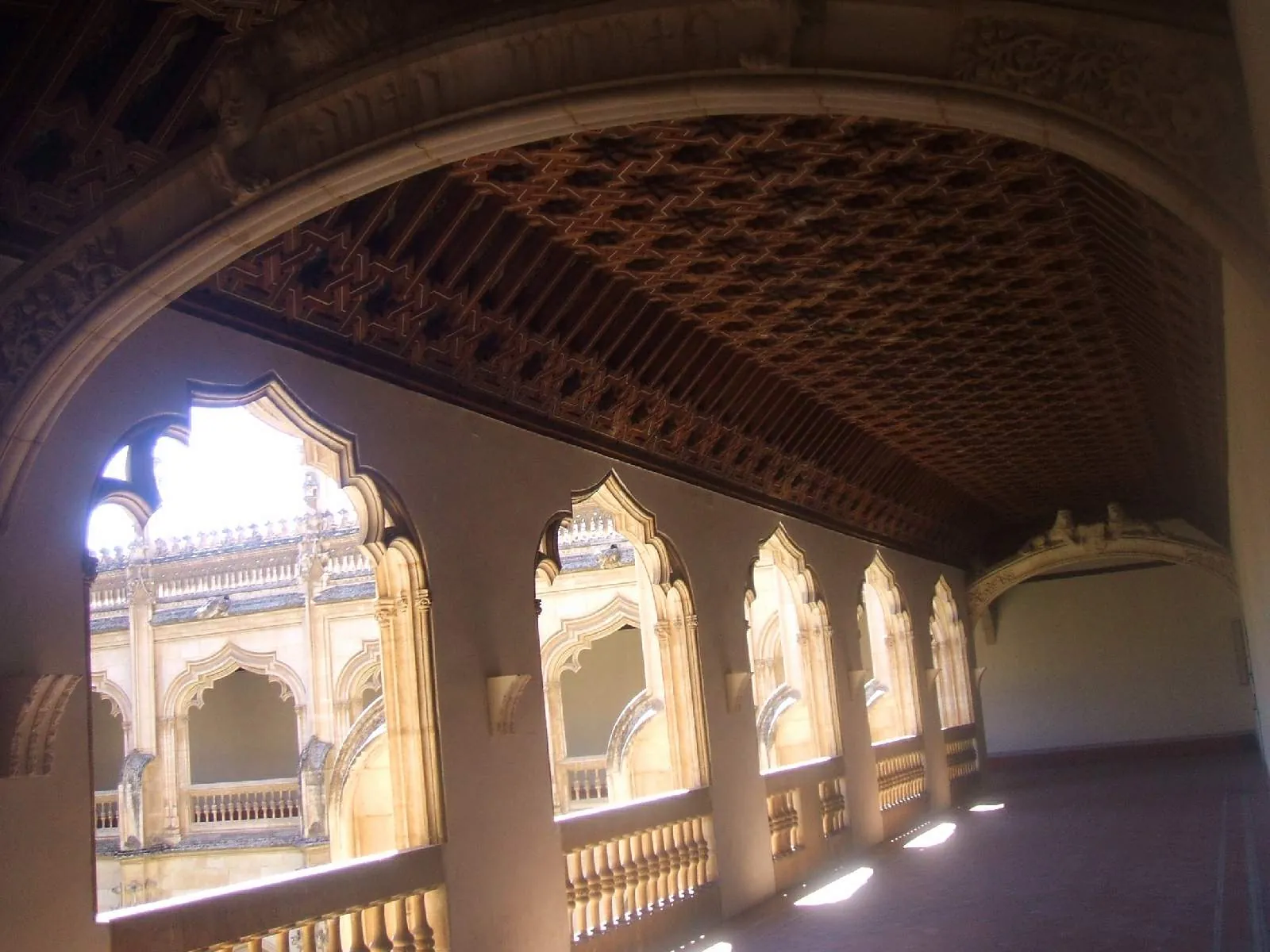
A 4-flight staircase takes you up to the upper cloister; its Plateresque, early Renaissance decoration is credited to Alonso de Covarrubias and includes the double-headed eagles of Emperor Charles V. Upstairs is plainer: whitewashed walls, a height of 4.60 m and a ceiling of painted larch wood covered in the badges of the Catholic Monarchs. Roaring lions on the arches hold up the shields of the kingdoms, Granada and Navarre among them, beside the motto “tanto monta, monta tanto”.
What to see near San Juan de los Reyes
You are in Toledo’s old Jewish quarter. About 130 m away, on the same street, is the Santa María la Blanca synagogue, and about 300 m away as the crow flies is the church of Santo Tomé, home to El Greco’s The Burial of the Count of Orgaz; both are on the tourist wristband. Towards the river Tagus, about 250 m away, is the San Martín bridge, and the cathedral is about 650 m off, again as the crow flies.
If you are visiting from Madrid, the El Escorial monastery has a free audio guide too:
 Free audio guideEl Escorial Monastery
All the audio guides for the city are on the Toledo page, and the rest of the country is under Spain.
Where to find it
FAQs
How do the free audio guides work?
They play right here on audioguidetravel.com, with no app to download and no sign-up. Press play and listen as you walk round: a phone and a pair of headphones are all you need. The audio streams from this page, so you’ll need mobile data or Wi-Fi.
Can I take the tour at my own pace?
Of course! You set the pace: pause whenever you like, jump back or forward 15 seconds, or tap the bar to jump to any point, and listen as many times as you want so you don’t miss a thing.
If I'm in a group, can we use the same audio guide?
Yes. The same free audio guide opens on as many phones as you like, so you can go round together as a group or with your family, each person at their own pace and with their own headphones. The quickest way is to send the link via WhatsApp, Telegram or however you like: the buttons just below let you share it right now.
Visitor information
As of 16 Oct 2026- Opening hours
- Daily 10:00-17:45 (16 Oct to 28 Feb) and 10:00-18:45 (1 Mar to 15 Oct); desk shuts 20 min earlier.
- Tickets
- €4 standard; €3 or €2.50 reduced; under-11s free. 7-sight tourist wristband €14.
- Time needed
- Audio guide about 4 min; the visit takes as long as you like.
- Getting there
- Calle de los Reyes Católicos 17, in the old Jewish quarter; enter from that street.
- Accessibility
- Wheelchair access to the lower cloister, sacristy and church (tell the desk); not the upper cloister.
- Tip
- In the cloister, look for the wolf-shaped gargoyle: it has the year 1888 carved on it.
- Official website
- www.sanjuandelosreyes.org
Nearby
More free audio guides in Spain
 4:26SevilleFlamenco Dance MuseumImmerse yourself in the heart of flamenco at the Flamenco Dance Museum in Seville, a sanctuary dedicated entirely…
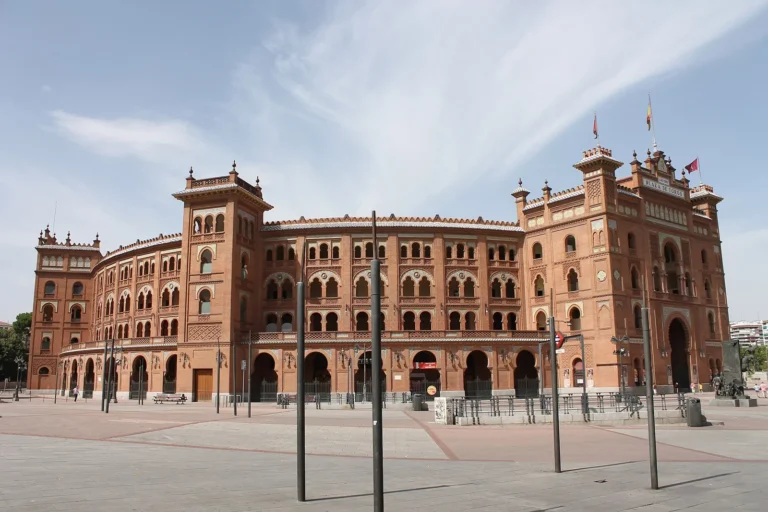 3:53MadridLas Ventas Bullring, Madrid: free audio guide, tour, ticketsLas Ventas is Madrid’s bullring: a red-brick Neo-Mudéjar landmark on Calle de Alcalá, opened in 1931 and the…
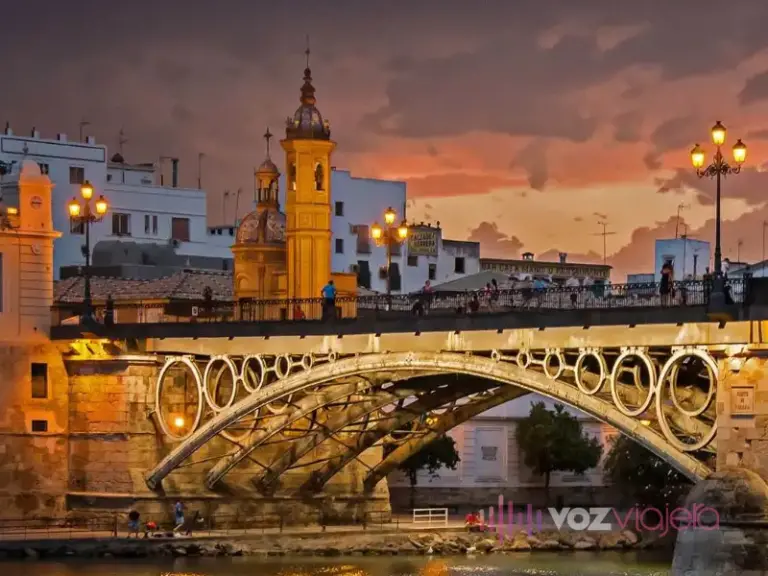 5:36SevilleTriana BridgeSeville, a city where every corner tells a story, invites you to cross the Triana Bridge or Isabel…