
British Museum: free audio guide, opening times and tickets
Free audio guide in English · no app, no sign-up
The British Museum is London’s great museum of human history. It was founded in 1753, opened in 1759 and entry is still free. It holds the Rosetta Stone, the Parthenon sculptures and the Sutton Hoo treasure, and until 11 July 2027 it also shows the Bayeux Tapestry.
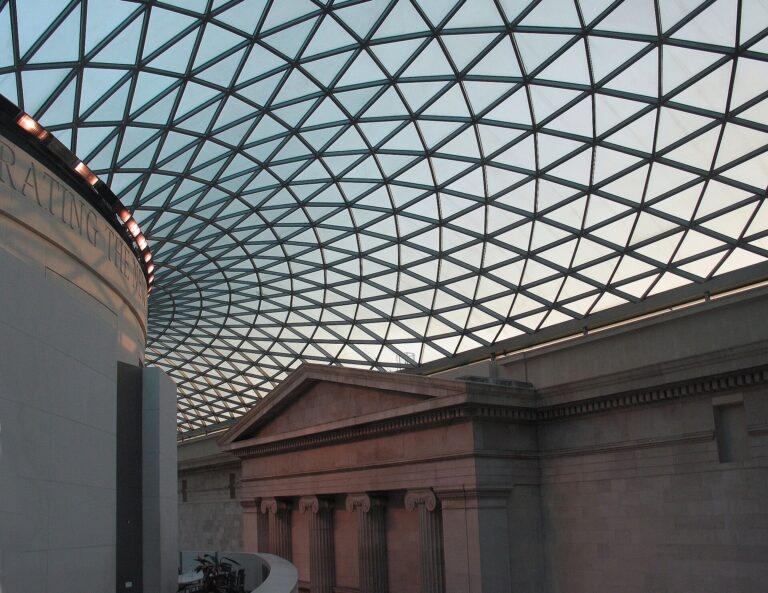 Audio guide
Before you go in
The few things that change your visit.
- Entry is free; book a timed slot for priority entry
- Open daily 10:00 to 17:00, and until 20:30 on Fridays
- Route: Rosetta Stone in Room 4, Parthenon in 18, mummies in 62-63, Sutton Hoo in 41
- Bayeux Tapestry in Room 30 until 11 July 2027; 2026 is sold out
- No wheeled suitcases, whatever their size
- Big Ben is about 2.1 km due south
On this page
- What the audio guide tells you
- Opening times, free tickets and gallery closures
- What to see in the British Museum: 5 objects and their rooms
- The Bayeux Tapestry and other exhibitions in 2026 and 2027
- British Museum history: from Sloane's collection to the Great Court
- Getting there, bag rules and access
- Combine it with other London audio guides
- Where to find it
The British Museum is London’s great museum of human history: 2 million years of it, spread across more than 50 galleries, from the Rosetta Stone to the Parthenon sculptures and the Sutton Hoo treasure. Entry is free, and it opens daily from 10:00 to 17:00, until 20:30 on Fridays. This is its free audio guide, made to be heard as you walk in, and it gives you a route by room number.
What the audio guide tells you
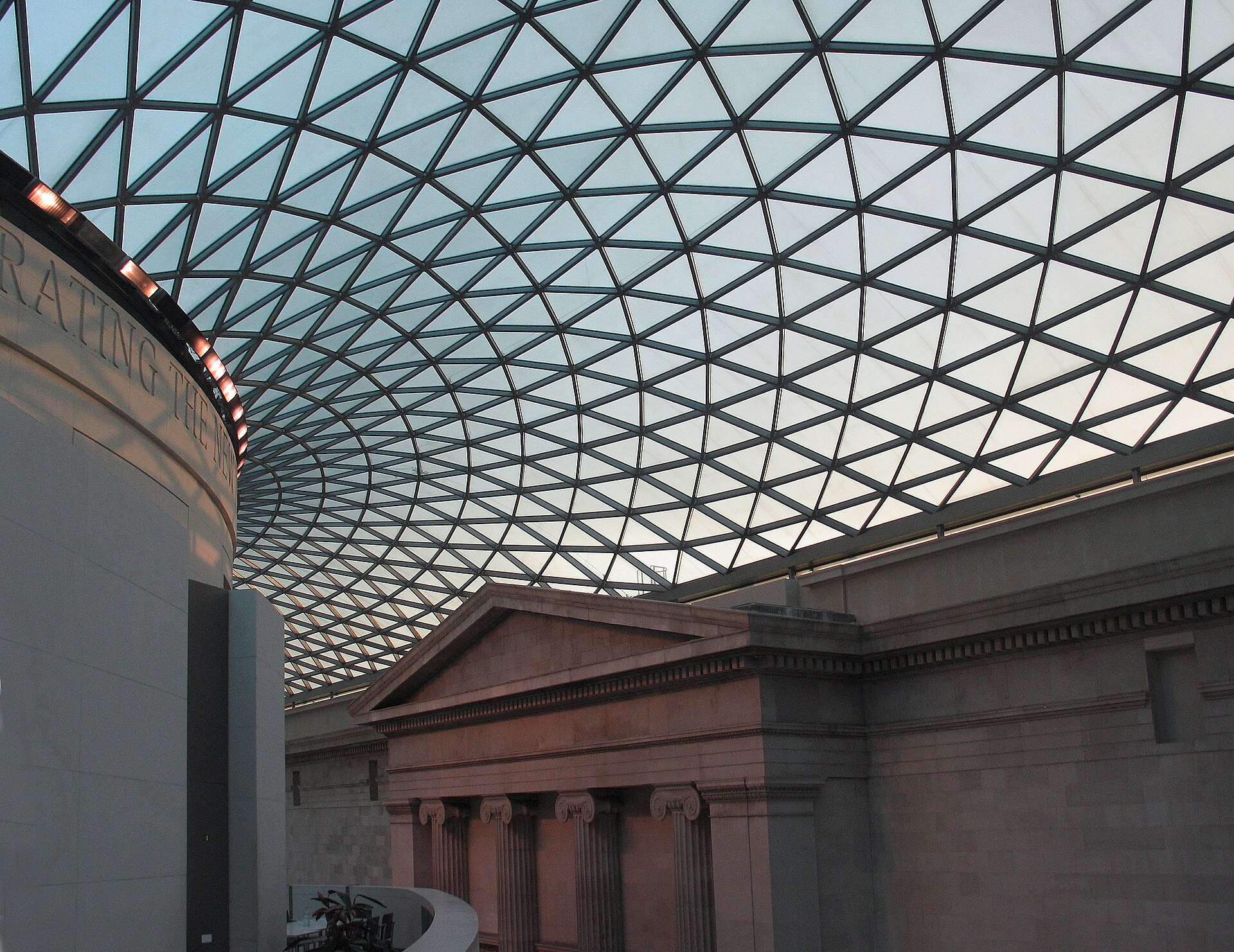
The audio guide lasts about 3 minutes. Press play under the glass roof of the Great Court, before you head off into the galleries. It doesn’t try to cover the whole museum: it picks 5 objects, tells you which room each one is in, and flags the Bayeux Tapestry. These are its stops:
| Under the glass roof | Where you are standing: the largest covered public square in Europe, opened in 2000, with the 1857 Reading Room at its heart. |
| A museum of everything | Founded in 1753, open since 1759, and built on the 71,000 objects of one physician, Sir Hans Sloane. |
| The route by numbers | The Rosetta Stone in Room 4, the winged bulls in Room 10, the Parthenon in Room 18, the mummies in Rooms 62 and 63, and Sutton Hoo in Room 41. |
| A visitor from France | The Bayeux Tapestry, in Room 30 until 11 July 2027. |
| Before you go | Why you don’t need to see it all today, and which way to walk for Big Ben. |
Opening times, free tickets and gallery closures
The permanent collection is free; you only pay for special exhibitions. Even so, it’s worth booking a free timed ticket on the museum’s website: it gets you priority entry at busy times. Without one, entry depends on capacity and you can expect a queue at peak times. One booking covers up to 9 people, and you should arrive at your time slot, not before.
| Opening hours | Daily, 10:00 to 17:00; Fridays until 20:30 |
| Last entry | 16:45; Fridays 20:15 |
| Great Court | 10:00 to 17:30; Fridays until 20:30 |
| Closed | 24, 25 and 26 December |
| Price | Free; special exhibitions are charged separately |
The Friday late opening runs every week except Good Friday (26 March 2027), with the last time slot at 19:00. Galleries start clearing 10 minutes before closing.
Some dates to know. On 30 September 2026 the museum closes at 15:30 for an event. Maintenance closures are also scheduled: Room 41, home of Sutton Hoo, is partly closed from 12 to 23 October 2026, and Room 4, the Rosetta Stone’s room, from 11 to 22 January 2027. Galleries can also close at short notice, so check the list of open galleries on the day.
The museum’s own audio guide is the Audio app. It’s a free download with 65 gallery introductions at no cost; the full guide covers 250 objects and costs £6 per language, and themed tours cost £1.99 to £2.99. Bring your own headphones and download it before you go.
What to see in the British Museum: 5 objects and their rooms
Nobody sees more than 50 galleries in a day, so go for a handful of objects. This is the audio guide’s route: the first 3 stops are on the ground floor and the last 2 on the upper floors.
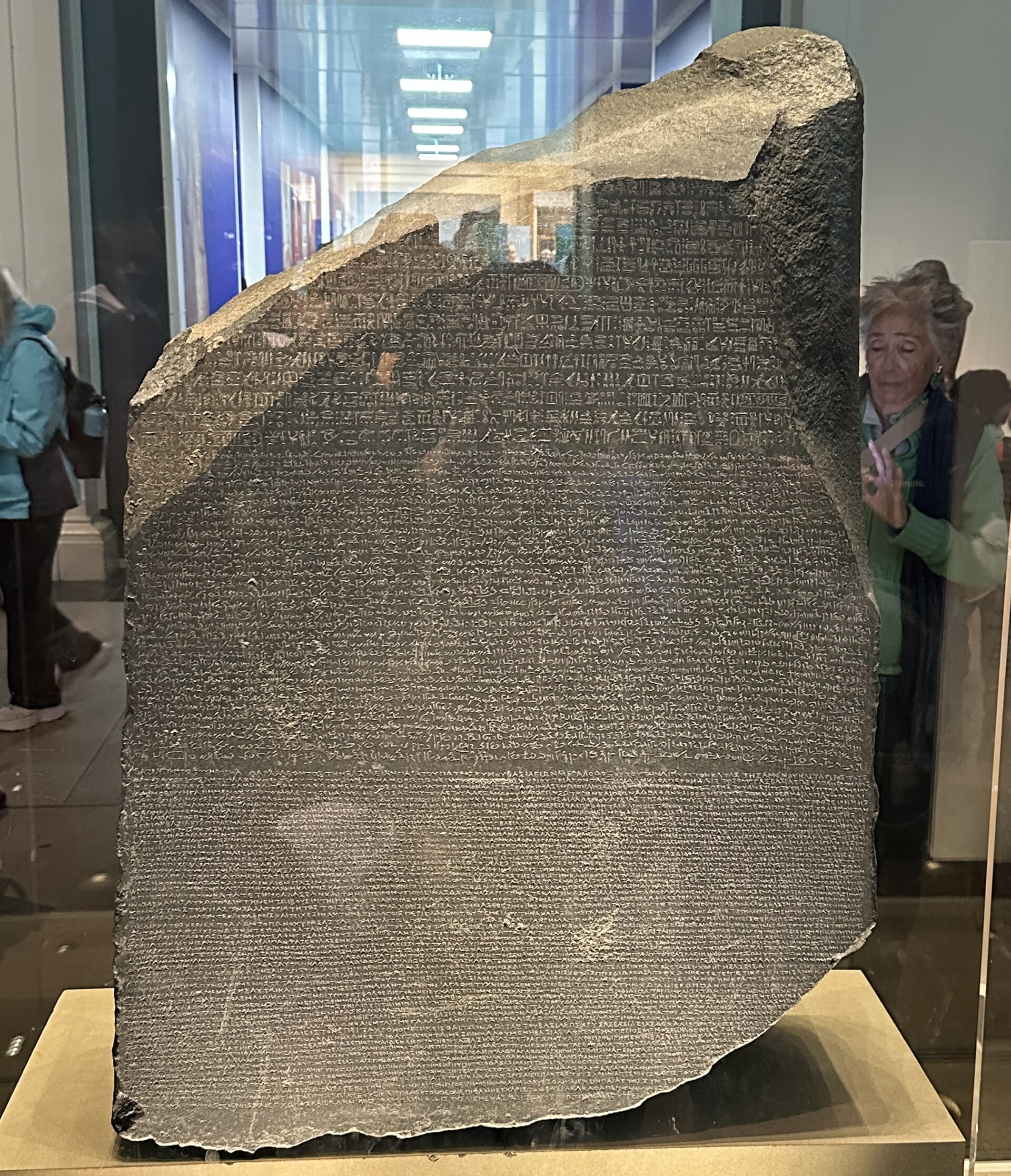
The Rosetta Stone (Room 4). This is the object that became the key to deciphering Egyptian hieroglyphs, and it arrived at the museum in 1802. The same room holds the colossal bust of Ramesses II, the largest Egyptian sculpture in the museum, and the sarcophagus of Nectanebo II, Egypt’s last true pharaoh.
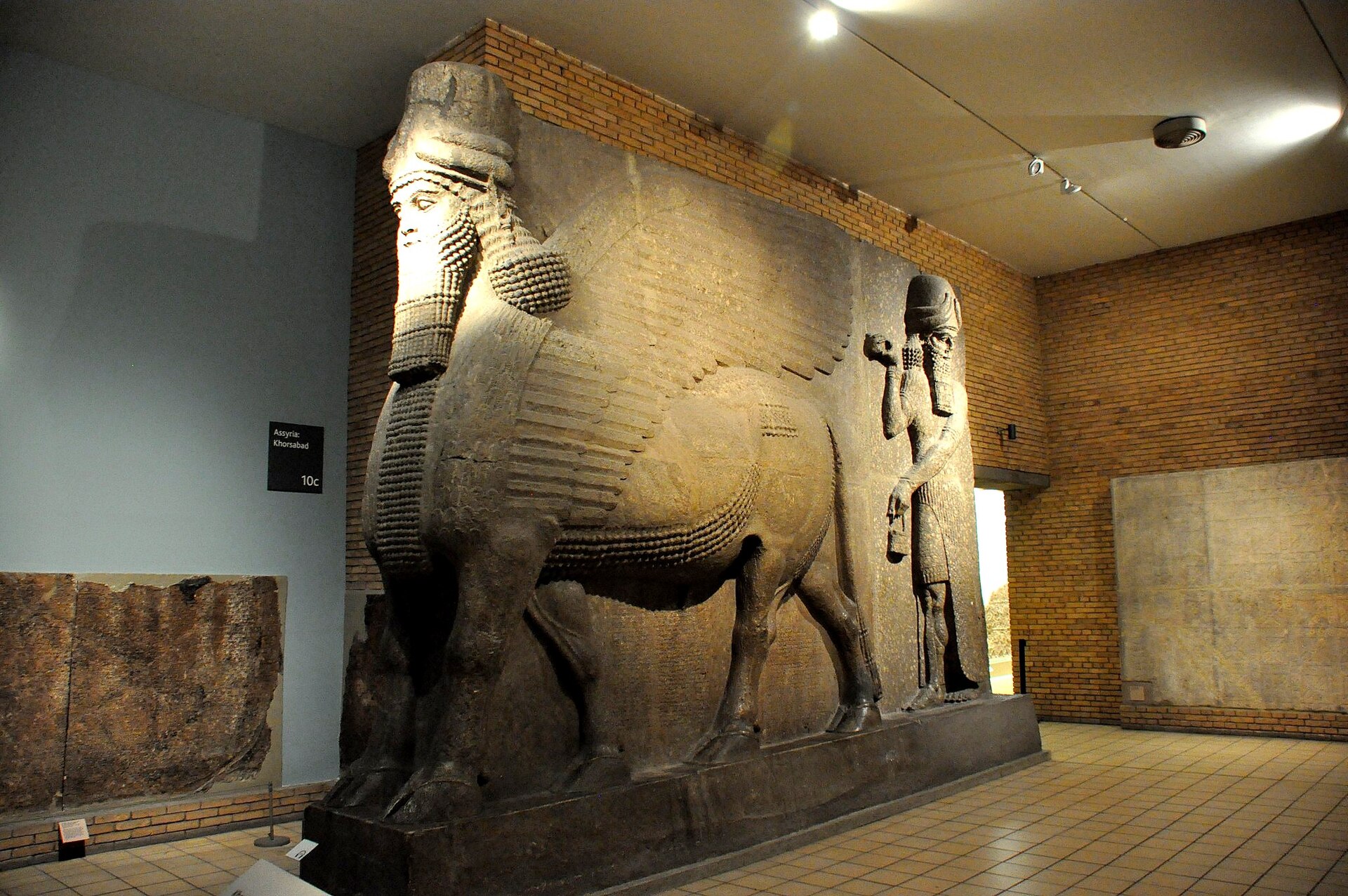
The winged bulls and the lion hunt (Room 10). A pair of colossal human-headed winged bulls, which once guarded the palace of the Assyrian king Sargon II at Khorsabad, in today’s Iraq, greet you here. Around them run the lion hunt reliefs of King Ashurbanipal (668 to 631 BC), carved for his palace at Nineveh: the release of the lions, the chase and the kill, full of tension and ranked among the finest achievements of Assyrian art.
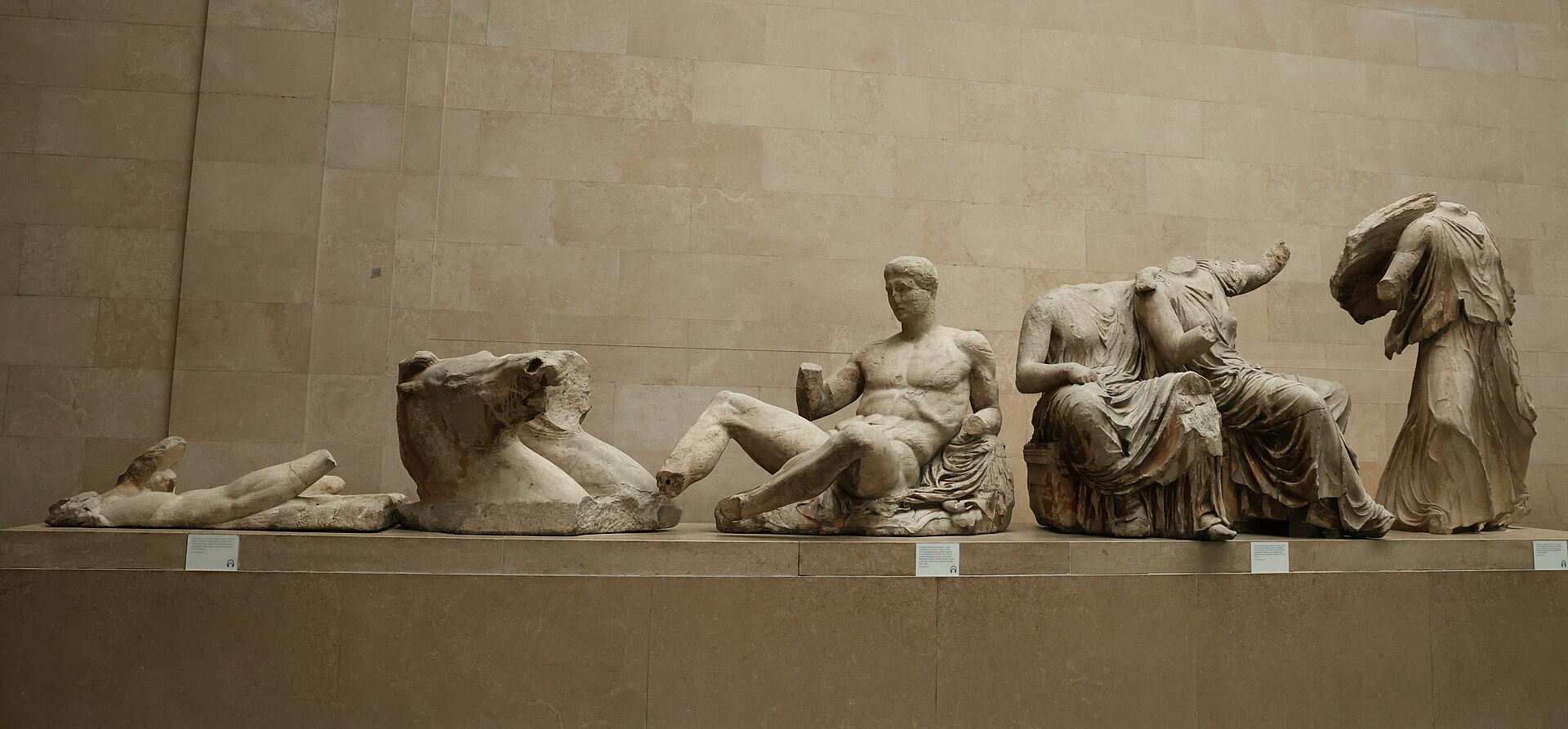
The Parthenon sculptures (Room 18). They decorated the outside of the temple of Athena on the Acropolis of Athens; they were designed by Pheidias and completed by 432 BC, and they have been on permanent display here since 1817. Lord Elgin’s agents removed them between 1801 and 1812, and Greece has long asked for their return. If you are heading to Athens, the temple itself has its own free Parthenon audio guide.
The mummies (Rooms 62 and 63). Mummies, coffins, funerary masks and the objects buried with the dead. And not only people: bulls, crocodiles, cats and falcons were mummified too. Today the museum’s researchers study them with medical CT scanners.
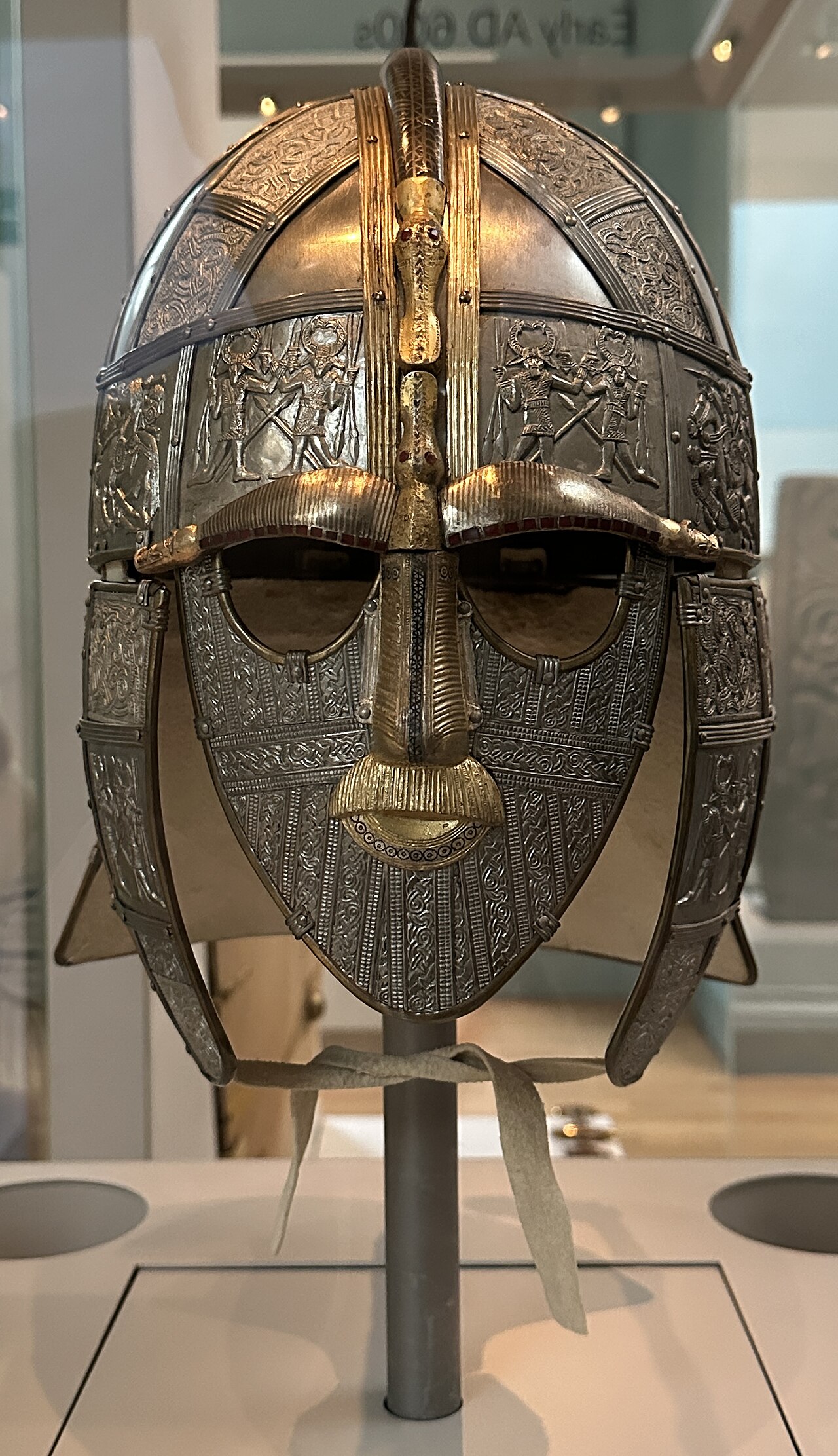
Sutton Hoo (Room 41). The Anglo-Saxon ship burial from Suffolk, excavated in 1939, is one of the most important discoveries in British archaeology. There are 2 helmets: the original and a replica showing how it once looked. The original is one of only 4 complete Anglo-Saxon helmets known. Don’t miss the gold belt buckle, made with more than 400 g of gold.
The Bayeux Tapestry and other exhibitions in 2026 and 2027
The big event of the season is in Room 30: the Bayeux Tapestry, on loan from France from 10 September 2026 to 11 July 2027. It is back in England for the first time since it was made, nearly 1,000 years ago. It is 70 metres long and tells the story of the events leading up to the Battle of Hastings and the Norman Conquest of 1066.
It has its own tickets and its own hours: Sunday to Wednesday 10:00 to 18:00, Thursday to Saturday 10:00 to 21:00. Tickets up to 31 December 2026 have sold out. January to March 2027 go on sale on 21 October 2026, and April to July in early 2027. Photography is not permitted inside.
| Adult | £33 standard · £27 off-peak · £25 on term-time weekdays, 15:30 to 16:20 |
| Students, 16 to 18, jobseekers | £25 |
| Disabled visitors | £25; an assistant goes free, booking required |
| Under 16 | Free, booked with an adult ticket (up to 4 per adult) |
There’s a maximum of 10 tickets per booking; tickets can only be used by the booker and ID may be checked.
From 1 October 2026 to 31 January 2027, the Korea exhibition fills Room 35, reached from the Great Court: adults £20 (£18 off-peak), under-16s free, closed 1 and 2 December while some works are rotated. Free to visit: «Declaring independence: USA 250», until 29 November 2026.
British Museum history: from Sloane’s collection to the Great Court
The museum was founded in 1753 and opened its doors in 1759. It was the first national museum to cover every field of human knowledge, open to visitors from anywhere in the world, and it grew from the collection of the physician Sir Hans Sloane: 71,000 objects.
The Greek Revival front on Great Russell Street is the work of Sir Robert Smirke, with 43 Ionic columns, each 14 m high. The pediment sculptures, installed in 1852, show The Progress of Civilisation. In the central courtyard his brother Sydney Smirke built the round Reading Room, 43 m across, which opened in 1857. Bram Stoker, Arthur Conan Doyle and Lenin all read there. The library moved out to the British Library in 1997.
The courtyard it left behind became the Great Court, designed by Foster and Partners: the largest covered public square in Europe, under a glass and steel roof in which no 2 panes are the same. The Queen opened it on 6 December 2000. In 2025 the museum welcomed 6,440,120 visitors.
Getting there, bag rules and access
The main entrance is on Great Russell Street (WC1B 3DG), with a second entrance on Montague Place. The nearest Tube station is Tottenham Court Road, a 5-minute walk; Holborn and Russell Square are 7 minutes away and Goodge Street 8. Buses 1, 8, 19, 25, 38, 55, 98 and 242 run along New Oxford Street. There is no visitor parking.
Every visitor goes through a security check and bag search. Wheeled suitcases are not allowed, whatever their size, and nor is anything bigger than 40 × 40 × 50 cm or heavier than 8 kg; the big rail stations (Euston, King’s Cross and Charing Cross) have luggage storage. The cloakroom, on your left as you come in through the main entrance, charges per item: £3 for a coat, £4 for a bag up to 4 kg and £6 for one of 4 to 8 kg; folded buggies are free. Photos and video for private use are allowed in most galleries, flash included, but tripods and selfie sticks are not.
There is a step-free entrance at the main entrance on Great Russell Street. Manual wheelchairs can be booked free in advance at tickets@britishmuseum.org, and if the queue is long you can tell a member of staff you need to skip it for access reasons. For paid exhibitions, an access companion goes free with a booking. The Audio app includes a free British Sign Language guide, and the Information Desk in the Great Court has a free sensory map and large print guides for the touch tours.
Combine it with other London audio guides
The British Museum sits in Bloomsbury, north of the other London sights. Big Ben is about 2.1 km due south in a straight line, and that is where the audio guide sends you. The London Eye is about 1.9 km south, across the river, and Buckingham Palace about 2.3 km to the south-west. Tower Bridge is about 3.9 km to the east. On foot it is always a little further. More are on the free audio guides of London page.
Reading this in Spanish? The same guide, written for a Spanish-speaking visitor and narrated in Spanish, is at Museo Británico en vozviajera.com.
Where to find it
FAQs
How do the free audio guides work?
Our audio guides work through the website audioguidetravel.com; you don’t need to download any app. Just follow the instructions on the website to guide you through British Museum: free audio guide, opening times and tickets while listening to our experts’ explanations.
Can I take the tour at my own pace?
Of course! Our free audio guides are designed so that you set the pace. You can pause, rewind, or listen as many times as you want without missing a detail. By visiting British Museum: free audio guide, opening times and tickets your way, you’ll enjoy it even more.
If I'm in a group, can we use the same audio guide?
Yes, our website allows sharing the same free audio guide among multiple devices. This way, you can visit British Museum: free audio guide, opening times and tickets as a group or family, listening to the explanations simultaneously. The quickest way to do this is to share the link via WhatsApp, email, or any method you like. I’ve included some buttons below for you to do that now.
Visitor information
As of 29 Sep 2026- Opening hours
- Daily, 10:00 to 17:00; Fridays until 20:30. Closed 24 to 26 December.
- Tickets
- Free. Exhibitions are extra: Bayeux Tapestry adults £25 to £33; under-16s free.
- Time needed
- About a 3-minute audio guide with a 5-object route. Last entry 16:45 (Fridays 20:15).
- Getting there
- Tube: Tottenham Court Road, a 5-minute walk; Holborn and Russell Square, 7 minutes.
- Accessibility
- Step-free entrance on Great Russell Street; free wheelchairs to borrow if booked ahead.
- Tip
- Book a free timed ticket for priority entry. Wheeled suitcases are not allowed in.
- Official website
- www.britishmuseum.org
Nearby
More free audio guides in London
 2:44LondonTower Bridge: free audio guide, hours and ticketsTower Bridge is the bascule bridge that Horace Jones and John Wolfe Barry designed and that went up…
 2:32LondonLondon Eye: free audio guide, tickets and opening hoursThe London Eye is the 135 m observation wheel that David Marks and Julia Barfield designed for the…
 2:44LondonBuckingham Palace: free audio guide, tickets and opening timesBuckingham Palace began as a townhouse built in 1703 for the Duke of Buckingham and became a palace…