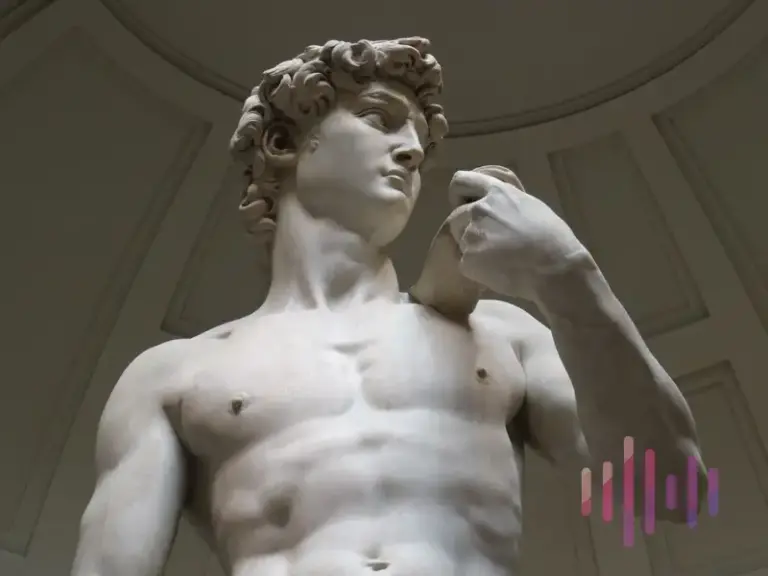
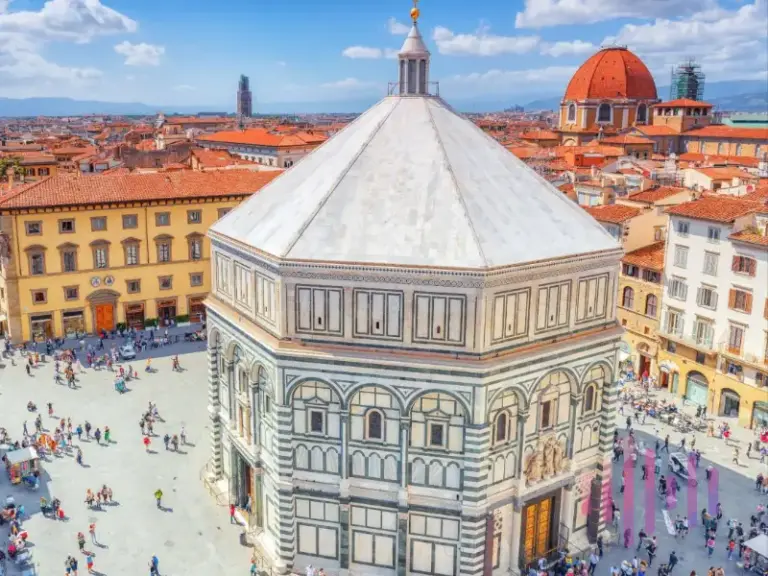
Baptistery of Saint John, Florence: free audio guide
Free audio guide in English · no app, no sign-up
Free audio guide to the Baptistery of Saint John in Florence, in English: 9 minutes on the octagon where Dante was baptized, the doors competition and Ghiberti’s Gates of Paradise. It plays on this page.
 Audio guide
The Baptistery of Saint John is the octagonal marble building facing Florence Cathedral, famous for its 3 sets of bronze doors, including the Gates of Paradise. This free audio guide plays on this page, from your phone’s browser, with no app and no sign-up, and lasts 9 minutes.
What the audio guide covers
The audio opens with a welcome and a couple of tips, then tells the story of the building and of the doors. Start it in the square, in front of the Baptistery. The table follows the audio in broad order.
| Stop | What it tells you |
|---|---|
| Welcome and tips | Come early in the morning or late in the afternoon, and look up at the mosaic vault (now behind scaffolding: see below). |
| Where Florentines were baptized | Dante and the Medici among the generations baptized here. |
| Legends of the origins | The old story of a Roman temple to Mars, which the audio tells as Florentines told it for centuries. |
| The doors competition | The contest for new bronze doors that many see as the start of the Renaissance, and young Lorenzo Ghiberti. |
| The Gates of Paradise | How long Ghiberti and his workshop spent on the east doors, and their biblical scenes. |
| The octagon | The white and green marble of the outside, seen from the square. |
| The 10 panels, one by one | Read from left to right and top to bottom: Adam and Eve, Cain and Abel, Noah, Abraham and Isaac, Jacob and Esau, Joseph and the rest of the stories. |
| Originals and copies | Why the original doors are in the Museo dell’Opera del Duomo and copies hang on the building. |
| Inside: the vault and the altar | The gold mosaic with the Last Judgement (now behind scaffolding), Dante and the altar, and a closing moment of silence. |

An octagon of white and green marble
The Baptistery is dedicated to John the Baptist, the patron saint of Florence, and stands between the cathedral and the Archbishop’s Palace. For centuries every child born in the city was baptized here: Dante Alighieri was one of them, and in his poem he hoped to come back one day and be crowned poet at the same font. The font in use today dates from about 1370.
No document records when it was built. Florentines long believed it had been a Roman temple to Mars, a legend dropped in the 19th century when excavations found the remains of a large Roman house underneath. Today the building is dated to the 11th or 12th century, judging by its stonework, and its dome and proportions owe a lot to the Pantheon in Rome. It inspired Brunelleschi’s studies of perspective and his own architecture.
Walk all the way round before you go in. Each of the 8 sides is clad in white marble framed by bands of dark green stone, in a strict geometric pattern that later inspired Renaissance architects such as Brunelleschi and Alberti. Above 3 of the doors stood groups of statues; only the Baptism of Christ over the east door is back in place, as a copy.
3 sets of doors, 3 centuries of bronze
The doors are why most people stop here. The oldest are the south doors by Andrea Pisano, started in 1330 and finished 6 years later: 28 panels, 20 with scenes from the life of John the Baptist and 8 with the virtues.

In 1401 the cloth merchants’ guild, which looked after the Baptistery, held a contest for a new pair of doors: each sculptor had to make a relief of the Sacrifice of Isaac. Ghiberti got the commission over Brunelleschi, among others, and their 2 trial panels are now in the Bargello museum. Ghiberti signed the contract in November 1403, at 25, and his workshop, which included the young Donatello, saw the doors installed in 1424. They show the life of Christ, and today they hang on the north side.
Then the guild gave him the third pair, which took the place of his first doors facing the cathedral: the east doors. This time he dropped the small frames of the earlier doors and made 10 large gilded panels from the Old Testament, each one telling several episodes at once, with a depth that looks like painting. He got the commission in 1425, and work on the doors ran from 1429 to 1447. Michelangelo said they were fit to be the gates of Paradise, and the name stuck.


Inside: the mosaic vault, the floor and a pope’s tomb
The vault is covered with mosaics on a gold ground, made between about 1240 and 1300 from around 10 million small tiles. Over the altar sits Christ in Judgement, about 6 metres tall, with the Last Judgement around him: heaven at his right hand, hell at his left. The other bands tell the story of Creation, of Joseph, of Mary and Christ, and of John the Baptist.

Today the vault is being restored and its mosaics are not visible: the official ticket site says the work will go on for the next couple of years.
So look down instead. The floor is an inlaid marble pavement, probably made during the 12th century, with a zodiac among its panels. And near the altar chapel is the tomb of Antipope John XXIII, by Donatello and Michelozzo: a gilded figure lying on a deathbed under a canopy of gilded drapery, the first Renaissance tomb with a canopy.


The restoration and the scaffolding tour
The restoration has turned into a visit of its own. The Opera di Santa Maria del Fiore, which runs the monuments of the square, sells a guided tour of the Baptistery restoration site, in Italian and English, for 65 €. The report below shows what the restoration site looks like from inside. There is also a cheaper guided tour of the Baptistery and the museum, at 25 € (15 € from 7 to 14).

Visiting: hours, passes and how to get in
The Baptistery is open every day from 8:30 am to 7:30 pm, except on the first Sunday of the month, when it closes at 1:30 pm. Allow about 30 minutes inside, plus time for the doors outside (our estimate). There is a dress code for the Baptistery and the cathedral: no flip-flops, no bare shoulders and nothing above the knee.
Passes are bought on the official site, tickets.duomo.firenze.it, or at the ticket office at Piazza San Giovanni 7. Besides the Ghiberti Pass there are the Giotto Pass, 20 €, which adds the bell tower, and the Brunelleschi Pass, 30 €, which adds the dome. If the Ghiberti Pass is sold out online, the ticket office sells a Ghiberti Pass On-site for the museum and the Baptistery only, with no time slot (15 €, not sold on the first Tuesday of the month, when the museum is closed).
In Florence, the audio guide to Michelangelo’s David is a short walk away. And if the Baptistery makes you want to see the building that inspired it, the Pantheon in Rome has its own free audio guide.
 Free audio guideMichelangelo’s David
 Free audio guidePantheon
Where to find it
FAQs
How do the free audio guides work?
They play right here on audioguidetravel.com, with no app to download and no sign-up. Press play and listen as you walk round: a phone and a pair of headphones are all you need. The audio streams from this page, so you’ll need mobile data or Wi-Fi.
Can I take the tour at my own pace?
Of course! You set the pace: pause whenever you like, jump back or forward 15 seconds, or tap the bar to jump to any point, and listen as many times as you want so you don’t miss a thing.
If I'm in a group, can we use the same audio guide?
Yes. The same free audio guide opens on as many phones as you like, so you can go round together as a group or with your family, each person at their own pace and with their own headphones. The quickest way is to send the link via WhatsApp, Telegram or however you like: the buttons just below let you share it right now.
Visitor information
As of 30 Oct 2026- Opening hours
- Every day 8:30 am - 7:30 pm; first Sunday of the month until 1:30 pm
- Tickets
- Ghiberti Pass 15 € (7-14: 5 €, under 7 free), with museum and Santa Reparata
- Time needed
- About 30 minutes inside, plus the doors outside (our estimate)
- Getting there
- In Piazza San Giovanni, facing the main door of Florence Cathedral; ticket office at Piazza San Giovanni 7.
- Accessibility
- Free for disabled visitors and carer (with documents); no step-free details: accessibilita@duomo.firenze.it
- Tip
- See the copies outside, then the original Gates of Paradise in the Opera del Duomo Museum
- Official website
- tickets.duomo.firenze.it