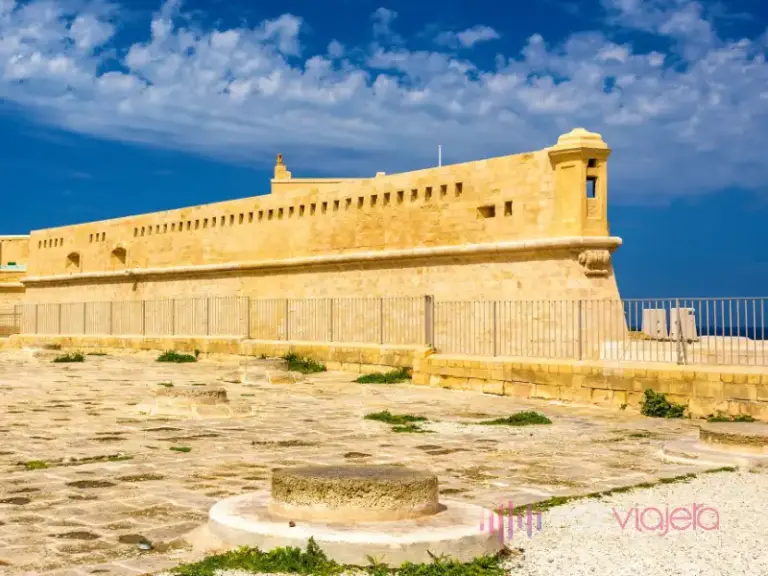
City Gate, Valletta: free audio guide to Renzo Piano’s gate
Free audio guide in English · no app, no sign-up
Free audio guide to City Gate in Valletta, in English: 4 minutes on the 5 gates that have stood here since 1569 and on crossing the bridge into the city. It plays on this page.
 Audio guide
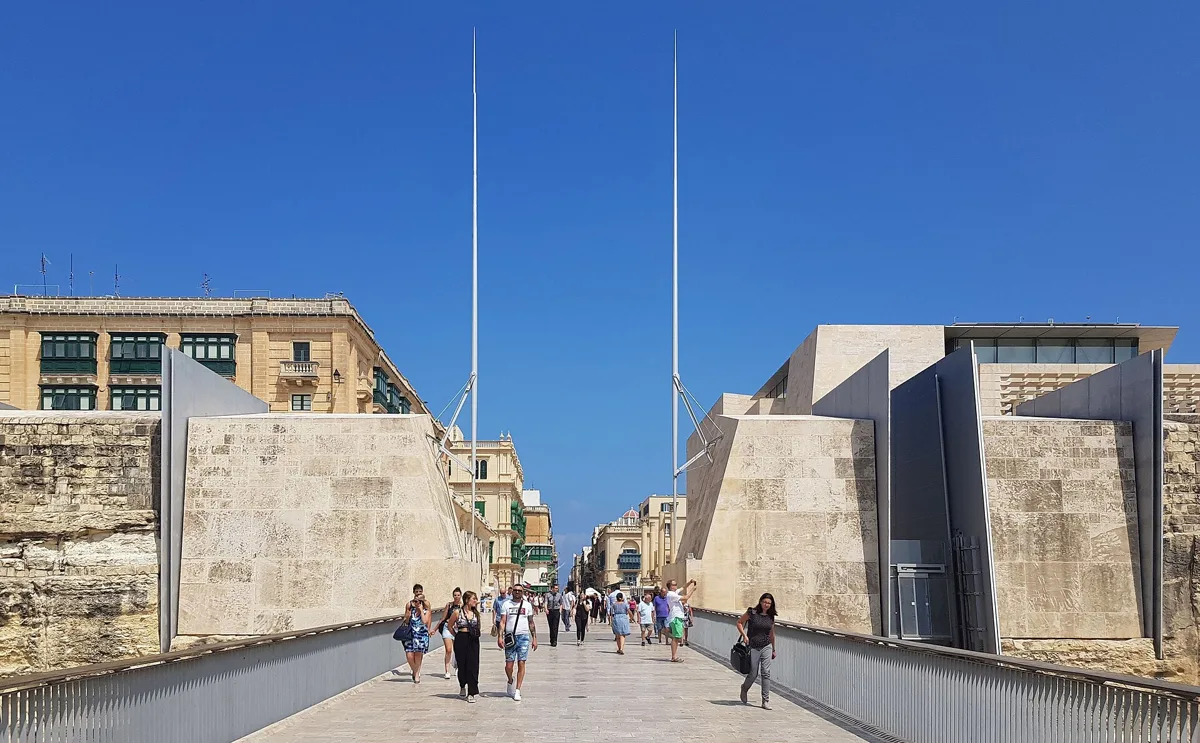
City Gate is the main entrance to Valletta, the capital of Malta: a bridge over the deep ditch and an opening in the city walls that leads straight into Republic Street. The gate you walk through today is the fifth on this spot, designed by Renzo Piano and finished in 2014. It is free and open at all hours, and this is its free audio guide, in English.
What the audio guide covers
It plays on this page, in your phone browser, with no app and no sign-up, and it lasts 4 minutes: short enough to listen to on the bridge before you walk in.
It starts with the names of the gate (Porta Reale, Kingsgate) and why this is the fifth version, then runs through its history from 1569 to the demolition of 2011. Next it explains how the gate was once protected outside the walls, and only then does it walk you through it. Near the end it answers a small riddle: why it was also called the “land gate”.
The stops in the audio
| Stop | What the audio tells you |
|---|---|
| Its names | Porta Reale or Kingsgate, the main entrance to Valletta, and why today’s gate is the fifth. |
| From 1569 to 1633 | Porta San Giorgio, renamed Porta Reale around 1586 and rebuilt in 1633. |
| The French and British years | “Porte Nationale” in 1798, the old name back from 1800 and a larger gate in 1853. |
| From 1964 to 2014 | The rationalist gate of the 1960s, pulled down in 2011, and Renzo Piano’s, completed in 2014. |
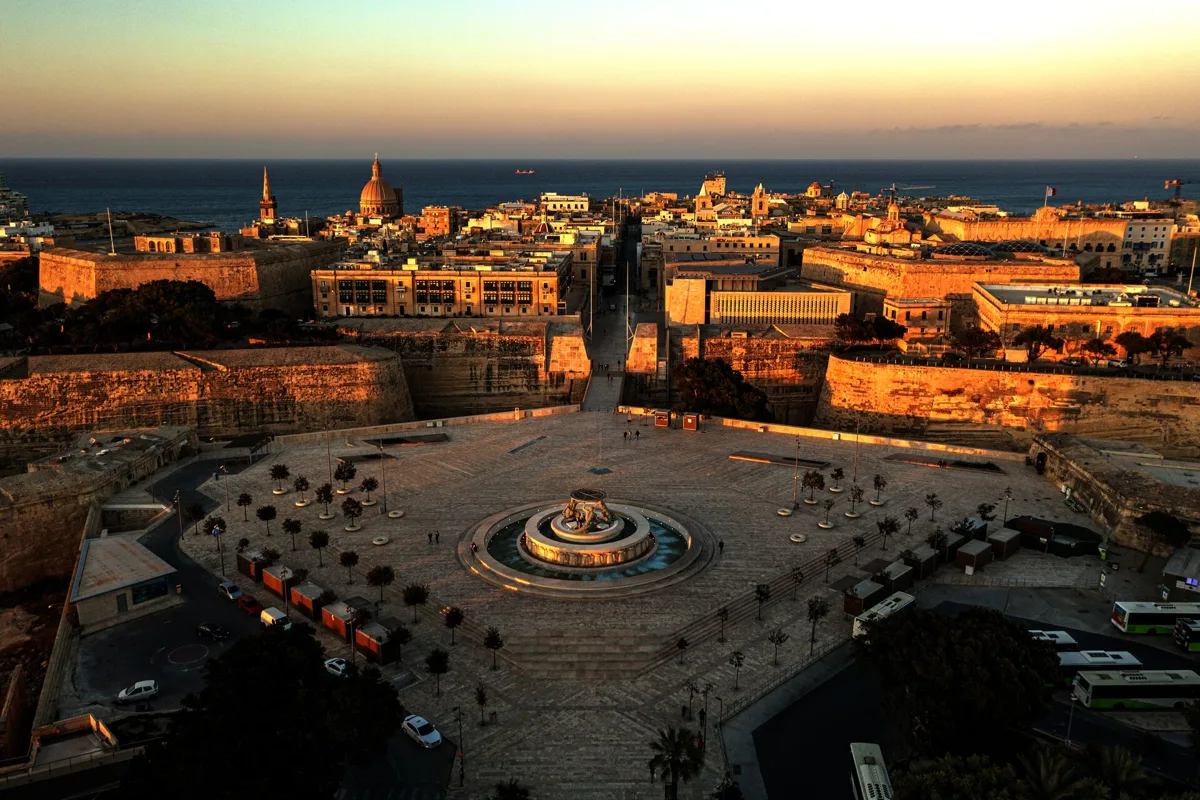
| Outside the walls | The outworks that guarded the gate, and the site that later became the bus terminus around the Triton Fountain. |
| Walking through | The walls, the ditch and the details of the gate as you cross. |
| The land gate | Why it was informally called the “Porta di Terra”. |
5 gates on the same spot, from 1569 to 2014
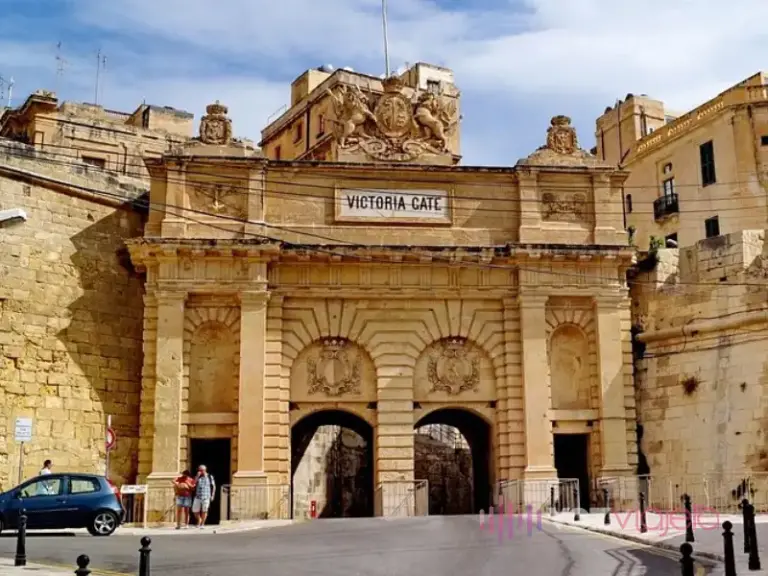
The first gate, Porta San Giorgio, was begun in 1566 under Grand Master Jean de Valette, who gave the city its name, and was complete by 1569. It was little more than a plain opening in the curtain wall, designed by Francesco Laparelli or by his Maltese assistant Girolamo Cassar. Around 1586 it was renamed Porta Reale, and in 1633 a grander gate replaced it, with a central arch, 2 side arches and a wooden drawbridge over the ditch. It is usually attributed to Tommaso Dingli.
During the French occupation, from 1798, it was briefly the Porte Nationale. In 1853 the British replaced it with a wider gate, Kingsgate, with statues of the Grand Masters L’Isle-Adam and de Valette on either side; both statues were destroyed when bombs hit the bridge in the Second World War. Kingsgate was pulled down in June 1964 and replaced by a rationalist gate by Alziro Bergonzo, finished in August 1965 and never much loved: it lasted until May 2011.
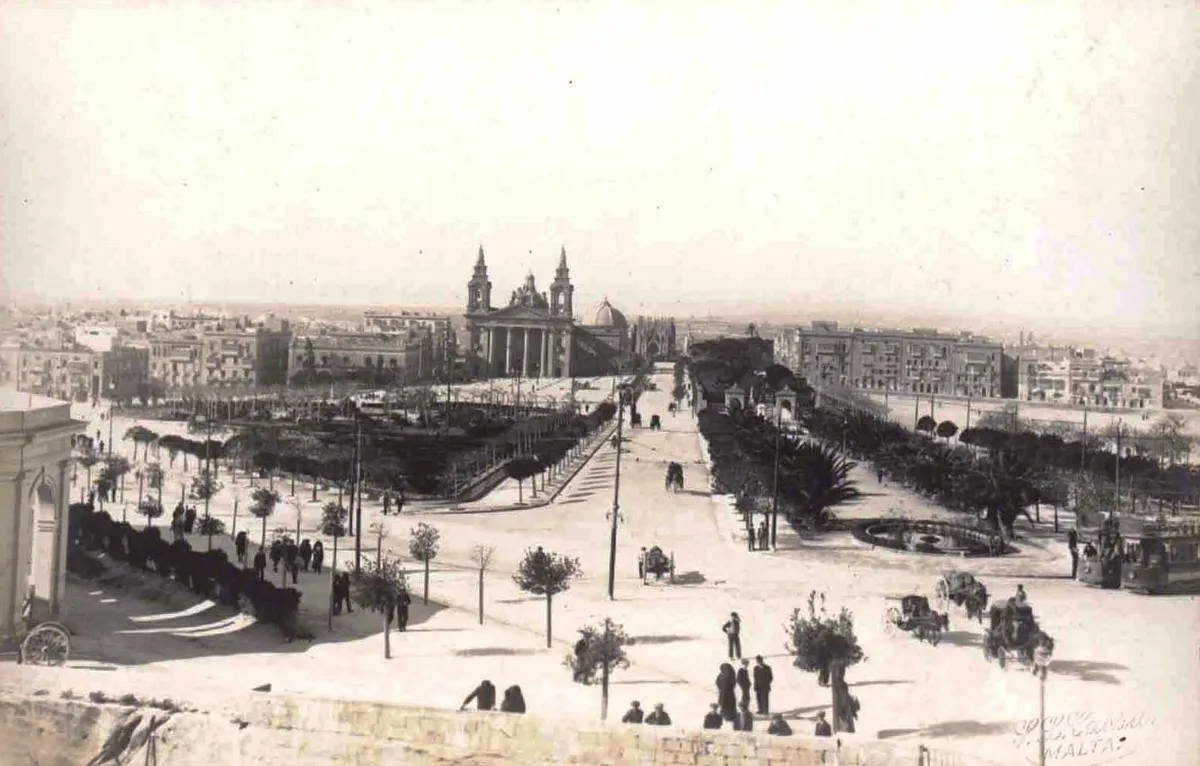
The bridge has been rebuilt several times, but it still rests on its original rock-hewn foundations. And the “land gate” nickname has a simple reason: this was the only way into Valletta from the land side.
Renzo Piano’s gate: a breach 8 metres wide
Piano set out to give back to the walls the feeling of depth and strength that the gate of the 1960s, which had removed 32 metres of the city wall, had taken away. His gate is a breach only 8 metres wide, open to the sky. Steel “blades” 60 mm thick slice through the wall to show where the old stone ends and the new begins. Its tapered shape and 2 steel poles 25 metres high are all that marks it out as the city gate.
The bridge was taken back to the width of the 1633 gate by removing later additions, so that crossing it feels like crossing a bridge again, with the ditch and the bastions in view on both sides. A new hard-stone quarry was opened on Gozo just to supply the blocks for the project.
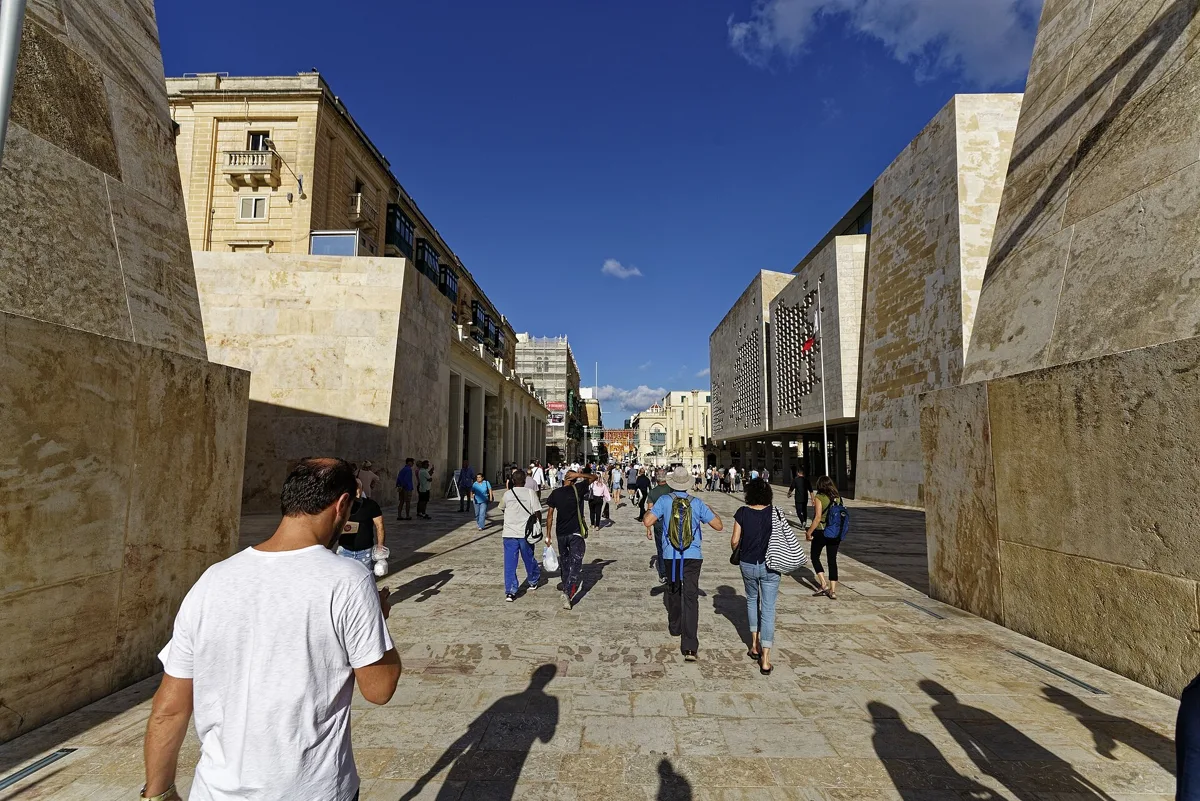
Inside, the raised stretch of Pope Pius V Street that used to run over the gate was demolished and replaced by 2 wide flights of steps, one on each side. They climb from Republic Street up to the bastions of St James’s Cavalier and St John’s Cavalier, and they let you see the fortifications at their full height.
Parliament House and the open-air theatre
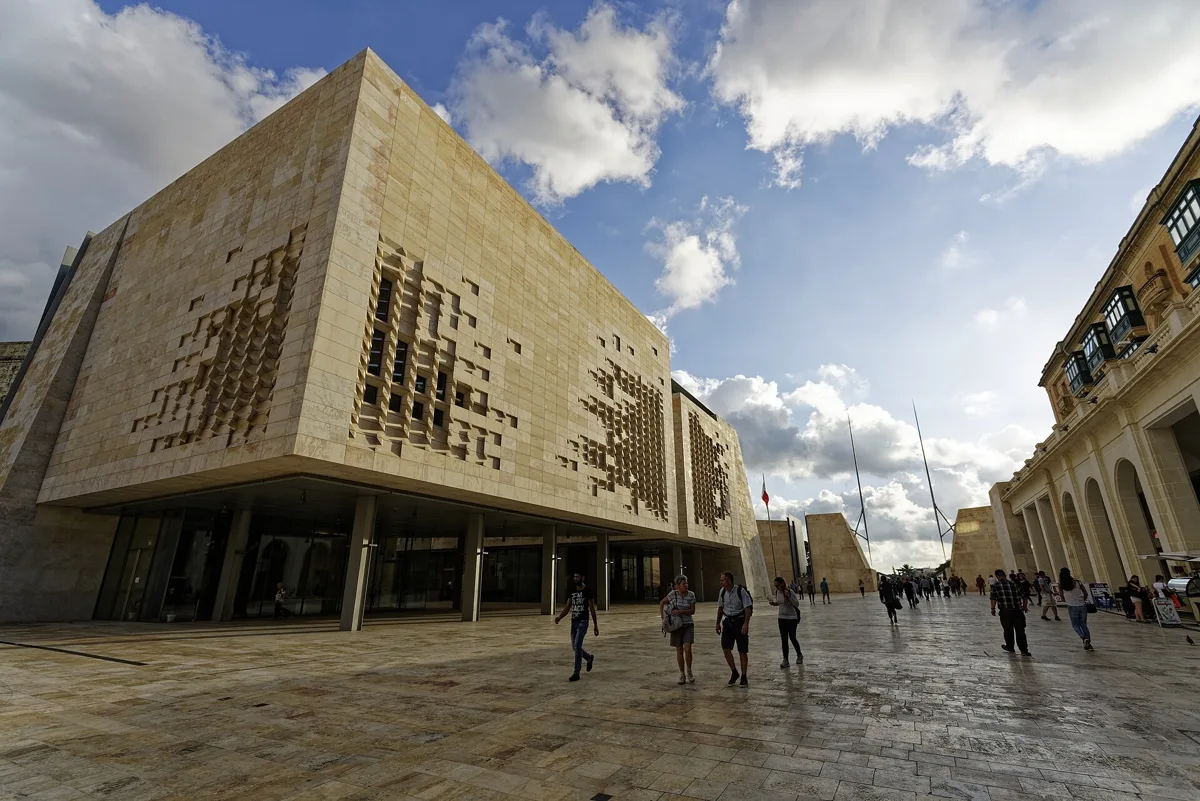
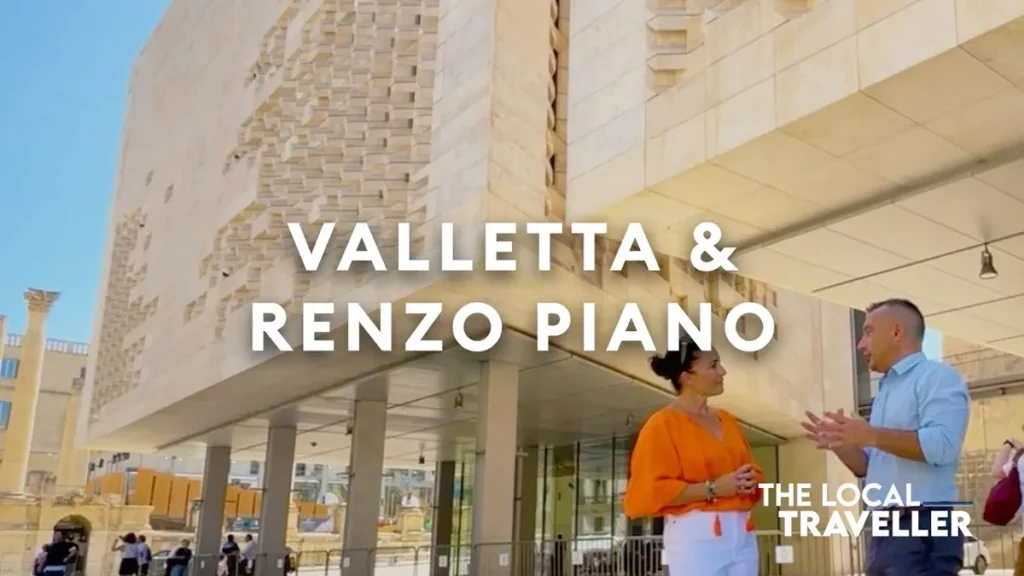
The gate is only one of the 4 parts of Piano’s plan. Just inside the gate, beside Republic Street, stands the new Parliament House: 2 massive blocks of stone balanced on slender columns, the northern one for the chamber and the southern one for the offices, with a courtyard between them as the main entrance. Each facade block was sculpted by a numerically controlled machine to filter the sun, and the building heats and cools itself in part with 40 geothermal boreholes 140 metres deep and 600 m² of solar panels on the roof.
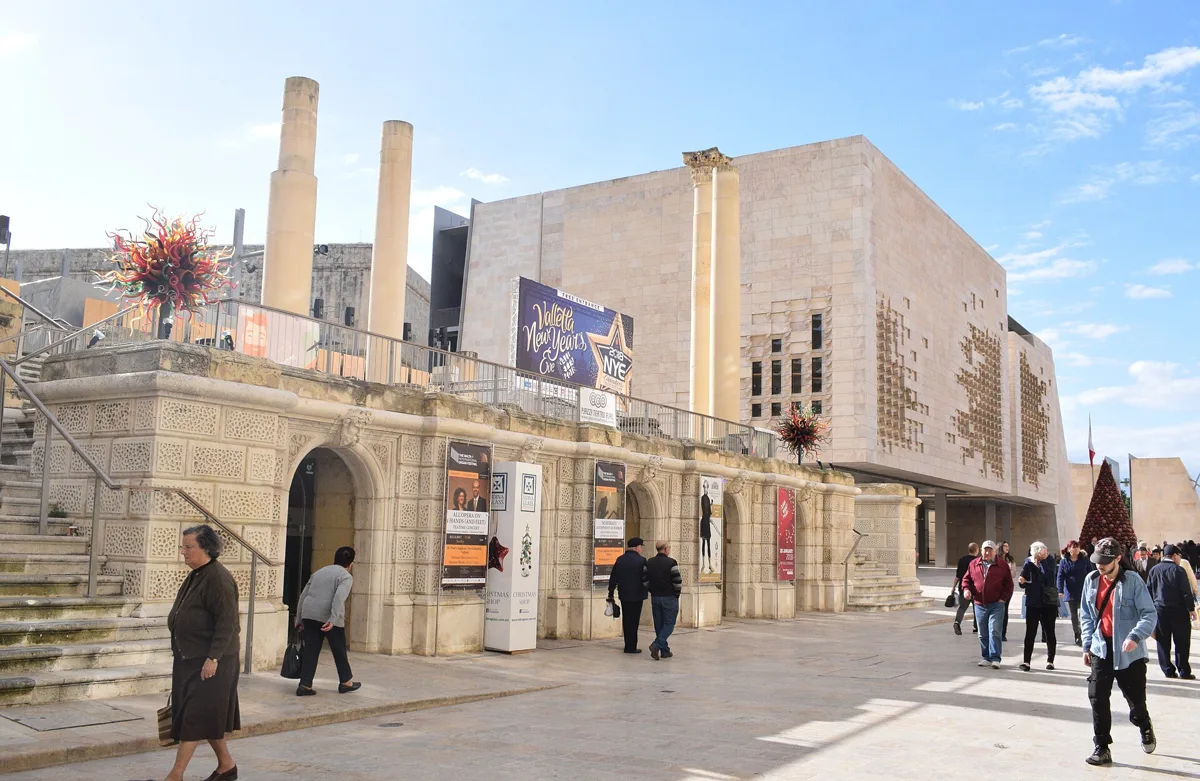
Next to it are the ruins of the Royal Opera House, built by E. M. Barry between 1862 and 1866 and destroyed by bombing in 1942. The ruins were restored and made safe, and a steel structure placed inside them works as an open-air theatre, Pjazza Teatru Rjal, with almost 1,000 seats for the summer season. When there is no show it is an open square that anyone can walk into.
Visiting City Gate: free, at any hour
City Gate is a public street: there is no ticket and no opening time, so you can come by day or at night. Allow about 15 minutes for the bridge, the breach and the side steps, then carry on into the city. The ruins of the opera house can be seen from the street and are open as a square when there is no show.
The audio suggests coming twice, once by day to see the detail of the stone and once after dark. The best moment to press play is on the bridge, with the ditch below you.
Getting there and what to see next
Valletta’s bus terminus is just outside the walls, near the Triton Fountain, and from the fountain the bridge leads straight to the gate. The square around the fountain is now pedestrian.
Through the gate begins Republic Street, the main street of Valletta, which runs all the way to Fort St Elmo at the opposite end of the city, the fort that guards the tip of the peninsula. It has its own free audio guide:
 Free audio guideSan Telmo Fort
You will find them both in our free Valletta audio guides. In Spanish, this audio guide is on vozviajera.com.
Where to find it
FAQs
How do the free audio guides work?
They play right here on audioguidetravel.com, with no app to download and no sign-up. Press play and listen as you walk round: a phone and a pair of headphones are all you need. The audio streams from this page, so you’ll need mobile data or Wi-Fi.
Can I take the tour at my own pace?
Of course! You set the pace: pause whenever you like, jump back or forward 15 seconds, or tap the bar to jump to any point, and listen as many times as you want so you don’t miss a thing.
If I'm in a group, can we use the same audio guide?
Yes. The same free audio guide opens on as many phones as you like, so you can go round together as a group or with your family, each person at their own pace and with their own headphones. The quickest way is to send the link via WhatsApp, Telegram or however you like: the buttons just below let you share it right now.
Visitor information
As of 4 Nov 2026- Opening hours
- Open at all hours: it is a public street
- Tickets
- Free, no ticket
- Time needed
- About 15 minutes for the bridge, the gate and the side steps
- Getting there
- Across the bridge from the Triton Fountain, near Valletta's bus terminus
- Accessibility
- Bridge and gate at street level; the 2 flights up to the bastions are steps
- Tip
- Once through, climb the side steps and turn round for the view of the breach and the bridge
- Official website
- www.rpbw.com